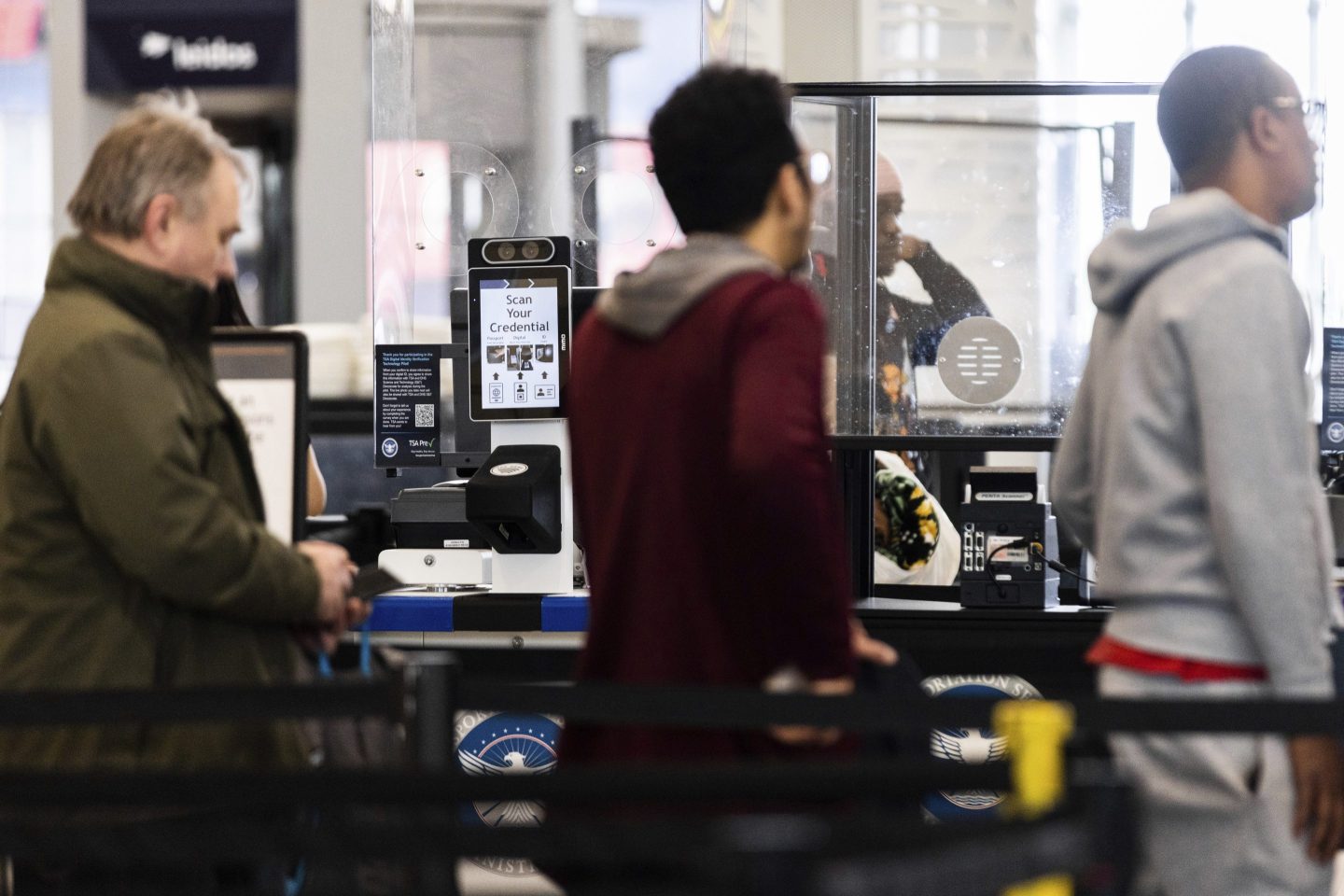
A passenger walks up to an airport security checkpoint, slips an ID card into a slot and looks into a camera atop a small screen. The screen flashes “Photo Complete” and the person walks through — all without having to hand over their identification to the TSA officer sitting behind the screen.
It’s all part of a pilot project by the Transportation Security Administration to assess the use of facial recognition technology at a number of airports across the country.
“What we are trying to do with this is aid the officers to actually determine that you are who you say who you are,” said Jason Lim, identity management capabilities manager, during a demonstration of the technology to reporters at Baltimore-Washington International Thurgood Marshall Airport.
The effort comes at a time when the use of various forms of technology to enhance security and streamline procedures is only increasing. TSA says the pilot is voluntary and accurate, but critics have raised concerns about questions of bias in facial recognition technology and possible repercussions for passengers who want to opt out.
The technology is currently in 16 airports. In addition to Baltimore, it’s being used at Reagan National near Washington, D.C., airports in Atlanta, Boston, Dallas, Denver, Detroit, Las Vegas, Los Angeles, Miami, Orlando, Phoenix, Salt Lake City, San Jose, and Gulfport-Biloxi and Jackson in Mississippi. However, it’s not at every TSA checkpoint so not every traveler going through those airports would necessarily experience it.
Travelers put their driver’s license into a slot that reads the card or place their passport photo against a card reader. Then they look at a camera on a screen about the size of an iPad, which captures their image and compares it to their ID. The technology is both checking to make sure the people at the airport match the ID they present and that the identification is in fact real. A TSA officer is still there and signs off on the screening.
A small sign alerts travelers that their photo will be taken as part of the pilot and that they can opt out if they’d like. It also includes a QR code for them to get more information.
Since it’s come out the pilot has come under scrutiny by some elected officials and privacy advocates. In a February letter to TSA, five senators — four Democrats and an Independent who is part of the Democratic caucus — demanded the agency stop the program, saying: “Increasing biometric surveillance of Americans by the government represents a risk to civil liberties and privacy rights.”
As various forms of technology that use biometric information like face IDs, retina scans or fingerprint matches have become more pervasive in both the private sector and the federal government, it’s raised concerns among privacy advocates about how this data is collected, who has access to it and what happens if it gets hacked.
Meg Foster, a justice fellow at Georgetown University’s Center on Privacy and Technology, said there are concerns about bias within the algorithms of various facial recognition technologies. Some have a harder time recognizing faces of minorities, for example. And there’s the concern of outside hackers figuring out ways to hack into government systems for nefarious aims.
With regard to the TSA pilot, Foster said she has concerns that while the agency says it’s not currently storing the biometric data it collects, what if that changes in the future? And while people are allowed to opt out, she said it’s not fair to put the onus on harried passengers who might be worried about missing their flight if they do.
“They might be concerned that if they object to face recognition, that they’re going to be under further suspicion,” Foster said.
Jeramie Scott, with the Electronic Privacy Information Center, said that while it’s voluntary now it might not be for long. He noted that David Pekoske, who heads TSA, said during a talk in April that eventually the use of biometrics would be required because they’re more effective and efficient, although he gave no timeline.
Scott said he’d prefer TSA not use the technology at all. At the least, he’d like to see an outside audit to verify that the technology isn’t disproportionally affecting certain groups and that the images are deleted immediately.
TSA says the goal of the pilot is to improve the accuracy of the identity verification without slowing down the speed at which passengers pass through the checkpoints — a key issue for an agency that sees 2.4 million passengers daily. The agency said early results are positive and have shown no discernable difference in the algorithm’s ability to recognize passengers based on things like age, gender, race and ethnicity.
Lim said the images aren’t being compiled into a database, and that photos and IDs are deleted. Since this is an assessment, in limited circumstances some data is collected and shared with the Department of Homeland Security’s Science and Technology Directorate. TSA says that data is deleted after 24 months.
Lim said the camera only turns on when a person puts in their ID card — so it’s not randomly gathering images of people at the airport. That also gives passengers control over whether they want to use it, he said. And he said that research has shown that while some algorithms do perform worse with certain demographics, it also shows that higher-quality algorithms, like the one the agency uses, are much more accurate. He said using the best available cameras also is a factor.
“We take these privacy concerns and civil rights concerns very seriously, because we touch so many people every day,” he said.
Retired TSA official Keith Jeffries said the pandemic greatly accelerated the rollout of various types of this “touchless” technology, whereby a passenger isn’t handing over a document to an agent. And he envisioned a “checkpoint of the future” where a passenger’s face can be used to check their bags, go through the security checkpoints and board the plane — all with little to no need to pull out a boarding card or ID documents.
He acknowledged the privacy concerns and lack of trust many people have when it comes to giving biometric data to the federal government, but said in many ways the use of biometrics is already deeply embedded in society through the use of privately owned technology.
“Technology is here to stay,” he said.