Google is not—repeat not—ceding party planning to Microsoft.
When Microsoft wanted to demonstrate how it was infusing generative A.I. into its popular business productivity software through its Copilot feature, Sumit Chuan, who leads the company’s Office Product Group, showed off how it helped her plan a graduation party for her daughter, generating ideas for themes, helping to write invitations, creating a slide show of photos to play at the event, and creating to-do lists and spreadsheets to track progress as the date of the event approaches.
So it was amusing that in a press briefing last week for reporters to preview all the cool A.I.-enabled stuff that Google was about to unveil at Google I/O, its annual developer conference, Jack Krawczyk, the product lead for Bard, Google’s A.I. chatbot rival to Microsoft’s Bing and OpenAI’s ChatGPT, noted how he used Bard to help write birthday party invitations for his son.
What does it say about the hype surrounding this technology—and about the home lives of Silicon Valley executives—that generative A.I.’s real killer use case is apparently planning your kid’s party? Beyond that, the dueling party planning case studies are illustrative of a pattern that has emerged in the Google-Microsoft rivalry: Microsoft announces an A.I.-powered feature and Google quickly matches it, maybe announces a few incremental advances of its own, but doesn’t manage to debut a breakthrough product that fundamentally alters the competitive landscape in the way that Microsoft’s embrace of OpenAI’s technology late last year did.
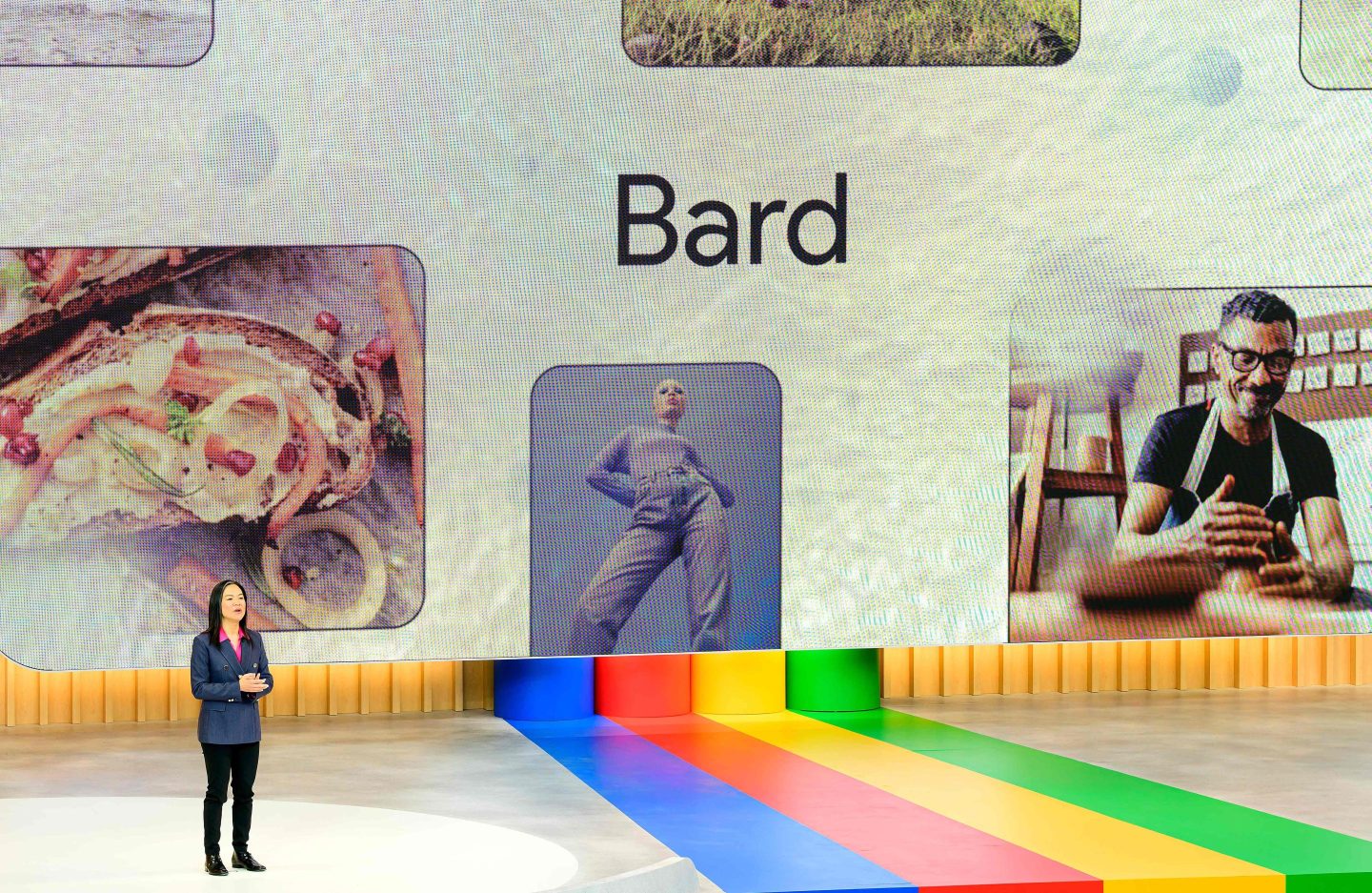
That was basically the story of yesterday’s Google I/O keynotes: Google announced no fewer than 25 new features that are powered by its latest large language model, PALM 2. It will write emails for you! Populate spreadsheets! Create slideshows! Bard is available in Japanese and Korean as well as English! Bard can input and output images now too! And it can code! (Although it may not do anything of these things as well as Bing or ChatGPT—according to some early side-by-side comparisons.)
It all seems like cool and useful stuff, but fairly incremental—and a lot of it merely ensures Google keeps pace with what Microsoft and an increasing slew of other competitors are offering. It was telling that one of the biggest applause lines of the I/O keynotes—at least from the livestream I was watching—was the announcement that Bard’s user interface now supports a “dark mode.” The ability to display colored text on a black background rather than dark text on a light background? Life changing, apparently.
The announcement that has far more potential to prove game changing in the long run is what Google is doing with search. But here Google’s caution—it is wary of tampering with the engine that powers about 80% of its revenues—is tempering any sense of just how radical the change could be, especially for companies, such as media organizations, whose businesses rely heavily on search traffic. Google emphasized throughout I/O yesterday that it wants to be both “bold and responsible” in its implementation of A.I. And not moving too fast, especially when it might undermine the business models of reliable information sources, seems to be part of that responsible element.
For now, Google is only launching what it is calling an “experimental” A.I.-powered search product that it calls SGE as part of a new sandbox for testing A.I. tools and features it calls Google Search Labs. Users will have to sign up for a waitlist at first and the product will only be available in the U.S. and in English initially.
The search product could be disruptive. It generates a coherent capsule answer of several paragraphs or a bullet-pointed list in response to most search queries. On desktop, it also displays three highly-relevant search results to the right of the capsule summary and includes standard web search results below the A.I.-generated summary. But journalists who have gotten access so far point out, on mobile devices, the capsule summary actually takes up the entire first screen. And, if the summary is good enough, many users may never bother clicking on any of the links (or even see them), potentially depriving those sites of any search traffic. This would be a nightmare for publishers and many other businesses. Elizabeth Reid, the vice president of engineering for Search, who demoed SGE for me, tried to allay such fears. “We want to ensure that we have a high value exchange with the ecosystem,” she said, using a term the Google Search team uses to refer to all those who generate information that Google then seeks organize through Search. “This has been something Search has always been focused on.”
Reid did not say, however, exactly how Google will ensure that those companies that create high-quality information will continue to be compensated for that effort. She said Google would continue to “do much experimentation” over the right number and kind of links to highlight. She also said that for searches that are likely to be for a product purchase, SGE uses generative A.I. to create a “buying guides” on the fly, in real-time, highlighting information from product descriptions that are relevant to a user’s search. The buying guide highlighted about five different “waterproof portable speakers for under $100” in the demo Reid showed me.
Remember, right now this new search tool is essentially performing in the Google equivalent of off-off-Broadway. For instance, one issue with the generative A.I. responses is that they take a lot longer to load than the results of standard Google search would—and that is with relatively little demand for the service given that it was basically only available inside Google when Reid demoed it for me. How long would each response take if all 3.5 billion search queries that Google handles daily were run through SGE? “Part of the technology fun is working on the latency,” Reid said sardonically during our demo as we waited for a response to load. To make a significant strategic difference in the company’s future, Google is going to have to bring generative A.I. to the main search bar. But it’s far from clear how quickly it will do so.
For now though, defense may be Google’s best offense. Why risk 80% of your revenues if you don’t have to? The company still has a 90% global marketshare in internet search. And while there are indications that Microsoft’s Bing has gained some converts with Bing Chat, there are no signs of a mass defection so far. In this environment, just matching competitor’s product features might be enough to ensure Google maintains its market dominance. (And in some areas, such as photo editing tools and mapping, Google offered some A.I. innovations at I/O that do seem to put it ahead of the competition. Meanwhile, an experimental product called Project Tailwind looked like it could really help anyone researching a major project, be it a book or film or a business intelligence or Wall Street analysts report.)
There is also hope that Google’s A.I. offerings will win it more cloud computing customers. “The call of the hour for Google, is to inspire enterprises and developers to recognize and reimagine their A.I. and cloud initiatives with Google’s broad portfolio,” Chirag Dekate, A.I. infrastructure and supercomputing analyst at technology research firm Gartner, said. “If Google succeeds in this mission, they will be successful in meaningfully changing cloud market shares.” Dekate added that “Google has the tools to dominate the AI battles, the perineal question is: Will they?”
Wall Street certainly liked what it saw yesterday. Google’s parent Alphabet has seen its stock price climb 8% over the past two days. The longer-term picture though remains unclear. For instance, the new Search experience is powered by Palm 2 and another A.I. model that Google has already used to help with search, called MUM, as well as its traditional knowledge graph search algorithm. But Pichai teased an even more powerful multi-modal generative A.I. foundation model that Google has in the works, called Gemini, several times in his keynote. From what little Pichai said about Gemini, it sounds like it could be transformative—trained not just to be multi-modal, but also to take actions. But giving generative A.I. agency is also potentially dangerous. And while there are a number of startups already working on these kinds of generative A.I. assistants and a lot of developers even building systems that can create their own sub-goals and try to execute them, it isn’t entirely clear how Google will square the concept of generative A.I. agents with its “bold and responsible” mantra.