Kurt Vonnegut didn’t deliver the famous “Wear Sunscreen” graduation speech published in the Chicago Tribune that was often mistakenly attributed to the celebrated author. But he could have.
Over his lifetime, he gave dozens of quirky commencement addresses. In those speeches, he made some preposterous claims. But they made people laugh and made them think. They were speeches the graduates remembered.
Having studied and written about Vonnegut for years, I wish he had been my commencement speaker. I graduated from Austin College, a small school in North Texas. I don’t even remember who gave my class’s graduation speech, much less a single word the speaker said. I suspect many others have had – and will have – similar experiences.
Young people, college students especially, loved Vonnegut. During the early and mid-1960s, he commanded an avid and devoted following on campuses before he had produced any bestsellers. Why was a middle-aged writer born in 1922 adored by a counterculture told not to trust anyone over 30? Why did he continue to appeal to younger generations until his death?
Their parents’ generation
Vonnegut, who died just before commencement season in 2007, was nearly 50 years old when his groundbreaking anti-war novel, “Slaughterhouse-Five,” was published in 1969.
A cultural touchstone, the novel changed the way Americans think and write about war. It helped usher in the postmodern style of literature with its playful, fragmented form, its insistence that reality is not objective and that history is not monolithic, and its self-reflection on its own status as art. Like Andy Warhol’s soup cans, “Slaughterhouse-Five,” with its jokes, drawings, risqué limericks and flying saucers, blurs the line between high and low culture.
Cited as one of the top novels of the 20th century, “Slaughterhouse-Five” has been transformed into film, theatrical plays, a graphic novel and visual art. It has inspired rock bands and musical interpretations. Vonnegut’s recurring refrain, “So it goes,” used 106 times in the novel, has entered the popular lexicon. The book has been banned, burned and censored.
In many ways, though, Vonnegut had more in common with the parents of the college students he addressed than with the students themselves. Father to six children – three of his own and three nephews who joined the family after his sister Alice and her husband died – Vonnegut had studied biochemistry at Cornell and had worked in corporate public relations. He continued to believe all his life in the civic virtues he learned as a student at Shortridge High School in Indianapolis.
He had the credibility of a World War II veteran, a member of what journalist Tom Brokaw would later call the “Greatest Generation.” Captured by the Germans during the Battle of the Bulge, he was sent to Dresden as a prisoner of war. There he was starved, beaten and put to work as a slave laborer. He survived the Allied firebombing of the city in February 1945 and was forced to help excavate hundreds of bodies of men, women and children who had been burned alive, suffocated and crushed to death.
Fool or philosopher?
If Vonnegut was, like the students’ fathers, a family man and a veteran, perhaps he also embodied the dad that students in 1969 dreamed their own fathers could be: funny, artistic, anti-establishment and anti-war.
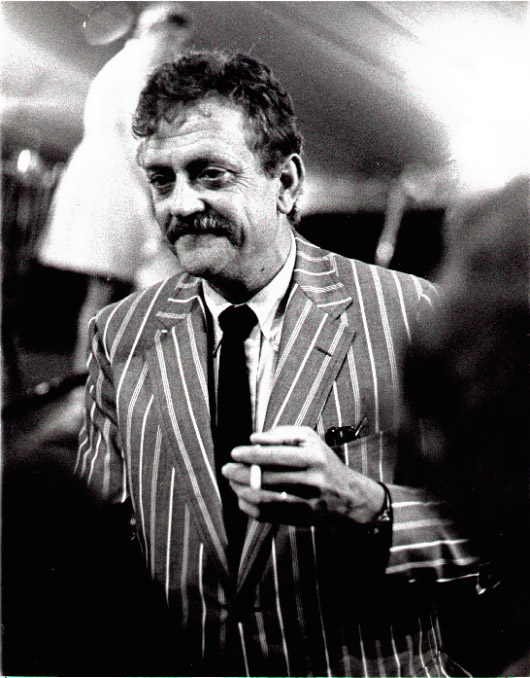
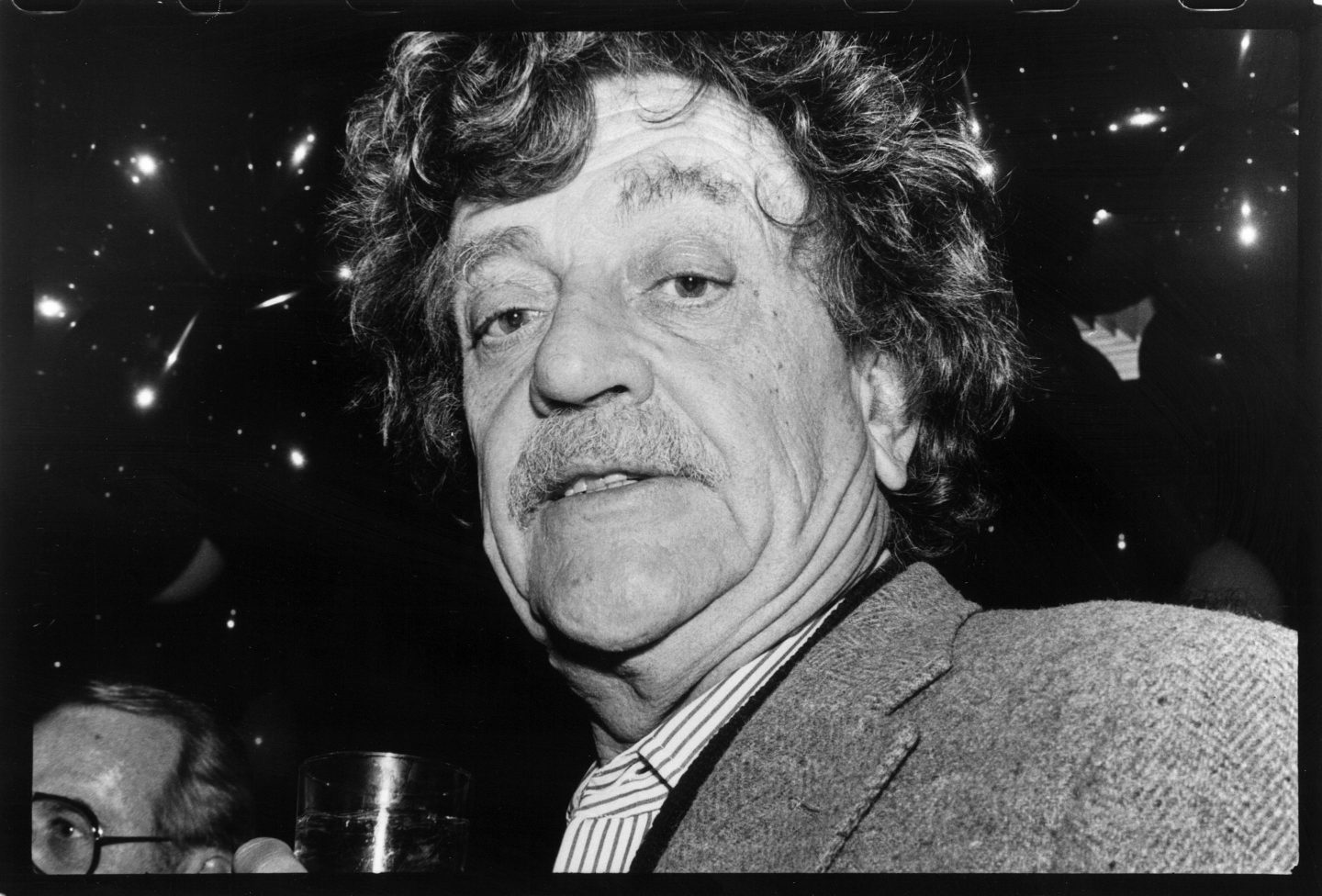
Vonnegut had the look – sad, kind eyes under that mop of uncontrollable hair, the full droopy mustache. A photo taken just before he delivered a commencement address at Bennington College in 1970 shows him wearing a loud striped jacket, reading glasses tucked neatly in its pocket, with a cigarette dangling at his fingertips.
Looking like a cross between Albert Einstein and a carnival huckster, Vonnegut had his contradictions on full display.
Was he a clown or a wise man? A fool or a philosopher?
The literary establishment did not quite know what to make of Vonnegut, either. A writer frequently dismissed by critics for his flying saucers and space aliens, for the simplicity of his prose, for pandering to what one reviewer called the “minimally intelligent young,” he was also praised for his inventiveness, for his lively and playful language, for the depth of feeling behind the zaniness, and for advocating decency and kindness in a chaotic world.
A forceful defense of art
As the U.S. was fighting what most college students believed was an unjust and imperialist war in Vietnam, Vonnegut’s message struck home. He used his own experience in World War II to destroy any notion of a good war.
“For all the sublimity of the cause for which we fought, we surely created a Belsen of our own,” he lamented, referencing the Nazi concentration camp.
The military-industrial complex, he told the graduates at Bennington, treats people and their children and their cities like garbage. Instead, Americans should spend money on hospitals and housing and schools and Ferris wheels rather than on war machinery.
In the same speech, Vonnegut playfully urged young people to defy their professors and fancy educations by clinging to superstition and untruth, especially what he considered the most ridiculous lie of all – “that humanity is at the center of the universe, the fulfiller or the frustrater of the grandest dreams of God Almighty.”
Vonnegut conceded that the military was probably right about the “contemptibility of man in the vastness of the universe.” Still, he denied that contemptibility and begged students to deny it as well by creating art. Art puts human beings at the center of the universe, whether they belong there or not, allowing people to imagine and create a saner, kinder, more just world than the one we really live in.
The generations, he told students at the State University of New York at Fredonia, are not that far apart and do not want that much from each other. Older people want credit for having survived so long – and often imaginatively – under difficult conditions. Younger people want to be acknowledged and respected. He urged each group not to be so “intolerably stingy” about giving the other credit.
A strain of sorrow and pessimism underlies all of Vonnegut’s fiction, as well as his graduation speeches. He witnessed the worst that human beings could do to one another, and he made no secret about his fears for the future of a planet suffering from environmental degradation and a widening divide between the rich and the poor.
If Vonnegut were alive and giving commencement speeches today, he would be speaking to college students whose parents and even grandparents he may have addressed in the past. Today’s graduates have lived through the COVID-19 pandemic and are drowning in social media. They face high housing costs and financial instability and are more depressed and anxious than previous generations.
I’m sure he would give these students the advice he gave so often over the years: to focus, in the midst of chaos, on what makes life worth living, to recognize the joyful moments – maybe by listening to music or drinking a glass of lemonade in the shade – and saying out loud, as his Uncle Alex taught him, “If this isn’t nice, what is?”