• Home
  • Latest
  • Fortune 500
  • Finance
  • Tech
  • Leadership
  • Lifestyle
  • Rankings
  • Multimedia
Environmentlithium

Bolivia is sitting on a goldmine of lithium but it’s setting up an ideological collision between modern society and indigenous religious views

By
Mario Orospe Hernández
and
The Conversation
The Conversation
Down Arrow Button Icon
By
Mario Orospe Hernández
and
The Conversation
The Conversation
Down Arrow Button Icon
April 21, 2023, 1:28 PM ET
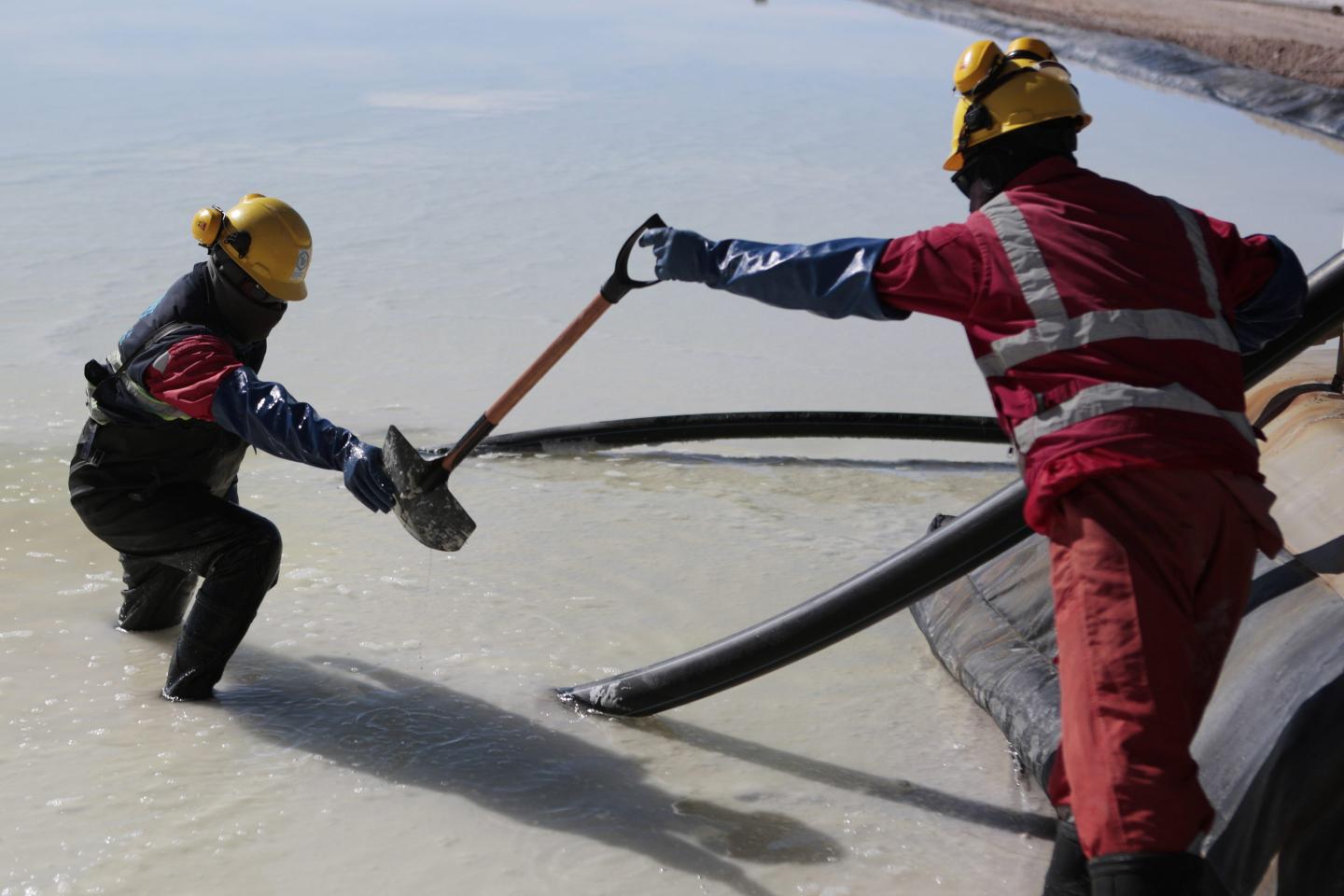
A worker hands a shovel to his colleague who is inside a salt recovery pool at the Llipi pilot Plant in the Uyuni Salt Flats on August 14, 2022 in Uyuni, Bolivia.
A worker hands a shovel to his colleague who is inside a salt recovery pool at the Llipi pilot Plant in the Uyuni Salt Flats on August 14, 2022 in Uyuni, Bolivia. Gaston Brito Miserocchi/Getty Images

Located in the heart of South America, Bolivia contains the largest lithium deposits in the world – an enviable position, in many countries’ eyes, as the market for electric vehicles takes off. Though EVs emit fewer greenhouse gases than fuel-powered vehicles, their batteries require more minerals – especially lithium, which is also used to make batteries for smartphones and computers.

Recommended Video

Unlike its neighbors Chile and Argentina, Bolivia has yet to become a major player in the global lithium market. In part, this is because its high-altitude salt flats aren’t suited to the usual extraction method, solar evaporation.

But that looks poised to change: In January 2023, state company YLB signed an agreement with the Chinese consortium CBC, which includes the world’s largest producer of lithium-ion batteries, to introduce a new method called direct lithium extraction.

It may prove an economic boon. But since colonial times, the legacy of mineral abundance in Bolivia has also been one of pollution, poverty and exploitation. While some residents are hopeful about the potential benefits of the growing lithium industry, others are concerned about extraction’s local impact. In particular, direct lithium extraction demands a great deal of fresh water, potentially endangering surrounding ecosystems as has happened in other parts of South America’s “lithium triangle.”

A rapid escalation of lithium extraction in the Bolivian Andes also represents a looming clash between two fundamentally different views of nature: modern industrial society’s and that of the Indigenous communities who call the region home – a focus of my current research collaborations and dissertation project.

The Pachamama

Bolivia is home to 36 ethnic groups across its highland and lowland regions. Aymara and Quechua peoples comprise most of the Indigenous communities in the Andes Mountains.

For these cultures, nature is not a means to human ends. Instead, it is seen as a group of beings with personhood, history and power beyond human reach. For example, the female divinity of fertility, to whom people owe respect, is the Pachamama. Since she sustains and secures the reproduction of life, Andean Indigenous people make offerings to the Pachamama in ancestral rituals known as “challas” that seek to reinforce their connection with her.

Similarly, highland groups recognize mountains not as a set of inert rocks, but as ancestral guardians called “Achachilas” in Aymara and “Apus” in Quechua. Each Andean community praises a nearby mountain whom they believe protects and oversees their lives.

In Uyuni, for example, where one of the two new lithium plants will be constructed, Indigenous communities acknowledge the presence of these sacred beings. To this day, worshipers in nearby Lipez region explain the salt flat’s origin with a traditional legend: It is the mother’s milk of their Apu, a female volcano named Tunupa.

However, religious concepts such as “sacred” or “divine” do not necessarily capture the relationships that Andean Indigenous people have long established with these more-than-human beings, who have been known since pre-colonial times as “huacas.” These entities are not considered “gods,” or thought of as dealing with otherworldly beliefs. Rather, they are treated as integral to people’s earthly everyday life.

For instance, before meals, Quechua and Aymara peoples throw coca leaves or spill their drinks on the ground to share their food with these beings as a sign of gratitude and reciprocity.

Lifeless matter

In industrial societies, on the other hand, nature is understood as something external to humanity – an object that can be mastered through science and technology. The modern economy turns nature into a source of raw materials: morally and spiritually inert matter that is there to be extracted and mobilized worldwide. Within this framework, a mineral like lithium is a resource to be developed in the pursuit of economic gains for human beings.

In fact, the history of these competing notions is deeply entwined with the history of the colonial era, as different cultures came into violent conflict. As the Spanish discovered the mineral bounty of the so-called New World, like gold and silver, they began an intensive extraction of its riches, relying on forced labor from local people and imported slaves.

The concept of “raw materials” can be traced to the theological notion of “prime matter.” The term originally comes from Aristotle, whose work was introduced to Christianity via Latin translations around the 12th century. In the way Christians adapted his idea of prime matter, everything was ordered by its level of “perfection,” ranging from the lowest level – prime matter, the most basic “stuff” of the world – to rocks, plants, animals, humans, angels and, finally, God.

The Catholic Church and the Spanish Empire later used this medieval understanding of matter as something passive, without spirit, to justify the extraction of resources during colonial times. The closer things were to prime matter, their argument supposed, the more they needed human imprint and an external purpose to make them valuable.

This notion was also used by Christian colonizers who were intent on destroying traditions that they saw as idolatrous. In their eyes, reverence toward a mountain or the earth itself was worshiping a mere “thing,” a false god. The church and the empire believed it was critical to desacralize these more-than-human beings and treat them as mere resources.

This flattened vision of nature served as the basis for the modern economic concept of raw materials, which was introduced in the 18th century with the birth of economics as a social science.

The road ahead

Bolivia’s lithium projects pose a new potential clash of worldviews. However, extraction initiatives have faced severe setbacks in the last few years, including social protests, the 2019 political crisis and a lack of necessary technology. The Chinese deal represents a new milestone, yet its outcomes are still uncertain: for the economy, for local communities and for the Earth.

Today, electric vehicles are widely considered part of the solution to the climate crisis. Yet they will necessitate a mining surge to meet their battery demands. If societies really want a greener future, technological shifts such as EVs will be just part of the answer, alongside other changes like more sustainable urban planning and improved public transportation.

But in addition, perhaps other cultures could learn from Andean relations with nature as more-than-human beings: an inspiration to rethink development and turn our own way of living into something less destructive.

The Fortune 500 Innovation Forum will convene Fortune 500 executives, U.S. policy officials, top founders, and thought leaders to help define what’s next for the American economy, Nov. 16-17 in Detroit. Apply here.
About the Authors
By Mario Orospe Hernández
See full bioRight Arrow Button Icon
By The Conversation
See full bioRight Arrow Button Icon

Latest in Environment

Finance
Lorem ipsum dolor sit amet, consectetur adipiscing elit, sed do eiusmod tempor incididunt ut labore et dolore magna aliqua. Ut enim ad minim veniam
By Fortune Editors
October 20, 2025
Finance
Lorem ipsum dolor sit amet, consectetur adipiscing elit, sed do eiusmod tempor incididunt ut labore et dolore magna aliqua. Ut enim ad minim veniam
By Fortune Editors
October 20, 2025
Finance
Lorem ipsum dolor sit amet, consectetur adipiscing elit, sed do eiusmod tempor incididunt ut labore et dolore magna aliqua. Ut enim ad minim veniam
By Fortune Editors
October 20, 2025
Finance
Lorem ipsum dolor sit amet, consectetur adipiscing elit, sed do eiusmod tempor incididunt ut labore et dolore magna aliqua. Ut enim ad minim veniam
By Fortune Editors
October 20, 2025
Finance
Lorem ipsum dolor sit amet, consectetur adipiscing elit, sed do eiusmod tempor incididunt ut labore et dolore magna aliqua. Ut enim ad minim veniam
By Fortune Editors
October 20, 2025
Finance
Lorem ipsum dolor sit amet, consectetur adipiscing elit, sed do eiusmod tempor incididunt ut labore et dolore magna aliqua. Ut enim ad minim veniam
By Fortune Editors
October 20, 2025

Most Popular

Finance
Lorem ipsum dolor sit amet, consectetur adipiscing elit, sed do eiusmod tempor incididunt ut labore et dolore magna aliqua. Ut enim ad minim veniam
By Fortune Editors
October 20, 2025
Finance
Lorem ipsum dolor sit amet, consectetur adipiscing elit, sed do eiusmod tempor incididunt ut labore et dolore magna aliqua. Ut enim ad minim veniam
By Fortune Editors
October 20, 2025
Finance
Lorem ipsum dolor sit amet, consectetur adipiscing elit, sed do eiusmod tempor incididunt ut labore et dolore magna aliqua. Ut enim ad minim veniam
By Fortune Editors
October 20, 2025
Finance
Lorem ipsum dolor sit amet, consectetur adipiscing elit, sed do eiusmod tempor incididunt ut labore et dolore magna aliqua. Ut enim ad minim veniam
By Fortune Editors
October 20, 2025
Finance
Lorem ipsum dolor sit amet, consectetur adipiscing elit, sed do eiusmod tempor incididunt ut labore et dolore magna aliqua. Ut enim ad minim veniam
By Fortune Editors
October 20, 2025
Finance
Lorem ipsum dolor sit amet, consectetur adipiscing elit, sed do eiusmod tempor incididunt ut labore et dolore magna aliqua. Ut enim ad minim veniam
By Fortune Editors
October 20, 2025
Fortune Secondary Logo
Rankings
  • 100 Best Companies
  • Fortune 500
  • Global 500
  • Fortune 500 Europe
  • Most Powerful Women
  • Future 50
  • World’s Most Admired Companies
  • See All Rankings
Sections
  • Finance
  • Fortune Crypto
  • Features
  • Leadership
  • Health
  • Commentary
  • Success
  • Retail
  • Mpw
  • Tech
  • Lifestyle
  • CEO Initiative
  • Asia
  • Politics
  • Conferences
  • Europe
  • Newsletters
  • Personal Finance
  • Environment
  • Magazine
  • Education
Customer Support
  • Frequently Asked Questions
  • Customer Service Portal
  • Privacy Policy
  • Terms Of Use
  • Single Issues For Purchase
  • International Print
Commercial Services
  • Advertising
  • Fortune Brand Studio
  • Fortune Analytics
  • Fortune Conferences
  • Business Development
  • Group Subscriptions
About Us
  • About Us
  • Editorial Calendar
  • Press Center
  • Work At Fortune
  • Diversity And Inclusion
  • Terms And Conditions
  • Site Map
  • About Us
  • Editorial Calendar
  • Press Center
  • Work At Fortune
  • Diversity And Inclusion
  • Terms And Conditions
  • Site Map
  • Facebook icon
  • Twitter icon
  • LinkedIn icon
  • Instagram icon
  • Pinterest icon

Latest in Environment

shetty
Commentaryfarming
When the shocks keep coming, farmer cooperatives are the only buffer that works
By Shobha ShettyApril 16, 2026
1 day ago
The Iran war’s fertilizer shock is hammering American farmers, and 70% can’t afford what they need for this year’s growing season
EconomyAgriculture
The Iran war’s fertilizer shock is hammering American farmers, and 70% can’t afford what they need for this year’s growing season
By Marco Quiroz-GutierrezApril 16, 2026
2 days ago
Jeff Bezos pledged $10 billion for climate change. With the 2030 clock ticking, his wife, Lauren Sánchez Bezos, is leading the charge to spend it
EnvironmentJeff Bezos
Jeff Bezos pledged $10 billion for climate change. With the 2030 clock ticking, his wife, Lauren Sánchez Bezos, is leading the charge to spend it
By Sydney LakeApril 15, 2026
2 days ago
Members of the public pose for photographs beside the Charging Bull, sometimes referred to as the Bull of Wall Street or the Bowling Green Bull on Broadway on April 14, 2025 in New York City.
EconomyWall Street
Markets haven’t rallied this fast since COVID. Iran volatility is just another ‘notch on the belt’ for investors, says J.P. Morgan strategist
By Eleanor PringleApril 15, 2026
2 days ago
hippo
EnvironmentColombia
Colombia approves plan to kill cocaine hippos roaming through center of country
By Manuel Rueda and The Associated PressApril 13, 2026
4 days ago
zohran
PoliticsNew York City
Zohran Mamdani’s promise at 100 days: ‘At our stores, eggs will be cheaper. Bread will be cheaper’
By Anthony Izaguirre and The Associated PressApril 13, 2026
4 days ago

Most Popular

Pope Leo warned the world is in ‘big trouble’ if Elon Musk becomes the first trillionaire
Success
Pope Leo warned the world is in ‘big trouble’ if Elon Musk becomes the first trillionaire
By Preston ForeApril 17, 2026
11 hours ago
A world going broke: IMF says America's $39 trillion national debt is actually a global problem—and AI may be the only rescue
Economy
A world going broke: IMF says America's $39 trillion national debt is actually a global problem—and AI may be the only rescue
By Nick LichtenbergApril 16, 2026
1 day ago
Jeff Bezos pledged $10 billion for climate change. With the 2030 clock ticking, his wife, Lauren Sánchez Bezos, is leading the charge to spend it
Environment
Jeff Bezos pledged $10 billion for climate change. With the 2030 clock ticking, his wife, Lauren Sánchez Bezos, is leading the charge to spend it
By Sydney LakeApril 15, 2026
2 days ago
MacKenzie Scott is bypassing the Ivy League and rewriting the $79 billion higher ed playbook by giving to HBCUs and community colleges
Politics
MacKenzie Scott is bypassing the Ivy League and rewriting the $79 billion higher ed playbook by giving to HBCUs and community colleges
By Sydney LakeApril 16, 2026
1 day ago
Germany already told its workers to ditch four-day weeks and work-life balance. Now the government wants to cut their pay for calling in sick, too
Success
Germany already told its workers to ditch four-day weeks and work-life balance. Now the government wants to cut their pay for calling in sick, too
By Orianna Rosa RoyleApril 16, 2026
2 days ago
NYC Mayor Zohran Mamdani points at Ken Griffin's $238 million penthouse on tax day: 'Today we're taxing the rich'
Personal Finance
NYC Mayor Zohran Mamdani points at Ken Griffin's $238 million penthouse on tax day: 'Today we're taxing the rich'
By Catherina GioinoApril 16, 2026
1 day ago

© 2026 Fortune Media IP Limited. All Rights Reserved. Use of this site constitutes acceptance of our Terms of Use and Privacy Policy | CA Notice at Collection and Privacy Notice | Do Not Sell/Share My Personal Information
FORTUNE is a trademark of Fortune Media IP Limited, registered in the U.S. and other countries. FORTUNE may receive compensation for some links to products and services on this website. Offers may be subject to change without notice.