• Home
  • Latest
  • Fortune 500
  • Finance
  • Tech
  • Leadership
  • Lifestyle
  • Rankings
  • Multimedia
FinanceEconomy

‘Dr. Doom’ Nouriel Roubini warns economic ‘trilemma’ is making a financial crash inevitable

Christiaan Hetzner
By
Christiaan Hetzner
Christiaan Hetzner
Senior Reporter
Down Arrow Button Icon
Christiaan Hetzner
By
Christiaan Hetzner
Christiaan Hetzner
Senior Reporter
Down Arrow Button Icon
March 31, 2023, 12:23 PM ET
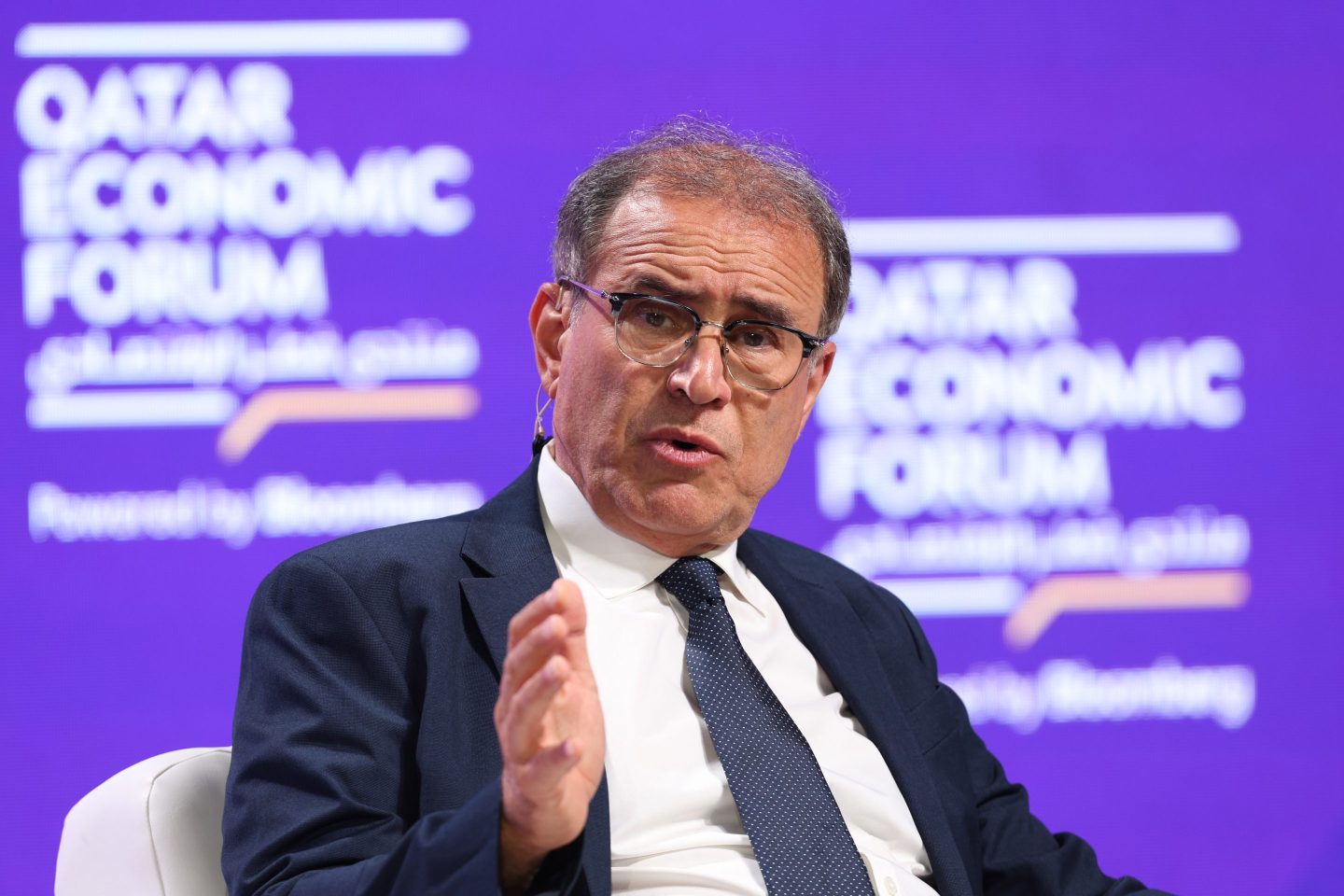
Nouriel Roubini expects an economic crash is inevitable.
Nouriel Roubini, famous for predicting the global financial crisis, expects an economic crash is inevitable.Christopher Pike—Bloomberg via Getty Images

One of the world’s most respected economists believes the banking crisis is far from over, and that U.S. authorities are merely buying themselves some time by insisting the banking system is “sound.”

Nouriel Roubini, chief executive of consulting firm Roubini Macro Associates, argued on Friday that the financial system will be unable to cope with the sheer scale of private and public debt that has already been amassed, spawning a “trilemma” that will soon trigger another phase of panic.

“We cannot achieve price stability, maintain economic growth, [and] have financial stability at the same time,” he told Bloomberg Television. “So eventually, we’ll have an economic and financial crash.”

Roubini, nicknamed “Dr. Doom” on Wall Street after predicting the 2008 global financial crisis, said concerns about the stability of U.S. lenders should not center solely around the banking system’s collective $620 billion in unrealized losses from underwater securities. 

Instead, he argued, attention should be given to the Fed’s 13-month campaign to hike interest rates by a cumulative four and three-quarter points—which Roubini said meant banks’ portfolios of long-duration loans like fixed-rate mortgages are now far less valuable. 

Once these risks are factored into the equation, the unrealized losses figure grows to $1.7 trillion, according to research published earlier this month from New York University’s Stern School of Business, where Roubini is a professor emeritus.

By comparison, the authors of the paper wrote, the entire banking system’s combined equity—in other words, its ability to absorb losses before going bankrupt—stands at just $2.1 trillion.  

“Hundreds of smaller banks are literally insolvent, so that’s the fundamental problem,” Roubini said. “When interest rates go higher, the value of securities and loans is lower, and then we have mass liquidity and solvency problems.”

Roubini told Bloomberghe disagreed with European Central Bank president Christine Lagarde, who argued last week that price stability and financial stability were not mutually exclusive, since sound, well-managed banks could see out a credit crunch as long as their liquidity is backstopped by monetary authorities.

In his view, this would work only when stresses are highly localized rather than systemic. In fact, he argued the problems are more deeply rooted than Lagarde would have people believe. 

Heading towards a hard landing

What started out as a funding mismatch and liquidity problem will snowball into balance sheet problems, Roubini predicted.

“Economic recession is going to lead us from duration and market risk to credit risk,” he warned.

That’s because the current crisis sparked by the depositor run on Silicon Valley Bank will force other regional lenders to cut back their supply of credit to small community businesses and households. 

As a result, credit growth will drop from an annual rate of 10% to potentially close to zero. Once U.S. gross domestic product moves from expansion to contraction, Roubini said, an economy swimming in debt will no longer be in a position to service its financial obligations. 

“In the 1970s when we had the stagflationary shock that led to inflation and recession, debt ratios in advanced economies were only about 100% of GDP— private and public debt. Today they are 420%,” he said.

The U.S. economy had one major advantage the last time its balance sheet was stretched back in 2008 and 2009. The global financial crisis brought about a sharp decline in consumer demand that helped to depress prices, allowing the Federal Reserve to cut rates to zero and crank up the printing press.

With little sign that consumer prices in the foreseeable future will return to the Fed’s 2% target growth rate, Roubini believes neither the U.S. central bank nor an indebted federal government will have the maneuvering room needed to sufficiently stimulate the economy.

“So we have the worst of the ’70s in terms of negative supply shock, reduced growth, and inflation, and we have debt ratios that are much higher than after the great financial crisis,” Roubini said. “We’re headed towards a hard landing.”
Subscribe to Well Adjusted, our newsletter full of simple strategies to work smarter and live better, from the Fortune Well team. Sign up today.
About the Author
Christiaan Hetzner
By Christiaan HetznerSenior Reporter
Instagram iconLinkedIn iconTwitter icon

Christiaan Hetzner is a former writer for Fortune, where he covered Europe’s changing business landscape.

See full bioRight Arrow Button Icon

Latest in Finance

US Federal Reserve Board Chairman Jerome Powell speaks during a news conference following a Federal Open Market Committee (FOMC) meeting in Washington, DC, on December 10, 2025.
Bankingjerome powell
Top economist Diane Swonk: Jerome Powell risks losing the Fed’s credibility on a gamble about AI and immigration
By Eva RoytburgDecember 10, 2025
1 hour ago
Jerome Powell, chairman of the US Federal Reserve, during a news conference following a Federal Open Market Committee (FOMC) meeting in Washington, DC, US, on Wednesday, Dec. 10, 2025. Federal Reserve officials delivered a third consecutive interest-rate reduction and maintained their outlook for just one cut in 2026.
EconomyFederal Reserve
Powell warns of a ‘very unusual’ economy as tariffs keep goods inflation high amid a weakening labor market
By Eva RoytburgDecember 10, 2025
1 hour ago
FBI
LawCrime
TV producer behind ‘I Married a Murderer’ makes FBI Most Wanted list on claim she got a $14.7 million bank loan as a fake heiress
By The Associated PressDecember 10, 2025
2 hours ago
Larry Ellison
Big TechMarkets
Oracle earnings may not be enough to assuage debt, AI deal fears
By Carmen Reinicke and BloombergDecember 10, 2025
2 hours ago
Federal Reserve Bank Chair Jerome Powell speaks during the George P. Shultz Memorial Lecture Series at Stanford University on December 01, 2025 in Stanford, California.
EconomyFederal Reserve
The Fed delivers a rare ‘hawkish cut’ as Powell tries to steady a softening job market
By Eva RoytburgDecember 10, 2025
4 hours ago
Jerome Powell, chairman of the US Federal Reserve, during the Hoover Institution's George P. Shultz Memorial Lecture Series in Stanford, California, US, on Monday, Dec. 1, 2025. The Federal Reserve said it was monitoring community and regional banks' commercial real estate loan portfolios amid concerns over "elevated interest rates, tighter underwriting standards, and lower commercial property values." Photographer: Jason Henry/Bloomberg via Getty Images
EconomyFederal Reserve
‘Be careful what you wish for’: Top economist warns any additional interest rate cuts after today would signal the economy is slipping into danger
By Eva RoytburgDecember 10, 2025
5 hours ago

Most Popular

placeholder alt text
Politics
Exclusive: U.S. businesses are getting throttled by the drop in tourism from Canada: ‘I can count the number of Canadian visitors on one hand’
By Dave SmithDecember 10, 2025
11 hours ago
placeholder alt text
Economy
‘Fodder for a recession’: Top economist Mark Zandi warns about so many Americans ‘already living on the financial edge’ in a K-shaped economy 
By Eva RoytburgDecember 9, 2025
1 day ago
placeholder alt text
Success
At 18, doctors gave him three hours to live. He played video games from his hospital bed—and now, he’s built a $10 million-a-year video game studio
By Preston ForeDecember 10, 2025
13 hours ago
placeholder alt text
Economy
‘Be careful what you wish for’: Top economist warns any additional interest rate cuts after today would signal the economy is slipping into danger
By Eva RoytburgDecember 10, 2025
5 hours ago
placeholder alt text
Banking
Jamie Dimon taps Jeff Bezos, Michael Dell, and Ford CEO Jim Farley to advise JPMorgan's $1.5 trillion national security initiative
By Nino PaoliDecember 9, 2025
1 day ago
placeholder alt text
Uncategorized
Transforming customer support through intelligent AI operations
By Lauren ChomiukNovember 26, 2025
14 days ago
Rankings
  • 100 Best Companies
  • Fortune 500
  • Global 500
  • Fortune 500 Europe
  • Most Powerful Women
  • Future 50
  • World’s Most Admired Companies
  • See All Rankings
Sections
  • Finance
  • Leadership
  • Success
  • Tech
  • Asia
  • Europe
  • Environment
  • Fortune Crypto
  • Health
  • Retail
  • Lifestyle
  • Politics
  • Newsletters
  • Magazine
  • Features
  • Commentary
  • Mpw
  • CEO Initiative
  • Conferences
  • Personal Finance
  • Education
Customer Support
  • Frequently Asked Questions
  • Customer Service Portal
  • Privacy Policy
  • Terms Of Use
  • Single Issues For Purchase
  • International Print
Commercial Services
  • Advertising
  • Fortune Brand Studio
  • Fortune Analytics
  • Fortune Conferences
  • Business Development
About Us
  • About Us
  • Editorial Calendar
  • Press Center
  • Work At Fortune
  • Diversity And Inclusion
  • Terms And Conditions
  • Site Map

© 2025 Fortune Media IP Limited. All Rights Reserved. Use of this site constitutes acceptance of our Terms of Use and Privacy Policy | CA Notice at Collection and Privacy Notice | Do Not Sell/Share My Personal Information
FORTUNE is a trademark of Fortune Media IP Limited, registered in the U.S. and other countries. FORTUNE may receive compensation for some links to products and services on this website. Offers may be subject to change without notice.