
• Home
  • News
  • Fortune 500
  • Tech
  • Finance
  • Leadership
  • Lifestyle
  • Rankings
  • Multimedia
FinanceMarkets

‘There is no alternative’ has been the order of the day for investors since 2008. Not anymore, Goldman Sachs says

Will Daniel
By
Will Daniel
Will Daniel
Down Arrow Button Icon
Will Daniel
By
Will Daniel
Will Daniel
Down Arrow Button Icon
March 27, 2023, 2:15 PM ET
Goldman Sachs says U.S. households will sell $750 billion worth of their stock holdings in 2023 .
Goldman Sachs says U.S. households will sell $750 billion worth of their stock holdings in 2023 .Michael M. Santiago—Getty Images

With U.S. Treasury and corporate bond yields rising, American investors have more options outside the equity market than they have for years, just as stocks are near their most “expensive” on a historical basis. It’s a combination that will result in U.S. households selling $750 billion worth of their stock holdings in 2023 as a new era for markets begins, according to David J. Kostin, Goldman Sachs chief U.S. equity strategist.

For years after the Great Recession of 2008, many investors lived by a mantra called “TINA”—or “there is no alternative” to stocks. The idea being that with interest rates near zero, savings accounts, U.S. Treasuries, and corporate bonds weren’t offering attractive returns, so the stock market was the only option. 

But when the Federal Reserve began aggressively raising interest rates in March 2022 in order to fight the rise of inflation, a new era began. “TINA” is now “TARA”—or “there are reasonable alternatives”— Kostin argues, pointing to bonds and treasuries as new viable options for investors.

“[F]lows into money market and bond funds signal an escalating household shift away from equities and toward the alternatives,” he wrote in a recent research note.

American households currently invest 40% of their financial assets into equities, but that’s changing. Even before March’s string of bank failures sent financial stocks tumbling, rising interest rates were driving many investors, particularly more conservative ones, away from equity markets. 

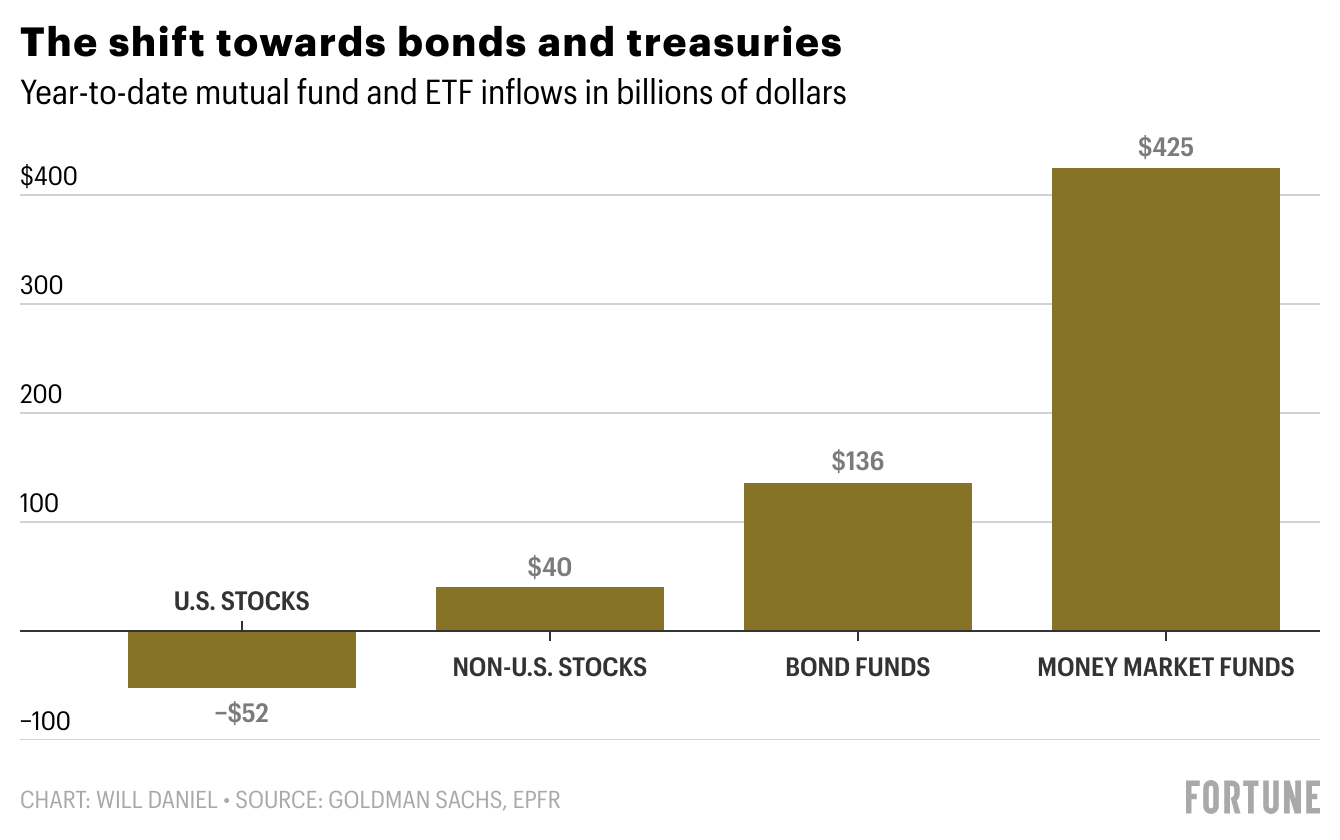
Household equity demand, adjusted for hedge fund buying, fell 78% year over year to just $209 billion in 2022, according to data from Goldman Sachs and the Federal Reserve. And investors pulled $52 billion from U.S. equity ETFs and mutual funds through March 23 while piling $425 billion into money market funds that invest in short-term debt like U.S. Treasury bills over the same period. Kostin said the data “reflected an increasing investor preference for lower-risk, yield-bearing assets.” 
He’s not the only one making the argument that investors’ stock obsession is coming to an end. Brendan Murphy, head of Core Fixed Income, North America at Insight Investment, told Fortune earlier this year that TINA justified a “shift into riskier assets” and “became embedded in investor psychology” after the Great Recession.

“It may take time for markets to readjust to a world where lower-risk assets provide meaningful returns, but as they do, flows should follow,” he said, adding that there will be a “gradual reallocation from higher-risk to lower-risk assets in the years ahead.”

Analysts have described the coming migration away from stocks as everything from “TIARA”—”there is a realistic alternative”—to “TAPAS”—“there are plenty of alternatives,” but Goldman Sachs’ new data provides, for the first time, some insight into just how sizable that migration could be.

The investment bank’s strategists laid out a “downside case” for the U.S. stock market, where the yield on the 10-year treasury continues to rise and consumers dramatically increase their savings rate, leading even more money to be pulled from stocks. If that happens, U.S. households could sell up to $1.1 trillion in stock this year. For comparison, at the end of 2022, total U.S. equity ownership was $65 trillion.


Subscribe to Well Adjusted, our newsletter full of simple strategies to work smarter and live better, from the Fortune Well team. Sign up today.
About the Author
Will Daniel
By Will Daniel
LinkedIn iconTwitter icon
See full bioRight Arrow Button Icon

Latest in Finance

RetailConsumer Spending
U.S. consumers are so financially strained they put more than $1 billion on buy-now, pay later services during Black Friday and Cyber Monday
By Jeena Sharma and Retail BrewDecember 5, 2025
6 hours ago
Elon Musk
Big TechSpaceX
Musk’s SpaceX discusses record valuation, IPO as soon as 2026
By Edward Ludlow, Loren Grush, Lizette Chapman, Eric Johnson and BloombergDecember 5, 2025
6 hours ago
data center
EnvironmentData centers
The rise of AI reasoning models comes with a big energy tradeoff
By Rachel Metz, Dina Bass and BloombergDecember 5, 2025
6 hours ago
Personal FinanceLoans
5 ways to use a home equity line of credit (HELOC)
By Joseph HostetlerDecember 5, 2025
6 hours ago
Netflix
InvestingAntitrust
Netflix–Warner Bros. deal sets up $72 billion antitrust test
By Josh Sisco, Samuel Stolton, Kelcee Griffis and BloombergDecember 5, 2025
6 hours ago
Schumer
Politicsnational debt
‘This is a bad idea made worse’: Senate Dems’ plan to fix Obamacare premiums adds nearly $300 billion to deficit, CRFB says
By Nick LichtenbergDecember 5, 2025
6 hours ago

Most Popular

placeholder alt text
Economy
Two months into the new fiscal year and the U.S. government is already spending more than $10 billion a week servicing national debt
By Eleanor PringleDecember 4, 2025
2 days ago
placeholder alt text
Success
‘Godfather of AI’ says Bill Gates and Elon Musk are right about the future of work—but he predicts mass unemployment is on its way
By Preston ForeDecember 4, 2025
1 day ago
placeholder alt text
Success
Nearly 4 million new manufacturing jobs are coming to America as boomers retire—but it's the one trade job Gen Z doesn't want
By Emma BurleighDecember 4, 2025
2 days ago
placeholder alt text
Success
Nvidia CEO Jensen Huang admits he works 7 days a week, including holidays, in a constant 'state of anxiety' out of fear of going bankrupt
By Jessica CoacciDecember 4, 2025
1 day ago
placeholder alt text
Real Estate
‘There is no Mamdani effect’: Manhattan luxury home sales surge after mayoral election, undercutting predictions of doom and escape to Florida
By Sasha RogelbergDecember 4, 2025
1 day ago
placeholder alt text
Economy
Tariffs and the $38 trillion national debt: Kevin Hassett sees ’big reductions’ in deficit while Scott Bessent sees a ‘shrinking ice cube’
By Nick LichtenbergDecember 4, 2025
1 day ago
Rankings
  • 100 Best Companies
  • Fortune 500
  • Global 500
  • Fortune 500 Europe
  • Most Powerful Women
  • Future 50
  • World’s Most Admired Companies
  • See All Rankings
Sections
  • Finance
  • Leadership
  • Success
  • Tech
  • Asia
  • Europe
  • Environment
  • Fortune Crypto
  • Health
  • Retail
  • Lifestyle
  • Politics
  • Newsletters
  • Magazine
  • Features
  • Commentary
  • Mpw
  • CEO Initiative
  • Conferences
  • Personal Finance
  • Education
Customer Support
  • Frequently Asked Questions
  • Customer Service Portal
  • Privacy Policy
  • Terms Of Use
  • Single Issues For Purchase
  • International Print
Commercial Services
  • Advertising
  • Fortune Brand Studio
  • Fortune Analytics
  • Fortune Conferences
  • Business Development
About Us
  • About Us
  • Editorial Calendar
  • Press Center
  • Work At Fortune
  • Diversity And Inclusion
  • Terms And Conditions
  • Site Map

© 2025 Fortune Media IP Limited. All Rights Reserved. Use of this site constitutes acceptance of our Terms of Use and Privacy Policy | CA Notice at Collection and Privacy Notice | Do Not Sell/Share My Personal Information
FORTUNE is a trademark of Fortune Media IP Limited, registered in the U.S. and other countries. FORTUNE may receive compensation for some links to products and services on this website. Offers may be subject to change without notice.