• Home
  • News
  • Fortune 500
  • Tech
  • Finance
  • Leadership
  • Lifestyle
  • Rankings
  • Multimedia
SuccessObituary

How Gordon Moore invented ‘Moore’s Law’ 3 years before co-founding Intel: ‘It’s what made Silicon Valley’

By
The Associated Press
Down Arrow Button Icon
By
The Associated Press
Down Arrow Button Icon
March 25, 2023, 12:39 PM ET
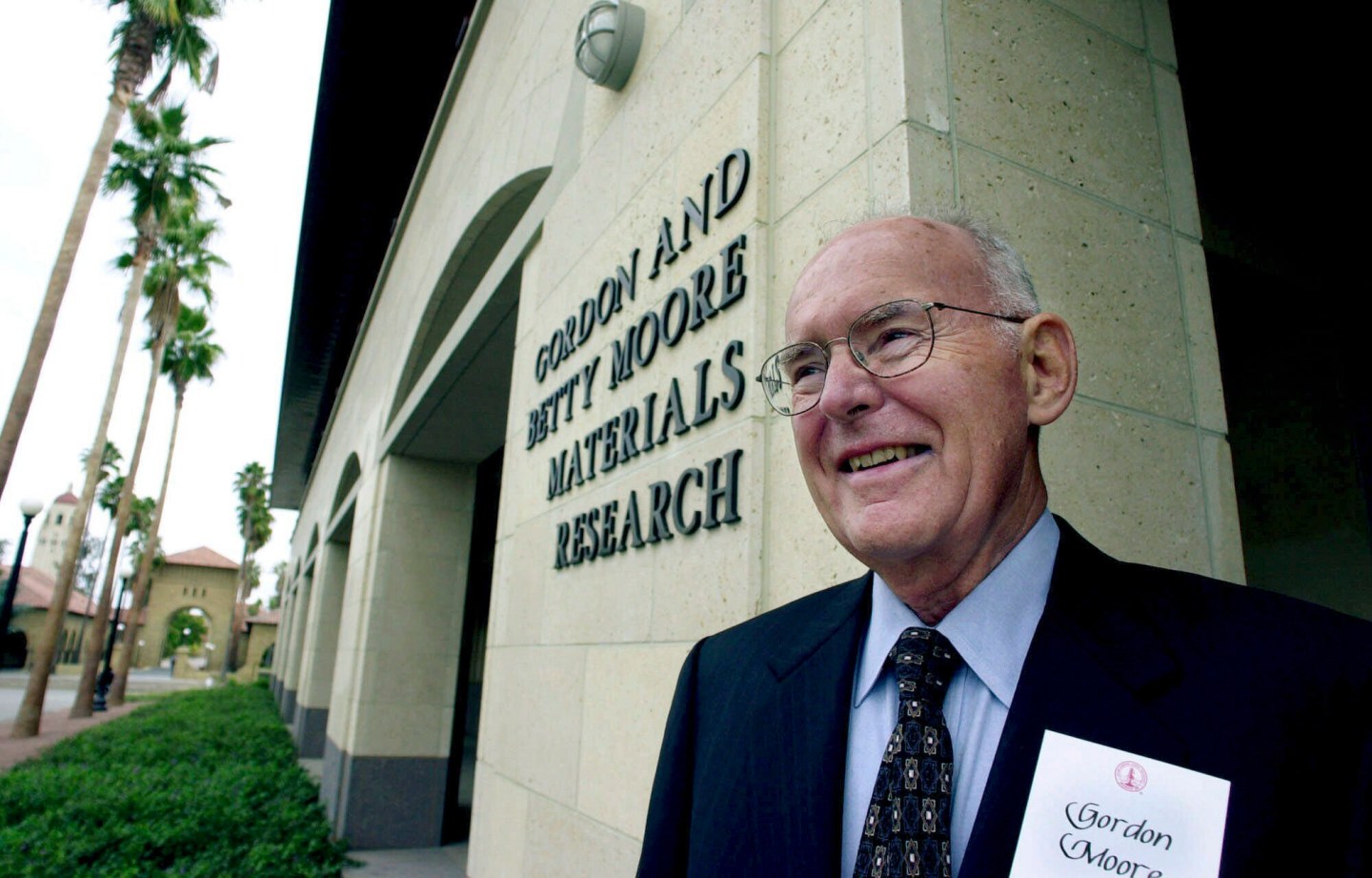
Gordon Moore
Intel founder and chairman emeritus, Gordon Moore, smiles as he tours during the dedication of the new Gordon and Betty Moore Material Research building at Stanford University on the Stanford, Calif., campus, Wednesday, Oct. 11, 2000. Paul Sakuma—AP Images

Gordon Moore, the Intel Corp. co-founder who set the breakneck pace of progress in the digital age with a simple 1965 prediction of how quickly engineers would boost the capacity of computer chips, has died. He was 94.

Moore died Friday at his home in Hawaii, according to Intel and the Gordon and Betty Moore Foundation.

Moore, who held a Ph.D. in chemistry and physics, made his famous observation — now known as “Moore’s Law” — three years before he helped start Intel in 1968. It appeared among a number of articles about the future written for the now-defunct Electronics magazine by experts in various fields.

The prediction, which Moore said he plotted out on graph paper based on what had been happening with chips at the time, said the capacity and complexity of integrated circuits would double every year.

Strictly speaking, Moore’s observation referred to the doubling of transistors on a semiconductor. But over the years, it has been applied to hard drives, computer monitors and other electronic devices, holding that roughly every 18 months a new generation of products makes their predecessors obsolete.

It became a standard for the tech industry’s progress and innovation.

“It’s the human spirit. It’s what made Silicon Valley,” Carver Mead, a retired California Institute of Technology computer scientist who coined the term “Moore’s Law” in the early 1970s, said in 2005. “It’s the real thing.”

Moore later became known for his philanthropy when he and his wife established the Gordon and Betty Moore Foundation, which focuses on environmental conservation, science, patient care and projects in the San Francisco Bay area. It has donated more than $5.1 billion to charitable causes since its founding in 2000.

“Those of us who have met and worked with Gordon will forever be inspired by his wisdom, humility and generosity,” foundation president Harvey Fineberg said in a statement.

Intel Chairman Frank Yeary called Moore a brilliant scientist and a leading American entrepreneur.

“It is impossible to imagine the world we live in today, with computing so essential to our lives, without the contributions of Gordon Moore,” he said.

In his book “Moore’s Law: The Life of Gordon Moore, Silicon Valley’s Quiet Revolutionary,” author David Brock called him “the most important thinker and doer in the story of silicon electronics.”

Moore was born in San Francisco on Jan. 3, 1929, and grew up in the tiny nearby coastal town of Pescadero. As a boy, he took a liking to chemistry sets. He attended San Jose State University, then transferred to the University of California, Berkeley, where he graduated with a degree in chemistry.

After getting his Ph.D. from the California Institute of Technology in 1954, he worked briefly as a researcher at Johns Hopkins University.

His entry into microchips began when he went to work for William Shockley, who in 1956 shared the Nobel Prize for physics for his work inventing the transistor. Less than two years later, Moore and seven colleagues left Shockley Semiconductor Laboratory after growing tired of its namesake’s management practices.

The defection by the “traitorous eight,” as the group came to be called, planted the seeds for Silicon Valley’s renegade culture, in which engineers who disagreed with their colleagues didn’t hesitate to become competitors.

The Shockley defectors in 1957 created Fairchild Semiconductor, which became one of the first companies to manufacture the integrated circuit, a refinement of the transistor.

Fairchild supplied the chips that went into the first computers that astronauts used aboard spacecraft.

In 1968, Moore and Robert Noyce, one of the eight engineers who left Shockley, again struck out on their own. With $500,000 of their own money and the backing of venture capitalist Arthur Rock, they founded Intel, a name based on joining the words “integrated” and “electronics.”

Moore became Intel’s chief executive in 1975. His tenure as CEO ended in 1987, thought he remained chairman for another 10 years. He was chairman emeritus from 1997 to 2006.

He received the National Medal of Technology from President George H.W. Bush in 1990 and the Presidential Medal of Freedom from President George W. Bush in 2002.

Despite his wealth and acclaim, Moore remained known for his modesty. In 2005, he referred to Moore’s Law as “a lucky guess that got a lot more publicity than it deserved.”

He is survived by his wife of 50 years, Betty, sons Kenneth and Steven, and four grandchildren.

Subscribe to Well Adjusted, our newsletter full of simple strategies to work smarter and live better, from the Fortune Well team. Sign up today.
About the Author
By The Associated Press
See full bioRight Arrow Button Icon

Latest in Success

Jensen Huang
SuccessBillionaires
Nvidia CEO Jensen Huang admits he works 7 days a week, including holidays, in a constant ‘state of anxiety’ out of fear of going bankrupt
By Jessica CoacciDecember 4, 2025
16 hours ago
Successphilanthropy
‘Have they given enough? No’: Melinda French Gates rips into billionaire class, saying Giving Pledge has fallen short
By Sydney LakeDecember 4, 2025
16 hours ago
Geoffrey Hinton gestures with his hands up
Successthe future of work
‘Godfather of AI’ says Bill Gates and Elon Musk are right about the future of work—but he predicts mass unemployment is on its way
By Preston ForeDecember 4, 2025
16 hours ago
Factory worker on assembly line.
SuccessGen Z
Nearly 4 million new manufacturing jobs are coming to America as boomers retire—but it’s the one trade job Gen Z doesn’t want
By Emma BurleighDecember 4, 2025
17 hours ago
SuccessWealth
Meet Luana Lopes Lara: The 29-year-old ex-ballerina spent summers working for Ray Dalio and Ken Griffin—now she’s the youngest female self-made billionaire
By Orianna Rosa RoyleDecember 4, 2025
18 hours ago
Boston Celtics head coach Joe Mazzulla stands on the court with his arms folded
Workplace CultureLeadership
You don’t need to have fun at work—take it from NBA head coach Joe Mazzulla: ‘Fun is a cop-out sometimes when things aren’t going well’
By Dave SmithDecember 4, 2025
21 hours ago

Most Popular

placeholder alt text
Economy
Two months into the new fiscal year and the U.S. government is already spending more than $10 billion a week servicing national debt
By Eleanor PringleDecember 4, 2025
21 hours ago
placeholder alt text
Success
‘Godfather of AI’ says Bill Gates and Elon Musk are right about the future of work—but he predicts mass unemployment is on its way
By Preston ForeDecember 4, 2025
16 hours ago
placeholder alt text
Success
Nearly 4 million new manufacturing jobs are coming to America as boomers retire—but it's the one trade job Gen Z doesn't want
By Emma BurleighDecember 4, 2025
17 hours ago
placeholder alt text
Success
Nvidia CEO Jensen Huang admits he works 7 days a week, including holidays, in a constant 'state of anxiety' out of fear of going bankrupt
By Jessica CoacciDecember 4, 2025
16 hours ago
placeholder alt text
North America
Jeff Bezos and Lauren Sánchez Bezos commit $102.5 million to organizations combating homelessness across the U.S.: ‘This is just the beginning’
By Sydney LakeDecember 2, 2025
3 days ago
placeholder alt text
Health
Bill Gates decries ‘significant reversal in child deaths’ as nearly 5 million kids will die before they turn 5 this year
By Nick LichtenbergDecember 4, 2025
1 day ago
Rankings
  • 100 Best Companies
  • Fortune 500
  • Global 500
  • Fortune 500 Europe
  • Most Powerful Women
  • Future 50
  • World’s Most Admired Companies
  • See All Rankings
Sections
  • Finance
  • Leadership
  • Success
  • Tech
  • Asia
  • Europe
  • Environment
  • Fortune Crypto
  • Health
  • Retail
  • Lifestyle
  • Politics
  • Newsletters
  • Magazine
  • Features
  • Commentary
  • Mpw
  • CEO Initiative
  • Conferences
  • Personal Finance
  • Education
Customer Support
  • Frequently Asked Questions
  • Customer Service Portal
  • Privacy Policy
  • Terms Of Use
  • Single Issues For Purchase
  • International Print
Commercial Services
  • Advertising
  • Fortune Brand Studio
  • Fortune Analytics
  • Fortune Conferences
  • Business Development
About Us
  • About Us
  • Editorial Calendar
  • Press Center
  • Work At Fortune
  • Diversity And Inclusion
  • Terms And Conditions
  • Site Map

© 2025 Fortune Media IP Limited. All Rights Reserved. Use of this site constitutes acceptance of our Terms of Use and Privacy Policy | CA Notice at Collection and Privacy Notice | Do Not Sell/Share My Personal Information
FORTUNE is a trademark of Fortune Media IP Limited, registered in the U.S. and other countries. FORTUNE may receive compensation for some links to products and services on this website. Offers may be subject to change without notice.