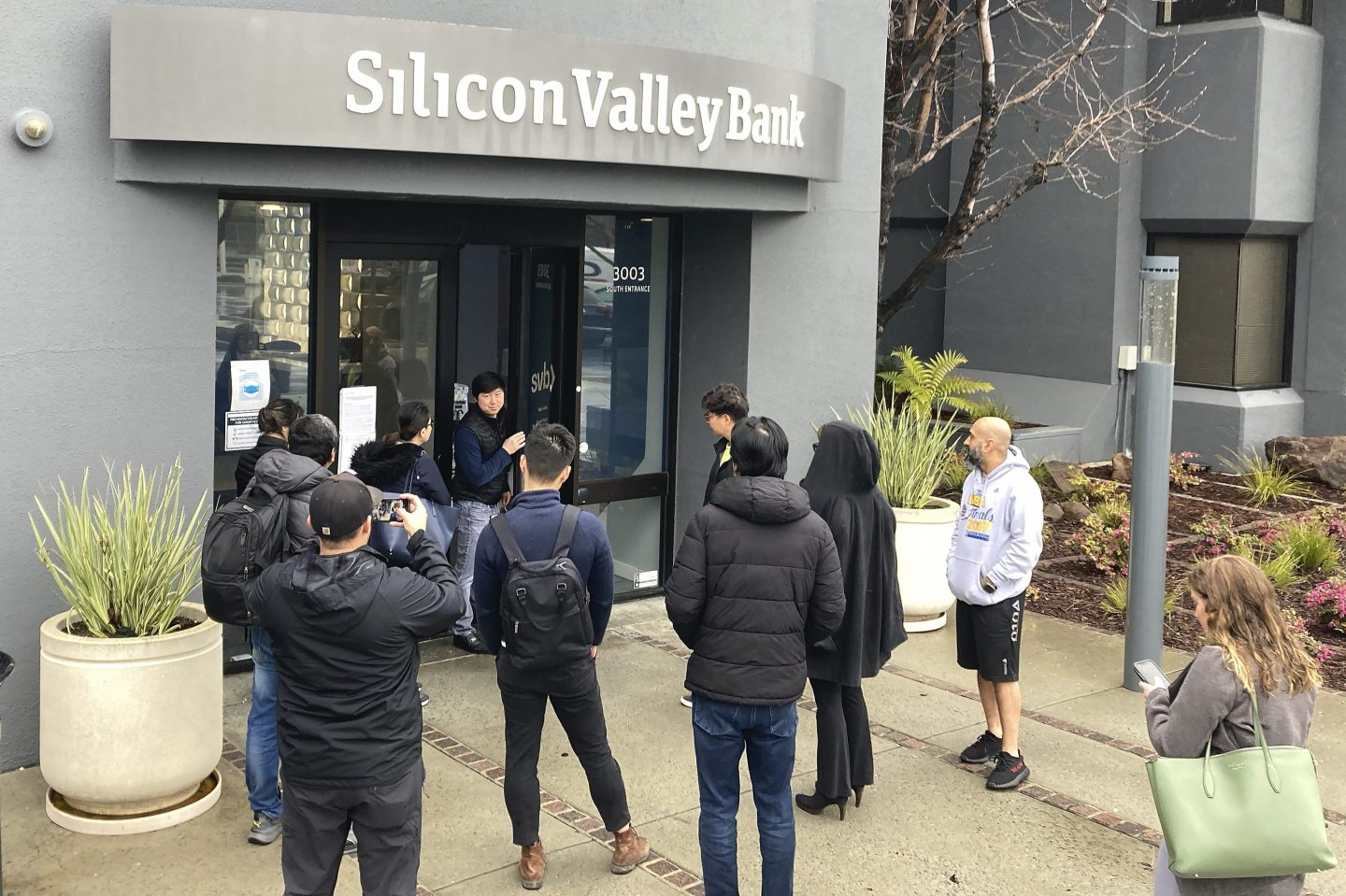
In the hours after some of Silicon Valley Bank’s biggest customers started pulling out their money, a WhatsApp group of startup founders who are immigrants of color ballooned to more than 1,000 members.
Questions flowed as the bank’s financial status worsened. Some desperately sought advice: Could they open an account at a larger bank without a Social Security Number? Others questioned whether they had to physically be at a bank to open an account, because they’re visiting parents overseas.
One clear theme emerged: a deep concern about the broader impact on startups led by people of color.
While Wall Street struggles to contain the banking crisis after the swift demise of SVB — the nation’s 16th largest bank and the biggest to fail since the 2008 financial meltdown — industry experts predict it could become even harder for people of color to secure funding or a financial home supporting their startups.
SVB had opened its doors to such entrepreneurs, offering opportunities to form crucial relationships in the technology and financial communities that had been out of reach within larger financial institutions. But smaller players have fewer means of surviving a collapse, reflecting the perilous journey minority entrepreneurs face while attempting to navigate industries historically rife with racism.
“All these folks that have very special circumstances based on their identity, it’s not something that they can just change about themselves and that makes them unbankable by the top four (large banks),” said Asya Bradley, a board member of numerous startups who has watched the WhatsApp group grapple with SVB’s demise.
Bradley said some investors have implored startups to switch to larger financial institutions to stymie future financial risks, but that’s not an easy transition.
“The reason why we’re going to regional and community banks is because these (large) banks don’t want our business,” Bradley said.
Banking expert Aaron Klein, a senior fellow in Economic Studies at the Brookings Institution, said SVB’s collapse could exacerbate racial disparities.
“That’s going to be more challenging for people who don’t fit the traditional credit box, including minorities,” Klein said. “A financial system that prefers the existing holders of wealth will perpetuate the legacy of past discrimination.”
Tiffany Dufu was gutted when she couldn’t access her SVB account and, in turn, could not pay her employees.
Dufu raised $5 million as CEO of The Cru, a New York-based career coaching platform and community for women. It was a rare feat for businesses founded by Black women, which get less than 1% of the billions of dollars in venture capital funding doled out yearly to startups. She banked with SVB because it was known for its close ties to the tech community and investors.
“In order to have raised that money, I pitched nearly 200 investors over the past few years,” said Dufu, who has since regained access to her funds and moved to Bank of America. “It’s very hard to put yourself out there and time after time — you get told this isn’t a good fit. So, the money in the bank account was very precious.”
A February Crunchbase News analysis determined funding for Black-founded startups slowed by more than 50% last year after they received a record $5.1 billion in venture capital in 2021. Overall venture funding dropped from about $337 billion to roughly $214 billion, while Black founders were hit disproportionately hard, dropping to just $2.3 billion, or 1.1% of the total.
Entrepreneur Amy Hilliard, a professor at the University of Chicago Booth School of Business, knows how difficult it is to secure financing. It took three years to secure a loan for her cake manufacturing company, and she had to sell her home to get it started.
Banking is based on relationships and when a bank like SVB goes under, “those relationships go away, too,” said Hilliard, who is African American.
Some conservative critics asserted SVB’s commitment to diversity, equity and inclusion were to blame, but banking experts say those claims were false. The bank slid into insolvency because its larger customers pulled deposits rather than borrow at higher interest rates and the bank’s balance sheets were overexposed, forcing it to sell bonds at a loss to cover the withdrawals.
“If we’re focused on climate or communities of color or racial equity, that has nothing to do with what happened with Silicon Valley Bank,” said Valerie Red-Horse Mohl, co-founder of Known Holdings, a Black, Indigenous, Asian American-founded investment banking platform focused on the sustainable growth of minority-managed funds.
Red-Horse Mohl — who has raised, structured and managed over $3 billion in capital for tribal nations — said most larger banks are led by white men and majority-white boards, and “even when they do DEI programs, it’s not a really deep sort of shifting of capital.”
Smaller financial institutions, however, have worked to build relationships with people of color. “We cannot lose our regional and community banks,” she said. “It would be a travesty.”
Historically, smaller and minority-owned banks have addressed funding gaps that larger banks ignored or even created, following exclusionary laws and policies as they turned away customers because of the color of their skin.
But the ripple effects from SVB’s collapse are being felt among these banks as well, said Nicole Elam, president and CEO of the National Bankers Association, a 96-year-old trade association representing more than 175 minority-owned banks.
Some have seen customers withdraw funds and move to larger banks out of fear, even though most minority-owned banks have a more traditional customer base, with secured loans and minimal risky investments, she said.
“You’re seeing customer flight of folks that we’ve been serving for a long time,” Elam said. “How many people may not come to us for a mortgage or small business loan or to do their banking business because they now have in their mind that they need to bank with a bank that is too big to fail? That’s the first impact of eroding public trust.”
Black-owned banks have been hit the hardest as the industry consolidates. Most don’t have as much capital to withstand economic downturns. At its peak, there were 134. Today, there are only 21.
But change is on the way. Within the last three years, the federal government, private sector and philanthropic community have invested heavily in minority-run depository institutions.
“In response to this national conversation around racial equity, people are really seeing minority banks are key to wealth creation and key to helping to close the wealth gap,” Elam said.
Bradley also is an angel investor, providing seed money for a number of entrepreneurs, and is seeing new opportunities as people network in the WhatsApp group to help each other remain afloat and grow.
“I’m really so hopeful,” Bradley said. “Even in the downfall of SVB, it has managed to form this incredible community of folks that are trying to help each other to succeed. They’re saying, ‘SVB was here for us, now we’re going to be here for each other.’”