

More than half of women experience workplace harassment at some point in their careers. And that doesn’t take into account men or nonbinary workers who face similar issues.
Many times, the experience is troubling but not life-altering, and workers move on without taking action. Other times, it’s egregious to the point where not only do workers report it, they feel it’s worth suing over. That was the case for former Fox News anchor Gretchen Carlson, who filed a lawsuit in 2016 claiming sexual harassment in one of the first big #MeToo cases.
But to pursue her claims, Carlson could sue only CEO Roger Ailes personally, not her employer Fox News, because of a common legal tool: an arbitration clause. These clauses, usually found in the fine print of employment contracts and employee handbooks, require workers to resolve employment disputes using the private arbitration system—a non-public, legal dispute resolution process that doesn’t provide plaintiffs with some of the same protections afforded in court cases.
About 60 million American workers, or about 54% of all nonunion, private-sector employees, are bound by some type of mandatory arbitration agreement that bars them from suing their employer in federal court.
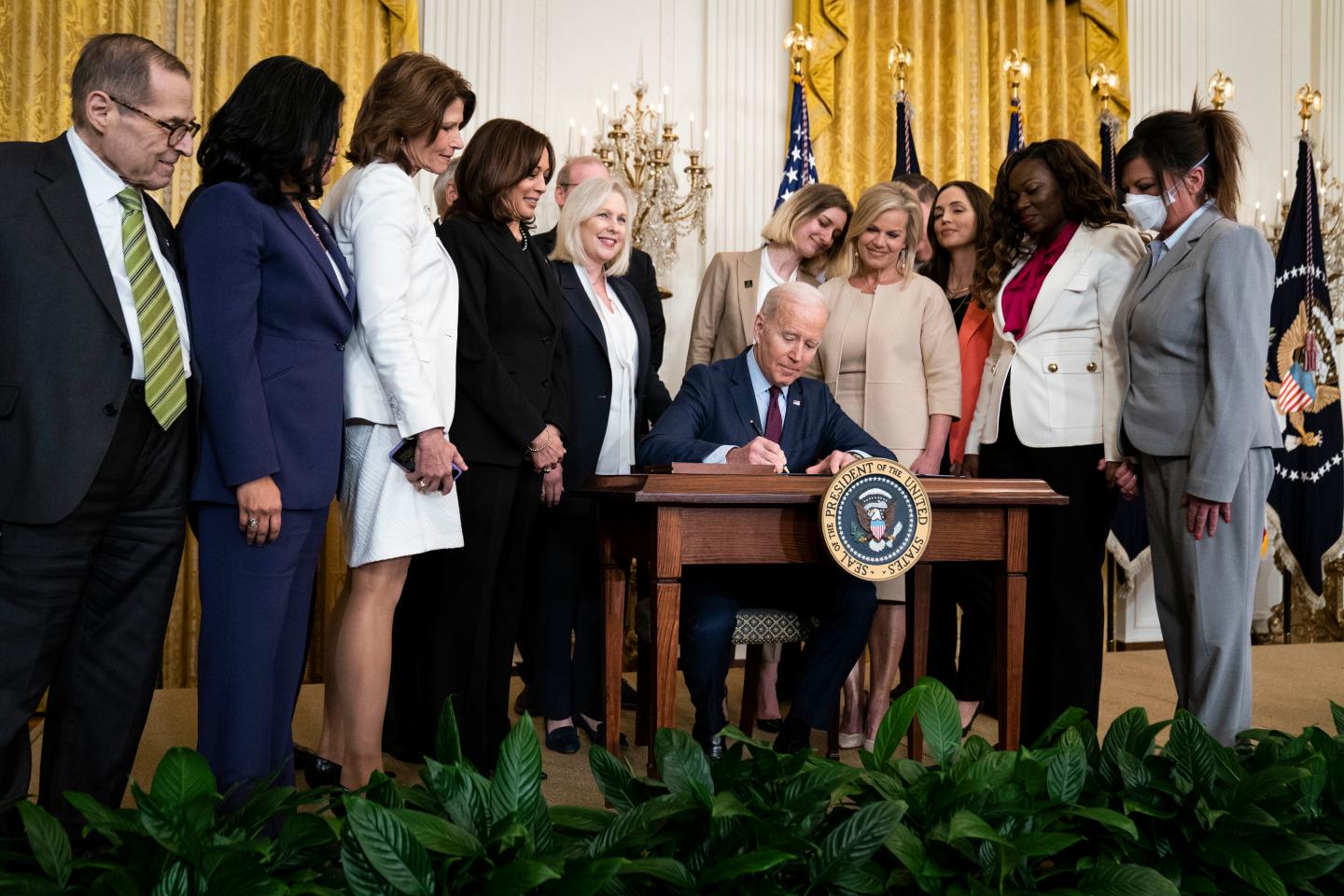
That changed, albeit slightly, last March, when President Joe Biden signed a law that prohibited employers from forcing workers to use arbitration to resolve sexual assault, sexual harassment, and related claims. Instead, the new, bipartisan law allowed workers the choice to use arbitration or bring their cases to court—whichever they preferred.
“This is, I think, a momentous day for justice and fairness in the workplace. And for those who experience sexual harassment or assault, you’re going to have the right today that you did not have yesterday. And that’s good news,” Biden said last year as he signed the Ending Forced Arbitration of Sexual Assault and Sexual Harassment Act into law. Carlson, a major proponent of the legislation, was standing proudly nearby.
Yet simply enacting the new law doesn’t solve all the problems facing workers seeking justice for sexual harassment. “Our strategy was to take a bite out of the apple, one little piece at a time,” says Carlson, who now leads the nonprofit Lift Our Voices.
The law’s narrow scope and potential loopholes do make the #MeToo-era win vulnerable to challenges that chip away at its protections. But the biggest challenge is still simply trying to get people to pay attention and to ultimately understand their rights amid a very complicated legal and quasi-legal systems.
“There’s just a tremendous amount of work left to be done,” Carlson tells Fortune.
Onus is still on workers to know their rights
Despite all of the noise around the new law, Carlson says she’s still seeing employers trying to hide behind arbitration agreements. Although the new law prohibits companies from forcing workers to arbitrate sexual harassment and related claims, it doesn’t require employers to spell that out.
“I would have liked to have mandated that companies have to adjust any future contract to parse out what this law says,” Carlson says. “I do believe that right now, [employers] are still probably hoping that people don’t know about the law.”
And workers shouldn’t count on their employer’s human resources department or the arbitrators to give them a rundown of the legal avenues available. “I’ve had women reach out to me saying that the company is still trying to force them into arbitration for sexual misconduct claims,” Carlson adds.
Of the three big arbitration venues—the American Arbitration Association (AAA), the Financial Industry Regulatory Authority (FINRA), and JAMS—only FINRA noted it had updated its procedures following the passage of the Ending Forced Arbitration law when queried by Fortune. AAA responded saying that in accordance with the legislation, it does not administer cases that relate to sexual harassment disputes or sexual assault disputes, unless the worker alleging the claims voluntarily elects arbitration.
“When the AAA receives a demand for arbitration filed by a self-represented party alleging claims of sexual harassment or sexual assault, the AAA provides them notice of the law,” the company said in a statement, noting that the law only impacts between 5% and 6% of cases a year.
JAMS, when queried, noted that its policies and procedures “have remained the same and did not require any updates,” and said it does adhere to and follow what the updated laws and regulations dictate.
“We have seen that forced arbitration is harmful really to workers across the board, but especially in these situations of sexual harassment and assault because of how they tend to be confidential. The outcomes and all the proceedings of the outcomes under arbitration are often kept out of the public eye,” says Jessica Stender, policy director and deputy legal director at Equal Rights Advocates.
The secrecy is not the only problem. When it comes to employment arbitration, the worker win rates tend to be lower than when the case is heard in state and federal court, according to recent academic research. Moreover, even among the employees who do prevail in arbitration, the monetary award amounts are significantly lower compared to state and federal jury trial verdicts.
There are a lot of reasons for that, opponents of arbitration argue. Corporations tend to have a hand in choosing the pool of arbitrators who may hear a case, typically selecting those who may be most sympathetic. Moreover, these arbitrators tend to be less diverse than even the pool of federal judges—and they don’t always follow federal litigation procedures that, for instance, call for robust discovery processes.
“As it is now, the onus is on the employee to understand the law,” Carlson says. “It's so important that we educate people because this affects millions of people potentially, and they may not know about it—[some] lawyers don't even know about this.”
There are battles brewing on how far the law really extends
One of the main reasons the Ending Forced Arbitration of Sexual Assault and Sexual Harassment Act was passed—and with some support from Republicans like South Carolina Senator Lindsey Graham—is that it’s narrow in scope and not retroactive.
Similar legislation that would end forced arbitration in all consumer and employment contracts, the FAIR Act, has remained stalled since passing the House of Representatives in 2019 and again in 2022.
There’s also some debate over the actual scope of the mandate. Any instances of workplace sexual harassment or assault that occur after March 3, 2022, and are brought in a lawsuit are clearly covered by the parameters of the law.
What about instances of sexual harassment that occurred prior to last March (yet within the statute of limitations), but the worker didn’t file a suit until after the law’s implementation? “It's still being battled,” says Scott Pollins, a Philadelphia-based employment attorney. “That issue hasn’t been clearly resolved over the last 11 months.” Arguably, if a case was filed after the law was implemented, it should be allowed in federal court, but Pollins says workers can likely expect employers to fight to keep those cases in arbitration until there’s clear-cut legal precedent.
We've lost like 40 years of knowing what the hell has been going on inside of our companies. It's really criminal.
—Gretchen Carlson
Another potential pitfall? Cases with claims that extend beyond the strict definition of sexual harassment or sexual assault. The law states that “related claims” can be considered, but Pollins says again, there’s some controversy on what exactly that all might entail. This week, a federal judge in Manhattan made things a bit clearer by ruling that the new law allows the entire employment case to proceed in court, not only harassment claims.
Another issue is that many employment cases that could have been setting precedent have been happening outside the court system. “Arbitration is a black hole,” Carlson says. “We've lost precedent for 40 years. Any kind of a human rights violation that's been forced into arbitration—there is no precedent for these cases. So we've lost like 40 years of knowing what the hell has been going on inside of our companies. It's really criminal.”
Going back for more
Excluding sex harassment claims from arbitration is an important step, but these types of claims represent a small portion of all harassment and discrimination employment cases, says Cliff Palefsky, a San Francisco–based employment lawyer with McGuinn, Hillsman & Palefsky. So while the new law is great, he says, it’s frustrating, at times, to see these claims get special treatment over allegations of gender bias, pregnancy discrimination, or civil rights violations.
Unfortunately, it's going to require federal legislation, the FAIR Act, or some other federal mandate to change that, because the courts are still “very happy” to clear their caseloads, known as dockets, Palefsky says. “Part of this is the courts really don't like employment cases. They really feel beleaguered and underfunded, so they're using arbitration as a form of docket control. And public policy really suffers.”
Right now, the legal system stands at a crossroads. Congress passes laws regulating employment conditions, and yet companies can basically say, if you want to work here, you have to waive the regulation that regulates us, Palefsky says: “There's no other context where a regulated party can unilaterally just opt out of the regulation.”
Which is why Carlson says her work is far from complete. “I've had some people say to me, ‘Oh, your work is done now that you passed your ending forced arbitration law.’ I'm like, what, no, we're just getting started. Because there's so much more work to do for other protected classes,” Carlson says.
“My message to companies is, come join us now because this movement is not going away,” she says, adding that employers can at any time choose to end their mandatory arbitration policies. In fact, several major companies, including Amazon and Google, have limited or eliminated various mandatory arbitration agreements in recent years—a move Carlson sees as a way of the future.
"We're on our way to solving this problem.”
Learn how to navigate and strengthen trust in your business with The Trust Factor, a weekly newsletter examining what leaders need to succeed. Sign up here.