Elon Musk’s enigmatic personality and unconventional tactics are emerging as key exhibits in a trial revolving around one of his most polarizing pursuits — tweeting.
The trial, centered on a pair of tweets announcing Musk had obtained the money to take Tesla private in 2018, reeled the 51-year-old billionaire into a federal courtroom in San Francisco for three days of testimony that opened a peephole into his often inscrutable mind.
Musk, who now owns the Twitter service that he deploys as his megaphone, was often a study in contrasts during his roughly eight hours on the stand. The CEO of the electric carmaker is facing a class-action lawsuit filed on behalf of Tesla shareholders after Musk tweeted about a company buyout that didn’t happen.
Through both his testimony and the evidence submitted around it, Musk came across as impetuous, brash, combative and contemptuous of anyone who questioned his motives as a game-changing entrepreneur who has inspired comparisons to Apple’s late co-founder, Steve Jobs.
At other times, Musk sounded like the savvy visionary that his supporters hail him to be — an intrepid rebel who by his own estimates has raised more than $100 billion from investors. They have been richly rewarded from his leadership of pioneering companies that include PayPal in digital payments, Tesla in electric vehicles and SpaceX in rocket ships.
“It is relatively easy for me to get investment support because my track record is extremely good,” Musk wryly observed.
But his confidence in his ability to get the money he wants to pursue his plans is one reason he found himself in court. The three-week trial is set to resume Tuesday and head for jury deliberations by Friday.
Here’s what to know so far:
PLANTING THE SEEDS
Evidence and testimony have shown Musk had started to mull taking Tesla private in 2017 so he wouldn’t have to hassle with the headaches and distractions that accompany running a publicly traded company.
After a July 31, 2018, meeting with a top representative from Saudi Arabia’s sovereign wealth fund, Musk sent a letter to Tesla’s board outlining why he wanted to take the automaker private at a price of $420 per share — about 20% above its stock price at the time.
Musk was serious enough that he had already discussed the pros and cons with Michael Dell, who had gone through the public-to-private transition in 2013 when he led a $25 billion buyout of the personal computer company bearing his name, according to trial evidence.
THE TROUBLESOME TWEETS
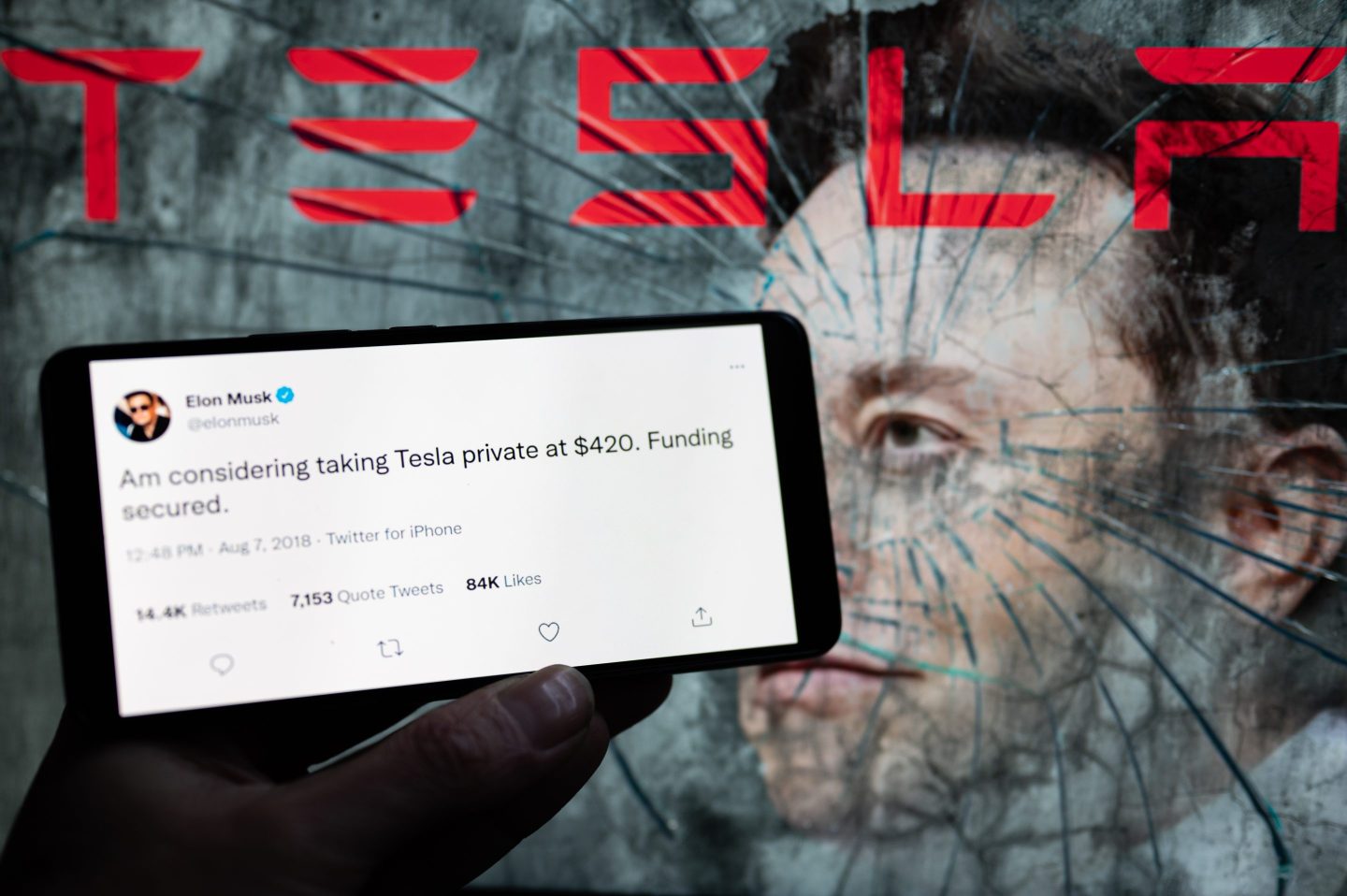
The crux of the case hinges on an Aug. 7, 2018, tweet in which Musk declared “funding secured” to take Tesla private. Musk abruptly posted the tweet minutes before boarding his private jet after being alerted that the Financial Times was about to publish a story that Saudi Arabia’s Public Investment Fund had spent about $2 billion buying a 5% stake in Tesla to diversify its interests beyond oil, according to his testimony.
Amid widespread confusion about whether Musk’s Twitter account had been hacked or he was joking, Musk followed up a few hours later with another tweet suggesting a deal was imminent.
Musk defended the initial tweet as a well-intentioned move to ensure all Tesla investors knew the automaker might be on its way to ending its then-eight-year run as a publicly held company.
“I had no ill motive,” Musk testified. “My intent was to do the right thing for all shareholders.”
Guhan Subramanian, a Harvard University business and law professor hired as an expert for shareholder lawyers, derided Musk’s method for announcing a potential buyout as an “extreme outlier” fraught with potential conflicts.
“The risk is that Mr. Musk timed his announcement of his (management buyout) proposal to serve his own interests rather then the interests of the company,” Subramanian testified.
WHERE’S THE MONEY?
There’s another issue threatening to undermine Musk’s defense. He hadn’t locked up the financing for his proposed deal or even pinned down down how much would be needed to pull it off, based on testimony from Musk, other witnesses and other evidence.
That is one reason U.S. District Judge Edward Chen had decided last year that Musk’s 2018 tweets were false and has instructed the jury to view them that way.
It also prompted regulators to allege Musk misled investors with the tweets, resulting in a $40 million settlement with the U.S. Securities and Exchange Commission that also required Musk to step down as Tesla’s chairman.
Chen ruled that the 2018 settlement, in which Musk didn’t acknowledge wrongdoing and has since lamented making, can’t be mentioned to the jury.
Musk testified that he believed he had secured an oral commitment to provide wherever money was needed for a Tesla buyout during a July 31, 2018, face-to-face meeting with Yasir al-Rumayyan, governor of Saudi Arabia’s wealth fund.
That was reinforced in testimony from Tesla’s former chief financial officer, Deepak Ahuja, who was at the discussions and took al-Rumayyan on a half-hour tour of a Tesla factory.
But a text message al-Rumayyan sent to Musk after the “funding secured” tweets made it appear that the discussions about the Saudi fund financing a private buyout were preliminary.
“I would like to listen to your plan Elon and what are the financial calculations to take it,” al-Rumayyan wrote to Musk, according to a copy submitted as evidence in the trial.
Musk framed al-Rumayyan’s text as an attempt to backpedal from his previous commitment. He also insisted the Saudi fund had given an “unequivocal commitment” to financing the buyout.
MONEY MANEUVERING
After his 2018 tweets, Musk tried to get the money needed for the Tesla buyout with the help of Egon Durban, co-CEO of the private equity firm Silver Lake, which helped finance the Dell buyout in 2013. Musk also enlisted Dan Dees, a top executive with Goldman Sachs, an investment banking firm that had worked closely with Tesla.
In testimony, both Durban and Dees discussed efforts to raise money for a Tesla buyout for a wide range of potential investors that included two Chinese companies, Alibaba and Tencent, as well as Google in documents initially code-named “Project Turbo,” then “Project Titanium.”
The buyout would have required anywhere from $20 billion to $70 billion, according to the documents — funding that never came close to getting raised, Durban and Dees both testified, largely because Musk scrapped the proposal to take Tesla private on Aug. 24, 2018, after consulting with shareholders.
Tesla’s shares are now worth eight times what they were then, after adjusting for two stock splits.
Musk still contends he could have gotten the money had he wanted and, even if there was a shortfall, he could have covered any gap by selling some of his stock in privately held SpaceX. That is a strategy Musk used in his $44 billion purchase of Twitter, except he sold about $23 billion of his stock in Tesla.
Durban and Dees both testified that they had no doubt the money for a buyout could have been raised — echoed by former Tesla director Antonio Gracias.
“He is the Michael Jordan of fundraising,” Gracias testified.
Learn how to navigate and strengthen trust in your business with The Trust Factor, a weekly newsletter examining what leaders need to succeed. Sign up here.