• Home
  • Latest
  • Fortune 500
  • Finance
  • Tech
  • Leadership
  • Lifestyle
  • Rankings
  • Multimedia
EnvironmentNuclear Power

Nuclear fusion has been a pipe dream for decades, but it might actually be on the cusp of commercial viability

By
Alasdair Lane
Alasdair Lane
Down Arrow Button Icon
November 14, 2022, 1:00 PM ET
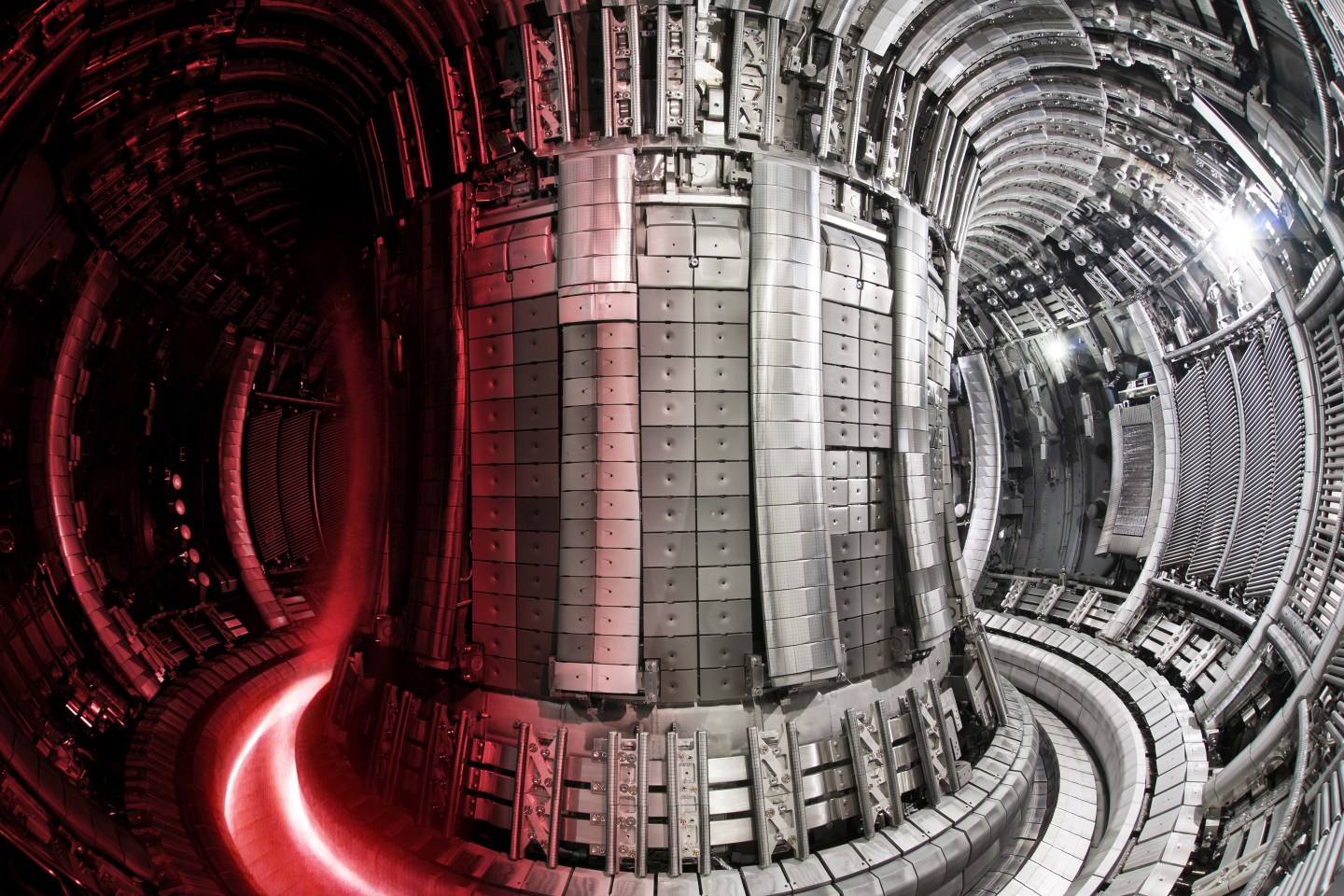
The U.K.-based JET laboratory recently managed to produce and maintain a comparatively high level of thermal energy over a five-second period, a promising sign for the viability of nuclear fusion.
The U.K.-based JET laboratory recently managed to produce and maintain a comparatively high level of thermal energy over a five-second period, a promising sign for the viability of nuclear fusion. Courtesy of Euro Fusion

In the packed field of prospective net-zero solutions, nuclear fusion stands out in its scope and ambition. By successfully replicating the reaction that powers the sun, humanity could—in the words of Stephen Hawking—unlock an “inexhaustible supply of energy, without pollution or global warming.” Fusion development has progressed at a glacial pace for decades, however, and breakthroughs have been intermittent at best. 

That could be about to change. With sweeping international collaboration and billions of dollars of public and private investment, scientists have recently made a series of meaningful advances in both the duration and power output possible from fusion reactions. 

Whereas nuclear fission—the process that drives conventional nuclear power plants—involves the splitting of atoms, fusion takes place when a pair of light atomic nuclei combine to form a single heavier one. When this happens, an immense amount of energy is released: four times as much as fission, and nearly 4 million times greater than the burning of fossil fuels. From a safety standpoint, nuclear meltdown is practically impossible, and only a small volume of relatively short-lived radioactive waste is produced.    

Fusion’s incredible promise is being pursued by a consortium of global physicists supported by China, Russia, the United States, and several European governments. With the funding taps open, significant progress has recently been made to overcome a litany of scientific challenges—not least the enormous temperatures required to trigger a fusion reaction. In the core of the sun, atoms combine at approximately 10 million degrees Celsius; on Earth, where gravitational forces are far, far smaller, at least 10 times as much heat is required.

As no known material can withstand contact with such scorching temperatures, scientists have devised different methods of confining super-hot plasma—a cloud of charged particles in which fusion occurs—to allow for continuous energy output. In California, the National Ignition Facility (NIF) is developing the use of high-powered lasers to compress fusion fuel into a tiny space, while researchers in other parts of the world favor confinement via strong magnetic fields. 

Promising progress

The Joint European Torus (JET) is a pioneer of the latter. Defeating its own world record for fusion power, the U.K.-based JET laboratory recently managed to produce and maintain a comparatively high level of thermal energy over a five second period. A little less than 60 megajoules (MJ) of energy was generated—just enough to boil a few dozen kettles—but it marked a significant step forward in the quest for sustained fusion energy. 

“A five-second pulse and 59 MJ of energy production might not sound like a lot, but it shows that we’re capable of achieving a sustained discharge that produces a high fusion yield,” says Joelle Mailloux, a nuclear physicist co-leading the JET research team. “We now have a blueprint for scaling up operations in the future, with the goal of maintaining output for much longer than a few seconds.”

Huge hurdles remain for global fusion research, however. JET’s record-breaking experiment used significantly more power than it produced—net energy gain from fusion is yet to be demonstrated anywhere—while the magnets used to contain the plasma warmed too quickly for extended operation. 

Nonetheless, progress is being made. Earlier this year, Chinese scientists managed to sustain a 17-minute fusion reaction—albeit with a fuel source which isn’t viable for large-scale power production. Then there is the International Thermonuclear Experimental Reactor (ITER)—the world’s most ambitious fusion project which, all going well, will be operational by mid-decade. 

Drawing on data from the soon-to-be decommissioned JET program, the far larger ITER facility in southern France is being constructed from materials that can withstand much higher temperatures, allowing, in theory, for fusion experiments to run long enough to produce more power than they consume. But that’s unlikely to happen before the late 2040s, experts say, and when it does, there’s no telling how quickly fusion energy will become cost-effective. 

‘A flurry of startups’

Another serious issue revolves around the two forms of hydrogen, deuterium and tritium, used to fuel ITER’s fusion reaction. Deuterium can be derived in abundance from seawater, but tritium is exceptionally rare (only 20 kilograms are thought to exist worldwide). To overcome this deficit, techniques for “breeding” tritium during fusion are being explored, Mailloux says, but again, that technology is likely decades from realization.    

Enter private enterprise. A flurry of startups seeking alternate fusion solutions have emerged in recent years, propelled by billions of dollars of venture capital investment. Among those is Google- and Chevron-backed TAE Technologies, a California-based firm developing tritium-free fusion reactors.  

By replacing the scarce tritium hydrogen isotope with nonradioactive hydrogen-boron, TAE chief executive Michl Binderbauer believes his team can sidestep problems around fuel availability and achieve commercial energy production as soon as the early 2030s.

“Our machines are far more compact than other fusion reactors; a small city can be powered by one roughly the size of a couple double-decker buses,” Binderbauer says. “This means they’ll be easier to centrally manufacture, unlocking economies of scale.” 

When it comes to pricing, TAE is bullish—cost per kWh will start out mid-field, Binderbauer claims, somewhere between nuclear fission at the high end, and natural gas at the bottom. And as the cost of fabricating complex components comes down, so too will the price of energy. 

Not all in the global science community are so confident, however. As a physics undergraduate in the 1960s, Emeritus Professor Ian Lowe—a green energy expert at Griffith University in Australia—first heard that commercial fusion power was at least 50 years away. More than a half century later, he’s worried that it still is. 

“Yes, there have been exciting developments, but ultimately all would-be fusion reactors are still in the research stage, and we need clean energy solutions now,” Lowe says. “We already have renewables that can generate cost-efficient zero-carbon power; scaling those up needs to be our focus.”

This story is part of The Path to Zero, a special series exploring how business can lead the fight against climate change.

About the Author
By Alasdair Lane
See full bioRight Arrow Button Icon

Latest in Environment

Finance
Lorem ipsum dolor sit amet, consectetur adipiscing elit, sed do eiusmod tempor incididunt ut labore et dolore magna aliqua. Ut enim ad minim veniam
By Fortune Editors
October 20, 2025
Finance
Lorem ipsum dolor sit amet, consectetur adipiscing elit, sed do eiusmod tempor incididunt ut labore et dolore magna aliqua. Ut enim ad minim veniam
By Fortune Editors
October 20, 2025
Finance
Lorem ipsum dolor sit amet, consectetur adipiscing elit, sed do eiusmod tempor incididunt ut labore et dolore magna aliqua. Ut enim ad minim veniam
By Fortune Editors
October 20, 2025
Finance
Lorem ipsum dolor sit amet, consectetur adipiscing elit, sed do eiusmod tempor incididunt ut labore et dolore magna aliqua. Ut enim ad minim veniam
By Fortune Editors
October 20, 2025
Finance
Lorem ipsum dolor sit amet, consectetur adipiscing elit, sed do eiusmod tempor incididunt ut labore et dolore magna aliqua. Ut enim ad minim veniam
By Fortune Editors
October 20, 2025
Finance
Lorem ipsum dolor sit amet, consectetur adipiscing elit, sed do eiusmod tempor incididunt ut labore et dolore magna aliqua. Ut enim ad minim veniam
By Fortune Editors
October 20, 2025

Most Popular

Finance
Lorem ipsum dolor sit amet, consectetur adipiscing elit, sed do eiusmod tempor incididunt ut labore et dolore magna aliqua. Ut enim ad minim veniam
By Fortune Editors
October 20, 2025
Finance
Lorem ipsum dolor sit amet, consectetur adipiscing elit, sed do eiusmod tempor incididunt ut labore et dolore magna aliqua. Ut enim ad minim veniam
By Fortune Editors
October 20, 2025
Finance
Lorem ipsum dolor sit amet, consectetur adipiscing elit, sed do eiusmod tempor incididunt ut labore et dolore magna aliqua. Ut enim ad minim veniam
By Fortune Editors
October 20, 2025
Finance
Lorem ipsum dolor sit amet, consectetur adipiscing elit, sed do eiusmod tempor incididunt ut labore et dolore magna aliqua. Ut enim ad minim veniam
By Fortune Editors
October 20, 2025
Finance
Lorem ipsum dolor sit amet, consectetur adipiscing elit, sed do eiusmod tempor incididunt ut labore et dolore magna aliqua. Ut enim ad minim veniam
By Fortune Editors
October 20, 2025
Finance
Lorem ipsum dolor sit amet, consectetur adipiscing elit, sed do eiusmod tempor incididunt ut labore et dolore magna aliqua. Ut enim ad minim veniam
By Fortune Editors
October 20, 2025
Rankings
  • 100 Best Companies
  • Fortune 500
  • Global 500
  • Fortune 500 Europe
  • Most Powerful Women
  • Future 50
  • World’s Most Admired Companies
  • See All Rankings
Sections
  • Finance
  • Leadership
  • Success
  • Tech
  • Asia
  • Europe
  • Environment
  • Fortune Crypto
  • Health
  • Retail
  • Lifestyle
  • Politics
  • Newsletters
  • Magazine
  • Features
  • Commentary
  • Mpw
  • CEO Initiative
  • Conferences
  • Personal Finance
  • Education
Customer Support
  • Frequently Asked Questions
  • Customer Service Portal
  • Privacy Policy
  • Terms Of Use
  • Single Issues For Purchase
  • International Print
Commercial Services
  • Advertising
  • Fortune Brand Studio
  • Fortune Analytics
  • Fortune Conferences
  • Business Development
About Us
  • About Us
  • Editorial Calendar
  • Press Center
  • Work At Fortune
  • Diversity And Inclusion
  • Terms And Conditions
  • Site Map

© 2025 Fortune Media IP Limited. All Rights Reserved. Use of this site constitutes acceptance of our Terms of Use and Privacy Policy | CA Notice at Collection and Privacy Notice | Do Not Sell/Share My Personal Information
FORTUNE is a trademark of Fortune Media IP Limited, registered in the U.S. and other countries. FORTUNE may receive compensation for some links to products and services on this website. Offers may be subject to change without notice.


Most Popular

placeholder alt text
Success
'I had to take 60 meetings': Jeff Bezos says 'the hardest thing I've ever done' was raising the first million dollars of seed capital for Amazon
By Dave SmithDecember 15, 2025
10 hours ago
placeholder alt text
Success
Meetings are not work, says Southwest Airlines CEO—and he’s taking action, by blocking his calendar every afternoon from Wednesday to Friday 
By Preston ForeDecember 15, 2025
12 hours ago
placeholder alt text
Success
Sorry, six-figure earners: Elon Musk says that money will 'disappear' in the future as AI makes work (and salaries) irrelevant
By Orianna Rosa RoyleDecember 15, 2025
14 hours ago
placeholder alt text
AI
Deloitte's CTO on a stunning AI transformation stat: Companies are spending 93% on tech and only 7% on people
By Nick LichtenbergDecember 15, 2025
17 hours ago
placeholder alt text
Uncategorized
Transforming customer support through intelligent AI operations
By Lauren ChomiukNovember 26, 2025
19 days ago
placeholder alt text
North America
Ford writes down $19.5 billion as it pivots electric Lighting line of vehicles
By Sasha RogelbergDecember 15, 2025
6 hours ago

Latest in Environment

loon
EnvironmentMaine
Maine is getting Loony again as population of beloved bird doubles since 1983
By Patrick Whittle and The Associated PressDecember 14, 2025
2 days ago
North AmericaMexico
U.S., Mexico strike deal to settle Rio Grande water dispute
By Fabiola Zerpa and BloombergDecember 13, 2025
2 days ago
carbon
Commentaryclimate change
Banking on carbon markets 2.0: why financial institutions should engage with carbon credits
By Usha Rao-MonariDecember 13, 2025
3 days ago
mackenzie
Personal Financephilanthropy
‘This year, I really see education and climate’: Patterns in billionaire MacKenzie Scott’s massive giving emerge with time
By Thalia Beaty and The Associated PressDecember 11, 2025
5 days ago
Google DeepMind cofounder and CEO Demis Hassabis
AIU.K.
Google DeepMind agrees to sweeping partnership with U.K. government focused on science and clean energy
By Jeremy KahnDecember 10, 2025
5 days ago
InnovationBrainstorm AI
Rivian CEO says buying an EV isn’t a political choice, pointing out that R1 buyers are split evenly between Republicans and Democrats
By Jason MaDecember 10, 2025
5 days ago