When Lily, a 27-year-old from central China’s Henan province, left her hometown for Hong Kong five years ago, she was full of hope for her future. A Big Four accounting firm had offered her a job in its Hong Kong office, located in a swanky building in the city’s bustling financial district.
But the daily grind frequently turned into late nights with no overtime pay. It ate into her weekends, leaving little time for sleep, exercise, dating, or hobbies like painting. Then, the COVID-19 pandemic struck at the same time Lily’s doting grandmother, who had raised her as a child, suffered a stroke. “My lao lao [grandma] was unwell, my parents were getting older and I wasn’t getting happier, just more exhausted,” Lily says.
The turn of events prompted her to resign and move back to her mainland China hometown last August, where she thought the pace of life might be slower than Hong Kong and the job search easier because of her English language skills and experience at an international company.
She discovered the opposite. Lily sent out at least 100 resumes in a six-month time span, for jobs located nationwide, with no results. “I studied so hard for so many years. I made it to Hong Kong, which is a dream for many young people, and worked so hard. So I decided to just lie flat and let it rot,” she says.
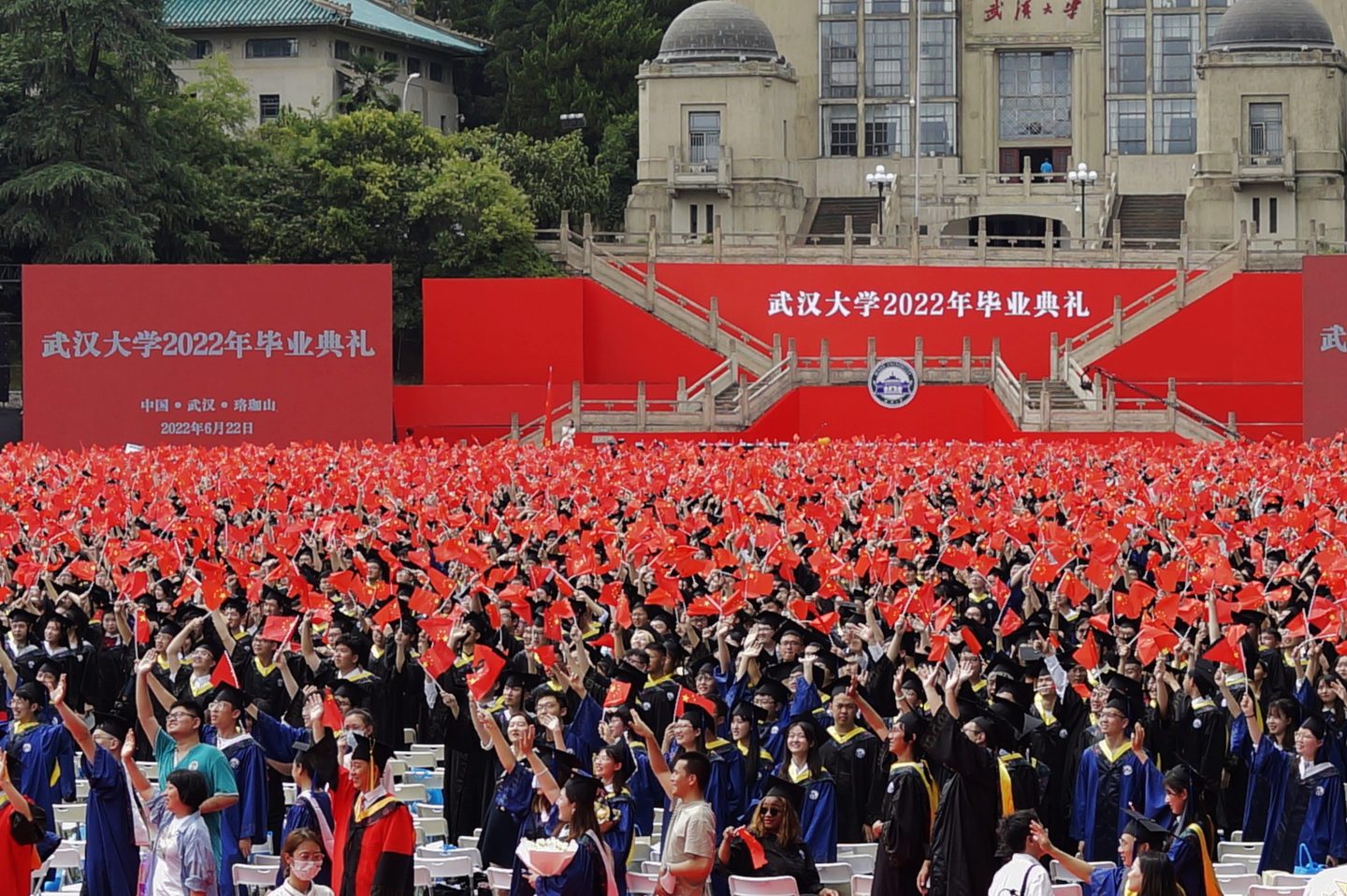
Lily’s sentiments echo that of many young Chinese. In recent years, a large number of them have embraced ‘lying flat’ (doing the bare minimum to get by), ‘letting it rot’ (making the best of a bad situation), and ‘involution’ (becoming stagnant rather than evolving). These fatalistic movements epitomize young people’s growing rejection of China’s cutthroat education system and work culture in which rewards in exchange for hard work have become increasingly illusory. The number of university graduates in China has surged, but white-collar jobs haven’t kept up. Nearly 11 million Chinese students will graduate from university this summer, but many of them may not be able to find a job.
Now, China faces a ticking time bomb: a generation of disenchanted and unemployed youth amid the biggest economic slowdown the country has seen in years, caused by the global slowdown and COVID lockdowns.
Great educational leap forward
China’s unprecedented development and urbanization spree of the last four decades included plans for a great educational leap forward. China had become a manufacturing powerhouse, but Beijing needed to educate the millions of new young urbanites to build a sophisticated workforce and advanced economy. The government’s annual public education spending grew from 1.7% of GDP to around 4% in 2021, or $557 billion.
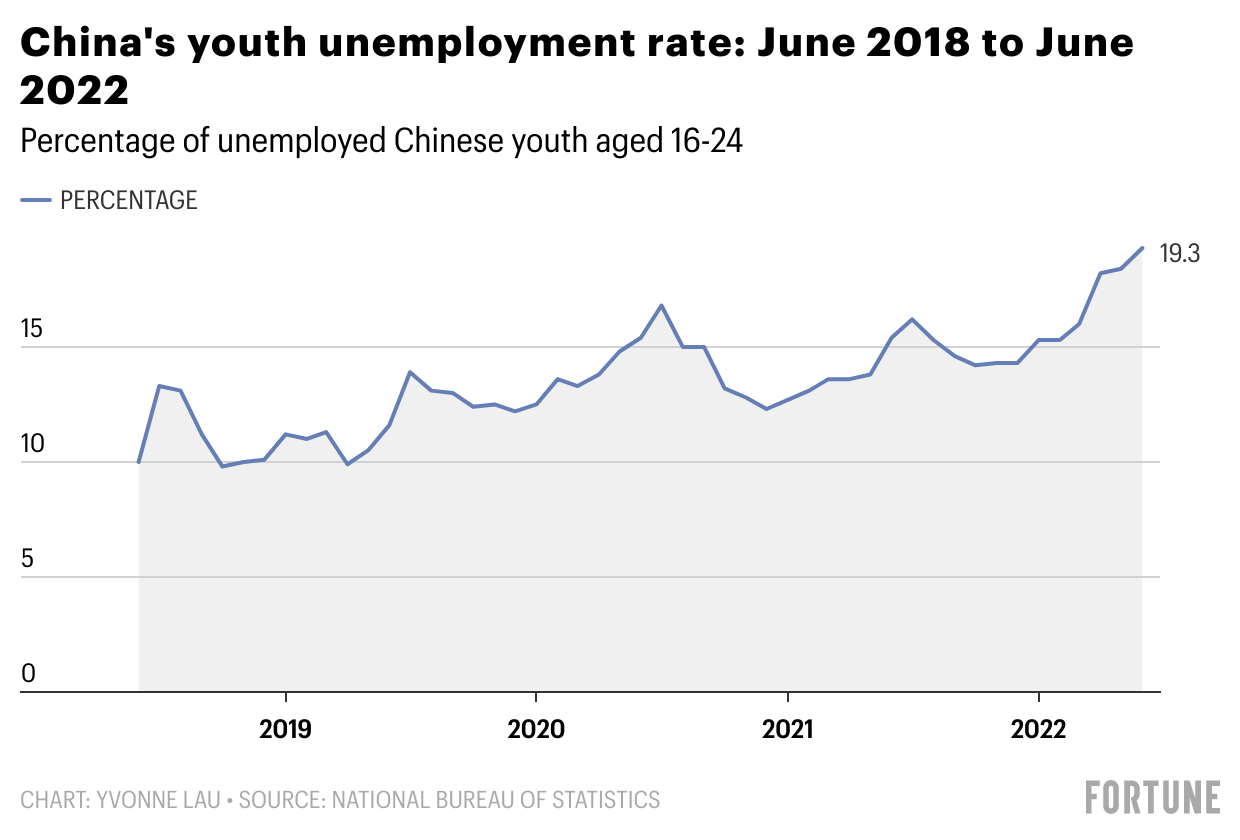
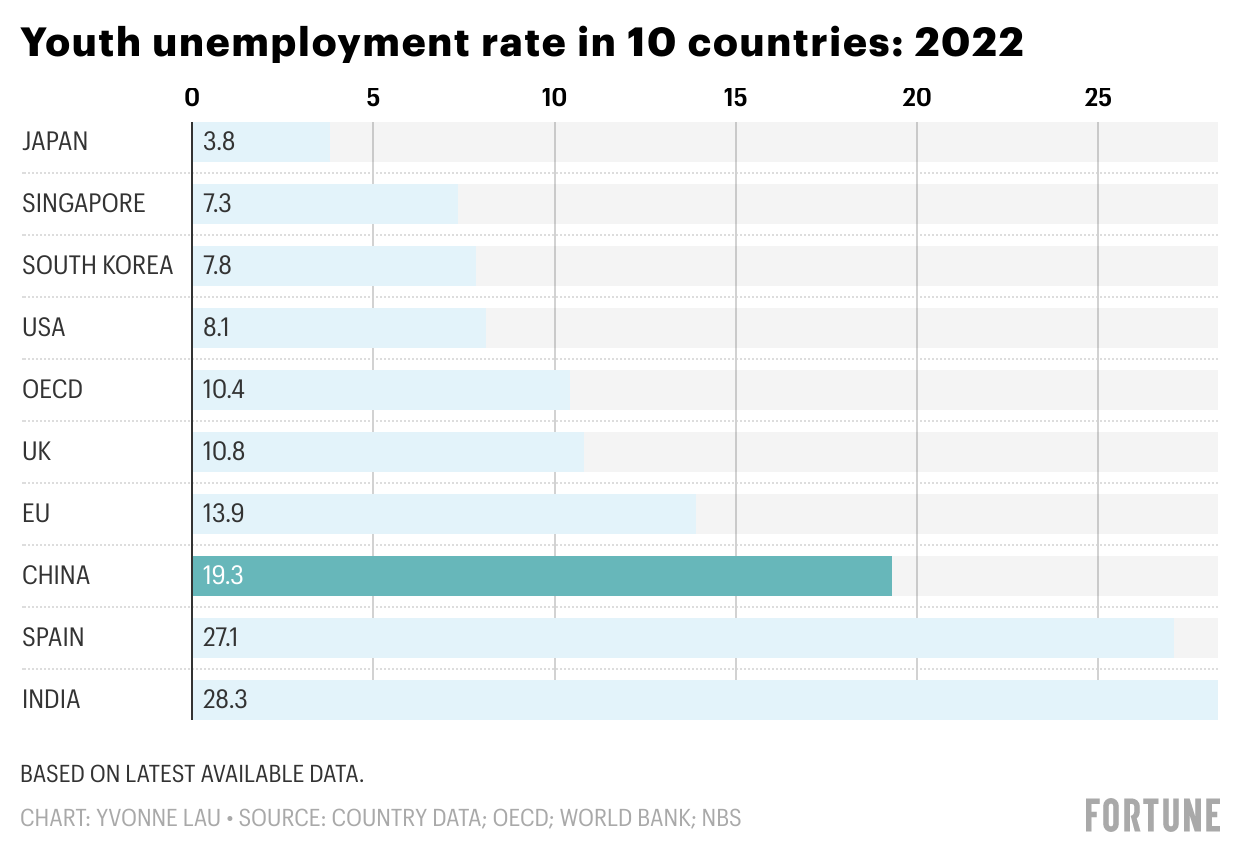
China may have been too successful in reaching its educational goals. In 1990, China minted half a million college graduates. This summer, a record 10.8 million will graduate from university—only to enter the worst labor market in decades. Earlier this month, China’s youth unemployment rate hit an all-time high of 19%.
China’s job market has fallen behind the number of graduates the country is now producing. “There simply aren’t enough white-collar jobs for white-collar workers,” Zak Dychtwald, founder of Young China Group, a research firm focused on Chinese youth, and author of Young China: How the Restless Generational Will Change Their Country and the World, told Fortune. This imbalance allows “employees [to] treat entry-level applicants like they’re disposable,” he says.
Meanwhile, the nation has more manufacturing jobs than it can fill. As China pursues its plan to become a high-tech manufacturing leader, it’ll need 62 million total manufacturing workers by 2025, but will be short 30 million. Young people are shunning manufacturing work and sectors like traditional automobiles and energy, Vivien Zhang, associate director of southern China at recruitment firm Robert Walters, told Fortune. Victor, a 25-year-old master’s student in business from Guangdong, said: “We didn’t study so hard just to work at a factory like the earlier generations.”
Social contract
The country’s educational gains came with a big sacrifice.
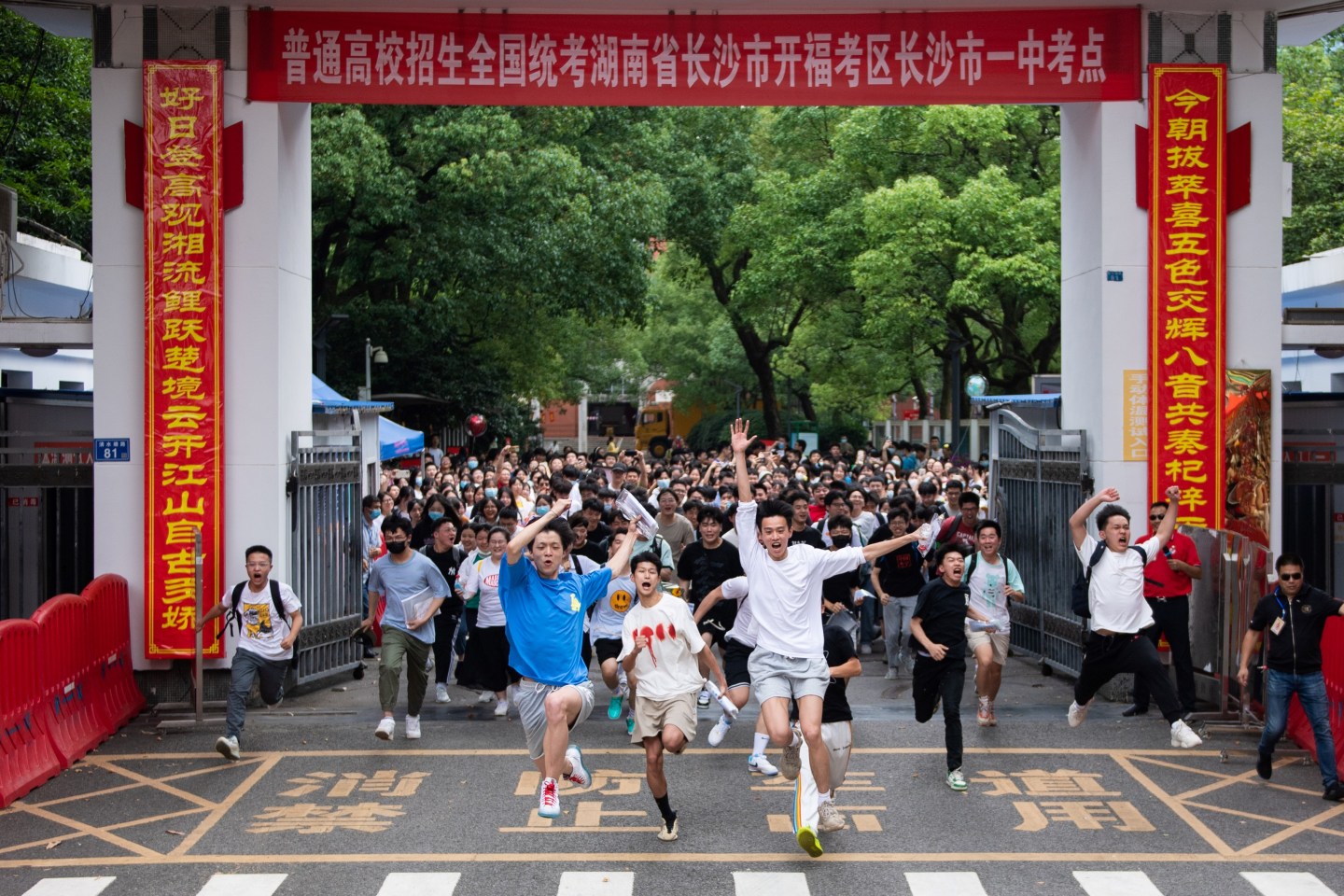
Chinese youth face intense pressure to succeed academically and spend years preparing for the ‘gaokao’—the country’s notoriously difficult college entrance exam. After finishing university—if they’re lucky enough to receive admission—young people then graduate into a similarly hyper-competitive job market. In recent years, young, educated workers who held sought-after jobs at China’s most vaunted tech companies began ‘lying flat’ and rejecting the ‘996’—9 a.m. to 9 p.m., six-days-a-week—work culture that Chinese Big Tech espoused. Pinduoduo, a grocery startup with a $73 billion market cap, asked staff in some units to work 300 hours a month, online commentators claimed; standard business hours total 160 hours per month. The app faced scrutiny in 2021 after the deaths of two young employees.
But in recent years, the idea of “giving up on fighting tooth and nail” for an increasingly elusive reward has grown in appeal, Eli Friedman, a Chinese labor expert, associate professor at Cornell University and author of The Urbanization of People: The Politics of Development, Labor Markets, and Schooling in the Chinese City, told Fortune.
Chinese youth today simply don’t hold the same expectations that they can climb the socioeconomic ladder, in contrast to earlier generations who came of age during the nation’s economic boom, Friedman says. China has reached the “end of the implicit agreement between the state and young people” that promised improvements in material well-being in exchange for keeping quiet about politics, he says.
Victor, the college student, worries about his life after graduation. “So many of my peers are struggling to find even their first job. Or if they had one, some quit because they were burnt out,” he says. “Chinese society says you can only be successful if you go to a good school, get a high-paying and high-status job and buy a home. But it seems almost impossible now.”
Beijing’s recent zero-COVID policies and its crackdown on private companies in a bid for ‘common prosperity’ only exacerbated youth unemployment and disenchantment.
In the last two years, the Chinese authorities have hit industries—from technology to education and real estate—with tough, new rules intended to rein in private firms and maintain ‘social harmony.’ The result? Companies lost money and shed jobs. The government last July banned tutoring companies—a $120 billion sector—from making a profit. China’s biggest private education firm alone fired 60,000 employees; one estimate from Beijing Normal University says 3 million related jobs are at risk. The state also ordered video game makers to impose screen time limits for gamers under 18 and halted new game releases for months. The policies decimated the industry: 14,000 gaming companies shut down and Tencent, China’s biggest maker, cut 20% to 30% of its staff in its gaming department last month, alone.
Millions of small businesses have shuttered as Beijing continues to rigidly pursue its zero-COVID strategy through harsh lockdowns and mass testing. As a result, alternative career options for China’s young people have diminished “significantly,” Valarie Tan, an analyst at China-EU think tank MERICS, told Fortune. Entrepreneurial careers, like setting up a café or shop, aren’t viable because of zero-COVID. “This is going to be a period of painful adjustment… for China’s youths,” Tan says.
The new Chinese dream
There’s no blueprint for how to manage China’s brewing storm: a generation of disenchanted and unemployed youth accompanied by a fragile and slowing economy.
But Beijing is trying to establish one. In particular, the government looks to quash any dissent ahead of the October Party Congress—the most important meeting on China’s political calendar, where Chinese President Xi Jinping will likely establish his third-term. Mentions of lying flat, letting it rot, and involution are heavily censored on Chinese social media. Xi has urged “everyone to participate… and avoid lying flat and involution. [We must] create opportunities for more people to become rich.”
The authorities are encouraging young people to move to the countryside, providing loans and tax benefits for university graduates who start businesses in rural communities, and giving subsidies to local governments and businesses to “absorb college graduates.” Graduates are increasingly turning towards civil service careers and jobs at state-run firms, which are viewed as stable with reasonable hours. Victor understands, but argues that the turn to state companies is akin to lying flat, because state jobs are easy jobs that are often corrupt, inefficient, and lack innovation. China last October also implemented a new vocational training plan to increase enrollment in vocational schools and add to the number of technical workers.
Yet it’s unlikely China will see any quick fixes to what are entrenched, long-term problems. In the near-term, the “downward pressure” on young people’s employment and wages will remain, Bruce Pang, head of research and chief economist of Greater China at real estate services firm JLL, told Fortune. Uncertainty about employment in China quickly transforms into weaker business confidence and consumer sentiment, so the country’s “labor market must remain stable to absorb pressure from slower economic growth,” Pang says. There are “strong expectations” from society that the state must step in and fix the labor market pains, Friedman says.
Lily, meanwhile, is still hopeful about her future. She’s taken up organic farming and hopes to open a small produce and gardening business soon. “Some people say involuting—moving backwards. But for now, I’m content living a simple and quiet life and looking after my family.”