• Home
  • Latest
  • Fortune 500
  • Finance
  • Tech
  • Leadership
  • Lifestyle
  • Rankings
  • Multimedia
Finance

The IMF is officially ‘gloomy’ as it slashes its outlook with the global economy ‘teetering on the edge’ of a return to the stagflationary 1970s 

By
Alena Botros
Alena Botros
Former staff writer
Down Arrow Button Icon
By
Alena Botros
Alena Botros
Former staff writer
Down Arrow Button Icon
July 26, 2022, 1:52 PM ET
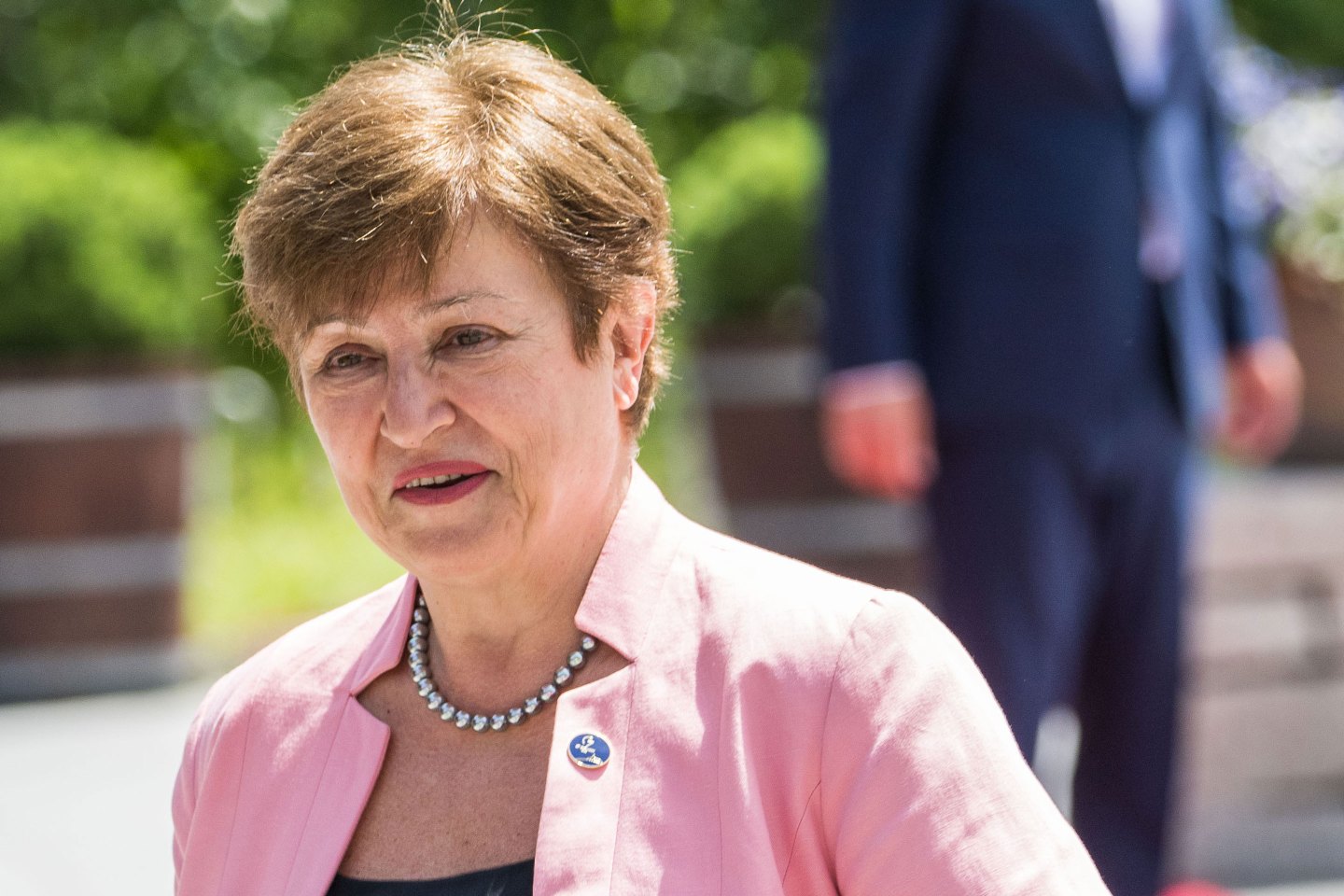
Managing Director of the International Monetary Fund Kristalina Georgieva in June.
Managing Director of the International Monetary Fund Kristalina Georgieva in June.Thomas Lohnes—Getty Images

As if the economic outlook wasn’t gloomy enough already, the International Monetary Fund just titled its World Economic Outlook, “Gloomy and More Uncertain.” 

In early July, IMF chief Kristalina Georgieva said a global recession could not be ruled out. The IMF subsequently said that the U.S. avoiding a recession was becoming increasingly challenging. 

On Tuesday, the IMF cut its global forecast, projecting real GDP to grow 3.2% this year and 2.9% in 2023, with a prediction of stalling growth in the U.S., China, and Europe—the world’s three largest economies. The initial forecast in April predicted 3.6% growth for both 2022 and 2023. 

While stressing that it’s not the baseline scenario, the IMF said it’s worried about a return to conditions similar to 1970s’ “stagflation,” a brutal combination of high inflation and stagnant growth. Supply-related shocks to food and energy prices from the war in Ukraine could continue to escalate inflation, it said, in turn triggering tighter monetary policies that could be severe enough to push the global economy into a recession.

Stalling growth is due to the U.S.’ reduced household purchasing power and tighter monetary policy, China’s lockdowns and real-estate crisis, and Europe’s tighter monetary policy caused by the war in Ukraine. 

Although the IMF said 2021 hinted at a tentative global recovery, it stressed the storm clouds that gathered quickly afterward. High inflation and negative spillovers from the war, compounded by an already weakened economy post pandemic, could be triggering a recession, the economists found. 

“The outlook has darkened significantly since April,” IMF’s Chief Economist, Pierre-Olivier Gourinchas wrote in a blog post. “The world may soon be teetering on the edge of a global recession, only two years after the last one.” 

Gourinchas said many of the risks flagged in April’s report have begun to materialize, for instance global output contracting in the second quarter of the year. 

Global inflation is expected to reach 6.6% in advanced economies and 9.5% in emerging market and developing economies this year because of increasing food and energy prices and lingering supply-demand imbalances—this triggers tighter financial conditions further shocking the economy. 

These risks could push the economy over the edge, and again force the IMF to revise its predictions. In an alternative scenario, the IMF said, inflation could rise further and global growth could decline to 2.6% in 2022 and 2% in 2023, putting growth in the bottom 10% of outcomes since the 1970s. These risks include a halt of European gas flow from Russia, more COVID outbreaks and shutdowns in China, and rising food and energy prices, to say a few. 

Still, the IMF says taming inflation should be the number one priority for policymakers. 

“Targeted fiscal support can help cushion the impact on the most vulnerable,” Gourinchas wrote. “But with government budgets stretched by the pandemic and the need for an overall disinflationary macroeconomic policy stance, offsetting targeted support with higher taxes or lower government spending will ensure that fiscal policy does not make the job of monetary policy even harder.”

Sign up for the Fortune Features email list so you don’t miss our biggest features, exclusive interviews, and investigations.

About the Author
By Alena BotrosFormer staff writer
LinkedIn iconTwitter icon

Alena Botros is a former reporter at Fortune, where she primarily covered real estate.

See full bioRight Arrow Button Icon

Latest in Finance

Julian Braithwaite is the Director General of the International Alliance for Responsible Drinking
CommentaryProductivity
Gen Z is drinking 20% less than Millennials. Productivity is rising. Coincidence? Not quite
By Julian BraithwaiteDecember 13, 2025
1 hour ago
carbon
Commentaryclimate change
Banking on carbon markets 2.0: why financial institutions should engage with carbon credits
By Usha Rao-MonariDecember 13, 2025
2 hours ago
Oracle chairman of the board and chief technology officer Larry Ellison delivers a keynote address during the 2019 Oracle OpenWorld on September 16, 2019 in San Francisco, California.
AIOracle
Oracle’s collapsing stock shows the AI boom is running into two hard limits: physics and debt markets
By Eva RoytburgDecember 13, 2025
5 hours ago
EconomyFederal Reserve
Trump names Warsh, Hassett as top Fed contenders, WSJ says
By Jennifer A. Dlouhy and BloombergDecember 12, 2025
15 hours ago
EconomyFederal Reserve
The Fed just ‘Trump-proofed’ itself with a unanimous move to preempt a potential leadership shake-up
By Jason MaDecember 12, 2025
18 hours ago
robots
InnovationRobots
‘The question is really just how long it will take’: Over 2,000 gather at Humanoids Summit to meet the robots who may take their jobs someday
By Matt O'Brien and The Associated PressDecember 12, 2025
19 hours ago

Most Popular

placeholder alt text
Economy
Tariffs are taxes and they were used to finance the federal government until the 1913 income tax. A top economist breaks it down
By Kent JonesDecember 12, 2025
1 day ago
placeholder alt text
Success
Apple cofounder Ronald Wayne sold his 10% stake for $800 in 1976—today it’d be worth up to $400 billion
By Preston ForeDecember 12, 2025
1 day ago
placeholder alt text
Success
40% of Stanford undergrads receive disability accommodations—but it’s become a college-wide phenomenon as Gen Z try to succeed in the current climate
By Preston ForeDecember 12, 2025
24 hours ago
placeholder alt text
Economy
For the first time since Trump’s tariff rollout, import tax revenue has fallen, threatening his lofty plans to slash the $38 trillion national debt
By Sasha RogelbergDecember 12, 2025
20 hours ago
placeholder alt text
Economy
The Fed just ‘Trump-proofed’ itself with a unanimous move to preempt a potential leadership shake-up
By Jason MaDecember 12, 2025
18 hours ago
placeholder alt text
Success
At 18, doctors gave him three hours to live. He played video games from his hospital bed—and now, he’s built a $10 million-a-year video game studio
By Preston ForeDecember 10, 2025
3 days ago
Rankings
  • 100 Best Companies
  • Fortune 500
  • Global 500
  • Fortune 500 Europe
  • Most Powerful Women
  • Future 50
  • World’s Most Admired Companies
  • See All Rankings
Sections
  • Finance
  • Leadership
  • Success
  • Tech
  • Asia
  • Europe
  • Environment
  • Fortune Crypto
  • Health
  • Retail
  • Lifestyle
  • Politics
  • Newsletters
  • Magazine
  • Features
  • Commentary
  • Mpw
  • CEO Initiative
  • Conferences
  • Personal Finance
  • Education
Customer Support
  • Frequently Asked Questions
  • Customer Service Portal
  • Privacy Policy
  • Terms Of Use
  • Single Issues For Purchase
  • International Print
Commercial Services
  • Advertising
  • Fortune Brand Studio
  • Fortune Analytics
  • Fortune Conferences
  • Business Development
About Us
  • About Us
  • Editorial Calendar
  • Press Center
  • Work At Fortune
  • Diversity And Inclusion
  • Terms And Conditions
  • Site Map

© 2025 Fortune Media IP Limited. All Rights Reserved. Use of this site constitutes acceptance of our Terms of Use and Privacy Policy | CA Notice at Collection and Privacy Notice | Do Not Sell/Share My Personal Information
FORTUNE is a trademark of Fortune Media IP Limited, registered in the U.S. and other countries. FORTUNE may receive compensation for some links to products and services on this website. Offers may be subject to change without notice.