• Home
  • Latest
  • Fortune 500
  • Finance
  • Tech
  • Leadership
  • Lifestyle
  • Rankings
  • Multimedia
Finance

Recession could be a self-fulfilling prophecy for the U.S., Moody’s economist Mark Zandi warns: ‘When sentiment is so fragile, it’s not going to take a whole lot to push us in’

By
Michael P. Regan
Michael P. Regan
,
Vildana Hajric
Vildana Hajric
, and
Bloomberg
Bloomberg
Down Arrow Button Icon
By
Michael P. Regan
Michael P. Regan
,
Vildana Hajric
Vildana Hajric
, and
Bloomberg
Bloomberg
Down Arrow Button Icon
July 17, 2022, 10:01 AM ET
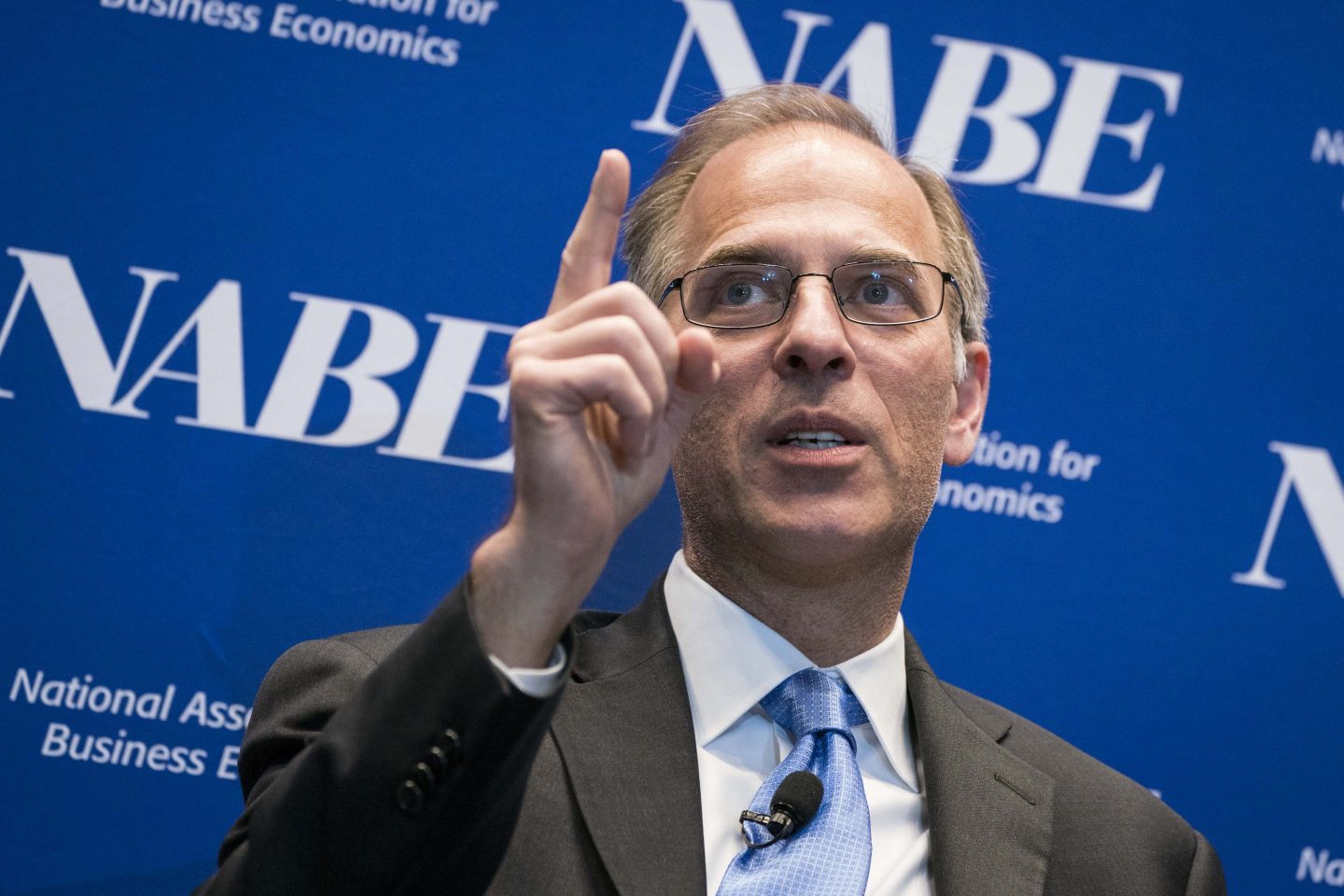
Mark Zandi, chief economist at Moody's Analytics Inc., speaks during the National Association of Business Economics (NABE) economic policy conference in Washington, D.C. on Feb. 25, 2020.
Mark Zandi, chief economist at Moody's Analytics Inc., speaks during the National Association of Business Economics (NABE) economic policy conference in Washington, D.C. on Feb. 25, 2020.Sarah Silbiger—Bloomberg/Getty Images

Mark Zandi, who has been an economist for more than three decades, says he’s never seen so many people convinced that a recession is imminent. 

And while he believes the U.S. economy can still avoid such an economic downturn, sentiment is so poor that it poses its own risk—a sort of self-fulfilling recession prophecy. Zandi, the chief economist at Moody’s Analytics, joined the “What Goes Up” podcast to discuss his outlook after government data this week showed the highest level of inflation in almost 41 years. 

Below are condensed and lightly edited highlights of the conversation. Click here to listen to the entire podcast, and subscribe to “What Goes Up” on Apple Podcasts or wherever you listen. 

Q: You have downgraded your GDP outlook for this year and next year. (Zandi now expects real growth of 1% this year and 2% in 2023, versus previous forecasts of 2% and 2.5% respectively.) What is going to happen over the next 18 to 24 months? 

A: I still have no recession (in his forecasts). Obviously, recession risks are high—I mean, clearly, when inflation is so high and the Fed is on DEFCON 1 and rightfully focused on getting that inflation down by jacking up interest rates, and sentiment is miserable, right? 

I talk to CEOs, CFOs, investors, friends, family—to the person, they think we’re going into recession. I’ve never seen anything like it. I’ve seen a lot of business cycles now. And no one predicts recessions. But in this one, everyone is predicting a recession. So when sentiment is so fragile, it’s not going to take a whole lot to push us in. I think with a little bit of luck, and some reasonably good policy-making by the Fed, we’re going to be able to avoid a recession. But I don’t say that with a lot of confidence.

I don’t think we need a recession to get inflation back in. Oil prices are going to roll over. Natural gas prices are going to fall. We’re going to see vehicle prices come down as supply-chain issues iron themselves out and we get more vehicle production. Commodity prices, goods prices more broadly, are going to come in.

Q: When you downgraded your GDP growth outlook, you said odds remain that the economic expansion will continue. What specifically were you thinking there? 

A: The thing that I take the most solace in is that, in my mind, the firewall between a continuing growing economy and a recession is the American consumer. If the American consumer hangs tough, just do their part, spend like they’ve always been spending, we’ll avoid a recession. And by the way, if the American consumer hangs tough, they’ll keep the global economy moving forward as well. You know, some parts of the global economy will go in, but the US consumer’s kind of driving the train right now. 

And if you look at the American consumer, they’re in pretty good shape. Obviously, they’re getting hammered by the high inflation right now, but they’ve got a lot of excess savings they built up during the pandemic and it’s across all income groups. 

For the typical American household, by my calculation, as of June they had $7,000-$8,000 in excess savings. So if I’m paying $500 more a month for the higher inflation and I have $7,000-$8,000 in excess savings, you can do the arithmetic. That buys me a little bit of time, right? I can use that excess savings to supplement my income, to offset the ill effects of the high inflation. 

Debt is low. Debt service burdens are about as low as they’ve ever been. People have locked in the previously record-low interest rates through refinancing. So they’re very insulated from the higher rates. You know, stock prices are down, but house prices are up. People are wealthier today.

Q: Speaking of home prices, I can’t help but wonder if we are in for a pretty nasty cooling off of the housing market. And it’s just such an important component of the economy. What does housing look like to you in the next year or two? And what are the potential ripple effects of it cooling off on the rest of the economy? 

A: Oh, it’s cooling off. It’s gone into deep freeze pretty fast here. Mortgage rates at just south of 6%, almost double what they were a year ago. And you just take that higher interest rate, you multiply by the higher house price, and you look at the monthly payment that a first-time home-buyer is facing—it’s $500-$600 more now than it was a year ago. That’s prohibitive. 

So, first-time home-buyers are locked out of the market. And trade-up buyers are kind of locked in, right? Because the average rate on outstanding mortgages, given all that refinancing I talked about earlier, is 3.5% to 4%. So, if you sell your home and buy another one and get a mortgage, you’re going from three-and-a-half, four, to six. That’s a big increase in payment. So people just aren’t going to do that. 

So, you’re seeing home sales come down dramatically already and listings are starting, too. I follow different markets across the country and I get listings emailed to me, and I can just feel it. If I go back, you know, six months ago, there was nothing, no inventory. But now the list is getting longer and longer and longer. And I expect house prices in parts of the country to fall, particularly in the areas where prices have been juiced the most in the pandemic—in the Southeast, in Florida, in the Mountain West.

I expect some price declines nationwide. We might be able to sneak through with prices just essentially going flat here for a couple, three years, and let household incomes and rents and construction costs kind of catch up. But that assumes no recession. If we get into a recession, then I think that’s going to put real downward weight on house prices. 

But I’ll say two other things about this one. This is by design, right? The Federal Reserve is raising interest rates to slow growth. And that happens through the most rate-sensitive sectors of the economy. Housing is the single-most interest-rate sensitive sector of the economy. So, this is not a big surprise. It is exactly what you would expect. 

And second, I don’t expect the prices to crash, because the mortgage lending that’s been done since the financial crisis and the collapse in housing back over a decade ago has been fantastic. I should disclose this: I’m on the board of directors of MGIC, a nationwide, publicly-traded mortgage insurer, and I’m on the chair of the risk committee. So I look at underwriting very carefully and it’s been pristine since the collapse. And the other thing is, it’s all plain vanilla 30-year, 15-year fixed rate, pre-payable mortgage, nothing fancy. 

And so, I just don’t see the stresses here to result in a big, sharp decline in prices. But prices going flat nationwide and down in a fair share of markets? Yeah, I would anticipate that. And I would say that’s exactly what the Fed wants to see.


Sign up for the Fortune Features email list so you don’t miss our biggest features, exclusive interviews, and investigations.
About the Authors
By Michael P. Regan
See full bioRight Arrow Button Icon
By Vildana Hajric
See full bioRight Arrow Button Icon
By Bloomberg
See full bioRight Arrow Button Icon

Latest in Finance

Finance
Lorem ipsum dolor sit amet, consectetur adipiscing elit, sed do eiusmod tempor incididunt ut labore et dolore magna aliqua. Ut enim ad minim veniam
By Fortune Editors
October 20, 2025
Finance
Lorem ipsum dolor sit amet, consectetur adipiscing elit, sed do eiusmod tempor incididunt ut labore et dolore magna aliqua. Ut enim ad minim veniam
By Fortune Editors
October 20, 2025
Finance
Lorem ipsum dolor sit amet, consectetur adipiscing elit, sed do eiusmod tempor incididunt ut labore et dolore magna aliqua. Ut enim ad minim veniam
By Fortune Editors
October 20, 2025
Finance
Lorem ipsum dolor sit amet, consectetur adipiscing elit, sed do eiusmod tempor incididunt ut labore et dolore magna aliqua. Ut enim ad minim veniam
By Fortune Editors
October 20, 2025
Finance
Lorem ipsum dolor sit amet, consectetur adipiscing elit, sed do eiusmod tempor incididunt ut labore et dolore magna aliqua. Ut enim ad minim veniam
By Fortune Editors
October 20, 2025
Finance
Lorem ipsum dolor sit amet, consectetur adipiscing elit, sed do eiusmod tempor incididunt ut labore et dolore magna aliqua. Ut enim ad minim veniam
By Fortune Editors
October 20, 2025

Most Popular

Finance
Lorem ipsum dolor sit amet, consectetur adipiscing elit, sed do eiusmod tempor incididunt ut labore et dolore magna aliqua. Ut enim ad minim veniam
By Fortune Editors
October 20, 2025
Finance
Lorem ipsum dolor sit amet, consectetur adipiscing elit, sed do eiusmod tempor incididunt ut labore et dolore magna aliqua. Ut enim ad minim veniam
By Fortune Editors
October 20, 2025
Finance
Lorem ipsum dolor sit amet, consectetur adipiscing elit, sed do eiusmod tempor incididunt ut labore et dolore magna aliqua. Ut enim ad minim veniam
By Fortune Editors
October 20, 2025
Finance
Lorem ipsum dolor sit amet, consectetur adipiscing elit, sed do eiusmod tempor incididunt ut labore et dolore magna aliqua. Ut enim ad minim veniam
By Fortune Editors
October 20, 2025
Finance
Lorem ipsum dolor sit amet, consectetur adipiscing elit, sed do eiusmod tempor incididunt ut labore et dolore magna aliqua. Ut enim ad minim veniam
By Fortune Editors
October 20, 2025
Finance
Lorem ipsum dolor sit amet, consectetur adipiscing elit, sed do eiusmod tempor incididunt ut labore et dolore magna aliqua. Ut enim ad minim veniam
By Fortune Editors
October 20, 2025
Fortune Secondary Logo
Rankings
  • 100 Best Companies
  • Fortune 500
  • Global 500
  • Fortune 500 Europe
  • Most Powerful Women
  • Future 50
  • World’s Most Admired Companies
  • See All Rankings
Sections
  • Finance
  • Fortune Crypto
  • Features
  • Leadership
  • Health
  • Commentary
  • Success
  • Retail
  • Mpw
  • Tech
  • Lifestyle
  • CEO Initiative
  • Asia
  • Politics
  • Conferences
  • Europe
  • Newsletters
  • Personal Finance
  • Environment
  • Magazine
  • Education
Customer Support
  • Frequently Asked Questions
  • Customer Service Portal
  • Privacy Policy
  • Terms Of Use
  • Single Issues For Purchase
  • International Print
Commercial Services
  • Advertising
  • Fortune Brand Studio
  • Fortune Analytics
  • Fortune Conferences
  • Business Development
  • Group Subscriptions
About Us
  • About Us
  • Editorial Calendar
  • Press Center
  • Work At Fortune
  • Diversity And Inclusion
  • Terms And Conditions
  • Site Map
Fortune Secondary Logo
  • About Us
  • Editorial Calendar
  • Press Center
  • Work At Fortune
  • Diversity And Inclusion
  • Terms And Conditions
  • Site Map
  • Facebook icon
  • Twitter icon
  • LinkedIn icon
  • Instagram icon
  • Pinterest icon

Latest in Finance

Nepali consumers wait in line carrying empty LPG cylinders as they rush to gas depots to refill them as growing tensions in West Asia halt the supply in Kathmandu, Nepal, on March 12, 2026. People wait for hours hoping to refill their gas cylinders. While some manage to purchase filled cylinders, many others return empty-handed as supplies remain limited. The disruption follows the escalating conflict involving the United States, Israel, and Iran, which heightens tensions across the Gulf region. Shipping through the Strait of Hormuz, a key maritime route bordering Iran, the United Arab Emirates, and Oman, is also affected by the conflict, disrupting the transport of gas and petroleum products. The impact is now felt in markets around the world.
EnergyIran
Exxon, Chevron, and other US oil and gas producers and refiners hit all-time-high stock values amid Iran war while consumers pay the price
By Jordan BlumMarch 12, 2026
1 hour ago
Personal Financemortgages
What is an assumable mortgage, and can it help you get a low interest rate?
By Joseph HostetlerMarch 12, 2026
1 hour ago
engineer
EconomyRecession
Goldman just raised recession odds to 25%. Here’s what Trump’s war economy is doing to jobs
By Nick LichtenbergMarch 12, 2026
2 hours ago
iran
Middle EastMiddle East
Iran’s new Supreme Leader warns of ‘opening other fronts’ in first statement from hiding
By Jon Gambrell, David Rising, Mike Corder, Natalie Melzer and The Associated PressMarch 12, 2026
3 hours ago
evs
Energygas
This 55-year-old supply chain management professor took a gamble last year: he bought an electric vehicle
By Alexa St. John, Tammy Webber and The Associated PressMarch 12, 2026
3 hours ago
CryptoBinance
Inside the Binance accounts internal investigators say helped transfer more than $1 billion to Iran-linked entities: A 79-year-old VIP Chinese trader and a suspected Iranian gold smuggler
By Leo Schwartz and Ben WeissMarch 12, 2026
3 hours ago

Most Popular

placeholder alt text
Economy
'This cannot be sustainable': The U.S. borrowed $50 billion a week for the past five months, the CBO says
By Eleanor PringleMarch 10, 2026
2 days ago
placeholder alt text
AI
'Proceed with caution': Elon Musk offers warning after Amazon reportedly had mandatory meeting to address 'high blast radius' and AI-related incidents
By Sasha RogelbergMarch 11, 2026
1 day ago
placeholder alt text
Commentary
How the ultrawealthy use smartphone apps to avoid millions in taxes
By Jose AtilesMarch 11, 2026
1 day ago
placeholder alt text
Success
BlackRock is splashing $100 million on training plumbers, electricians, and HVAC technicians as its CEO flags a skilled trade worker shortage
By Preston ForeMarch 11, 2026
1 day ago
placeholder alt text
Economy
The $38.9 trillion national debt is costing you thousands of extra dollars per year on your mortgage. Here’s how it adds up
By Jake AngeloMarch 11, 2026
1 day ago
placeholder alt text
Future of Work
Shark Tank's Kevin O'Leary doesn't care if you work from your basement. He just wants to know if you can ‘execute’
By Marco Quiroz-GutierrezMarch 10, 2026
3 days ago

© 2026 Fortune Media IP Limited. All Rights Reserved. Use of this site constitutes acceptance of our Terms of Use and Privacy Policy | CA Notice at Collection and Privacy Notice | Do Not Sell/Share My Personal Information
FORTUNE is a trademark of Fortune Media IP Limited, registered in the U.S. and other countries. FORTUNE may receive compensation for some links to products and services on this website. Offers may be subject to change without notice.