• Home
  • Latest
  • Fortune 500
  • Finance
  • Tech
  • Leadership
  • Lifestyle
  • Rankings
  • Multimedia

How COVID and a nationwide pivot to organic farming pushed Sri Lanka’s economy to the brink of collapse

Nicholas Gordon
By
Nicholas Gordon
Nicholas Gordon
Asia Editor
Down Arrow Button Icon
Nicholas Gordon
By
Nicholas Gordon
Nicholas Gordon
Asia Editor
Down Arrow Button Icon
April 9, 2022, 6:00 AM ET

After years of mismanagement, Sri Lanka’s economy is in the grips of a debt crisis.

The Sri Lankan rupee has plunged 32% since the beginning of the year, making it the world’s worst performing currency, trading even lower against the U.S. dollar than the Russian ruble, which has rebounded to its prewar level.

The tanking rupee has left importers on the South Asian island unable to pay for goods. Sri Lanka’s government has ordered street lights to be turned off since the start of the month, to save electricity amid long blackouts caused by a shortage of fuel imports. Schools have canceled exams owing to a shortage of paper. And, most critically, imported foodstuffs are doubling in price, making them unaffordable for Sri Lankan households.

The crisis risks “acute food shortages and starvation,” for Sri Lankans, the country’s parliamentary speaker warned on Wednesday.

In the face of popular protests over their handling of the national debt, Sri Lankan President Gotabaya Rajapaksa and his older brother Prime Minister Mahinda Rajapaksa—members of the political family that have led Sri Lanka for much of the past two decades—have refused to step down. But they’re among the few ruling politicians left standing in Sri Lanka’s embattled government.
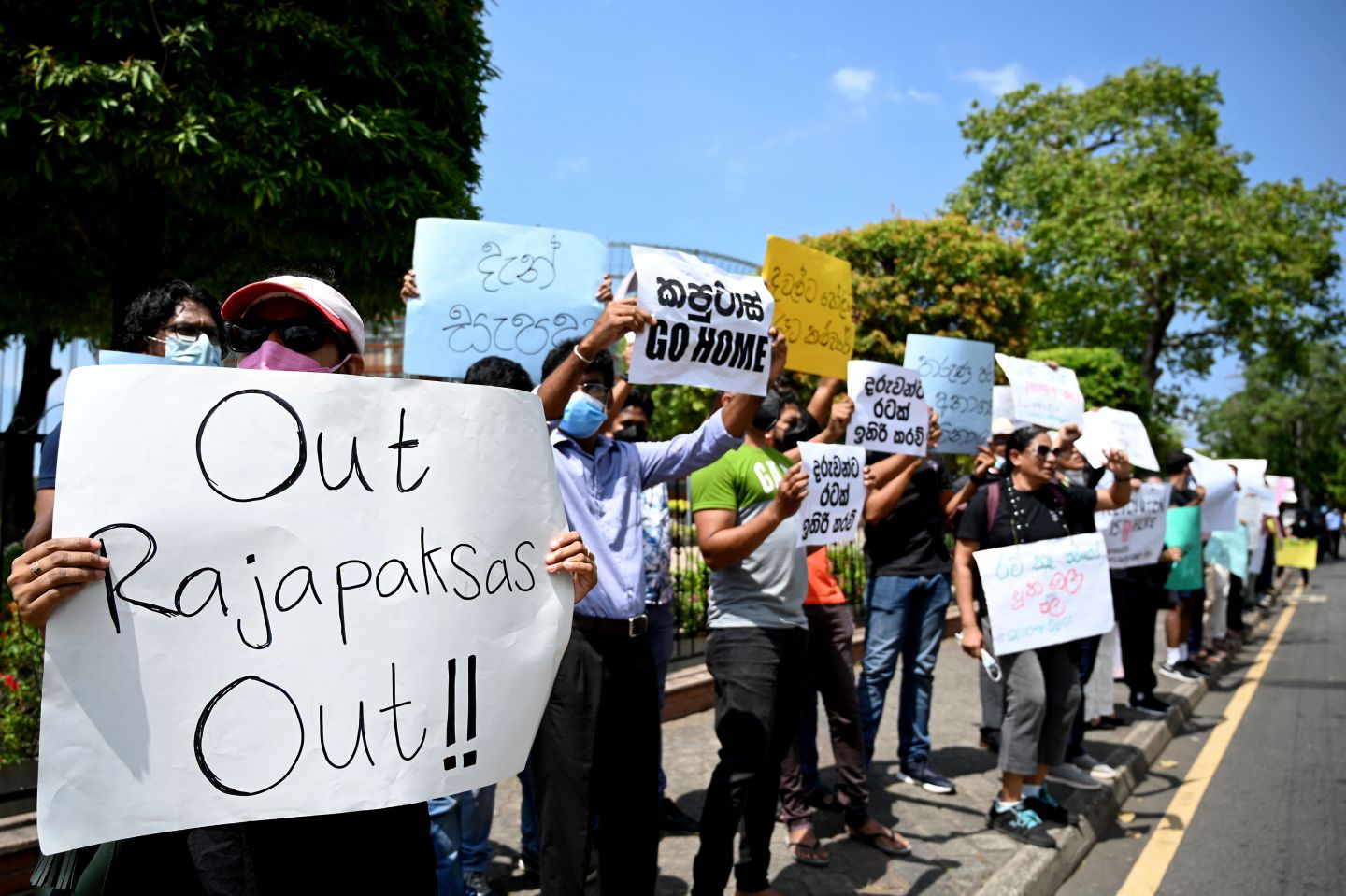
Protesters gather in Colombo to demonstrate against rising fuel and food prices.
Ishara S. Kodikara—AFP/Getty Images

Sri Lanka’s cabinet resigned en masse on April 3, leaving the government scrambling to find new officials to help steer the country through the crises. Over 40 parliamentarians quit the ruling coalition a few days later, on April 5, denying the Rajapaksas their governing majority in the legislature.

With the government in tatters, Sri Lanka’s beleaguered president is desperately seeking foreign loans to dig the country out of a debt crisis that has been years in the making.

A history of debt

The Asian Development Bank in 2019 described Sri Lanka’s economy as “a tale of two deficits.”

The island nation consistently imports more than it exports, creating a trade deficit, while government spending habitually exceeds government revenue, creating a budget deficit. The dual debts are a recipe for economic crisis, which Sri Lanka is stomaching now.

To sustain its overdrawn government budget, Sri Lanka has historically loaded up on debt and borrowed huge sums to invest in massive infrastructure projects—such as the Chinese-funded Hambantota International Port—with hopes that the end result would drive economic growth. Sri Lanka’s current debt-to-GDP ratio has skyrocketed in recent years, increasing from 42% in 2019 to 104% in 2021.

But many of its costly infrastructure projects have been economic duds, and without any genuine source of revenue, the Sri Lankan government is left unable to repay the interest on its loans.

According to Bloomberg, Sri Lanka has about $8.6 billion in debt payments due this year, yet, as of March, the country has only $1.94 billion in its reserves. Sri Lanka must pay $78.2 million in interest payments on April 18, followed by a $1 billion payment on a bond maturing on July 25. Investors doubt Sri Lanka will be able to make the July payment, with the bond trading well below face value at $0.54 to the dollar on Thursday.

The Sri Lankan government has tried to find ways to bolster its foreign reserve holdings so that it has enough money to settle its debt payments. On March 12, the central bank ordered Sri Lankan exporters to convert their foreign currency into rupees within 180 days to help replenish the bank’s foreign reserves. But with debt levels almost four times the country’s reserves, a payments crisis is brewing.

Enter COVID

Sri Lanka’s ability to service its debt was always shaky, but government policy and the COVID pandemic made the task almost impossible.

In 2019, then–finance minister Basil Rajapaksa—younger brother to both the president and prime minister—passed a series of drastic tax cuts ahead of parliamentary elections, in a bid to ease the strain placed on Sri Lanka’s economy by the deadly Easter bombings of April 2019. The multiple bombings, which killed over 260 people, devastated Sri Lanka’s tourism industry, which contributed almost 13% of the country’s GDP before the pandemic and is an important source of foreign currency. 

But in 2020 the COVID pandemic brought tourism levels to a low point: By 2021, Sri Lanka had welcomed just 173,000 travelers for the year, down from 2.3 million in 2018.

People queue to buy kerosene during Sri Lanka’s ongoing fuel shortage.
Rebecca Conway—Getty Images

The crushing impact of COVID—which also slashed the volume of remittances the country received from Sri Lankans working abroad—combined with the government’s lower tax revenues pushed ratings agencies like Fitch to downgrade the country’s credit rating that year, effectively freezing Sri Lanka out of international bond markets. Desperate for dollars, the Sri Lankan government seemingly made a daring bid to save money on imports.

Organic farms

In April 2021, the Sri Lankan government mandated that all agriculture in the country switch to organic farming and banned the import of chemical fertilizers. President Rajapaksa argued that the ban was necessary in order to control the health effects of fertilizers, but critics argued that the real reason was to stop imports from draining the country’s foreign reserves.

As Aruna Kulatunga, a former government adviser on agriculture, told the New York Times, “the country was hit not with chronic kidney disease but with a chronic shortage of dollars.”

But with little training on how to farm without chemical inputs, farmers saw their yields collapse. Rice production fell by 50%, forcing the country to import rice for the first time in years, and tea production slumped, too, tanking one of the island’s key export industries. By March this year, inflation in Sri Lanka hit 18.8%—the highest in Asia, and a level not seen since the Sri Lankan Civil War—and food prices soared 30% over the year before.

Sri Lankans have taken to the streets to express their frustration over shortages of food, fuel, and other products. Protesters clashed with police near the president’s residence on March 31, leading the government to invoke a state of emergency and impose a curfew. But the drastic measures didn’t work—the protests continued, and the president withdrew the state of emergency on Tuesday.

On Friday, Sri Lanka’s opposition said they would advance a motion to strip the president of emergency powers.

What happens now?

President Gotabaya Rajapaksa has now appointed an advisory panel that will engage with lenders like the International Monetary Fund to negotiate another bailout, and both India and China have offered to provide Sri Lanka with funds to help it cover its debt. On March 17, India offered $1 billion in credit to the country, while offering aid in terms of essential medicine and fuels. Sri Lanka is also in negotiations with China for an additional $2.5 billion in credit.

For now, the Rajapaksas are standing firm. “I would like to remind that 6.9 million voted for the president,” said Johnston Fernando, chief government whip in the Sri Lankan legislature, on Wednesday. “We are saying as government that under no circumstance will the president resign.”

But resolving the political crisis might not necessarily end the economic crisis, which may come to a head in 10 days with Sri Lanka’s next debt payment.

“It is not just the president or the prime minister resigning,” Bhavani Fonseka, senior researcher at the Centre for Policy Alternatives, a liberal Sri Lankan think tank, told Bloomberg. “There doesn’t seem to be a plan among the political leadership on what can be done.”

Never miss a story: Follow your favorite topics and authors to get a personalized email with the journalism that matters most to you.

About the Author
Nicholas Gordon
By Nicholas GordonAsia Editor
LinkedIn iconTwitter icon

Nicholas Gordon is an Asia editor based in Hong Kong, where he helps to drive Fortune’s coverage of Asian business and economics news.

See full bioRight Arrow Button Icon

Latest in

Finance
Lorem ipsum dolor sit amet, consectetur adipiscing elit, sed do eiusmod tempor incididunt ut labore et dolore magna aliqua. Ut enim ad minim veniam
By Fortune Editors
October 20, 2025
Finance
Lorem ipsum dolor sit amet, consectetur adipiscing elit, sed do eiusmod tempor incididunt ut labore et dolore magna aliqua. Ut enim ad minim veniam
By Fortune Editors
October 20, 2025
Finance
Lorem ipsum dolor sit amet, consectetur adipiscing elit, sed do eiusmod tempor incididunt ut labore et dolore magna aliqua. Ut enim ad minim veniam
By Fortune Editors
October 20, 2025
Finance
Lorem ipsum dolor sit amet, consectetur adipiscing elit, sed do eiusmod tempor incididunt ut labore et dolore magna aliqua. Ut enim ad minim veniam
By Fortune Editors
October 20, 2025
Finance
Lorem ipsum dolor sit amet, consectetur adipiscing elit, sed do eiusmod tempor incididunt ut labore et dolore magna aliqua. Ut enim ad minim veniam
By Fortune Editors
October 20, 2025
Finance
Lorem ipsum dolor sit amet, consectetur adipiscing elit, sed do eiusmod tempor incididunt ut labore et dolore magna aliqua. Ut enim ad minim veniam
By Fortune Editors
October 20, 2025

Most Popular

Finance
Lorem ipsum dolor sit amet, consectetur adipiscing elit, sed do eiusmod tempor incididunt ut labore et dolore magna aliqua. Ut enim ad minim veniam
By Fortune Editors
October 20, 2025
Finance
Lorem ipsum dolor sit amet, consectetur adipiscing elit, sed do eiusmod tempor incididunt ut labore et dolore magna aliqua. Ut enim ad minim veniam
By Fortune Editors
October 20, 2025
Finance
Lorem ipsum dolor sit amet, consectetur adipiscing elit, sed do eiusmod tempor incididunt ut labore et dolore magna aliqua. Ut enim ad minim veniam
By Fortune Editors
October 20, 2025
Finance
Lorem ipsum dolor sit amet, consectetur adipiscing elit, sed do eiusmod tempor incididunt ut labore et dolore magna aliqua. Ut enim ad minim veniam
By Fortune Editors
October 20, 2025
Finance
Lorem ipsum dolor sit amet, consectetur adipiscing elit, sed do eiusmod tempor incididunt ut labore et dolore magna aliqua. Ut enim ad minim veniam
By Fortune Editors
October 20, 2025
Finance
Lorem ipsum dolor sit amet, consectetur adipiscing elit, sed do eiusmod tempor incididunt ut labore et dolore magna aliqua. Ut enim ad minim veniam
By Fortune Editors
October 20, 2025
Fortune Secondary Logo
Rankings
  • 100 Best Companies
  • Fortune 500
  • Global 500
  • Fortune 500 Europe
  • Most Powerful Women
  • World's Most Admired Companies
  • See All Rankings
  • Lists Calendar
Sections
  • Finance
  • Fortune Crypto
  • Features
  • Leadership
  • Health
  • Commentary
  • Success
  • Retail
  • Mpw
  • Tech
  • Lifestyle
  • CEO Initiative
  • Asia
  • Politics
  • Conferences
  • Europe
  • Newsletters
  • Personal Finance
  • Environment
  • Magazine
  • Education
Customer Support
  • Frequently Asked Questions
  • Customer Service Portal
  • Privacy Policy
  • Terms Of Use
  • Single Issues For Purchase
  • International Print
Commercial Services
  • Advertising
  • Fortune Brand Studio
  • Fortune Analytics
  • Fortune Conferences
  • Business Development
  • Group Subscriptions
About Us
  • About Us
  • Press Center
  • Work At Fortune
  • Terms And Conditions
  • Site Map
  • About Us
  • Press Center
  • Work At Fortune
  • Terms And Conditions
  • Site Map
  • Facebook icon
  • Twitter icon
  • LinkedIn icon
  • Instagram icon
  • Pinterest icon

Latest in

Elon Musk arrives at the federal courthouse as opening statements begin in the trial over Elon Musk's lawsuit against OpenAI in Oakland, California, on April 28, 2026.
LawElon Musk
Elon Musk accuses Google co-founder of loving robots as much as people: ‘Larry Page called me a ‘specieist”
By Eva RoytburgApril 28, 2026
1 hour ago
Disneyland implements facial recognition to keep the lines moving, but guests say they didn’t know it was optional
CybersecurityDisney
Disneyland implements facial recognition to keep the lines moving, but guests say they didn’t know it was optional
By Catherina GioinoApril 28, 2026
1 hour ago
trump
Economynational debt
The $39 trillion national debt just got its own version of the viral Doomsday essay
By Nick LichtenbergApril 28, 2026
1 hour ago
Screen displaying stock market index performance in green and red.
NewslettersEye on AI
Bloomberg, the OG of financial data firms, has a potent new AI agent. How it built it holds lessons for other companies
By Jeremy KahnApril 28, 2026
2 hours ago
torsten slok
AIJobs
A 160-year-old paradox explains why AI will create more lawyers and accountants—not fewer, top economist says
By Jake AngeloApril 28, 2026
2 hours ago
Britain's King Charles III listens as President Donald Trump speaks during a State Visit arrival ceremony on the South Lawn of the White House, Tuesday, April 28, 2026, in Washington.
PoliticsDonald Trump
‘God save the king,’ Trump says as he welcomes Charles on America’s 250th anniversary of independence
By Steven Sloan, Josh Boak, Mary Clare Jalonick and The Associated PressApril 28, 2026
3 hours ago

Most Popular

Apple cofounder Ronald Wayne—whose stake would be worth up to $400 billion had he not sold it in 1976—says that at 91, he has no regrets
Success
Apple cofounder Ronald Wayne—whose stake would be worth up to $400 billion had he not sold it in 1976—says that at 91, he has no regrets
By Preston ForeApril 27, 2026
1 day ago
‘The cost of compute is far beyond the costs of the employees’: Nvidia executive says right now AI is more expensive than paying human workers
AI
‘The cost of compute is far beyond the costs of the employees’: Nvidia executive says right now AI is more expensive than paying human workers
By Sasha RogelbergApril 28, 2026
16 hours ago
The U.S. military may have already used up half of its most expensive missiles, and it could take up to 4 years to rebuild its stockpiles
Politics
The U.S. military may have already used up half of its most expensive missiles, and it could take up to 4 years to rebuild its stockpiles
By Sasha RogelbergApril 24, 2026
4 days ago
Current price of silver as of Monday, April 27, 2026
Personal Finance
Current price of silver as of Monday, April 27, 2026
By Joseph HostetlerApril 27, 2026
1 day ago
Current price of gold as of April 27, 2026
Personal Finance
Current price of gold as of April 27, 2026
By Danny BakstApril 27, 2026
1 day ago
Current price of oil as of April 27, 2026
Personal Finance
Current price of oil as of April 27, 2026
By Joseph HostetlerApril 27, 2026
1 day ago

© 2026 Fortune Media IP Limited. All Rights Reserved. Use of this site constitutes acceptance of our Terms of Use and Privacy Policy | CA Notice at Collection and Privacy Notice | Do Not Sell/Share My Personal Information
FORTUNE is a trademark of Fortune Media IP Limited, registered in the U.S. and other countries. FORTUNE may receive compensation for some links to products and services on this website. Offers may be subject to change without notice.