From protecting human rights to acting ethically to promoting decent working conditions, companies worldwide are failing to live up to their promises to be socially responsible.
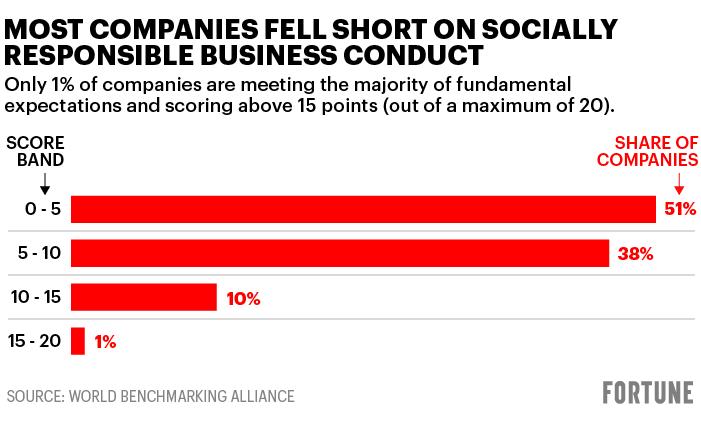
Pressure from shareholders and the public just isn’t enough to force companies to uphold their pledges to protect human rights, according to a World Benchmarking Alliance study of 1,000 companies across more than 60 countries. Only 10 of those companies have achieved the fundamental expectations of the United Nations’ Sustainable Development Goals, according to the WBA. That’s a failure rate of 99% for these powerful companies, which the WBA estimates generate about 25% of the world’s gross domestic product and employ more than 56.5 million people.
“We definitely believe that voluntary measures can only take us so far,” says Sofía del Valle, engagement manager at WBA, in an interview with Fortune. “It’s not going to take us where we need to be.”
As more companies continue to announce new net-zero commitments, there is growing skepticism among sustainability experts whose data calls into question companies’ ability to deliver on these promises. With the pandemic highlighting the need for action on a global scale, there are now growing calls for regulation, lawsuits, and even mass walkouts by scientific researchers to force action.
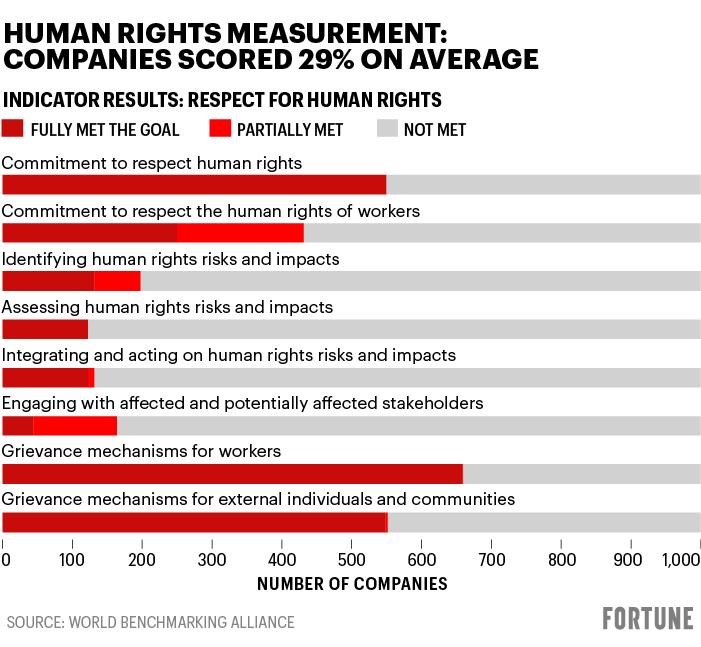
In its assessment, the WBA examined corporate actions to measure a range of human rights including companies’ paying a living wage, providing a safe environment, embedding basic rights into their workplaces, and offering remedies for abuses. Also looked at was whether a company was acting ethically by eschewing bribery, paying fair taxes, and having a responsible lobbying policy. The industries covered were wide-ranging—from retail to telecommunications to agriculture to oil and gas. More than half the companies scored “disappointingly low,” the WBA notes.
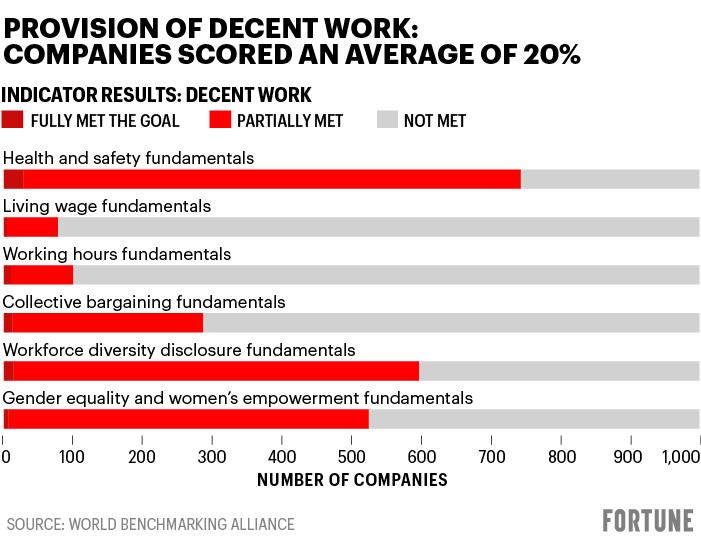
That’s why effective legislation—not just a “tick-box exercise”—is needed to provide a framework that will force companies to take greater action in protecting human rights, the group says.
While it is difficult to enact worldwide standards, legislation in a big enough market can have a cascading effect, del Valle points out. In February, for instance, the European Union enacted a due diligence law that requires companies to identify adverse impacts that their activities have on human rights issues, such as child labor, and on the environment. The rules also push companies to prevent and end any of those impacts, or face fines and sanctions. Since the law requires companies to perform due diligence throughout their production chains, there “will be a massive push in all the markets that are linked to Europe,” del Valle notes.
The right to privacy has been gaining more attention as headlines of cyber-hacks exposing individuals’ data grow more frequent. Yet only about half the companies in the WBA study have made a public commitment to protecting personal data worldwide. Only one in five companies even has a global privacy statement.
While the WBA called on all companies to adopt global privacy practices, del Valle says the area is evolving so quickly that many human rights organizations aren’t up to speed on the risks. The groups are paying more attention to it, though, as more people are affected. In 2021, about 5.9 billion accounts were breached by hackers, according to a study from VPN provider Atlas VPN.
Calls for more regulation
The European Union took a big step toward protecting data and privacy in 2018 with its General Data Protection Regulation, which places obligations on companies and organizations to keep secure any details they collect on people in the EU. Some non-EU countries, ranging from Chile to South Korea, have adopted privacy laws, as have U.S. states including California, Colorado, and Virginia.
Even so, data protection will remain spotty because “it is unlikely that there will be a worldwide standard for privacy,” says Safia Kazi, privacy professional practices principal at ISACA, an international IT-governance business association. And a regulatory standard is necessary, she notes.
“If the regulations are more or less similar, companies can adopt enterprise-wide best practices. But if regulations have a lot of variation, it may make sense to arbitrage for various markets,” Kazi says, noting policymakers and regulators need to step up for the change to take place. “Unfortunately, shareholders and the general public don’t have the leverage needed to make enterprises act ethically.”
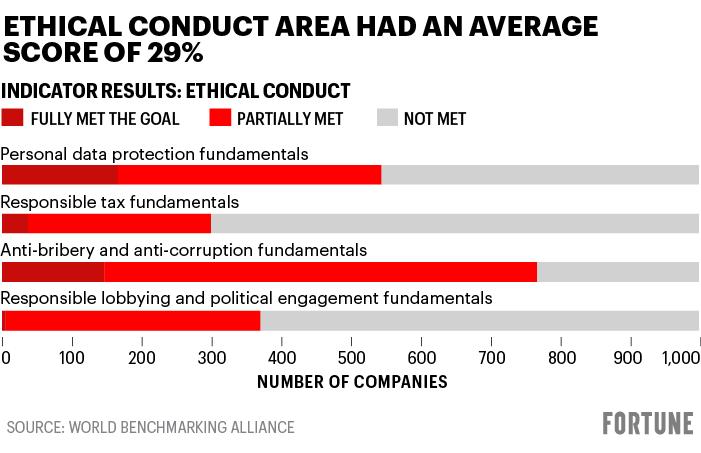
Large corporations yield great influence on regulation, either through lobbying or taxes, and show little inclination to be transparent about how they try to affect national economies. Transparency is needed to force companies to act ethically, the WBA says, because voluntary measures have failed. Only 8% of the companies surveyed disclose how much they spend on lobbying and efforts to shape legislation. Only a tick more—9%—disclose how much in taxes they pay for each jurisdiction where the company is a resident for tax purposes.
As the WBA says in the report, “How much trust is possible when corporate influence is veiled in secrecy?” Advocates of climate change legislation would tell you that the answer is none.
Like the universally accepted human rights tracked by the WBA, there has been a growing consensus on the science behind the adverse impacts some company practices have on the environment. But in climate, as in human rights, passing legislation to address the issue has proved more challenging.
“Regulators and policymakers are being scuppered by vested interests,” says Dylan Tanner, executive director of climate change think tank InfluenceMap. With climate change, there has been pressure on financial firms to stop funding projects that harm the environment, and there is some hope that lenders will factor in human rights commitments when deciding whom to provide with financing and how much to charge.
There’s a limit to what the financial world can do, though, Tanner adds.
“Pressure from the finance sector is the cherry, but the cake has to be the policymakers,” he says.
Still, several recent steps may help blunt corporate influence and move human rights legislation ahead. Last year, the Organization for Economic Cooperation and Development announced that 130 countries representing 90% of global GDP had agreed to establish a new framework to reform the international tax system, a move that the WBA calls a positive step that may lead to greater transparency and accountability. In November, the nonprofit International Financial Reporting Standards Foundation said it would create an International Sustainability Standards Board that, the WBA says, may create disclosures that are “comparable, reliable, and consistent.”
NewClimate Institute echoes the WBA’s belief that corporate pledges are unreliable and consumer and shareholder pressure isn’t enough to make companies act responsibly. In a report assessing the climate commitments of 25 big companies, NewClimate found that only one company’s net-zero pledge was of “reasonable integrity,” while the majority failed to put forward targets that would meet their pledges.
One of the NewClimate report’s authors, policy analyst Silke Mooldijk, hesitates to blame all the legislative inertia on lobbying and tax influence, however. She says two common failings also contribute to the lack of urgency. “Some countries have only just realized that these regulations are needed,” she says, noting the slowness of bureaucracy and government is also playing a role.
ESG activists may turn to the courts more often to force companies to meet their public pledges in the wake of a Supreme Court decision that even general statements like a commitment to ethics and integrity can lead to a lawsuit. In the case of <em>Goldman Sachs</em> Group Inc. v. Arkansas Teacher Retirement System, investors claimed the company’s generic statements regarding its commitments and compliance initiatives were misleading in the face of later-revealed conflicted transactions. Companies should be mindful that ESG pledges may carry legal risks even if they appear generic or aspirational in nature, Bracewell LLP lawyers warned.
Also on the table are less likely tactics, such as the radical pitch by three climate researchers in the journal Climate and Development. “We call for a moratorium on climate change research until governments are willing to fulfill their responsibilities in good faith and urgently mobilize coordinated action from the local to global levels,” the scientists warned.
Still, some companies continue to make pledges. American International Group this month committed to net-zero greenhouse gas emissions across its underwriting and investment portfolios by no later than 2050, planning a “transparent journey toward sustainability advancement.”
And not everyone’s pledges fall short. The WBA gave Firmenich, the Swiss fragrance and flavors company, an overall score of 11.5 out of 20, ranking it especially high on providing decent workplaces and acting ethically. Emmanuel Butstraen, president of the taste and beyond division at Firmenich, called the ranking a recognition of the company’s “contributions to improving the global food system.” The company’s goal, he said, is to operate the “most traceable, sustainable, and ethical value chain.”
“Although some companies have translated their human rights commitments into robust management processes, the vast majority are still failing to ‘know and show’ how they have taken tangible action,” the WBA notes.
“The whole world saw what we knew was the problem,” del Valle says, but “we are farther away from the goals than we were in 2018.”
This story is part of The Path to Zero, a special series exploring how business can lead the fight against climate change.