• Home
  • Latest
  • Fortune 500
  • Finance
  • Tech
  • Leadership
  • Lifestyle
  • Rankings
  • Multimedia
Magazinesupply chains

Backlog at the Port of Vancouver is a sign of supply-chain disruption to come

By
Kat Eschner
Kat Eschner
Down Arrow Button Icon
By
Kat Eschner
Kat Eschner
Down Arrow Button Icon
December 1, 2021, 6:15 AM ET

First came the shipping containers. Then came the atmospheric river. In mid-November, Vancouver’s port was already piled high when record-setting rains resulted in flooding and mudslides that destroyed roads, bridges, and train tracks, effectively cutting off North America’s third-largest trade hub from the rest of the continent. 

The unfolding disaster is expected to tangle up supply chains for months if not longer. “There’s $550 million a day of goods that normally traverse the gateway,” said Peter Xotta, vice president of operations and supply chain for the Vancouver Fraser Port Authority. “This event obviously has had far-reaching implications, not just for the flow of goods but for the residents of the area.” 

The Port of Vancouver has not been directly affected by flooding, but rail shipping has been suspended, and the highways that act as arteries to Canada’s interior have been closed. Xotta says the port is working with emergency managers to figure out how long the closures would continue, but the extent of the damage is still being assessed. 

The port is unusual in that it ships a diversified range of consumer goods and commodities, including oil from Alberta, grains from Saskatchewan and Manitoba, and minerals and lumber from British Columbia and points farther north. It is also the main entry point for imported consumer goods coming to Canada. 

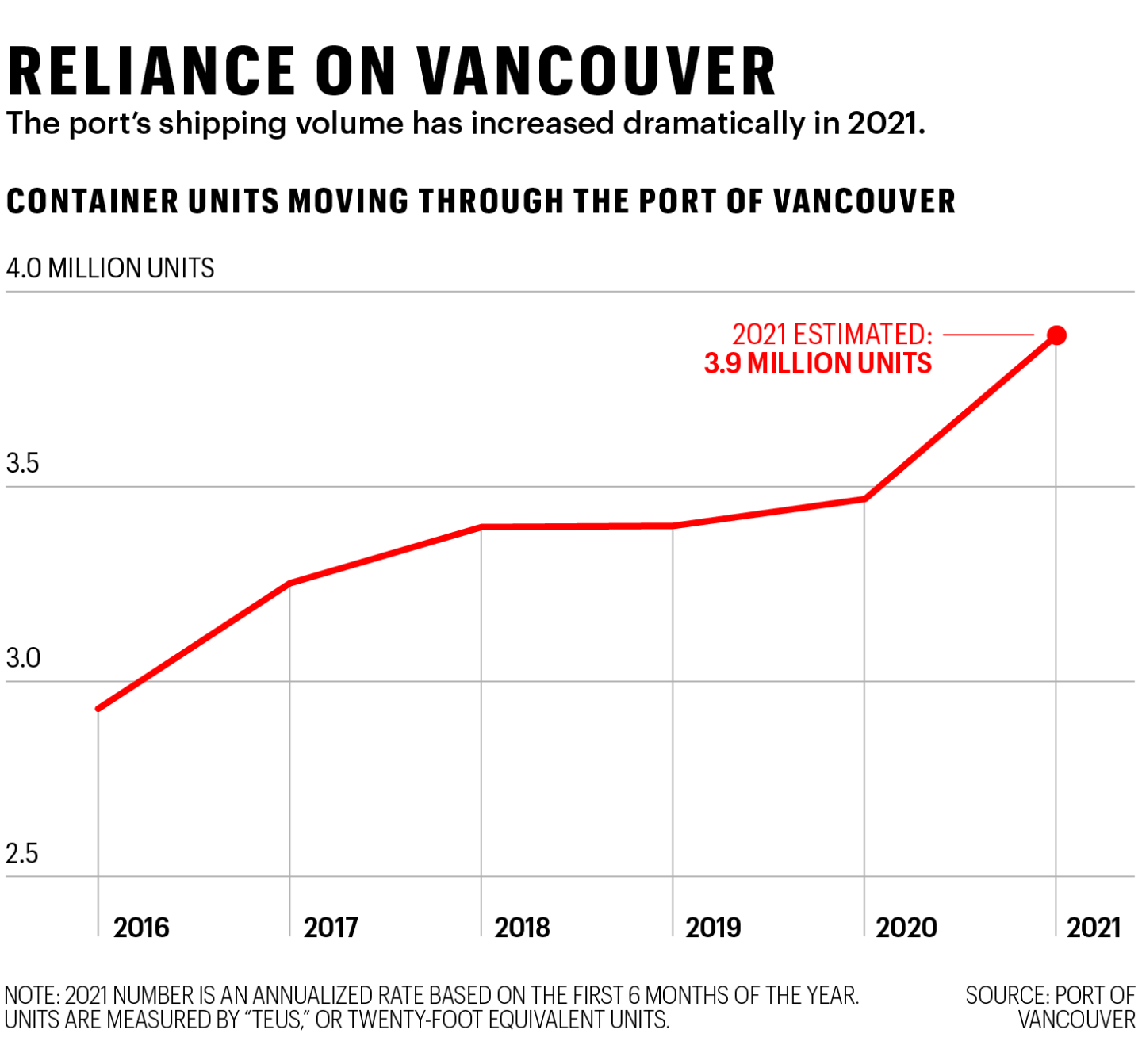
In the first half of 2021, the port experienced a 7% rise in cargo volumes over midyear 2020, setting a record. Container quantities increased by almost 25%, and grains by 20% over midyear. One notable increase was in the volume of empty containers backed up at the port, a phenomenon also experienced at West Coast ports in the U.S.

Xotta is hesitant to even speculate on how long it would take the supply chain to normalize. For now, he says, shipping terminals are sending out their existing inventory to the Asia-Pacific and other regions. “Once that’s exhausted, they will remain idle until rail service resumes,” he says.

As for goods headed back the other way to Central Canadian markets, they’re not presently going anywhere. Depending on how long this state of affairs continues, “vessels will start to back up,” Xotta says.   

If the situation doesn’t resolve soon, shortages of fuel, consumer goods, and even some medical supplies could sweep the region. The interruption could also cause consumer prices to rise as shipping costs rack up along the route that commodities end up taking. On a call during the week of the flooding, CN Rail executives told investors that any lost revenue for the quarter could be made up by raising shipping prices within Western Canada.  

The situation underscores the importance of building resiliency into the supply chain in the face of climate change, says Adel Guitouni, a professor of supply-chain management at the University of Victoria’s Gustavson School of Business. “We need to have redundancy in these kinds of networks,” he says. “What we were thinking to be 100-year episodes now happen almost every year.” 
Economists predict that the floods will rank among Canada’s costliest natural disasters. They come on the heels of a grueling summer of heat and yet another season of wildfires in British Columbia’s interior. These events also impacted shipping, though to a far lesser degree, and caused shortages in the lumber sector.

The heat and fire from earlier in the year exacerbated the rain’s damage by making soil unstable, which caused mudslides and worsened the flooding. “You see how this vicious cycle between the fires, the extreme heat, and the rain is going to put our infrastructure under stress,” says Guitouni. 

These closures will result in costly shipping delays and may produce shortages. Some goods are being rerouted north to Prince Rupert, B.C., and other points south along the U.S. West Coast, but extra capacity is limited right now. Similarly, some truckers are headed southward, but that move comes with extra costs and logistical issues.

What we were thinking to be 100-year episodes now happen almost every year.

Adel Guitouni, University of Victoria

This incident is one in a string of recent examples of extreme weather disrupting delivery networks. In Asia, the ongoing semiconductor shortage has been exacerbated by Taiwan’s worst drought in more than half a century. Earlier this year, Winter Storm Uri devastated Texas, causing shortages of plastics and petrochemicals. 

Ripples from these events are felt up and down the supply chain, in parts of the world you wouldn’t expect and in industries that might seem unrelated at first glance. “That’s the unfortunate nature of all the interdependencies we have in the global economy,” says Guitouni. 

Amid all this destruction, Guitouni and others in his field see new opportunities to make a positive impact. Their goal is to promote the idea of a regenerative supply chain that offers economic and social benefits to people and the environment at every point. “One action along the supply chain is worth multiple times the action you take within one organization,” Guitouni says. 

A version of this article appears in the December 2021/January 2022 issue of Fortune with the headline, “A port cut off.”

Subscribe to Fortune Daily to get essential business stories straight to your inbox each morning.
About the Author
By Kat Eschner
See full bioRight Arrow Button Icon

Latest from the Magazine

Finance
Lorem ipsum dolor sit amet, consectetur adipiscing elit, sed do eiusmod tempor incididunt ut labore et dolore magna aliqua. Ut enim ad minim veniam
By Fortune Editors
October 20, 2025
Finance
Lorem ipsum dolor sit amet, consectetur adipiscing elit, sed do eiusmod tempor incididunt ut labore et dolore magna aliqua. Ut enim ad minim veniam
By Fortune Editors
October 20, 2025
Finance
Lorem ipsum dolor sit amet, consectetur adipiscing elit, sed do eiusmod tempor incididunt ut labore et dolore magna aliqua. Ut enim ad minim veniam
By Fortune Editors
October 20, 2025
Finance
Lorem ipsum dolor sit amet, consectetur adipiscing elit, sed do eiusmod tempor incididunt ut labore et dolore magna aliqua. Ut enim ad minim veniam
By Fortune Editors
October 20, 2025
Finance
Lorem ipsum dolor sit amet, consectetur adipiscing elit, sed do eiusmod tempor incididunt ut labore et dolore magna aliqua. Ut enim ad minim veniam
By Fortune Editors
October 20, 2025
Finance
Lorem ipsum dolor sit amet, consectetur adipiscing elit, sed do eiusmod tempor incididunt ut labore et dolore magna aliqua. Ut enim ad minim veniam
By Fortune Editors
October 20, 2025

Most Popular

Finance
Lorem ipsum dolor sit amet, consectetur adipiscing elit, sed do eiusmod tempor incididunt ut labore et dolore magna aliqua. Ut enim ad minim veniam
By Fortune Editors
October 20, 2025
Finance
Lorem ipsum dolor sit amet, consectetur adipiscing elit, sed do eiusmod tempor incididunt ut labore et dolore magna aliqua. Ut enim ad minim veniam
By Fortune Editors
October 20, 2025
Finance
Lorem ipsum dolor sit amet, consectetur adipiscing elit, sed do eiusmod tempor incididunt ut labore et dolore magna aliqua. Ut enim ad minim veniam
By Fortune Editors
October 20, 2025
Finance
Lorem ipsum dolor sit amet, consectetur adipiscing elit, sed do eiusmod tempor incididunt ut labore et dolore magna aliqua. Ut enim ad minim veniam
By Fortune Editors
October 20, 2025
Finance
Lorem ipsum dolor sit amet, consectetur adipiscing elit, sed do eiusmod tempor incididunt ut labore et dolore magna aliqua. Ut enim ad minim veniam
By Fortune Editors
October 20, 2025
Finance
Lorem ipsum dolor sit amet, consectetur adipiscing elit, sed do eiusmod tempor incididunt ut labore et dolore magna aliqua. Ut enim ad minim veniam
By Fortune Editors
October 20, 2025
Fortune Secondary Logo
Rankings
  • 100 Best Companies
  • Fortune 500
  • Global 500
  • Fortune 500 Europe
  • Most Powerful Women
  • Future 50
  • World’s Most Admired Companies
  • See All Rankings
Sections
  • Finance
  • Fortune Crypto
  • Features
  • Leadership
  • Health
  • Commentary
  • Success
  • Retail
  • Mpw
  • Tech
  • Lifestyle
  • CEO Initiative
  • Asia
  • Politics
  • Conferences
  • Europe
  • Newsletters
  • Personal Finance
  • Environment
  • Magazine
  • Education
Customer Support
  • Frequently Asked Questions
  • Customer Service Portal
  • Privacy Policy
  • Terms Of Use
  • Single Issues For Purchase
  • International Print
Commercial Services
  • Advertising
  • Fortune Brand Studio
  • Fortune Analytics
  • Fortune Conferences
  • Business Development
  • Group Subscriptions
About Us
  • About Us
  • Editorial Calendar
  • Press Center
  • Work At Fortune
  • Diversity And Inclusion
  • Terms And Conditions
  • Site Map
  • About Us
  • Editorial Calendar
  • Press Center
  • Work At Fortune
  • Diversity And Inclusion
  • Terms And Conditions
  • Site Map
  • Facebook icon
  • Twitter icon
  • LinkedIn icon
  • Instagram icon
  • Pinterest icon

Latest from the Magazine

Who owns ideas in the AI age?
MagazinePublishing
Who owns ideas in the AI age?
By Francesca CassidyApril 8, 2026
2 days ago
Southeast Asia’s business leaders want wellness at work—as long as the programs get real results
Magazine100 Best Companies to Work For
Southeast Asia’s business leaders want wellness at work—as long as the programs get real results
By Alice WilliamsApril 8, 2026
2 days ago
So… what are we doing with AI? Innovating in an age of caution
MagazineStrategy
So… what are we doing with AI? Innovating in an age of caution
By Francesca CassidyApril 7, 2026
2 days ago
Anthropic’s research shows that AI can already do a huge portion of many jobs; its top economist talks about how that could shape the future of work
MagazineAutomation
Anthropic’s research shows that AI can already do a huge portion of many jobs; its top economist talks about how that could shape the future of work
By Matthew Heimer and Nicolas RappApril 7, 2026
3 days ago
Fortune Archives: Who gets a seat at the table?
MagazineFortune Archives
Fortune Archives: Who gets a seat at the table?
By Indrani SenApril 5, 2026
5 days ago
Watches like this $455,000 timepiece can’t be made by a machine—and that’s exactly why they’re the ultimate flex amid the analog revival
MagazineWatches
Watches like this $455,000 timepiece can’t be made by a machine—and that’s exactly why they’re the ultimate flex amid the analog revival
By Adam EraceApril 4, 2026
5 days ago

Most Popular

The U.S. government is spending $88 billion a month in interest on national debt—equal to spending on defense and education combined
Economy
The U.S. government is spending $88 billion a month in interest on national debt—equal to spending on defense and education combined
By Fortune EditorsApril 9, 2026
13 hours ago
2 years ago, Saudi Arabia quietly canceled the ‘petrodollar’ deal with America that wired the world economy for 50 years. Then war broke out in Iran
Energy
2 years ago, Saudi Arabia quietly canceled the ‘petrodollar’ deal with America that wired the world economy for 50 years. Then war broke out in Iran
By Fortune EditorsApril 7, 2026
2 days ago
Gen Z doesn't want your full-time job. They want several part-time roles, and it's reshaping the entire workforce
Success
Gen Z doesn't want your full-time job. They want several part-time roles, and it's reshaping the entire workforce
By Fortune EditorsApril 9, 2026
17 hours ago
Self-made billionaire MrBeast says his work-life balance is nonexistent and calls it a ‘miracle’ if he works less than 15-hour days: ‘I live to work’
Success
Self-made billionaire MrBeast says his work-life balance is nonexistent and calls it a ‘miracle’ if he works less than 15-hour days: ‘I live to work’
By Fortune EditorsApril 8, 2026
1 day ago
The U.S. had a national debt ‘home run’ in its grasp, says Jamie Dimon. But the government did nothing, and now its best option is crisis management
Economy
The U.S. had a national debt ‘home run’ in its grasp, says Jamie Dimon. But the government did nothing, and now its best option is crisis management
By Fortune EditorsApril 8, 2026
2 days ago
Gen Z workers are so fearful AI will take their job they’re intentionally sabotaging their company’s AI rollout
AI
Gen Z workers are so fearful AI will take their job they’re intentionally sabotaging their company’s AI rollout
By Fortune EditorsApril 8, 2026
1 day ago

© 2026 Fortune Media IP Limited. All Rights Reserved. Use of this site constitutes acceptance of our Terms of Use and Privacy Policy | CA Notice at Collection and Privacy Notice | Do Not Sell/Share My Personal Information
FORTUNE is a trademark of Fortune Media IP Limited, registered in the U.S. and other countries. FORTUNE may receive compensation for some links to products and services on this website. Offers may be subject to change without notice.