
Last December, the United Kingdom became the first country to administer COVID-19 vaccines. That first-mover advantage is looking more like a liability right now as the effectiveness of that initial batch of doses appears to wear down, and cases spike again.
On Thursday, COVID cases topped 50,000 for the first time in the past three months, and deaths reached 115. Under that backdrop, Britain’s public health officials are warning that vaccine immunity has begun to decline, predicting the country is headed for another harsh winter. Now doctors are openly calling for new restrictions on the public. Politicians, meanwhile, are determined to keep the economy fully open.
Buoyed by the success of the early vaccine rollout, U.K. Prime Minister Boris Johnson had put all his hope in a kind of “wall of immunity” keeping the virus at bay. But faced with the highly transmissible Delta variant, herd immunity proved dubious at best.
Israel, another early vaccine-mover, started to offer booster shots to people over 60 from July 1, as the number of cases started to increase across the country. Case numbers there then subsided, and a larger public health crisis was averted, further indication that boosters will be an important line of defense for the world’s biggest economies this winter. As Berenberg economist Holger Schmieding said in a recent investor note, “The vaccine protection becomes less effective over time, and booster jabs can make a decisive difference.”
But unlike Israel, which has strict vaccine passport and public-masking policies in place, the U.K. has no such restrictions. It’s also behind the curve in providing booster shots to vulnerable Britons. The British Medical Association has called government inaction “incredibly concerning.”
“The government has taken its foot off the brake, giving the impression that the pandemic is behind us,” BMA council chair Chaand Nagpaul said, calling the reality today an “unacceptable rate of infections, hospitalizations, and deaths, unheard-of in similar European nations.”
Excluded Britain
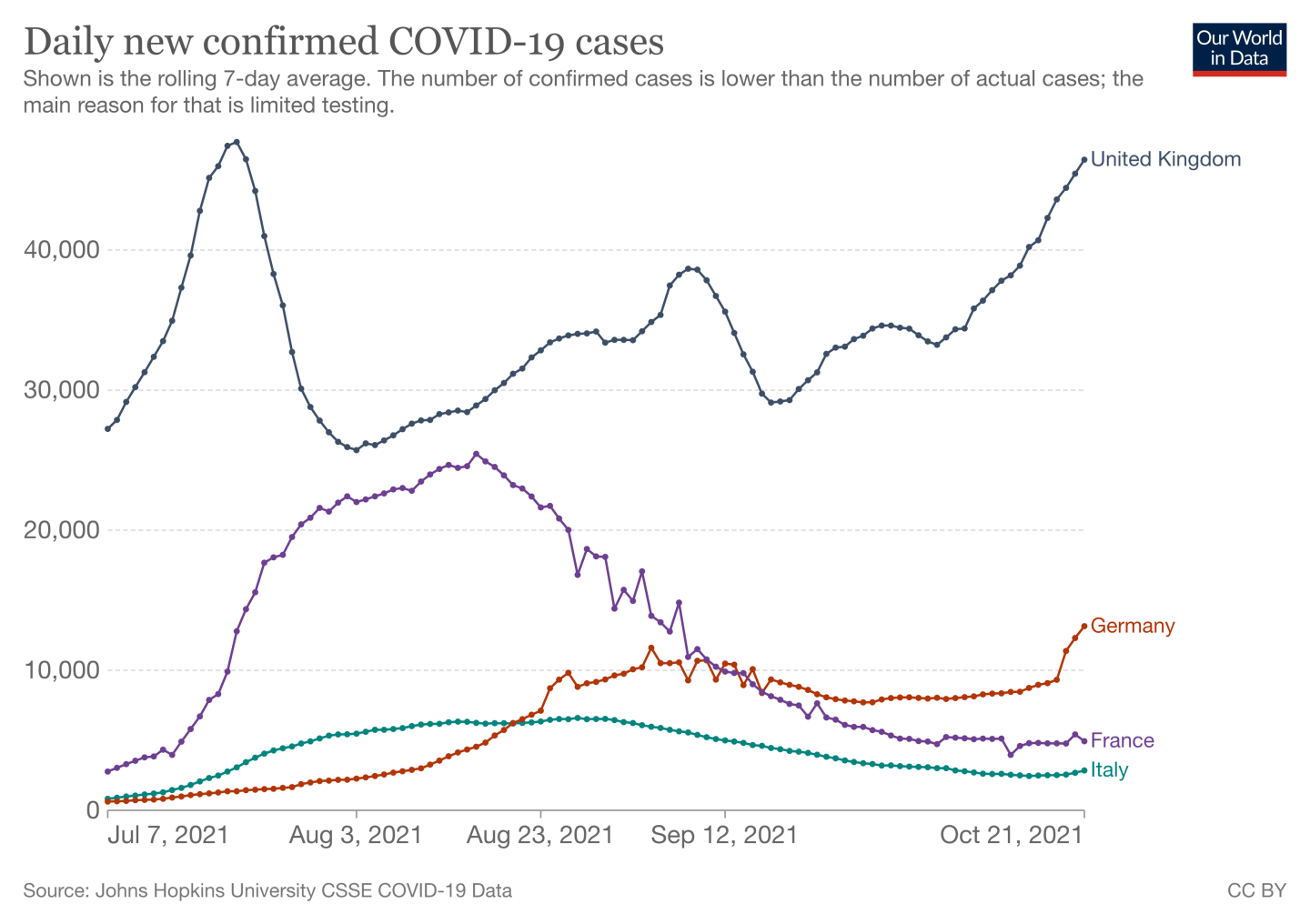
Since July 19, there have been no COVID-19 restrictions in place for Britons. That means no mask on the subway, complete mixing at schools regardless of vaccination status, and unlimited capacity at restaurants, pubs, and nightclubs. It’s a far cry from what you see in neighboring France and Italy, where workers are required to show proof of vaccination or a recent negative test to enter a workplace, as are diners wishing to enter a bar or restaurant.
This more lax style has inevitably led to more cases, U.K. officials lament. According to Public Health England, the 52,000 new infections reported yesterday put Britain far above the rest of Europe.
Britain’s handling of the epidemic even led the normally straitlaced Italian Prime Minister Mario Draghi to take a dig at the U.K. as an example of what countries should not do. “The U.K., one of the countries that conducted its vaccination campaign with great speed, after abandoning all caution, today has around 50,000 daily new cases and 200 dead yesterday,” Bloomberg reported Draghi said Wednesday to Italy’s lower house of Parliament.
This has prompted doctors from across the U.K. to call for a “plan B” coronavirus response—reintroducing social distancing measures, mask mandates, and requiring proof of vaccination. Despite the urgent calls from U.K. scientists, the government firmly rejected the suggestions. Instead, it will throw its lot behind doubling down on vaccines as it heads into winter.
And while the saving grace was that deaths were still low, as vaccinations make it much safer to contract COVID-19, hospitalizations have gone up by 10% in the last week.
“It’s about one year since we had the vaccine, and it’s time to reappraise what they have achieved,” says Paul Moss, a professor at the University of Birmingham’s Institute of Immunology and Immunotherapy, noting the U.K. is now seeing antibody levels that developed after the second vaccine “beginning to wane.”
Even the economists at Berenberg are wondering how this will trend. The report carried a headline: “Another uptick in the U.K. now?”
More must-read business news and analysis from Fortune:
- China isn’t the only economy decoupling from the U.S.
- What you need to know about the Delta Plus COVID variant and the danger it poses
- Mortgage rates may spike 30% next year, according to a new forecast
- How high Goldman Sachs predicts home prices will go in 2022
- 4 things to know about stimulus checks in 2022 and beyond