

Plastic: Next to the burning of fossil fuels, it represents one of the greatest environmental threats facing the planet.
Researchers estimate that since 1950, more than 8.3 billion metric tons of the stuff has been produced, more than one ton for every person currently on the planet. Once used, much of it is burned. The rest winds up in landfills or in the ocean, where it can take up to five centuries to fully decompose. In the meantime, it poses a threat to wildlife and, through potentially carcinogenic microplastics that enter the food chain, us too.
London-based startup FabricNano is targeting this scourge with a new kind of manufacturing that harnesses the chemical laboratories that exist inside the cells of living organisms, but it does so without the need to actually use living things. Its first product is a precursor for the creation of biodegradable polyester, which FabricNano’s founders think they can produce at a price that will make it competitive with the petroleum-based plastics that are used in everything from water bottles to fast-food trays.
Among those inspired by that vision are actress Emma Watson of Harry Potter fame, Twitter cofounder Biz Stone, and Alexander Moscho, the former chief executive of Bayer. They are part of a $12.5 million investment round in FabricNano, led by London-based venture capital firm Atomico, announced today.
Harvesting the power of single-cell organisms is one of humankind’s oldest manufacturing techniques: Think of beer, wine, cheese, and bread. Traditional biomanufacturing uses microbes, such as yeast, that either naturally produce a chemical or, more recently, that have been genetically modified to do so.
But there are several potential problems: Growing single-cell organisms in large vats can be difficult. The amount of chemical produced, known as the yield, can be inconsistent, especially because the cells at the bottom of the vats often respond poorly to the pressure and heat created. Evenly distributing food for the cells can be a problem. For many chemical processes, cells are also relatively inefficient, partly because the cells need to consume energy to live.
This tends to make biomanufacturing expensive compared with other chemical processes, so it is most often used for specialty chemicals and materials. Think pharmaceuticals, cosmetics, carpeting, and molded parts in automobiles. Biomanufacturing also doesn’t work for certain chemicals because the chain reactions needed to create them produce toxins that kill the cells before the process can be completed.
FabricNano is one of just a handful of companies working to commercialize a technology that sidesteps many of these pitfalls, known as “cell-free biomanufacturing.” Other companies also working in the area include San Diego startup Debut Biotech, which has a partnership with Dutch materials company DSM; Daicel Arbor Biosciences in Ann Arbor, Mich., which is mostly focused on uses of the technology in life science; and French biotech company Synthelis.
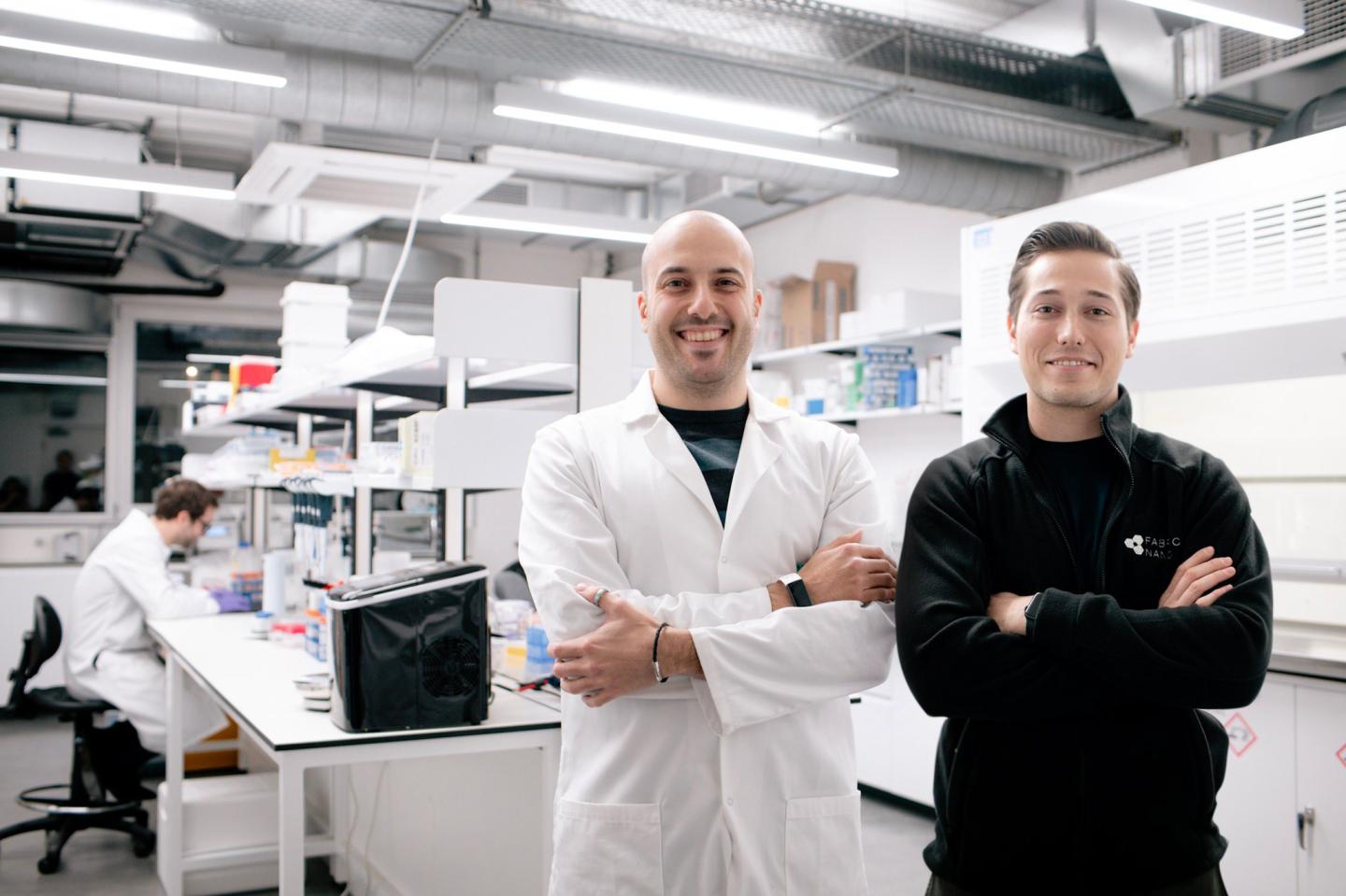
In FabricNano’s case, it has pioneered a wafer-like substance made of DNA suspended in liquid that forms a kind of platform on which various enzymes and proteins can produce the same chemical reactions as would occur inside a cell, but without the need for an actual living organism. Because there are no living cells, the chemical reactions are more efficient, can be used in large vats without worrying about inconsistent yields, and can produce chemicals that would prove toxic to cells.
“Cell-free is the technology that I wish we’d had 10 years ago when I was trying to source biodegradable materials for Unilever,” says Mike Butler, who served as a research and development director at the consumer products giant specifically working on sustainability and advanced materials from 2008 to 2018. At the time, Butler says, only cell-based biomanufacturing processes were available. But they were “too tricky to optimize” because of the difficulty of “keeping all the little bugs happy,” he says, referring to the microbes.
While Butler says that “there is some really great stuff out there” in terms of biodegradable plastics, they tend to be between three and five times more expensive than conventional petroleum-based plastics. As a result, Unilever and other companies have largely built their sustainability strategies around the use of recycled plastic rather than biodegradable or compostable materials. New technologies could alter that equation, he says. (Now the technical director at U.K. specialty chemicals company William Blythe, Butler has consulted with FabricNano on how to commercialize its technology.)
FabricNano’s DNA-based wafer is critical, says John Woodley, a chemical engineering professor at the Technical University of Denmark who serves as a scientific adviser to FabricNano. “It holds the enzymes together and positions them the right way, so they are very close to each other,” he says. This makes the chemical reactions controllable and efficient.
Siraj Khaliq, a partner at Atomico who led the financing round and will be joining FabricNano’s board, says the venture capital firm found the modular nature of FabricNano’s DNA wafer technology compelling. “There are all kinds of benefits that come from controlling and being able to build with biology as you would with hardware,” he tells Fortune.
FabricNano’s system makes it cheaper to manufacture some chemicals, such as one called 1,3-propanediol. Currently, 1,3-propanediol can be biomanufactured and turned into biodegradable plastic, but not at a price that is competitive with the petroleum-based single-use plastics. “Why is Coke not shifting to bio-based plastics? Because it’s too expensive and the market is too price sensitive,” says Grant Aarons, FabricNano’s cofounder and chief executive.
For instance, DuPont produces a biodegradable nylon, called Biomax PTT, that is made from biomanufactured 1,3-propanediol. But it costs about $3 per kilogram, whereas petroleum-based plastics cost just $1 per kilogram, Aarons says. (Fortune wrote about a similar biomanufactured product from Cargill Dow in 2003.)
Woodley says that FabricNano’s cell-free process could close this gap. “1,3-propanediol is a well-established chemical product, but it is expensive and, basically, it is too slow to biomanufacture,” he says. “There is an opportunity to drive this much faster and bring the price down.”
FabricNano can convert sugars that are used as feed stock for the chemical reaction to the plastic end product with nearly 100% efficiency, compared to about 40% efficiency inside living cells, Aarons says. What’s more, because the company isn’t using living cells, the sugars it uses don’t have to be particularly pure. To power its process, FabricNano can use waste glycerin that is a byproduct of biodiesel production, and is often simply burned by biodiesel producers because there’s currently no market for it.
Although Aarons says three large chemical companies that he declined to name have shown interest in FabricNano’s product, the company has not started shipping any of it. He said the company would use the money from the current funding round to ensure that it could scale up its production of the DNA wafers and perfect its process for creating 1,3-propanediol.
The same cell-free method can also be used to produce other chemicals and materials, including pharmaceuticals, the CEO says.
Woodley says the biggest limitation to FabricNano’s success may be finding a reliable and inexpensive source of the enzymes used in the chemical reaction. In living organisms, most of the enzymes are produced by the cells themselves, or the organism ingests them from the environment. In FabricNano’s case, the enzymes must be purchased.
Watson, who played Hermione in the Harry Potter franchise, became a seed investor in FabricNano after being approached by the company on the advice of Atomico and Tania Boler, the founder of Elvie, a startup that makes innovative technology for women, including a breast pump. Boler is also a seed investor in FabricNano. She formerly had roles in several development organizations and at the United Nations cultural organization Unesco. Watson is currently the United Nations Women Goodwill Ambassador and interested in environmental causes.
Other venture capital firms taking part in the financing round include Backed, Hoxton Ventures, and Entrepreneur First. The latest funding brings the total amount of venture capital FabricNano has raised to $16 million.