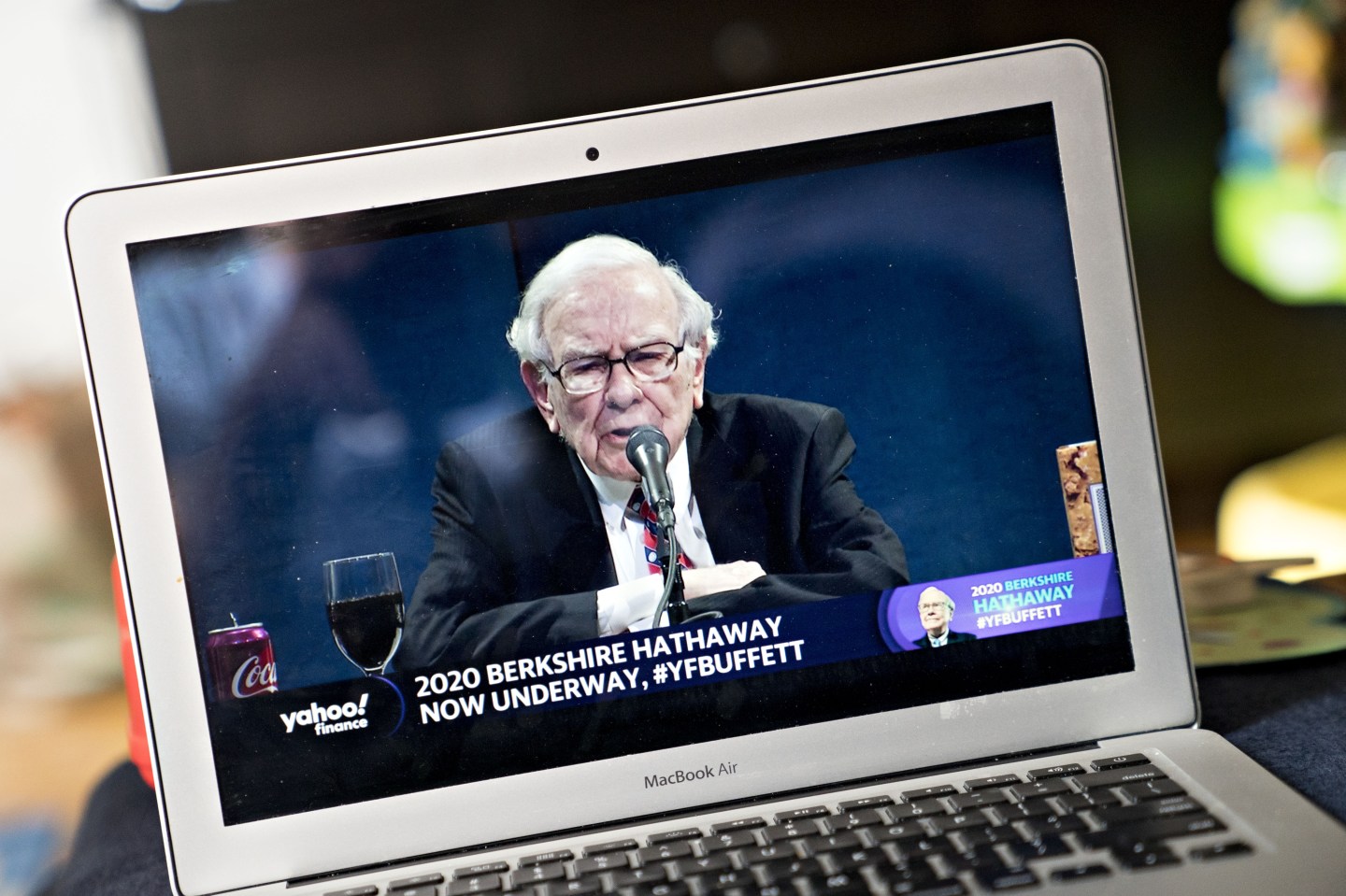
Every spring in the beforetimes, fervent Warren Buffett fans converged in Omaha for Berkshire Hathaway’s annual shareholder meeting. Some 40,000 investors would fly in for the carnival known as “Woodstock for capitalists.” But, like so many large gatherings since March 2020, its past two iterations have been deflatingly virtual.
The video remove didn’t stop Buffett’s event from making headlines in early May: Berkshire’s 90-year-old CEO and its vice chairman, Charlie Munger, spent about three and a half hours fielding questions that shareholders submitted in writing, ahead of or during a webcast from Los Angeles. And with the United States rapidly reopening for post-pandemic life, Buffett ended this year’s meeting by telling investors that “the odds are very, very good that we get to hold this next year in Omaha.”
But most public companies aren’t Berkshire Hathaway—in either party-planning approach or share price. Companies are required by state law to hold yearly gatherings for shareholders to elect their boards of directors; most do so from April through June. The majority of these annual shareholder meetings range from the contentious to the deliberately boring, in what corporate-governance expert Douglas Chia calls “perfunctory exercises.”
And, like so many other events since March 2020, the pandemic forced most of them online. In 2020, 78% of S&P 500 companies held virtual-only annual meetings, with 86% doing so in 2021, according to data provider MyLogIQ. That was an abrupt—if, to tech vendors like Broadridge Financial Solutions and Mediant Communications, long-awaited—reversal from previous years. In 2019, only 326 virtual annual meetings were held through Broadridge, which counts 52% of the Fortune 500 as clients. In 2020, Broadridge hosted 1,957 virtual annual meetings and says it is on track to host more than 2,257 on its platform in 2021.
Now, even as reopenings accelerate across the country, some corporate-governance experts are betting that many annual meetings will never return to the real world.
“There are a lot of companies that could go back in-person—but won’t. They’ve seen the benefits and convenience of having a virtual annual meeting,” says Chia, president of consultancy Soundboard Governance and a fellow at Rutgers Law School’s Center for Corporate Law and Governance.
Some future event-planning will depend on the state governments that mandate whether annual meetings must be held in person; states including California and New York temporarily lifted some restrictions during the pandemic but have yet to enact permanent change. But from a company perspective, the benefits of virtual meetings include reducing the costs of organizing a physical event that isn’t always well-attended—and potentially exerting more control over investor questions, public criticisms, or even protests.
Which is why many shareholder representatives decry the virtual migration. Last spring, as the pandemic swept over the U.S. and companies scrambled to move their shareholder meetings online, only 36% of questions submitted by two active investors and study participants during virtual meetings were addressed, according to an academic paper first published in August. In 32% of meetings, the shareholders ran into substantial technical problems that prevented them from submitting questions at all, the study found.
“Companies made it incredibly difficult last year to submit questions,” says Miriam Schwartz-Ziv, a senior lecturer at the School of Business Administration at the Hebrew University of Jerusalem and the study’s author. “There’s an impact to making those choices,” she adds. “It’s a choice not to address questions—and it does affect the time spent on shareholder concerns.”
Silencing small shareholders?
Most annual meetings are big events for small shareholders. The largest and most powerful institutional investors—such as BlackRock, State Street, or Vanguard—have the financial heft to bend a board’s ear at any time. But for retail investors and smaller funds, a company’s annual meeting can be their sole opportunity to make their voices heard.
“It’s the one occasion of the year where shareholders of any size get to engage with corporate leaders at the highest level,” says Amy Borrus, executive director of the Council of Institutional Investors, which represents pension funds and other large asset managers.
“Virtual meetings should be used to supplement the traditional meeting, not as a substitute,” she adds, “and not to silence shareholders.”
Still, some companies tried to mute investors long before the Zoom era. Before annual meetings went virtual, some were physically remote—often when executives seemed to have incentives to minimize attendance (and public criticism) from shareholders, customers, or employees.
In 2011, amid the mounting anti-bank protests that would culminate in the Occupy Wall Street movement, New York–based Goldman Sachs and JPMorgan Chase moved their annual shareholder gatherings to, respectively, New Jersey and Ohio. In 2019, as workers and then-presidential candidate Sen. Bernie Sanders criticized McDonald’s over wages and its handling of sexual-harassment allegations, the fast-food chain relocated its annual meeting from its Chicago headquarters to a Dallas airport hotel.
This year, facing a new round of public criticism over wages, workplace culture, and the messy firing of its previous CEO, McDonald’s held its annual meeting virtually. Investors were allowed to submit questions in writing but not to ask them on camera or over the phone. The whole thing took about 45 minutes. (A McDonald’s spokesperson declined to comment on either meeting.)
McDonald’s is hardly alone in this low-key, low-tech approach: Broadridge says that 95% of its 2020 virtual meetings allowed investors to submit questions in writing, and only 1% of the events were conducted over video, in addition to audio. So it’s remarkable that some virtual meetings have managed to feature more drama, especially as shareholders pressure companies to fulfill their commitments to racial, social, and environmental justice. (Just last week, Exxon Mobile lost a closely watched battle with investors, and two seats on its board, over the oil company’s approach to climate change.)
But most pandemic-era virtual meetings “have been boring,” says Chia, a former assistant general counsel and corporate secretary for Johnson & Johnson. “And from experience, I know that they are intentionally boring. That is exactly what the companies are going for.”
As a result, shareholder representatives are urging companies to plan “hybrid” rather than purely virtual meetings in the future, so that investors can choose to attend (and ask questions) in person. “Many companies will stick with virtual meetings because for some it’s cheaper, and it’s also a way to hear from potentially more of your smaller shareholders,” CII’s Borrus says. “But it also really puts the onus on the company to make sure that shareholders can participate meaningfully.”
Chia, who led a Rutgers working group on virtual-meeting best practices and published its recommendations in December, acknowledges the advantages of “hybrid” meetings. But he’s skeptical that many companies will bother with the time and expense of organizing both in-person and virtual components of future events.
“I don’t think you’re going to see a lot of companies moving to hybrid—but the virtual annual meeting doesn’t have to be a missed opportunity,” he says. “Companies can do a lot of things to facilitate a more open dialogue on a host of issues,” like allowing shareholders to ask their questions on video.
“That tech already exists—companies just choose not to use it,” he says. “But there is potential for this democratizing effect.”
A few companies have indeed made improvements for 2021, and Broadridge is now offering what it calls “Zoom-like” video technology for its virtual meetings.
Meanwhile, virtual meetings do have one undeniable benefit for investors: It’s easier to show up for more of them. Attendance at virtual meetings more than doubled between 2019 and 2020, according to ISS Corporate Solutions (ICS), a consultancy unit of Institutional Shareholder Services.
Virtual meetings “are the prudent course of action when people need a safe distance, but they’re also convenient for the company and they encourage shareholder participation,” says Peter Kimball, head of advisory and client services for ICS. “There is a real expectation that virtual meetings are here to stay.”
Which even some of the most active shareholders see as a silver lining. Take James McRitchie of CorpGov.net, a vocal independent investor known for filing shareholder proposals, who worked with Schwartz-Ziv on her research into how companies handled virtual meetings last year.
Despite criticizing many companies’ virtual tactics, McRitchie acknowledges some benefits from the digital shift—in part because it’s a lot easier to attend more events when he doesn’t have to fly around the country to do so.
“I’ve been vehemently opposed to virtual shareholder meetings for a number of reasons, and I still think there are many problems,” McRitchie says. “But boy, it sure saves a lot of time.”