Infosys president Ravi Kumar was trying to get global attention on vaccines last year.
“Businesses can play a pivotal role in encouraging vaccine literacy and engendering vaccination trust in the workplace,” he said in a prescient December email to me. “Building and sustaining vaccine confidence has never been more important.”
Five months later, Kumar is in the middle of an all-out war against COVID-19, but his tact and rhetoric remain the same. The bulk of Infosys’s 250,000 employees work in India, where rates of the virus are surging. Headlines report record-high numbers; 400,000 cases a day this week, and growing despair over a lack of vaccines, oxygen, and hospital beds. It’s dire.
The implications of this calamity extend far beyond India, which is what Kumar has been sounding alarms on all along. Infosys, an emblem of the global economy and India’s rise within, operates in 46 countries; Kumar is based in New York, a departure from top executives past, and Infosys has committed to hiring tens of thousands of workers in the U.S. in the next two years.
There might be no “going back” to the world we once were. Still, companies like Infosys warn the current lack of global coordination, evident in fights over patents to passports, poses a great threat to the connected workforce and economy we have become. Kumar’s approach to fighting COVID, protecting workers and business, warrants emulation by others dependent on globalization (i.e., most of us). Some lessons:
Nobody’s safe until we all are
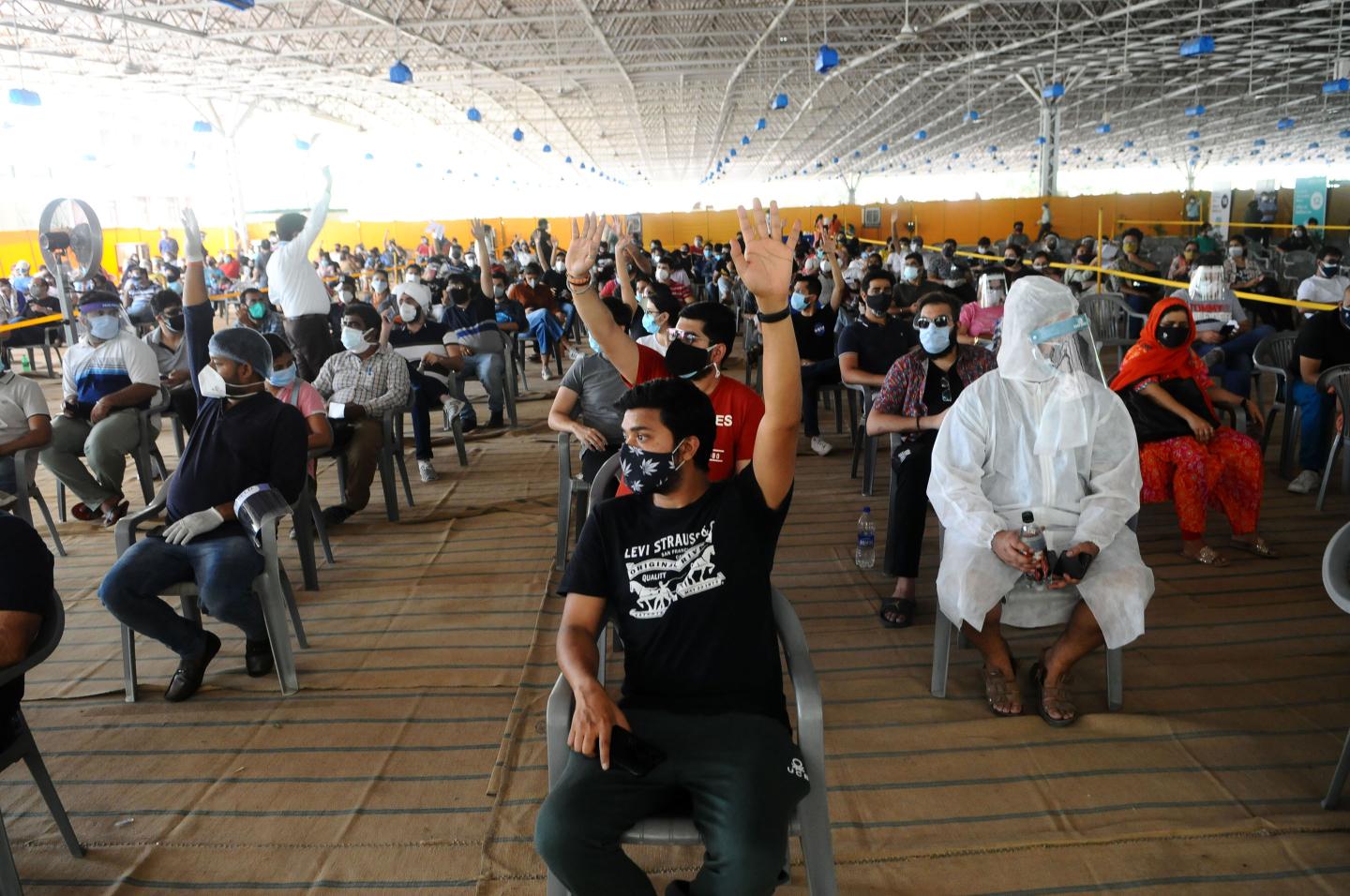
It’s jarring to see the images from India, Brazil, and other countries fighting COVID outbreaks, as the U.S. celebrates a surplus of vaccines and circulates memos on reopening offices. Kumar reminds us not to be complacent: “It’s important to understand that with this pandemic, no one is safe unless everyone is safe,” he said. “The private sector’s role is to make sure the global economy continues to move forward, and [that] large, global employers like us can engage with our people across borders to build trust and ease public hesitancy toward vaccines.”
While the past few years and a rise of autocratic leaders forced some countries to turn inward, our interdependence remains: It is literally impossible to go a day without consuming a good or service that doesn’t involve the labor of people from countries other than our own. As I wrote in a recent piece on my community news site, connecting neighborhoods in New York City to the issue of broader global vaccine equity: “If you want to see your grandmother again or grab a bulgogi burger at McDonald’s in Korea, we need to commit to the idea of everyone in the world being worthy of a COVID vaccine.”
Employers play a role in spreading that message, too. Said Kumar: “Businesses are uniquely equipped to chime in with reason and reassurance and to bring the transparency and clarity that is needed to counter the spread of distrust and fear associated with COVID-19 vaccinations.”
In the absence of rules or coordination or common sense, companies must step up
Infosys employees who travel for work have been asked to self-quarantine “irrespective of government regulations” and avoid visiting Infosys or client offices for a minimum of one week upon their arrival.
Travelers, leisure and business alike, have voiced frustration over conflicting, confusing guidance on COVID tests and quarantine restrictions. In the absence of coordination, Kumar explains, “governments are focused on their citizens, those who are largely located within a geographic border; businesses focus on their employees—no matter where they are.”
One study by TNMT, which monitors trends in travel and mobility, concludes workers will come to rely on this guidance when making decisions about travel: “Companies will need to put additional emphasis on their moral and legal obligation to protect employees.”
The same survey also said technology cannot replace business travel, which makes the urgency of fighting COVID even more imperative for a global economy. “It’s not just about being in the same room, it’s also about showing commitment. What if you are working on a multimillion-dollar contract, and propose a Zoom call, while your competitors fly out to see the potential client in person. Who do you think looks more committed?” said Wouter Geerts, a senior research analyst at Skift, a travel site.
Give employees with COVID time off
Infosys provides 21 days of additional paid leave for employees who have contracted or are recovering from COVID. Contrast that with the six to 10 days seemingly more common in U.S. workplaces, or the two weeks secured by public sector employers.
Take care of employees’ families, too
Last week, Indian newspapers reported Infosys had set up COVID care centers in offices in Pune and Bangalore, and more were on the way; some campuses also have set up vaccination centers. Notably, they are not just for workers but their families too. This holistic approach—it’s not uncommon to see entire housing colonies, hospitals, and schools built by Indian employers—is significant because it addresses a common source of COVID transmission: households and families.
It also eases vaccine distribution (a rollout which has been complicated and outright bungled in many parts of the world) by taking it to a place people are already familiar with: work.
Make vaccines free and accessible
The message over and over from Kumar, back in December, then in March and now, has been that Infosys will cover the cost of vaccines for employees. It’s about more than the money, he noted: “This is important to us because not only do we want to reduce this burden on our employees, but also because we believe that businesses have a big role to play in vaccinating the world.”
Customizing is key, said Bonnie Puckett, an employment lawyer with Ogletree Deakins, because workers around the world have different realities when it comes to COVID: Some countries are still in lockdown; others are wide open; many are in between. “The vaccine supply is quite limited in many places, and preemptive communication about mandating the vaccine or asking employees about vaccination status can come across as tone deaf,” she said. Puckett added that she is seeing companies help their workers get the vaccine whenever possible. They are trying to “secure vaccine supply for employees in the limited number of locations where this is a possibility,” she said. “And some are researching the extent to which cross-border ‘vaccine tourism’ is possible.”
Almost half of organizations in a Gartner HR survey say they won’t track employees’ vaccination status. But free vaccines, on-site vaccines, and other perks help underscore where a company stands on the issue. Clif Bar & Co. announced last week that employees will receive a $150 incentive if they get vaccinated. If they donate that amount, the company will apply the money to the Migrant Clinicians Network, which addresses farmworkers’ health inequities. “Equitable access to vaccines is an issue of paramount importance to businesses right now,” said Clif Bar CEO Sally Grimes. “Too many of our nation’s workers, especially frontline employees, still face significant hurdles to getting vaccinated.”
Every workplace in the world must acknowledge trauma
Like many companies offering enhanced benefits, Infosys has rolled out a series of initiatives over the past year related to mental health, self-care, women’s health, and work/life balance.
That’s important as countries such as India, Brazil, Peru, Nepal, and Sweden see a rise in cases. Just because your city or country is opening up does not mean the person on videoconference (or their family) is out of the woods yet. The post-COVID recovery will be an uneven, likely inequitable one, and employers need to continue to treat a global workforce as fragile—and connected.
A strong COVID response can be good for business
A business newspaper reporting on Infosys’s new COVID centers was sure to point out: “The company, which gets 86% of its revenues from markets like the U.S. and Europe, said it sees no impact on its client deliverables due to the current health situation.”
The private sector has much at stake right now, and it’s okay to admit that mobilizing effective COVID responses is as much about taking care of employees as about taking care of business.
Besides death tolls and case counts, the other daily headlines we are seeing related to India: “Four reasons why India’s COVID-19 crisis may derail the global economy” and “India’s COVID-19 crisis threatens a global oil recovery,” for example.
I asked Madhavi Sunder, a Georgetown law professor, what multinational companies (MNCs) can do to help stave off further crisis. She had two ideas. One, donate to Covax, the initiative to bridge the vaccine divide in developing countries. And two, she said, “MNCs can help pay for vaccine manufacturers in the developing world to retrofit their factories for COVID-19 vaccine production. We need to invest to help ready manufacturers in Thailand, Brazil, South Africa, Bangladesh, and other developing countries.”
As we have seen through the pandemic, what happens in one country does not stay in one country.
Visit Fortune’s SmarterWorking Hub presented by Future Forum by Slack. And read more here:
- IBM’s new path to a six-figure job no longer requires a college degree.
- Smile! Humor may be the missing ingredient at work right now.
- Right now, it’s all about the side hustle.
- Why an immigrant mindset is such a valuable asset during COVID.
- The great big (and confusing) return to the office is beginning.