• Home
  • Latest
  • Fortune 500
  • Finance
  • Tech
  • Leadership
  • Lifestyle
  • Rankings
  • Multimedia

Trendingnow

1

After forcing workers back to the office, Goldman Sachs and JPMorgan Chase are now letting their staff work remotely—but only for the World Cup

2

Markets tumble worldwide as Fed resets expectations: $400 billion wiped off SpaceX stock

3

Meet the 2 men putting New York's $300 billion pension fund in play for the first time in 20 years

1

After forcing workers back to the office, Goldman Sachs and JPMorgan Chase are now letting their staff work remotely—but only for the World Cup

2

Markets tumble worldwide as Fed resets expectations: $400 billion wiped off SpaceX stock

3

Meet the 2 men putting New York's $300 billion pension fund in play for the first time in 20 years
CommentaryCoronavirus

In the fight against COVID, Brazil’s surge won’t stay in Brazil

By
Carolyn Barber
Carolyn Barber
Down Arrow Button Icon
By
Carolyn Barber
Carolyn Barber
Down Arrow Button Icon
April 23, 2021, 9:00 AM ET
Commentary Brazil Covid
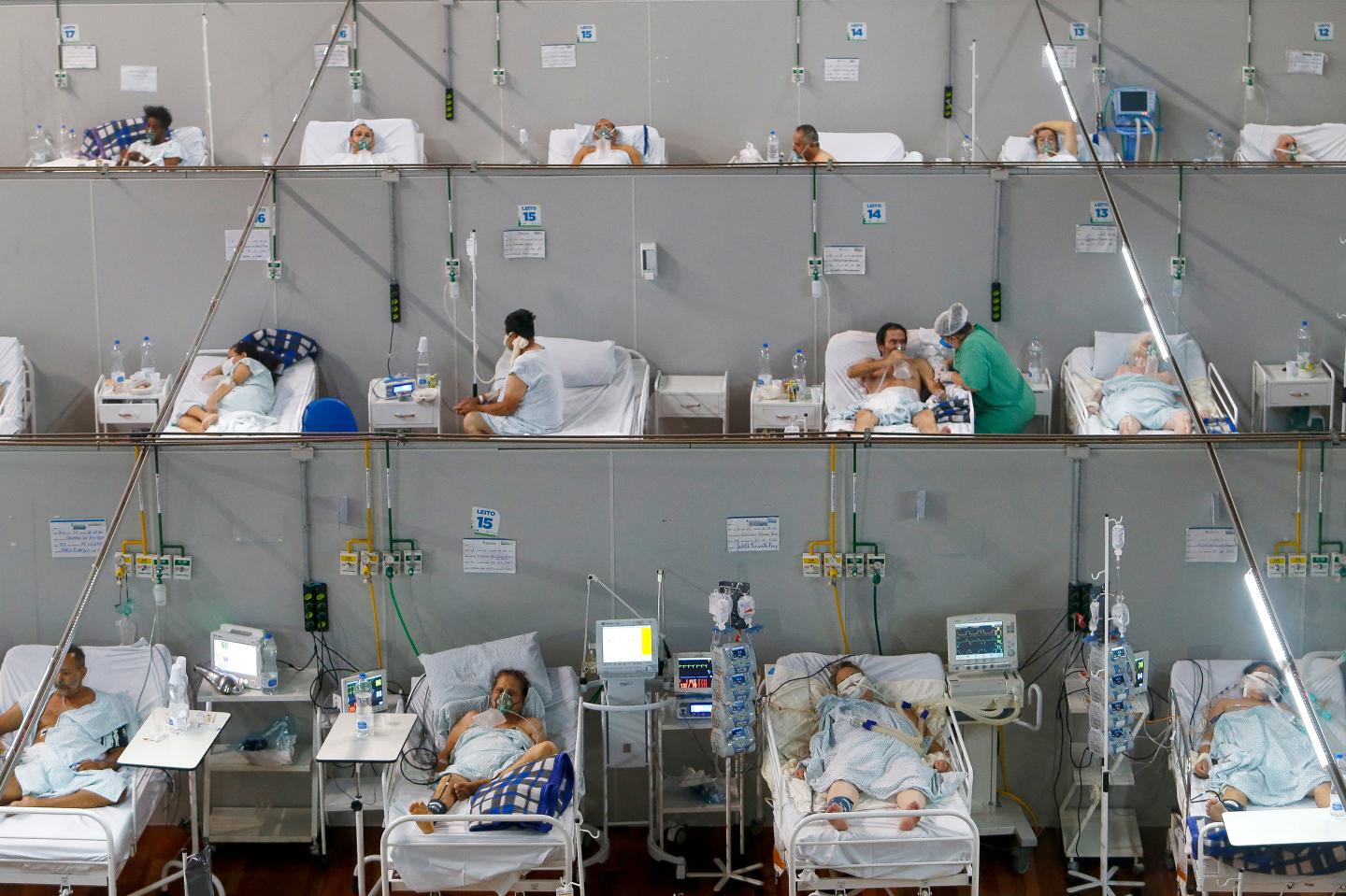
Patients at a field hospital in Santo André, Brazil, on March 26, 2021.MIGUEL SCHINCARIOL—AFP/Getty Images
Add Fortune on Google for similar content.

The helicopter view of the COVID-19 crisis gripping Brazil might, at first glance, look awfully familiar. It includes a botched initial response and the downplaying of its seriousness by those at the top, the undermining of science and vaccination efforts, the crush of patients on overloaded intensive care units, and the promotion of quack “cures” like hydroxychloroquine and ivermectin, among other missteps.

But the Brazil story contains a twist that even those in the U.S. might not have anticipated: the emergence of a variant that may be twice as transmissible as the original, which is mutating in ways that could make it more resistant to vaccines. And because the country has failed to control it, Brazil is functionally now an exporter of a deadly strain that already has been found in half of American states.

This is a humanitarian moment, but it’s also about to be a global one. In interviews with multiple physicians and researchers in Brazil, a picture emerges of a health system on the brink of collapse—and what happens in Brazil is not going to stay in Brazil.

“I have been working in the ICU since 2010, and I can honestly say that I have never experienced an event with such drastic impact on critical care capacity strain,” Dr. Regis Rosa, a physician at Hospital Moinhos de Vento in Porto Alegre, told me in an email. “Lack of ICU beds and essential treatments, as well as the lack of trained professionals and increased workload, are part of a common scenario to Brazilian hospitals.”

It is a grim scene. Experts in Brazil describe perilous circumstances, with hospitals across multiple states running low on things like “intubation kits” that include sedatives and analgesic and neuromuscular medications needed to allow doctors and nurses to intubate patients for ventilation. 

Absent those kits, patients sometimes have tubes inserted in their throats using inadequate or nonstandard medication, a painful and potentially dangerous procedure that causes some to “buck the tube,” or choke. “Diluting sedatives and the more frequent use of restraints have been part of the ‘standard of care’ in this context of treatment shortages,” said Rosa.

“The [hospital care] situation is dire in the whole country,” Marcelo Gomes, a researcher at Brazil’s Oswaldo Cruz Foundation, or Fiocruz, explained in an email. A regional hospital in Mato Grosso do Sul, Gomes said, recently denied admission to new ICU patients for 24 hours while it negotiated the loan of medications from a pool of private hospitals. Some patients, he said, “died while waiting for an ICU bed,” and the patient wait lists sometimes number in the hundreds.

Brazil has the second-highest total of confirmed COVID-19 deaths in the world at more than 375,000, trailing only the U.S.—and with the emergence of the P.1 variant, the country’s health system has been pushed to the brink. “Collapse is imminent,” São Paulo Health Secretary Jean Gorinchteyn wrote in a letter to the federal government.

Much of the blame has been laid at the feet of Brazil’s President, Jair Bolsonaro, who has repeatedly minimized COVID’s danger and recently told reporters, “All of us are going to die one day. There is no point running away from reality. We have to stop being a country of sissies.” 

Bolsonaro has a long record of doubting mask efficacy and flouting public health recommendations, and the Order of Attorneys of Brazil recently concluded that his inaction during the COVID crisis constitutes grounds for impeachment. 

Luciano Goldani, professor of medicine and editor-in-chief of the Brazilian Journal of Infectious Diseases, said in an interview that although Brazil’s public health system has worked well in the past to fend off viruses like H1N1 influenza and polio, Bolsonaro is a “denialist…He doesn’t believe too much in the health consequences of COVID-19.”

Now, with the virus raging, an exhausted health system cannot meet demand. A recent survey showed that hospitals in six states have critically low oxygen supplies, and although its hospitals contain roughly 36,000 ICU beds, one of the largest numbers per capita in the world, Brazil has fewer than 6,000 adult critical care physicians and only about 1,500 pediatric critical care doctors. Rosa said that some hospitals have had to contract non-intensivists or even hire newly graduated medical school clinicians who lack the experience for this complex care.

Meanwhile, “Our immunization process is very slow,” said Goldani. With a total of 32 million doses administered, just over 4% of the population is fully vaccinated. Supply is the bottleneck. “If we don’t have vaccines, we cannot vaccinate,” Goldani said simply.

If the government had prioritized vaccines from the get-go, experts believe, Brazil would be in a very different place. “We didn’t do any deals last year, so we are struggling to get vaccines now,” said Goldani. 

Bolsonaro, who once suggested that Pfizer’s vaccine might turn people into crocodiles, turned down that company’s offer last August to sell Brazil 70 million doses. It was not until last month that his government finally contracted for 100 million doses, along with millions more from other suppliers, including both Fiocruz (AstraZeneca) and São Paulo’s Butantan Institute (the China-made CoronaVac, which Goldani said has provided about 80% of Brazilian vaccinations so far). Unfortunately, supply constraints have plagued local vaccine production.

Goldani said the belated vaccine plan is a good “medium- to long-term strategy.” In the meantime, mitigations like masking, distancing, and crowd avoidance are critical. Brazilian expert Marcia C. de Castro, chair of the Department of Global Health and Population at the Harvard T.H. Chan School of Public Health, told me she believes lockdowns should be imposed in hard-hit areas of Brazil as soon as possible. Bolsonaro avidly opposes such restrictions.

The pandemic in Brazil demands the world’s attention—and the world can, indeed, help. The U.S. alone has purchased three times the amount of coronavirus vaccines it needs for its adult population; as of mid-March, it had contracted to buy 1.2 billion doses from six different vaccine manufacturers, according to the Washington Post. Perhaps America could redirect some of these spare doses Brazil’s way. 

And perhaps the U.S. government can share intellectual property rights on patent no. 10,960,070—more commonly known as the ’070 patent—which relates to spike protein stabilization in vaccines, and encourage companies like Moderna to share their technological expertise so Brazil and other countries can manufacture highly effective mRNA vaccines locally.

These would certainly qualify as humanitarian efforts. But if that appeal isn’t strong enough, then the U.S. should simply confront the larger truth: If it doesn’t help control the spread of the variant in Brazil, Americans will soon be the ones dealing with the brutal effects of its perilous surge.

Carolyn Barber has been an emergency department physician for 25 years. She is cofounder of the homeless work program Wheels of Change and author of the book Runaway Medicine: What You Don’t Know May Kill You, which was a top-ranked Amazon bestseller in health care administration.

About the Author
By Carolyn Barber
See full bioRight Arrow Button Icon
Add Fortune on Google for similar content.

Latest in Commentary

Finance
Lorem ipsum dolor sit amet, consectetur adipiscing elit, sed do eiusmod tempor incididunt ut labore et dolore magna aliqua. Ut enim ad minim veniam
By Fortune Editors
October 20, 2025
Finance
Lorem ipsum dolor sit amet, consectetur adipiscing elit, sed do eiusmod tempor incididunt ut labore et dolore magna aliqua. Ut enim ad minim veniam
By Fortune Editors
October 20, 2025
Finance
Lorem ipsum dolor sit amet, consectetur adipiscing elit, sed do eiusmod tempor incididunt ut labore et dolore magna aliqua. Ut enim ad minim veniam
By Fortune Editors
October 20, 2025
Finance
Lorem ipsum dolor sit amet, consectetur adipiscing elit, sed do eiusmod tempor incididunt ut labore et dolore magna aliqua. Ut enim ad minim veniam
By Fortune Editors
October 20, 2025
Finance
Lorem ipsum dolor sit amet, consectetur adipiscing elit, sed do eiusmod tempor incididunt ut labore et dolore magna aliqua. Ut enim ad minim veniam
By Fortune Editors
October 20, 2025
Finance
Lorem ipsum dolor sit amet, consectetur adipiscing elit, sed do eiusmod tempor incididunt ut labore et dolore magna aliqua. Ut enim ad minim veniam
By Fortune Editors
October 20, 2025

Most Popular

Finance
Lorem ipsum dolor sit amet, consectetur adipiscing elit, sed do eiusmod tempor incididunt ut labore et dolore magna aliqua. Ut enim ad minim veniam
By Fortune Editors
October 20, 2025
Finance
Lorem ipsum dolor sit amet, consectetur adipiscing elit, sed do eiusmod tempor incididunt ut labore et dolore magna aliqua. Ut enim ad minim veniam
By Fortune Editors
October 20, 2025
Finance
Lorem ipsum dolor sit amet, consectetur adipiscing elit, sed do eiusmod tempor incididunt ut labore et dolore magna aliqua. Ut enim ad minim veniam
By Fortune Editors
October 20, 2025
Finance
Lorem ipsum dolor sit amet, consectetur adipiscing elit, sed do eiusmod tempor incididunt ut labore et dolore magna aliqua. Ut enim ad minim veniam
By Fortune Editors
October 20, 2025
Finance
Lorem ipsum dolor sit amet, consectetur adipiscing elit, sed do eiusmod tempor incididunt ut labore et dolore magna aliqua. Ut enim ad minim veniam
By Fortune Editors
October 20, 2025
Finance
Lorem ipsum dolor sit amet, consectetur adipiscing elit, sed do eiusmod tempor incididunt ut labore et dolore magna aliqua. Ut enim ad minim veniam
By Fortune Editors
October 20, 2025
Fortune Secondary Logo
Rankings
  • 100 Best Companies
  • Fortune 500
  • Global 500
  • Fortune 500 Europe
  • Most Powerful Women
  • World's Most Admired Companies
  • See All Rankings
  • Lists Calendar
Sections
  • Finance
  • Fortune Crypto
  • Features
  • Leadership
  • Health
  • Commentary
  • Success
  • Retail
  • Mpw
  • Tech
  • Lifestyle
  • CEO Initiative
  • Asia
  • Politics
  • Conferences
  • Europe
  • Newsletters
  • Personal Finance
  • Environment
  • Magazine
  • Education
Customer Support
  • Frequently Asked Questions
  • Customer Service Portal
  • Privacy Policy
  • Terms Of Use
  • Single Issues For Purchase
  • International Print
Commercial Services
  • Advertising
  • Fortune Brand Studio
  • Fortune Analytics
  • Fortune Conferences
  • Business Development
  • Group Subscriptions
About Us
  • About Us
  • Press Center
  • Work At Fortune
  • Terms And Conditions
  • Site Map
  • About Us
  • Press Center
  • Work At Fortune
  • Terms And Conditions
  • Site Map
  • Facebook icon
  • Twitter icon
  • LinkedIn icon
  • Instagram icon
  • Pinterest icon

Latest in Commentary

sb
Commentaryclimate change
The climate policy triangle: why leaders can no longer choose between growth, security and sustainability
By Sebastian BuckupJune 23, 2026
8 hours ago
brett
CommentaryManagement
Middle managers aren’t going extinct—they’re evolving into something more powerful
By Brett HurtJune 23, 2026
17 hours ago
ravi
CommentaryAI agents
Yale School of Management: surveillance pricing is just the beginning. AI agents will be the real test of corporate trust
By Ravi Dhar and Jon IwataJune 23, 2026
18 hours ago
elon
CommentaryElon Musk
Elon Musk’s trillion dollars aren’t real — and that’s the point
By Douglas P. McCormickJune 23, 2026
18 hours ago
gen z
CommentaryCareers
Gen Z: if you want to succeed at work, you need to start friction-maxxing
By Michelle SobelJune 23, 2026
19 hours ago
rp
CommentaryLaw
Cooley CEO: Big Law won’t survive if it treats AI as just an efficiency tool
By Rachel ProffittJune 23, 2026
19 hours ago

Most Popular

After forcing workers back to the office, Goldman Sachs and JPMorgan Chase are now letting their staff work remotely—but only for the World Cup
Success
After forcing workers back to the office, Goldman Sachs and JPMorgan Chase are now letting their staff work remotely—but only for the World Cup
By Orianna Rosa RoyleJune 23, 2026
17 hours ago
Markets tumble worldwide as Fed resets expectations: $400 billion wiped off SpaceX stock
Banking
Markets tumble worldwide as Fed resets expectations: $400 billion wiped off SpaceX stock
By Jim EdwardsJune 23, 2026
19 hours ago
Meet the 2 men putting New York's $300 billion pension fund in play for the first time in 20 years
Investing
Meet the 2 men putting New York's $300 billion pension fund in play for the first time in 20 years
By Nick LichtenbergJune 22, 2026
2 days ago
Current price of oil as of June 23, 2026
Personal Finance
Current price of oil as of June 23, 2026
By Joseph HostetlerJune 23, 2026
17 hours ago
Former U.S. Secret Service agent says bringing your authentic self to work stifles teamwork: 'You don’t get high performers, you get sloppiness'
Success
Former U.S. Secret Service agent says bringing your authentic self to work stifles teamwork: 'You don’t get high performers, you get sloppiness'
By Sydney LakeJune 21, 2026
3 days ago
Current price of oil as of June 22, 2026
Personal Finance
Current price of oil as of June 22, 2026
By Joseph HostetlerJune 22, 2026
2 days ago

© 2026 Fortune Media IP Limited. All Rights Reserved. Use of this site constitutes acceptance of our Terms of Use and Privacy Policy | CA Notice at Collection and Privacy Notice | Do Not Sell/Share My Personal Information
FORTUNE is a trademark of Fortune Media IP Limited, registered in the U.S. and other countries. FORTUNE may receive compensation for some links to products and services on this website. Offers may be subject to change without notice.