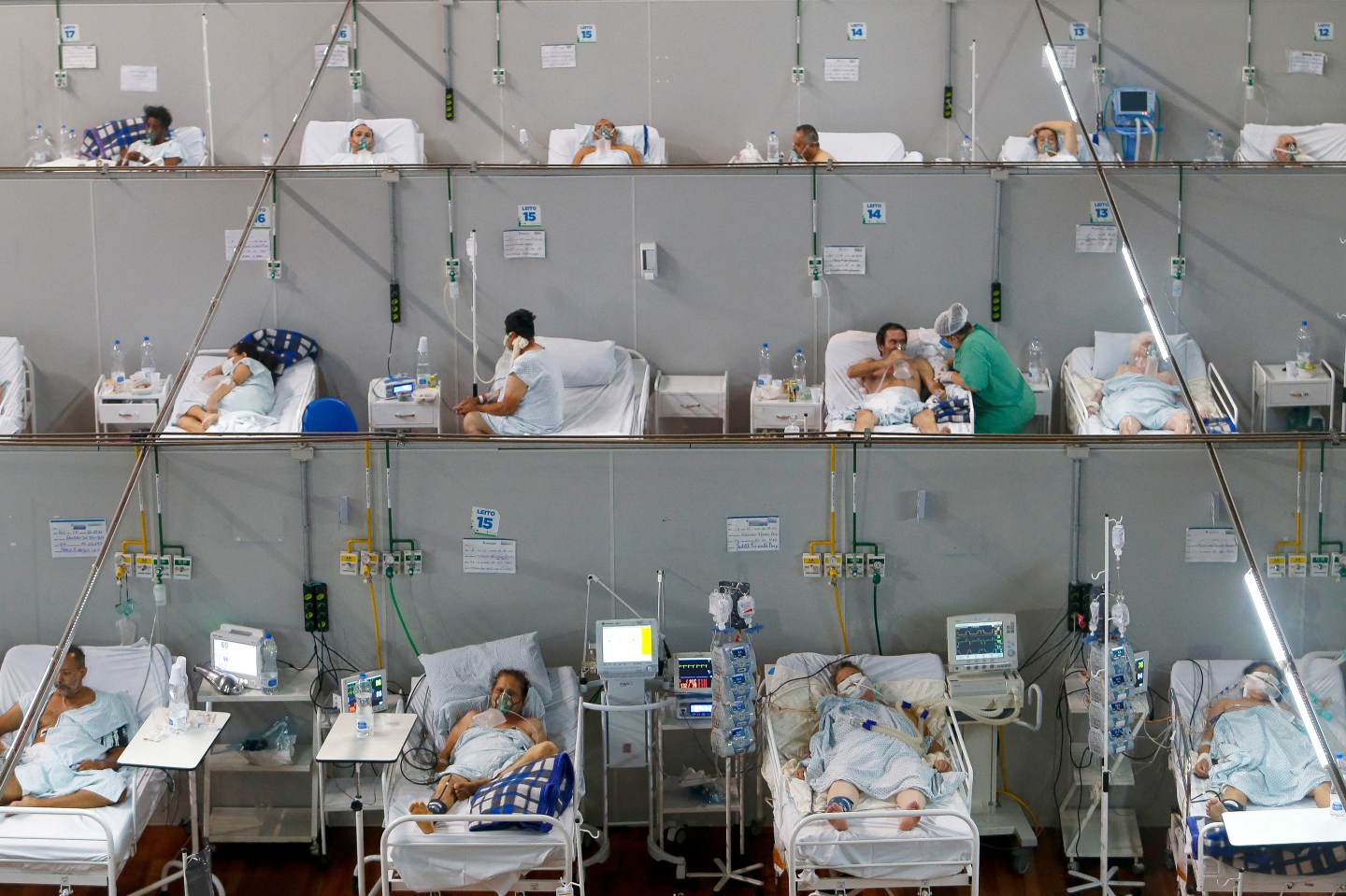
The helicopter view of the COVID-19 crisis gripping Brazil might, at first glance, look awfully familiar. It includes a botched initial response and the downplaying of its seriousness by those at the top, the undermining of science and vaccination efforts, the crush of patients on overloaded intensive care units, and the promotion of quack “cures” like hydroxychloroquine and ivermectin, among other missteps.
But the Brazil story contains a twist that even those in the U.S. might not have anticipated: the emergence of a variant that may be twice as transmissible as the original, which is mutating in ways that could make it more resistant to vaccines. And because the country has failed to control it, Brazil is functionally now an exporter of a deadly strain that already has been found in half of American states.
This is a humanitarian moment, but it’s also about to be a global one. In interviews with multiple physicians and researchers in Brazil, a picture emerges of a health system on the brink of collapse—and what happens in Brazil is not going to stay in Brazil.
“I have been working in the ICU since 2010, and I can honestly say that I have never experienced an event with such drastic impact on critical care capacity strain,” Dr. Regis Rosa, a physician at Hospital Moinhos de Vento in Porto Alegre, told me in an email. “Lack of ICU beds and essential treatments, as well as the lack of trained professionals and increased workload, are part of a common scenario to Brazilian hospitals.”
It is a grim scene. Experts in Brazil describe perilous circumstances, with hospitals across multiple states running low on things like “intubation kits” that include sedatives and analgesic and neuromuscular medications needed to allow doctors and nurses to intubate patients for ventilation.
Absent those kits, patients sometimes have tubes inserted in their throats using inadequate or nonstandard medication, a painful and potentially dangerous procedure that causes some to “buck the tube,” or choke. “Diluting sedatives and the more frequent use of restraints have been part of the ‘standard of care’ in this context of treatment shortages,” said Rosa.
“The [hospital care] situation is dire in the whole country,” Marcelo Gomes, a researcher at Brazil’s Oswaldo Cruz Foundation, or Fiocruz, explained in an email. A regional hospital in Mato Grosso do Sul, Gomes said, recently denied admission to new ICU patients for 24 hours while it negotiated the loan of medications from a pool of private hospitals. Some patients, he said, “died while waiting for an ICU bed,” and the patient wait lists sometimes number in the hundreds.
Brazil has the second-highest total of confirmed COVID-19 deaths in the world at more than 375,000, trailing only the U.S.—and with the emergence of the P.1 variant, the country’s health system has been pushed to the brink. “Collapse is imminent,” São Paulo Health Secretary Jean Gorinchteyn wrote in a letter to the federal government.
Much of the blame has been laid at the feet of Brazil’s President, Jair Bolsonaro, who has repeatedly minimized COVID’s danger and recently told reporters, “All of us are going to die one day. There is no point running away from reality. We have to stop being a country of sissies.”
Bolsonaro has a long record of doubting mask efficacy and flouting public health recommendations, and the Order of Attorneys of Brazil recently concluded that his inaction during the COVID crisis constitutes grounds for impeachment.
Luciano Goldani, professor of medicine and editor-in-chief of the Brazilian Journal of Infectious Diseases, said in an interview that although Brazil’s public health system has worked well in the past to fend off viruses like H1N1 influenza and polio, Bolsonaro is a “denialist…He doesn’t believe too much in the health consequences of COVID-19.”
Now, with the virus raging, an exhausted health system cannot meet demand. A recent survey showed that hospitals in six states have critically low oxygen supplies, and although its hospitals contain roughly 36,000 ICU beds, one of the largest numbers per capita in the world, Brazil has fewer than 6,000 adult critical care physicians and only about 1,500 pediatric critical care doctors. Rosa said that some hospitals have had to contract non-intensivists or even hire newly graduated medical school clinicians who lack the experience for this complex care.
Meanwhile, “Our immunization process is very slow,” said Goldani. With a total of 32 million doses administered, just over 4% of the population is fully vaccinated. Supply is the bottleneck. “If we don’t have vaccines, we cannot vaccinate,” Goldani said simply.
If the government had prioritized vaccines from the get-go, experts believe, Brazil would be in a very different place. “We didn’t do any deals last year, so we are struggling to get vaccines now,” said Goldani.
Bolsonaro, who once suggested that Pfizer’s vaccine might turn people into crocodiles, turned down that company’s offer last August to sell Brazil 70 million doses. It was not until last month that his government finally contracted for 100 million doses, along with millions more from other suppliers, including both Fiocruz (AstraZeneca) and São Paulo’s Butantan Institute (the China-made CoronaVac, which Goldani said has provided about 80% of Brazilian vaccinations so far). Unfortunately, supply constraints have plagued local vaccine production.
Goldani said the belated vaccine plan is a good “medium- to long-term strategy.” In the meantime, mitigations like masking, distancing, and crowd avoidance are critical. Brazilian expert Marcia C. de Castro, chair of the Department of Global Health and Population at the Harvard T.H. Chan School of Public Health, told me she believes lockdowns should be imposed in hard-hit areas of Brazil as soon as possible. Bolsonaro avidly opposes such restrictions.
The pandemic in Brazil demands the world’s attention—and the world can, indeed, help. The U.S. alone has purchased three times the amount of coronavirus vaccines it needs for its adult population; as of mid-March, it had contracted to buy 1.2 billion doses from six different vaccine manufacturers, according to the Washington Post. Perhaps America could redirect some of these spare doses Brazil’s way.
And perhaps the U.S. government can share intellectual property rights on patent no. 10,960,070—more commonly known as the ’070 patent—which relates to spike protein stabilization in vaccines, and encourage companies like Moderna to share their technological expertise so Brazil and other countries can manufacture highly effective mRNA vaccines locally.
These would certainly qualify as humanitarian efforts. But if that appeal isn’t strong enough, then the U.S. should simply confront the larger truth: If it doesn’t help control the spread of the variant in Brazil, Americans will soon be the ones dealing with the brutal effects of its perilous surge.
Carolyn Barber has been an emergency department physician for 25 years. She is cofounder of the homeless work program Wheels of Change and author of the book Runaway Medicine: What You Don’t Know May Kill You, which was a top-ranked Amazon bestseller in health care administration.