Last June, as the nation convulsed with protests against racial inequality and the police killings of George Floyd, Breonna Taylor, and too many others, Nike was in the same predicament as much of corporate America—pledging to help rectify society’s mistreatment and exclusion of Black people, while simultaneously being called out for its own failings on that front.
Even as the sports-gear maker promised to prioritize racial inclusion, some of its own workers took to social media to decry racism at the company, citing microaggressions, lesser advancement opportunities for Black employees, and instances of Black shoppers being profiled at Nike stores. Nike stressed that the company prohibited discrimination based on race, but it encouraged workers to keep speaking out, and CEO John Donahoe admitted in a memo to staff that “our most important priority is to get our own house in order.”
Nine months later, Nike made its commitment to equity more tangible—by pegging some of Donahoe’s pay to it. In March, Nike announced that part of its executives’ long-term bonuses would be contingent on hitting specific diversity goals by 2025. Donahoe’s potential penalty for missing those targets: a six- or even seven-figure chunk of his compensation.
Business leaders have long been saying the right things about racial and gender inclusion, with only modest improvements to show for it. (There are still only five Black CEOs and 40 female CEOs in the Fortune 500, to cite but one metric.) But as diversity becomes an ever greater focus of Wall Street, employees, and the public, more corporate boards are aligning executives’ pay with their platitudes. The past year’s upheaval is “causing companies to think, ‘If we’re serious about this, we ought to make sure there is a visible link between what we say and do and how we’re rewarding our executives,’ ” says Don Lowman, a global leader at Korn Ferry who advises boards on compensation.
This year alone, Apple, McDonald’s, and Chipotle Mexican Grill are among the boldface-name companies to make bonuses partially contingent on measurable progress on gender and racial equity. Alphabet’s Google took a step in that direction, saying it will include such metrics in executive performance reviews. Uber, once criticized for its “bro culture,” linked bonuses to diversity two years ago; Microsoft, Intel, and utility FirstEnergy have been doing so even longer.
The shift doesn’t yet add up to a mad rush: A mere 97 of the companies in the Russell 3000 (or 3.2%) have at least one diversity goal for at least one top executive, according to compensation consulting firm Pearl Meyer, citing data from Main Data Group. Still, diversity and inclusion are joining climate-friendliness as areas where companies are being urged to prove their merit—not least by investors who want companies to meet environmental, social, and governance (ESG) benchmarks. (Fortune is part of this effort, partnering with financial data firm Refinitiv on a program called “Measure Up,” to help companies collect and report diversity and inclusion data.) Aalap Shah, a managing director at Pearl Meyer, says that as recently as 2018, when he spoke to executives and boards about diversity as a factor in compensation, he’d get quizzical looks. But since last summer, companies are listening up, lest they be seen as out of step.
Companies are typically pegging 10% to 15% of bonuses to the goals. Bonuses account for about 20% of executive comp, according to leadership data firm Equilar, so the targets put only 2% to 3% of a C-suite dweller’s pay at risk. Still, 3% of a CEO compensation package can add up to a pay cut that’s symbolically large. In a regulatory filing in February, for example, McDonald’s said progress on “human capital” metrics would determine 15% of bonuses—and noted that missing those goals would have cost CEO Chris Kempczinski more than $300,000 in 2020.
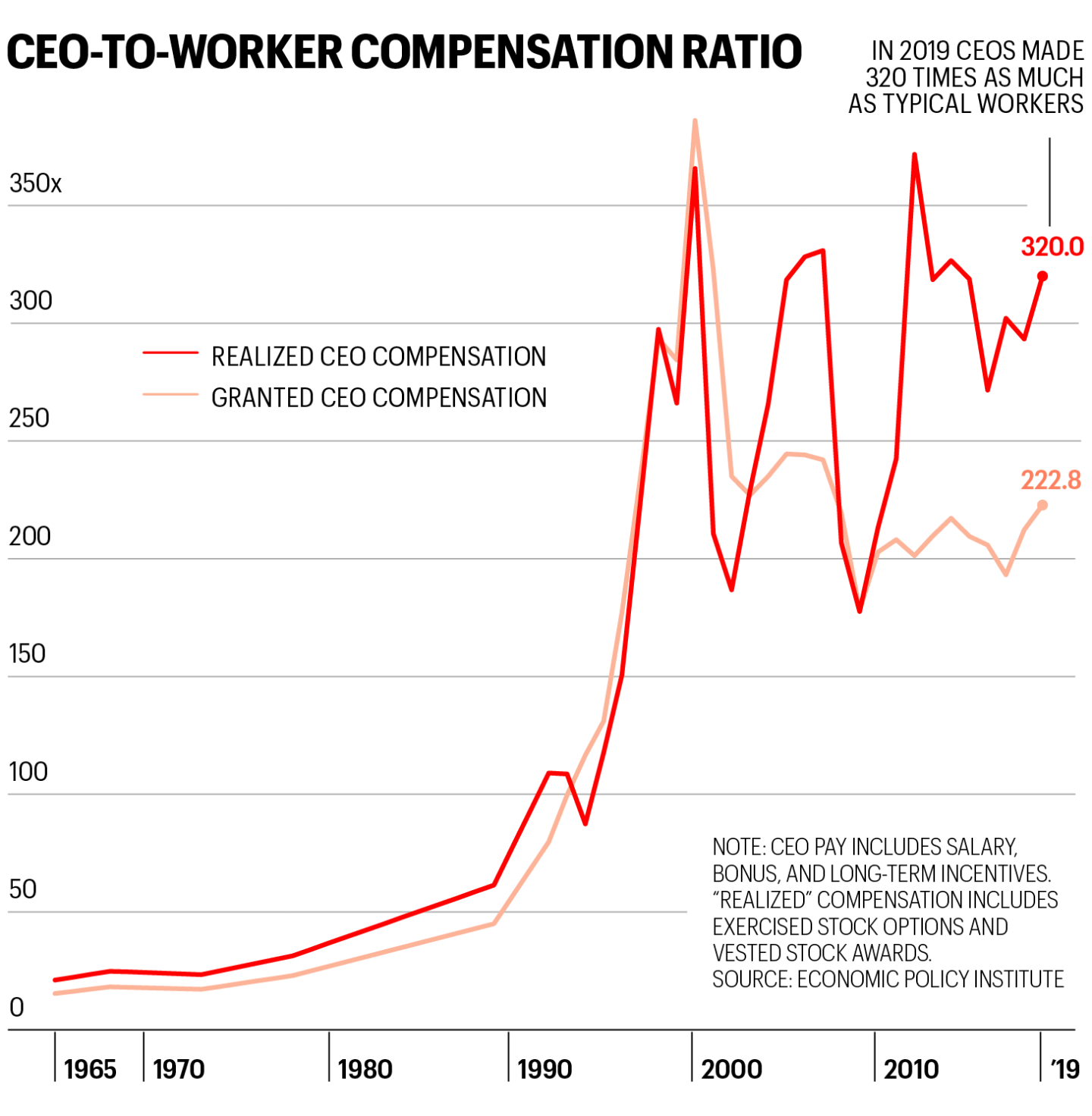
Indeed, holding executives accountable on gender and racial equity is particularly crucial given the economic inequity embedded in the CEO-worker pay gap. According to the Economic Policy Institute, the ratio of CEO compensation to rank-and-file pay at public companies was 320 to 1 in 2019, with much of that gap reflecting the sky-high value of bonuses and stock options. Amid such glaring disparities, companies face pressure to show that their executives earn their riches by contributing to a greater good. Diversity targets could help activists apply such pressure. But it’s too early to tell what targets will work best—and whether the cost of missing them is high enough.

It’s telling that many companies have linked pay to diversity following an outcry from their own employees. Google, for example, has faced internal backlash over its treatment of women and people of color; McDonald’s is under withering scrutiny for a purportedly sexist management culture and for its treatment of Black employees and franchisees.
According to proxy-vote adviser Institutional Shareholder Services, 18.9% of 6,400 public companies it studied last year worldwide (and 8.3% of 2,800 companies in the U.S.) had tied compensation to at least one environmental or social incentive. “What gets measured gets done,” says ISS director of research Anthony Campagna.
But companies have struggled to decide how to measure progress on inclusion. Sustainability targets involve relatively objective factors like carbon emissions, water use, and waste reduction. But in diversity, hitting numerical goals—say, elevating a certain number of women or people of color to management—doesn’t ensure an inclusive culture. “You can go out and hire 10 people tomorrow and satisfy that objective, but not really have made progress in your diversity practices,” warns Korn Ferry’s Lowman.
Courtney Yu, director of research at Equilar, says the most effective incentives will reward executives for building better pipelines to leadership for underrepresented groups. That could involve recruiting from a wider range of colleges, including historically Black colleges and universities; improving mentorship programs; and providing better family-care support to working mothers.
8.3%
Share of U.S. public companies tying executive compensation to at least one environmental or social goal
The challenge, Yu says, is measuring progress on such criteria in a way that boards are comfortable with. Some experts cite Microsoft’s approach as a model. CEO Satya Nadella and other executives earn bonuses both for hitting quantitative marks, such as drawing a certain percentage of suppliers and workers from underrepresented groups, and for more qualitative achievements, such as consensus in internal polling that the company provides a work environment where minorities can prosper.
Whatever metrics companies choose, they’ll be more likely to result in enduring changes if they’re tied to long-term incentive packages rather than annual bonuses. Nike’s decision to link long-term awards to 2025 goals is a testament to that strategy. (Nike’s goals include buying $1 billion a year from suppliers in underrepresented demographics; elevating women to 45% of management jobs; and establishing pay equity between men and women.)
History suggests that CEOs who miss targets may not actually face a pay cut. Boards have wide discretion to change compensation based on extenuating circumstances. Among the companies that used that discretion to prop up pay after a COVID-rattled 2020 were theater chain AMC Entertainment, General Electric—and Nike, which gave Donahoe a special cash bonus of $6.75 million last summer after the pandemic made it impossible for him to meet financial targets. (Nike said in a filing that it wanted “to reward strong pre-pandemic performance and to ensure sustained employee engagement.”)
It’s possible, though, that boards won’t attempt such maneuvers around diversity, since they’d risk losing the trust of their workforces, customers, and investors. Compensation experts note that companies’ actions on diversity already get plenty of public scrutiny, which in turn could fuel a virtuous cycle of adoption of concrete targets. Says Pearl Meyer’s Shah, “This is a true cultural shift.”
This article appears in the April/May issue of Fortune with the headline, “Want progress on diversity? Link it to pay.”