Our mission to make business better is fueled by readers like you. To enjoy unlimited access to our journalism, subscribe today.
Alan Yuen, a 60-year-old recent Hong Kong retiree, walked out of the Hong Kong Central Library on Friday morning with a sense of relief, happy that he was one of the first people in the city to receive a COVID-19 vaccine shot.
“The process was very smooth, just like getting any other injection,” he says. “But psychologically speaking, I feel safer.”
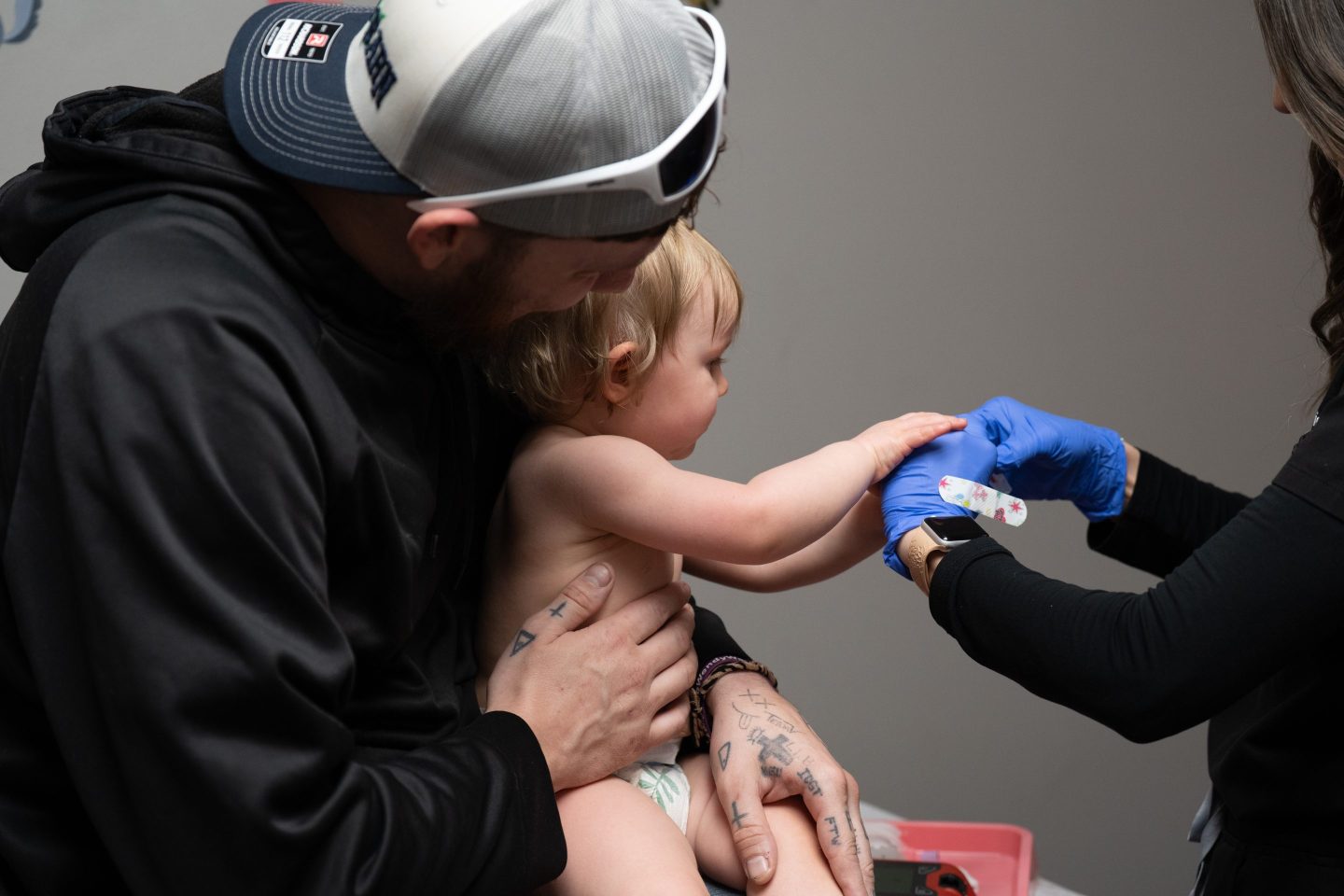
Like four other sites in the city on Friday, Hong Kong’s main library had turned into a makeshift COVID-19 vaccine center as government workers administered doses on the first day of Hong Kong’s campaign to inoculate its 7.5 million residents.
Hong Kong has approved two COVID-19 vaccines for use in the city—a 50% effective vaccine from Chinese maker Sinovac and a 95% effective one from German company BioNTech and U.S. drugmaker Pfizer. But on Friday, it was only administering Sinovac’s vaccine; BioNTech’s has run into delays but is expected to arrive in Hong Kong on Saturday.
Yuen said he didn’t have a strong preference about which vaccine to get, but opted for Sinovac because he could access it earlier and he had heard that it only induced minimal side effects.
“The protection of the Sinovac vaccine, comparatively speaking, may be lower,” he says, but Sinovac’s vaccine was available first.
Yuen’s choice is one that millions around the world may soon contend with; whether to get a less effective vaccine now or wait to get a stronger one later.
That question soon will be relevant in the U.S., which is poised to grant emergency authorization to Johnson & Johnson’s single dose COVID-19 vaccine in coming days. It’s less effective—66%—than the Pfizer and Moderna vaccines that are also available in the U.S. But limited supply of Pfizer and Moderna doses means that a J&J jab may be the only immediate option for some Americans.
Consumers’ conundrum about taking a less effective vaccine is a challenge for public health officials too. Eager to get as many people vaccinated as quickly as possible, they must determine how to get their communities to take a vaccine that may be seen as second-best.
Especially in places with high rates of COVID-19, scientists advise taking whatever vaccine is most readily available to protect yourself and others from severe COVID-19 infections and help the world reach herd immunity. And they argue that taking one of the less effective vaccines now doesn’t necessarily mean you can’t take a more effective COVID-19 vaccine later. Researchers around the world are now embarking on mixed trials to test the safety and efficacy of taking two doses of two different vaccines in the same regimen.
If it turns out, as many scientists suspect will be the case, that getting an initial dose with one vaccine and a booster dose with a different vaccine confers similar, or in some cases, even better, immunity than getting two doses of the same vaccine, it will help ease the logistical challenge of vaccinating the world’s population. Public health officials won’t need to worry as much about supply shortages since they can use a different vaccine for first and second doses. And it may encourage the public to take the vaccine that’s immediately available, even if it’s not their top choice.
Vaccine consumerism
Last June, the U.S. Food & Drug Administration set a 50% efficacy threshold for approving a COVID-19 vaccine, a figure that the World Health Organization also applied in its evaluation of COVID-19 vaccines.
But Pfizer and Moderna’s blockbuster phase III results in November recalibrated the public’s expectations for how good a COVID-19 vaccine should be. With efficacy rates above 90%, they immediately became the gold standard of COVID-19 vaccines that others are measured against. And most vaccines that have completed phase III trials since then have fallen short of the high bar they set.
In November, AstraZeneca said that its vaccine was 62% effective in preventing infections. Earlier this year, vaccine makers Sinovac and Johnson & Johnson have posted efficacy rates of 50.4% and 66%, respectively.
One exception is Russia’s Sputnik V vaccine, which posted a 92% efficacy rate on Feb. 2.
Scientists argue that even with lower efficaciousness, vaccines are critical tools in helping the world end the devastating COVID-19 pandemic, especially because Pfizer and Moderna doses remain in short supply and have storage requirements that exempt some poorer countries from using them.
Ben Cowling, an epidemiologist at Hong Kong University, says that in a place like Hong Kong, it may make sense to wait for vaccines with higher efficacy rates since residents are at low risk of catching the disease on a day-to-day basis. But in places with higher rates of infection, less effective vaccines can prevent severe cases of COVID-19 and related deaths.
“A lot of the [less effective] vaccines are very good at protection against severe disease,” he says. “Protection against mild infections” is where less effective vaccines may come up short.
Still, with more markets like Hong Kong, the U.S., the U.K., and parts of Europe offering multiple vaccines with dissimilar efficacy rates, researchers have found that there is more resistance to taking vaccines that offer less protection.
In Hong Kong, for example, a citywide poll in January found that 29.5% residents were willing to take Sinovac’s vaccine compared to the 56% willing to take the Pfizer-BioNTech vaccine. In Germany, officials are warning that citizens have turned down opportunities to take the AstraZeneca vaccine in favor of waiting for the more effective Moderna jabs.
Semra Ozdemir, an expert in medical decision making at the Duke-NUS Medical School in Singapore, says that people may refrain from taking vaccines due to concerns about efficacy and where they are produced.
Based on surveys she conducted in Singapore, Ozdemir estimates that roughly 30% to 35% of the city’s population is likely to not get vaccinated right away partially because they want to wait for the best vaccines available.
For governments to reach these people, they must be as forthcoming as possible in providing information about the vaccines and why the public should take them. “These are the people who are highly educated, they read, they want to know [about the vaccines], they believe in science, and want to believe in the numbers,” she says. Discerning members of the public, she says, “want to have more information, more data. For them, transparency is important.”
No need to choose
But even if people accept a less effective vaccine now, they may have the option to get a different vaccine in the future.
Cowling says that no matter which vaccine people get first, they will likely have the option to get a booster of a different vaccine sometime after their first injections.
“I don’t think you’d have to use the same vaccine again. A booster dose after a year or two could be with another vaccine,” says Cowling. “I would not expect any concerns about safety or risk.”
In fact, he claims that booster shots may become prevalent even before countries reach herd immunity levels.
“If we can’t reach herd immunity level in Hong Kong after the first round of vaccinations…Then we will have to find a way to improve the immunity in the population, either by vaccinating people who didn’t want to get vaccinated or by boosting the immunity of people who have been vaccinated,” Cowling says.
Mixed trials
Scientists are now engaged in early trials to determine the safety and efficacy of administering doses of separate vaccines in tandem.
In the U.K., which has approved vaccines from AstraZeneca, Pfizer, and Moderna, the National Institute for Health Research is carrying out a study to see if doses of the Pfizer and AstraZeneca vaccines can be alternated, so that a person receiving an initial dose of one vaccine can receive a jab of the other as their second dose.
The study involves more than 800 volunteers, age 50 and older, and is being conducted at eight sites across England. The volunteers will receive either two doses of the same vaccine, or one dose of each vaccine in different combinations and intervals.
Other scientists have been supportive of the study, with many saying their hunch is that the study will show that mixing vaccine types for the two doses is safe and effective.
“The antigen used in all of the vaccines currently licensed in the U.K. is exactly the same spike protein, so the immune system will recognize it and can be expected to respond at least as well if a different product is used for boosting,” Peter English, a doctor who specializes in communicable disease control and a former editor of Vaccines in Practice Magazine.
It is also possible that the vaccines will work better when used in combination with alternating doses than when a person receives two doses of a single vaccine type, English said. He noted that this has already been shown to be the case for vaccines for hepatitis B, for instance.
Jonathan Van-Tam, the U.K.’s deputy chief medical officer and the senior official responsible for the study, said that given the challenges of vaccinating not only the entire U.K. population, but much of the world’s population against COVID-19, “there are definitely advantages to having data that could support a more flexible immunization program.”
In Hong Kong on Friday, Freddy Chua, a financier in his 60s, said that he had some doubts about getting a vaccine that might be less effective than others, but he ultimately decided that it would be better to get what’s available now rather than wait for a different one later.
“I wanted to sign up for the early vaccine because I’m from Singapore,” he said, and he hopes that getting a vaccine—any vaccine—will mean he won’t have to quarantine for 14 or 21 days next time he goes home.