• Home
  • Latest
  • Fortune 500
  • Finance
  • Tech
  • Leadership
  • Lifestyle
  • Rankings
  • Multimedia
Commentaryclimate change

It’s time to think about climate adaptation

By
David Pogue
David Pogue
Down Arrow Button Icon
By
David Pogue
David Pogue
Down Arrow Button Icon
February 21, 2021, 10:00 AM ET

In 2007, a New York Times story about climate change featured an interview with John Holdren, Barack Obama’s senior science adviser. What he said has become famous in climate circles: “We basically have three choices: mitigation, adaptation, and suffering. We’re going to do some of each. The question is what the mix is going to be.”

Mitigation means trying to stop climate change. You know: Phase out fossil fuels. Fly less. Eat less beef. By now, we’ve heard this kind of advice thousands of times.

To be sure, it’s absolutely correct. We’re now getting hit by four times as many weather disasters each year as we did in the ’80s, and 2020 brought us the most hurricanes, the biggest wildfires, and the highest temperature ever measured. We should all be mitigating climate change as though our lives depend on it—and our descendants’.

What we don’t hear often, though, is how slowly Nature will respond to our efforts. President Biden has committed to taking aggressive action in the fight against climate change in his first 100 days, with the ultimate goal of putting the country on the path to achieving “economy-wide net-zero emissions no later than 2050.” It’s an ambitious and worthwhile plan to be sure, but it will take time to see the results. Even if we stopped burning fossil fuels tomorrow, the land ice would not suddenly stop melting, the seas would not immediately stop rising, and weather systems would not promptly stop going crazy.

That’s because 93% of our planet’s new, improved heat has gone into the oceans, which take many decades to heat up or cool down. The planet’s climate will take at least a lifetime to reset.
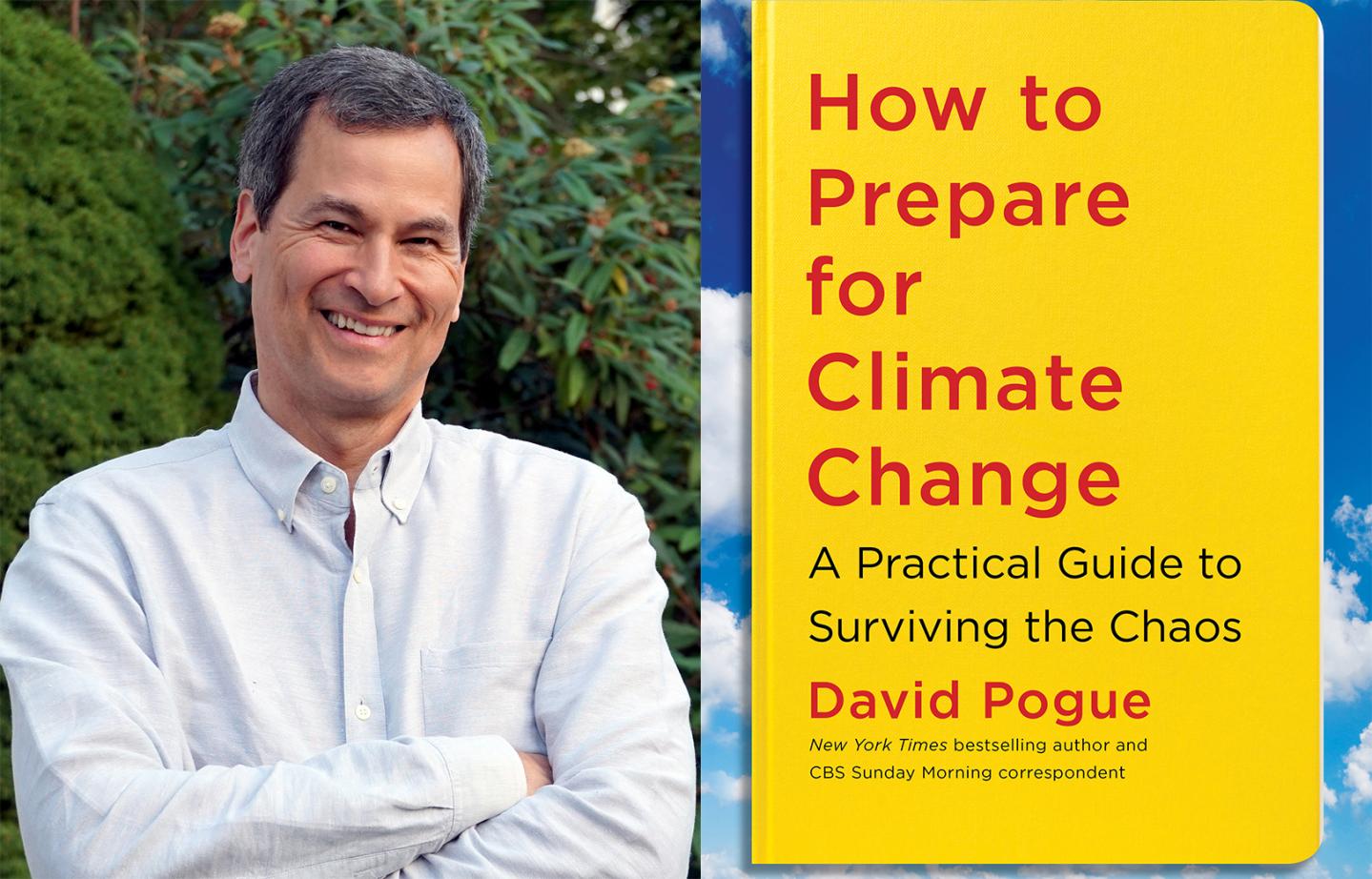
David Pogue, author of ‘How to Prepare for Climate Change: A Practical Guide to Surviving the Chaos’
Courtesy of Simon & Schuster

It’s therefore time to start paying more attention to the second piece of the Holdren Formula: adaptation. Adaptation means accepting that climate chaos is here to stay, and taking steps to cope with it.

Big corporations, governments, and industries are already deeply invested in adaptation efforts: moving farmland to cooler regions, developing heat- and drought-tolerant crops, buying out homeowners in flood-prone areas. Cities like London, Tokyo, Rotterdam, Venice, and Jakarta have built some of the biggest public-works projects ever constructed, on a science-fictionish scale; enormous seawalls, colossal retractable barriers, and immense tunnel systems intended to protect their coasts from rising sea levels. (New York City is working up similar plans.)

But what about puny, noninstitutional entities like you? Have you done anything to make yourself and your family more resilient?

One reason to consider taking some personal preparation steps is obvious: You’ll be better protected physically and financially when weather disasters strike. (And yes, it could happen to you. These days, about 25 million Americans a year are affected by what meteorologists delicately call “extreme-weather events.”)

But there’s a mental payoff, too. Psychologists have long known that in any situation where you feel depressed and helpless, taking action is one of the few reliable antidotes. Preparing for something that’s unknown and frightening gives you a sense that you have some control over your situation. You feel better immediately.

So how do you prepare for climate change? For starters, fix your insurance. Half of all Americans live in coastal counties, but only 18% of flood-zone residents have flood insurance. (It comes as a surprise to many Americans, too, that homeowners insurance does not cover flood damage. Flood insurance is a separate purchase, provided, in the U.S., almost exclusively by FEMA’s National Flood Insurance Program.)

Hurricanes, wildfires, superstorms, flooding, wildfires, tornadoes, and water shortages may seem like very different expressions of climate chaos, but they tend to affect us in similar, predictable ways: The power goes out, the local water supply gets contaminated, store shelves are empty of essentials.

Another readiness step, therefore, involves preparing to ride out those situations. Look into a generator, even a small one. Dedicate a shelf to nonperishable groceries that can tide you over. Either stock up on bottled water—the FDA says it remains drinkable indefinitely before opening—or familiarize yourself with the drinkable emergency water that’s already in your home. You’ve got 50 to 100 gallons in your hot-water heater, in your pipes, and in your toilets. (Collect the water from the toilet tank. Don’t drink from the bowl unless you’re a cocker spaniel.)

During recent hurricanes and fires, our cell towers have lost power, too. Now you’ve got no cell service for coordinating with your family. The simple solution: Designate meeting spots in advance. Paste the plan into the Notes app on every family member’s phone; it won’t do any good if everybody’s forgotten what’s in it when disaster strikes.

The ultimate preparation for climate chaos, of course, is moving away from it. True, very few people move exclusively to escape the effects of climate change (yet), and, of course, not everyone can afford to move.

But 40 million Americans do relocate every year. If you find yourself among them, and weather disasters are a consideration, here’s the guidance: You want to be far enough West to escape sea-level rise, superstorms, and exploding mosquito and tick populations; far enough North to avoid hurricanes and blistering heat; and far enough East to avoid wildfires and smoke. You also want to be somewhere that isn’t already experiencing historic water shortages.

The sweet spot is the Great Lakes region: Illinois, Indiana, Michigan, Minnesota, New York, Ohio, Pennsylvania, and Wisconsin. Not only are they well away from rising seas, blistering heat, devastating fires, and water shortages, but they’ve got vast, reliable sources of fresh water. Midwestern cities also have infrastructure you’ll care about in the coming years, like a relatively low cost of living, room to grow, and good hospitals.

Even if you decide to stay where you are, though, it doesn’t take much time or cost much money to take some of the smaller steps. Set aside a Saturday. Involve your kids—make it a scavenger hunt. They, too, will reap the mental health benefits of feeling more in charge.

If you need motivation, consider the drought rates, the number of wildfires, the intensity of rainstorms, and the number of “hundred-year” superstorms in the past couple of years. You can safely assume that things won’t be getting any better than they are right now.

Above all, remember the Holdren Formula: mitigation + adaptation now = less suffering later.

David Pogue is a science and tech correspondent for CBS Sunday Morning and the author of How to Prepare for Climate Change (Simon & Schuster).

About the Author
By David Pogue
See full bioRight Arrow Button Icon

Latest in Commentary

Finance
Lorem ipsum dolor sit amet, consectetur adipiscing elit, sed do eiusmod tempor incididunt ut labore et dolore magna aliqua. Ut enim ad minim veniam
By Fortune Editors
October 20, 2025
Finance
Lorem ipsum dolor sit amet, consectetur adipiscing elit, sed do eiusmod tempor incididunt ut labore et dolore magna aliqua. Ut enim ad minim veniam
By Fortune Editors
October 20, 2025
Finance
Lorem ipsum dolor sit amet, consectetur adipiscing elit, sed do eiusmod tempor incididunt ut labore et dolore magna aliqua. Ut enim ad minim veniam
By Fortune Editors
October 20, 2025
Finance
Lorem ipsum dolor sit amet, consectetur adipiscing elit, sed do eiusmod tempor incididunt ut labore et dolore magna aliqua. Ut enim ad minim veniam
By Fortune Editors
October 20, 2025
Finance
Lorem ipsum dolor sit amet, consectetur adipiscing elit, sed do eiusmod tempor incididunt ut labore et dolore magna aliqua. Ut enim ad minim veniam
By Fortune Editors
October 20, 2025
Finance
Lorem ipsum dolor sit amet, consectetur adipiscing elit, sed do eiusmod tempor incididunt ut labore et dolore magna aliqua. Ut enim ad minim veniam
By Fortune Editors
October 20, 2025

Most Popular

Finance
Lorem ipsum dolor sit amet, consectetur adipiscing elit, sed do eiusmod tempor incididunt ut labore et dolore magna aliqua. Ut enim ad minim veniam
By Fortune Editors
October 20, 2025
Finance
Lorem ipsum dolor sit amet, consectetur adipiscing elit, sed do eiusmod tempor incididunt ut labore et dolore magna aliqua. Ut enim ad minim veniam
By Fortune Editors
October 20, 2025
Finance
Lorem ipsum dolor sit amet, consectetur adipiscing elit, sed do eiusmod tempor incididunt ut labore et dolore magna aliqua. Ut enim ad minim veniam
By Fortune Editors
October 20, 2025
Finance
Lorem ipsum dolor sit amet, consectetur adipiscing elit, sed do eiusmod tempor incididunt ut labore et dolore magna aliqua. Ut enim ad minim veniam
By Fortune Editors
October 20, 2025
Finance
Lorem ipsum dolor sit amet, consectetur adipiscing elit, sed do eiusmod tempor incididunt ut labore et dolore magna aliqua. Ut enim ad minim veniam
By Fortune Editors
October 20, 2025
Finance
Lorem ipsum dolor sit amet, consectetur adipiscing elit, sed do eiusmod tempor incididunt ut labore et dolore magna aliqua. Ut enim ad minim veniam
By Fortune Editors
October 20, 2025
Fortune Secondary Logo
Rankings
  • 100 Best Companies
  • Fortune 500
  • Global 500
  • Fortune 500 Europe
  • Most Powerful Women
  • World's Most Admired Companies
  • See All Rankings
  • Lists Calendar
Sections
  • Finance
  • Fortune Crypto
  • Features
  • Leadership
  • Health
  • Commentary
  • Success
  • Retail
  • Mpw
  • Tech
  • Lifestyle
  • CEO Initiative
  • Asia
  • Politics
  • Conferences
  • Europe
  • Newsletters
  • Personal Finance
  • Environment
  • Magazine
  • Education
Customer Support
  • Frequently Asked Questions
  • Customer Service Portal
  • Privacy Policy
  • Terms Of Use
  • Single Issues For Purchase
  • International Print
Commercial Services
  • Advertising
  • Fortune Brand Studio
  • Fortune Analytics
  • Fortune Conferences
  • Business Development
  • Group Subscriptions
About Us
  • About Us
  • Lists Calendar
  • Press Center
  • Work At Fortune
  • Terms And Conditions
  • Site Map
  • About Us
  • Lists Calendar
  • Press Center
  • Work At Fortune
  • Terms And Conditions
  • Site Map
  • Facebook icon
  • Twitter icon
  • LinkedIn icon
  • Instagram icon
  • Pinterest icon

Latest in Commentary

tenzin
Commentaryclean energy
The Iran War just made the clean energy transition non-negotiable
By Tenzin SeldonApril 23, 2026
5 hours ago
Software developers discussing programming code and planning how to create innovative software at co-working office. Two software developers checking programming code on computer screen. working through a coding problem together.
Commentaryregulation
Inflated AI claims are under fire—and the regulatory reckoning is coming
By Perrie M. WeinerApril 23, 2026
6 hours ago
Kemba Walden served as Acting National Cyber Director of the United States and is President of the Paladin Global Institute.
CommentaryHacking
Former national cyber director: Anthropic’s ‘Mythos’ AI can hack nearly anything and we aren’t ready
By Kemba WaldenApril 23, 2026
8 hours ago
frank
CommentaryVisa
Visa CMO: AI agents are your new customers — here’s how to sell to them
By Frank Cooper IIIApril 22, 2026
23 hours ago
shlomit
Commentarycyber
The Mythos meeting focused on the wrong AI risk to banks. Here’s the one nobody is talking about
By Shlomit WagmanApril 22, 2026
1 day ago
one piece
CommentaryPersonal Finance
Gen Z is doing (almost) everything right with money—and still getting burned
By Beth KoblinerApril 22, 2026
1 day ago

Most Popular

Cursor’s 25-year-old CEO is a former Google intern who just inked a $60 billion deal with SpaceX
AI
Cursor’s 25-year-old CEO is a former Google intern who just inked a $60 billion deal with SpaceX
By Marco Quiroz-GutierrezApril 22, 2026
22 hours ago
Officials will flush 50,000 toilets to flood a Utah lake in order to generate electricity
Environment
Officials will flush 50,000 toilets to flood a Utah lake in order to generate electricity
By Mead Gruver, Dorany Pineda and The Associated PressApril 22, 2026
21 hours ago
When interest on national debt overtook military spending, it triggered a limit where the U.S. may ‘cease to be a great power,’ warns Hoover historian
Economy
When interest on national debt overtook military spending, it triggered a limit where the U.S. may ‘cease to be a great power,’ warns Hoover historian
By Eleanor PringleApril 23, 2026
7 hours ago
‘Something sinister’: What we know about the FBI probe into dead and missing scientists linked to space and military industries
Economy
‘Something sinister’: What we know about the FBI probe into dead and missing scientists linked to space and military industries
By Jim EdwardsApril 22, 2026
1 day ago
'Something sinister could be happening': FBI looks into dead or missing nuclear and space defense scientists tied to NASA, Blue Origin, and SpaceX
Politics
'Something sinister could be happening': FBI looks into dead or missing nuclear and space defense scientists tied to NASA, Blue Origin, and SpaceX
By Catherina GioinoApril 21, 2026
2 days ago
Elon Musk thinks college is ‘basically for fun’—but his former Tesla HR chief tells Gen Z their liberal arts degree is more valuable than ever
Success
Elon Musk thinks college is ‘basically for fun’—but his former Tesla HR chief tells Gen Z their liberal arts degree is more valuable than ever
By Preston ForeApril 22, 2026
1 day ago

© 2026 Fortune Media IP Limited. All Rights Reserved. Use of this site constitutes acceptance of our Terms of Use and Privacy Policy | CA Notice at Collection and Privacy Notice | Do Not Sell/Share My Personal Information
FORTUNE is a trademark of Fortune Media IP Limited, registered in the U.S. and other countries. FORTUNE may receive compensation for some links to products and services on this website. Offers may be subject to change without notice.