• Home
  • Latest
  • Fortune 500
  • Finance
  • Tech
  • Leadership
  • Lifestyle
  • Rankings
  • Multimedia
Financeunemployment

By one measure, this recovery is 10 times faster than the one after the Great Recession—but there’s a catch

By
Lance Lambert
Lance Lambert
Former Real Estate Editor
Down Arrow Button Icon
By
Lance Lambert
Lance Lambert
Former Real Estate Editor
Down Arrow Button Icon
January 5, 2021, 8:00 AM ET

The early months of the coronavirus pandemic saw the U.S. economy plunge at its fastest rate in history. Over a two-month period, the jobless rate shot up from 3.5% in February 2020 to 14.7% in April—its highest level since 1940—while second-quarter GDP declined 32.9% on an annualized basis. During this period the Congressional Budget Office forecast that the unemployment rate would remain above double digits for more than six quarters, ending 2021 at 10.1%. All signs pointed to the U.S. sinking into the worst downturn since the Great Depression, or maybe even into another depression.

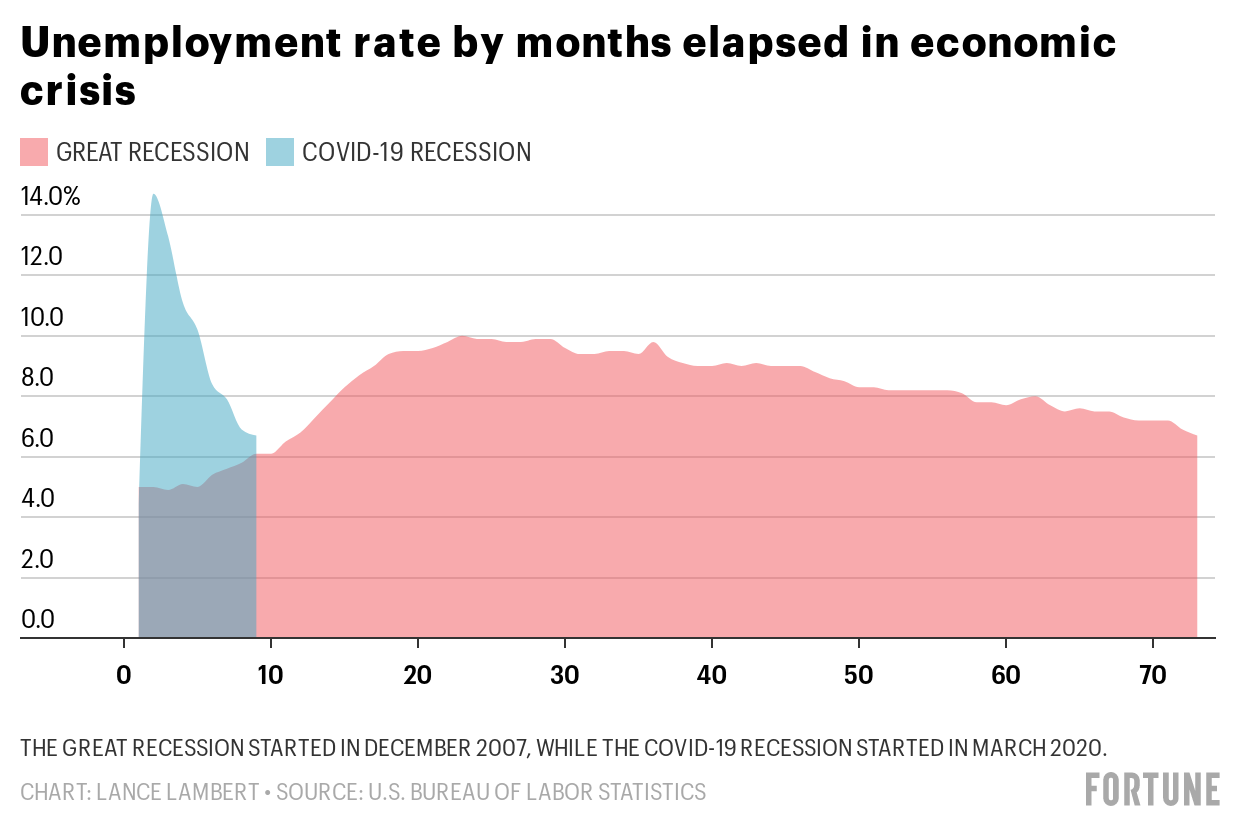
But the bleakest outlooks didn’t come to pass. Despite a lingering pandemic and mass joblessness, the recent economic recovery is among the fastest in American history—at least on paper. Since peaking in April, the unemployment rate has fallen every month, and it now sits at 6.7%. During this crisis the unemployment rate was above 7% for six months. For comparison, the Great Recession that followed the financial crisis saw unemployment top 7% for 59 consecutive months, from December 2008 to October 2013. That means that after the Great Recession, the economy took almost 10 times as long as it did in what we’ll call the COVID-19 Recession to bring the jobless rate under 7%. (See the chart below.)

“We view the coronavirus recession as much more V-shaped than previous postwar cycles, which were mostly driven by financial shocks to asset markets and income,” wrote Goldman Sachs researchers in a November 2020 report. During financial crashes, like the one in 2008, lending dries up and businesses struggle to borrow: Cue slow growth. Fortunately, that hasn’t been an issue during this recent downturn.

This doesn’t mean the current economy is strong, or that we’re close to a full recovery. Look no further than the fact 10.7 million Americans are jobless and looking for work. While the country looks to have avoided the darkest scenario of a multiyear depression, full economic healing is still some distance away.

In part, the economy recovered so quickly during the spring and summer because so many of the job cuts that occurred during the spring lockdowns were temporary. Employers like barbershops and dental offices that furloughed or cut workers during the onset of shutdowns were able to bring those workers back once their states eased up on restrictions. In June 2020 alone, 4.8 million workers were hired or rehired. But those easy job recoveries dried up months ago, and as a result the economic rebound is slowing. In November, the economy added just 245,000 jobs, enough to push the jobless rate down from 6.9% to 6.7%.
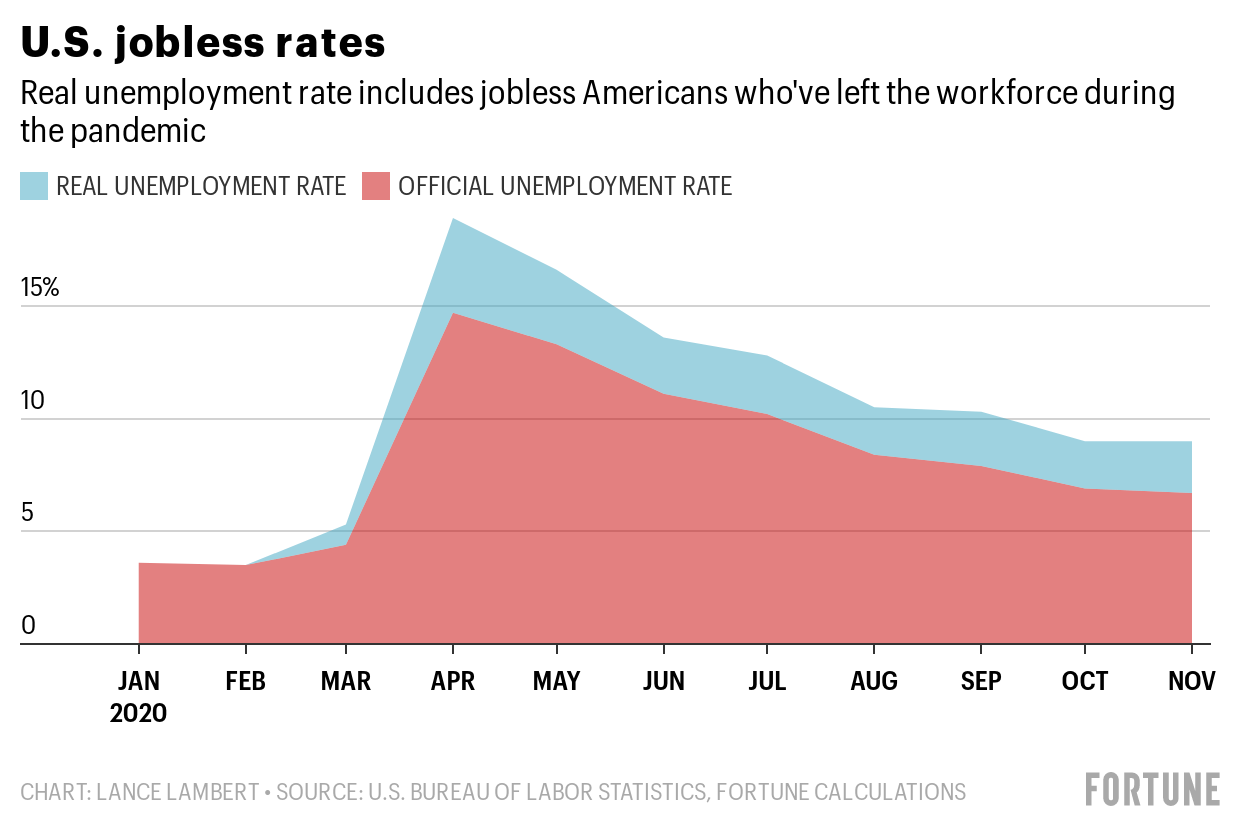
The sustained drop in the unemployment rate signals a growing economy. However, that figure is also severely undercounting joblessness. The Bureau of Labor Statistics (BLS) official unemployment rate calculation includes as “unemployed” only out-of-work Americans who are searching for new positions. If jobless persons aren’t searching, they get dropped out of the civilian labor force statistics altogether. (The unemployment rate is calculated by dividing the number of unemployed Americans by the civilian labor force count.)

That method of calculation makes the unemployment rate ill-suited for measuring periods when masses of workers drop out of the labor force. That’s exactly what occurred during the first months of the deadly pandemic. Health concerns have led some workers, including many senior citizens and immunocompromised Americans, to quit looking for work until the virus is tamed. Meanwhile, many parents—usually moms—were forced to stop working in order to attend to school-age kids whose classrooms are remote or hybrid. That’s why the civilian labor force declined from 164.5 million in February 2020 to 156.5 million in April 2020. It has since rebounded to 160.5 million, but is still down 4 million from pre-crisis levels.

If the BLS were to include those 4 million jobless Americans who have yet to return to the workforce in its unemployment rate, the “real” jobless rate would sit at 9% for November. That’s well above the current 6.7% rate. Still, even this real unemployment rate is falling: It peaked at 18.9% in April, when the official unemployment rate was at 14.7%.
Regardless of how one measures the U.S. economy, the trend shows that the country is growing while also seeing its rate of growth slow. In the third quarter of 2020, from July to September, GDP climbed 33.1% on an annualized basis. But we aren’t maintaining that rate. Goldman Sachs expects the upcoming release of 2020 fourth-quarter GDP growth to show an economy that grew by 5%.

Why is growth slowing? Economists point to the ongoing pandemic, which keeps businesses like airlines and hotels constrained and prevents a full economic rebound. That’s why a successful vaccine rollout is so critical.

“In the U.S., we expect virus resurgence to weigh on activity through January, though services activity has proven more resilient than expected. We expect a large rebound in the first half of 2021 on the back of widespread immunization—with 50% of the population expected to be vaccinated by April—and forecast above-consensus 5.3% growth in 2021,” Goldman Sachs researchers wrote in a December report.

In that scenario, Goldman Sachs forecast a jobless rate of 5.2% by the end of 2021. If that comes to fruition, it would mark a historic economic rebound from one of the worst crashes in U.S. history. For comparison, following the 2007–2009 Great Recession, the jobless rate didn’t get back down to 5.2% until July 2015.

About the Author
By Lance LambertFormer Real Estate Editor
Twitter icon

Lance Lambert is a former Fortune editor who contributes to the Fortune Analytics newsletter.

See full bioRight Arrow Button Icon

Latest in Finance

Finance
Lorem ipsum dolor sit amet, consectetur adipiscing elit, sed do eiusmod tempor incididunt ut labore et dolore magna aliqua. Ut enim ad minim veniam
By Fortune Editors
October 20, 2025
Finance
Lorem ipsum dolor sit amet, consectetur adipiscing elit, sed do eiusmod tempor incididunt ut labore et dolore magna aliqua. Ut enim ad minim veniam
By Fortune Editors
October 20, 2025
Finance
Lorem ipsum dolor sit amet, consectetur adipiscing elit, sed do eiusmod tempor incididunt ut labore et dolore magna aliqua. Ut enim ad minim veniam
By Fortune Editors
October 20, 2025
Finance
Lorem ipsum dolor sit amet, consectetur adipiscing elit, sed do eiusmod tempor incididunt ut labore et dolore magna aliqua. Ut enim ad minim veniam
By Fortune Editors
October 20, 2025
Finance
Lorem ipsum dolor sit amet, consectetur adipiscing elit, sed do eiusmod tempor incididunt ut labore et dolore magna aliqua. Ut enim ad minim veniam
By Fortune Editors
October 20, 2025
Finance
Lorem ipsum dolor sit amet, consectetur adipiscing elit, sed do eiusmod tempor incididunt ut labore et dolore magna aliqua. Ut enim ad minim veniam
By Fortune Editors
October 20, 2025

Most Popular

Finance
Lorem ipsum dolor sit amet, consectetur adipiscing elit, sed do eiusmod tempor incididunt ut labore et dolore magna aliqua. Ut enim ad minim veniam
By Fortune Editors
October 20, 2025
Finance
Lorem ipsum dolor sit amet, consectetur adipiscing elit, sed do eiusmod tempor incididunt ut labore et dolore magna aliqua. Ut enim ad minim veniam
By Fortune Editors
October 20, 2025
Finance
Lorem ipsum dolor sit amet, consectetur adipiscing elit, sed do eiusmod tempor incididunt ut labore et dolore magna aliqua. Ut enim ad minim veniam
By Fortune Editors
October 20, 2025
Finance
Lorem ipsum dolor sit amet, consectetur adipiscing elit, sed do eiusmod tempor incididunt ut labore et dolore magna aliqua. Ut enim ad minim veniam
By Fortune Editors
October 20, 2025
Finance
Lorem ipsum dolor sit amet, consectetur adipiscing elit, sed do eiusmod tempor incididunt ut labore et dolore magna aliqua. Ut enim ad minim veniam
By Fortune Editors
October 20, 2025
Finance
Lorem ipsum dolor sit amet, consectetur adipiscing elit, sed do eiusmod tempor incididunt ut labore et dolore magna aliqua. Ut enim ad minim veniam
By Fortune Editors
October 20, 2025
Fortune Secondary Logo
Rankings
  • 100 Best Companies
  • Fortune 500
  • Global 500
  • Fortune 500 Europe
  • Most Powerful Women
  • World's Most Admired Companies
  • See All Rankings
  • Lists Calendar
Sections
  • Finance
  • Fortune Crypto
  • Features
  • Leadership
  • Health
  • Commentary
  • Success
  • Retail
  • Mpw
  • Tech
  • Lifestyle
  • CEO Initiative
  • Asia
  • Politics
  • Conferences
  • Europe
  • Newsletters
  • Personal Finance
  • Environment
  • Magazine
  • Education
Customer Support
  • Frequently Asked Questions
  • Customer Service Portal
  • Privacy Policy
  • Terms Of Use
  • Single Issues For Purchase
  • International Print
Commercial Services
  • Advertising
  • Fortune Brand Studio
  • Fortune Analytics
  • Fortune Conferences
  • Business Development
  • Group Subscriptions
About Us
  • About Us
  • Press Center
  • Work At Fortune
  • Terms And Conditions
  • Site Map
  • About Us
  • Press Center
  • Work At Fortune
  • Terms And Conditions
  • Site Map
  • Facebook icon
  • Twitter icon
  • LinkedIn icon
  • Instagram icon
  • Pinterest icon

Latest in Finance

tillis
CommentaryCongress
Thom Tillis: Free markets built American prosperity. Government intervention puts it at risk
By Thom Tillis and John StanfordApril 30, 2026
55 minutes ago
iran
CommentaryIran
The Strait of Hormuz is a data problem, not just a military one
By Erik Bethel and Ami DanielApril 30, 2026
1 hour ago
Current refi mortgage rates report for April 30, 2026
Personal FinanceReal Estate
Current refi mortgage rates report for April 30, 2026
By Glen Luke FlanaganApril 30, 2026
3 hours ago
Mortgage rates today, April 30, 2026
Personal Financemortgages
Mortgage rates today, April 30, 2026
By Glen Luke FlanaganApril 30, 2026
3 hours ago
Current ARM mortgage rates report for April 30, 2026
Personal FinanceReal Estate
Current ARM mortgage rates report for April 30, 2026
By Glen Luke FlanaganApril 30, 2026
3 hours ago
The debt crisis Congress has been ignoring could cost the average U.S. household $18,000 a year, according to a Brookings analysis
EconomyFinance
The debt crisis Congress has been ignoring could cost the average U.S. household $18,000 a year, according to a Brookings analysis
By Shawn TullyApril 30, 2026
3 hours ago

Most Popular

Apple cofounder Ronald Wayne—whose stake would be worth up to $400 billion had he not sold it in 1976—says that at 91, he has no regrets
Success
Apple cofounder Ronald Wayne—whose stake would be worth up to $400 billion had he not sold it in 1976—says that at 91, he has no regrets
By Preston ForeApril 27, 2026
3 days ago
‘Take the money and run’: Johns Hopkins economist Steve Hanke on why the UAE quit OPEC
Energy
‘Take the money and run’: Johns Hopkins economist Steve Hanke on why the UAE quit OPEC
By Shawn TullyApril 29, 2026
1 day ago
‘The cost of compute is far beyond the costs of the employees’: Nvidia executive says right now AI is more expensive than paying human workers
AI
‘The cost of compute is far beyond the costs of the employees’: Nvidia executive says right now AI is more expensive than paying human workers
By Sasha RogelbergApril 28, 2026
2 days ago
Jamie Dimon gets candid about national debt: ‘There will be a bond crisis, and then we’ll have to deal with it’
Economy
Jamie Dimon gets candid about national debt: ‘There will be a bond crisis, and then we’ll have to deal with it’
By Eleanor PringleApril 29, 2026
23 hours ago
‘They left me no choice’: Powell isn’t going anywhere—blocking Trump from another Fed appointee
Banking
‘They left me no choice’: Powell isn’t going anywhere—blocking Trump from another Fed appointee
By Eva RoytburgApril 29, 2026
15 hours ago
More than two-thirds of U.S. schools say they’re unable to afford the cost of student free lunch—and MAHA’s dietary guidelines may make it worse
Economy
More than two-thirds of U.S. schools say they’re unable to afford the cost of student free lunch—and MAHA’s dietary guidelines may make it worse
By Sasha RogelbergApril 29, 2026
1 day ago

© 2026 Fortune Media IP Limited. All Rights Reserved. Use of this site constitutes acceptance of our Terms of Use and Privacy Policy | CA Notice at Collection and Privacy Notice | Do Not Sell/Share My Personal Information
FORTUNE is a trademark of Fortune Media IP Limited, registered in the U.S. and other countries. FORTUNE may receive compensation for some links to products and services on this website. Offers may be subject to change without notice.