
• Home
  • Latest
  • Fortune 500
  • Finance
  • Tech
  • Leadership
  • Lifestyle
  • Rankings
  • Multimedia

Trendingnow

1

Jeff Bezos wants the bottom half of earners to pay zero income tax—he says nurses making just $75K should save $12K a year

2

Indeed chief economist says we’re entering an era of ‘great mismatch’ thanks to a generational imbalance of workers

3

Apple’s Steve Wozniak says he cofounded the tech giant after 5 rejections from HP—not to ‘make money.’ For years, his paycheck was just $50

1

Jeff Bezos wants the bottom half of earners to pay zero income tax—he says nurses making just $75K should save $12K a year

2

Indeed chief economist says we’re entering an era of ‘great mismatch’ thanks to a generational imbalance of workers

3

Apple’s Steve Wozniak says he cofounded the tech giant after 5 rejections from HP—not to ‘make money.’ For years, his paycheck was just $50
Commentarydiversity and inclusion

Black women are missing from corporate leadership. The problem begins with the pipeline

By
Anna Gifty Opoku-Agyeman
and
Fanta Traore
Fanta Traore
Down Arrow Button Icon
By
Anna Gifty Opoku-Agyeman
and
Fanta Traore
Fanta Traore
Down Arrow Button Icon
November 11, 2020, 1:00 PM ET
Commentary-Black Woman Corporate Leadership
To build reliable career pathways for Black womxn, the authors write, companies should help them overcome barriers to studying economics, finance, data science, and other quantitative fields.FG Trade—Getty Images

The recent comments by the CEO of Wells Fargo about a supposed lack of Black talent to hire from generated considerable controversy. Charles Scharf’s comments also alluded to a prevailing attitude toward diversity, equity, and inclusion efforts in corporate settings. And while that attitude is a problem in its own right, Scharf’s comments highlight a more troubling truth: The pipeline of Black talent into financial services is not where it should be, particularly for Black women, and the root of that trend is systemic.

Dana Peterson of Citibank recently found that systemic racism has cost Black people $16.1 trillion and 6.1 million jobs. That same racism, coupled with sexism, also manifests in corporate boardrooms and explains why there have only ever been two Black women Fortune 500 CEOs. Which begs the question: How do we use public financial commitments and newfound attention toward ending anti-Black racism to generate bold solutions that actually upend systemic racism in corporate settings? 

Our recent white paper suggests that companies can begin to tackle this challenge by addressing the talent pipeline, specifically for Black women in quantitative fields such as economics, finance, math, and accounting. Understanding how corporate settings serve (or rather do not serve) Black women begins with determining whether Black women are equipped with the information and skills needed to ensure their success at the highest levels of leadership.

We show that from 2015 through 2019, across majors such as economics, math, accounting, and finance, the number of Black women completing degrees has been on the decline despite slight increases for both Asian-Americans and Hispanics. Furthermore, fields that are deemed more quantitatively demanding, such as economics, finance, and math, have considerably less representation of Black women.
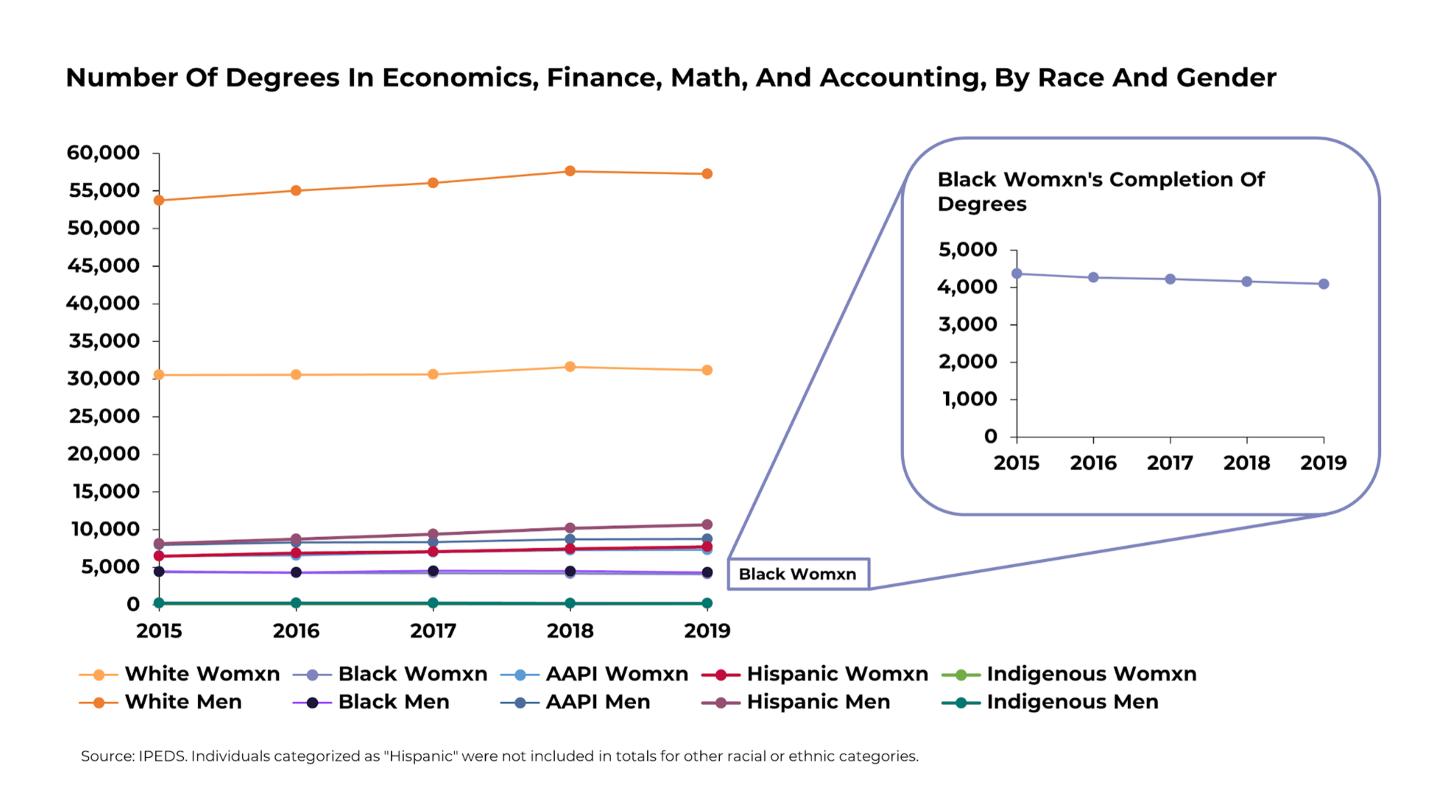
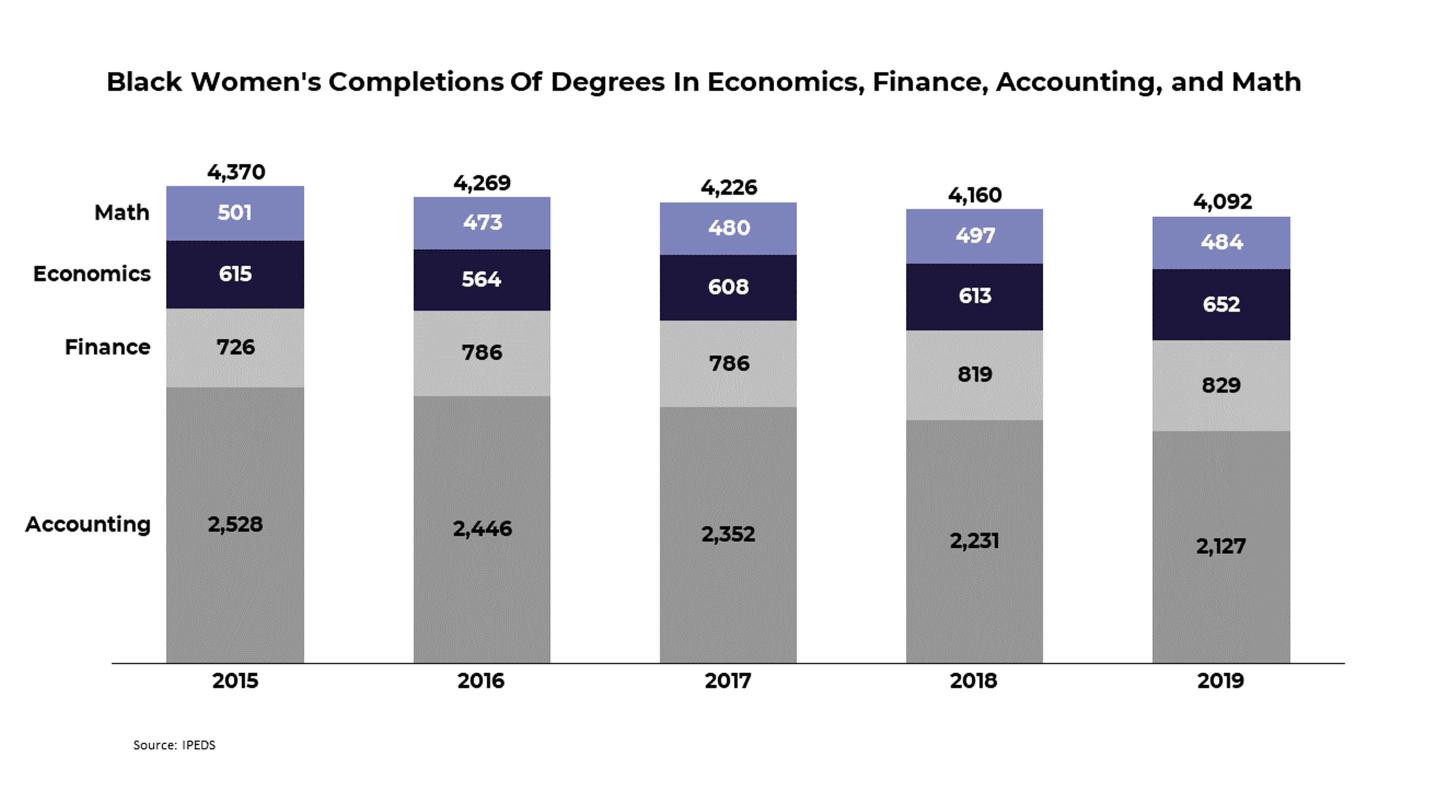
This decline in representation matters. Black women are arguably among the most important economic decision-makers in the country because our decisions shape our communities and the labor market for decades. Black women make up approximately 7% of the total U.S. population, but degree completion data shows that in 2019, Black women made up only 2.5% of those completing degrees in economics, finance, accounting, or math. And a similar trend emerges when you look at data across career professionals in these same fields. Black women’s representation in careers across finance, economics, math, and accounting is not increasing. COVID-19 has also likely made these outcomes worse, considering that mass job layoffs continue to disproportionately impact Black women as our unemployment rate climbs to an astronomical 12.7%. 

One may wonder why this is the case. Research shows that over time the following constraints contribute to low participation of Black women in economics and related fields: 

  • Access to information: A recent paper by economists Gary Hoover, Ebonya Washington, and Amanda Bayer finds that too few students have access to information about careers in economics, or about what economists do, and that more information would be an asset. Our own experience echoes this point: 73% of Black women who attended the Sadie Collective conference in 2020 shared that they did not feel prepared for a career in economics and related fields. After the conference’s skill-building workshops and panels, a post-survey showed that 94% of respondents felt more prepared.
  • Discrimination in the field: A New York Times op-ed, coauthored by one of us, Anna Gifty, and Lisa D. Cook, also showed that Black women consistently feel the brunt of discrimination in the profession, more so than other groups. And on average, Black women take the most measures to avoid possible harassment, discrimination, or unfair/disrespectful treatment compared to white and Asian respondents regardless of gender. 
  • Lack of role models: According to a 2019 report, fewer than 0.5% of Ph.D.s in economics were awarded to Black women—and it is hard to be what you cannot see. When asked before the Sadie Collective’s second annual conference, “Have you ever met a Black women economist?,” 33.5% of respondents shared that they had not. In a related statistic, only 2.2% of tenured or tenure-track economics faculty identified as Black in the 2018–2019 academic year. Moreover, among grade schools across the nation, there is a lack of exposure to quantitative-science majors and professions, along with negative perceptions surrounding the mathematical ability of Black girls. 

Here’s the bottom line: As long as companies rely on quantitative analysis to wield power in our economy and national policy, the absence of Black women from these fields will counteract any public declarations made toward addressing the impact of anti-Black racism within society and the workplace. 

To begin addressing the abysmal lack of Black women in the corporate space, we suggest that organizations provide sustained financial and programmatic support to existing initiatives that are among the best at doing the work. These include our own organization, The Sadie Collective, the only nonprofit organization centered on improving the pipeline and pathways for Black women in economics, finance, data science, and policy; Black Girls in Boardrooms, which offers mentoring support and workshops to Black women who have entered the corporate world; and Corporate in Color, which provides training sessions and one-on-one advice to Black women who want to refine their personal brand in corporate settings. Additionally, the corporate world can look to digital movements that showcase Black people in math, including #BlackinMathWeek, happening Nov. 8–14,  and #BlackinDataWeek, which will follow.

What 2020 has shown us is that corporate diversity is in desperate need of a makeover. While the accumulation of unfortunate killings of unarmed Black people had to be the turning point, centering Black people—and more specifically, Black women—goes beyond just statements. In order to ensure that many more Black girls follow in the footsteps of women like Thasunda Brown Duckett of JPMorgan Chase, Bozoma Saint John of Netflix, or Mellody Hobson of Ariel Investments, the corporate world must commit to centering Black women, as Vice President-elect Kamala Harris emphasized in her victory speech on Saturday. Corporations must decide whether this current moment is one that demands change within, and beyond, the boardroom.

Read the full Sadie Collective white paper here.

***

Fanta Traore is a graduate of Howard University’s economics department, a former Federal Reserve employee, and current dual degree MPP/MBA candidate at Yale University. Anna Gifty Opoku-Agyeman is a researcher, speaker, and writer who is an alum of Harvard University’s Research Scholar in Economics program and the University of Maryland, Baltimore County. They cofounded the Sadie Collective, which addresses the underrepresentation of Black women in economics and related fields, and the viral digital campaign #BlackBirdersWeek. Follow them on Twitter (@itsafronomics, @TheFantaTraore) and Instagram (@annagiftyo, @TheFantaTraore).

About the Authors
By Anna Gifty Opoku-Agyeman
See full bioRight Arrow Button Icon
By Fanta Traore
See full bioRight Arrow Button Icon

Latest in Commentary

Finance
Lorem ipsum dolor sit amet, consectetur adipiscing elit, sed do eiusmod tempor incididunt ut labore et dolore magna aliqua. Ut enim ad minim veniam
By Fortune Editors
October 20, 2025
Finance
Lorem ipsum dolor sit amet, consectetur adipiscing elit, sed do eiusmod tempor incididunt ut labore et dolore magna aliqua. Ut enim ad minim veniam
By Fortune Editors
October 20, 2025
Finance
Lorem ipsum dolor sit amet, consectetur adipiscing elit, sed do eiusmod tempor incididunt ut labore et dolore magna aliqua. Ut enim ad minim veniam
By Fortune Editors
October 20, 2025
Finance
Lorem ipsum dolor sit amet, consectetur adipiscing elit, sed do eiusmod tempor incididunt ut labore et dolore magna aliqua. Ut enim ad minim veniam
By Fortune Editors
October 20, 2025
Finance
Lorem ipsum dolor sit amet, consectetur adipiscing elit, sed do eiusmod tempor incididunt ut labore et dolore magna aliqua. Ut enim ad minim veniam
By Fortune Editors
October 20, 2025
Finance
Lorem ipsum dolor sit amet, consectetur adipiscing elit, sed do eiusmod tempor incididunt ut labore et dolore magna aliqua. Ut enim ad minim veniam
By Fortune Editors
October 20, 2025

Most Popular

Finance
Lorem ipsum dolor sit amet, consectetur adipiscing elit, sed do eiusmod tempor incididunt ut labore et dolore magna aliqua. Ut enim ad minim veniam
By Fortune Editors
October 20, 2025
Finance
Lorem ipsum dolor sit amet, consectetur adipiscing elit, sed do eiusmod tempor incididunt ut labore et dolore magna aliqua. Ut enim ad minim veniam
By Fortune Editors
October 20, 2025
Finance
Lorem ipsum dolor sit amet, consectetur adipiscing elit, sed do eiusmod tempor incididunt ut labore et dolore magna aliqua. Ut enim ad minim veniam
By Fortune Editors
October 20, 2025
Finance
Lorem ipsum dolor sit amet, consectetur adipiscing elit, sed do eiusmod tempor incididunt ut labore et dolore magna aliqua. Ut enim ad minim veniam
By Fortune Editors
October 20, 2025
Finance
Lorem ipsum dolor sit amet, consectetur adipiscing elit, sed do eiusmod tempor incididunt ut labore et dolore magna aliqua. Ut enim ad minim veniam
By Fortune Editors
October 20, 2025
Finance
Lorem ipsum dolor sit amet, consectetur adipiscing elit, sed do eiusmod tempor incididunt ut labore et dolore magna aliqua. Ut enim ad minim veniam
By Fortune Editors
October 20, 2025
Fortune Secondary Logo
Rankings
  • 100 Best Companies
  • Fortune 500
  • Global 500
  • Fortune 500 Europe
  • Most Powerful Women
  • World's Most Admired Companies
  • See All Rankings
  • Lists Calendar
Sections
  • Finance
  • Fortune Crypto
  • Features
  • Leadership
  • Health
  • Commentary
  • Success
  • Retail
  • Mpw
  • Tech
  • Lifestyle
  • CEO Initiative
  • Asia
  • Politics
  • Conferences
  • Europe
  • Newsletters
  • Personal Finance
  • Environment
  • Magazine
  • Education
Customer Support
  • Frequently Asked Questions
  • Customer Service Portal
  • Privacy Policy
  • Terms Of Use
  • Single Issues For Purchase
  • International Print
Commercial Services
  • Advertising
  • Fortune Brand Studio
  • Fortune Analytics
  • Fortune Conferences
  • Business Development
  • Group Subscriptions
About Us
  • About Us
  • Press Center
  • Work At Fortune
  • Terms And Conditions
  • Site Map
  • About Us
  • Press Center
  • Work At Fortune
  • Terms And Conditions
  • Site Map
  • Facebook icon
  • Twitter icon
  • LinkedIn icon
  • Instagram icon
  • Pinterest icon

Latest in Commentary

employees
CommentarySuccession
Millions of business owners are about to retire. They should sell to their employees
By Matt Helmer and Maxwell JohnsonMay 23, 2026
11 hours ago
Ashley Yetman
Commentarydisruption
Everyone is blaming AI for the death of ‘craft.’ Take a good look in the mirror
By Ashley YetmanMay 23, 2026
11 hours ago
clay
CommentaryLoneliness
I’ve spent 25 years studying loneliness. AI is about to make it much worse
By Clay RoutledgeMay 23, 2026
13 hours ago
ambrose
CommentaryRobotics
Former NASA Robotics Chief: America is building the wrong kind of robots — and China knows it
By Robert AmbroseMay 23, 2026
14 hours ago
morris
CommentaryEntrepreneurship
My startup hit $200 million ARR. But first I walked away from 2.5 million YouTube subscribers and nearly went bankrupt
By Joel MorrisMay 23, 2026
16 hours ago
brotman
CommentaryVenture Capital
I’ve spent 25 years in venture capital. Here’s how it quietly shut ordinary Americans out of the AI wealth boom—and what could fix it
By Steve BrotmanMay 22, 2026
1 day ago

Most Popular

Jeff Bezos wants the bottom half of earners to pay zero income tax—he says nurses making just $75K should save $12K a year
Success
Jeff Bezos wants the bottom half of earners to pay zero income tax—he says nurses making just $75K should save $12K a year
By Preston ForeMay 21, 2026
2 days ago
Indeed chief economist says we’re entering an era of ‘great mismatch’ thanks to a generational imbalance of workers
Success
Indeed chief economist says we’re entering an era of ‘great mismatch’ thanks to a generational imbalance of workers
By Emma BurleighMay 22, 2026
1 day ago
Apple’s Steve Wozniak says he cofounded the tech giant after 5 rejections from HP—not to ‘make money.’ For years, his paycheck was just $50
Success
Apple’s Steve Wozniak says he cofounded the tech giant after 5 rejections from HP—not to ‘make money.’ For years, his paycheck was just $50
By Preston ForeMay 22, 2026
1 day ago
Microsoft reports are exposing AI's real cost problem: Using the tech is more expensive than paying human employees
AI
Microsoft reports are exposing AI's real cost problem: Using the tech is more expensive than paying human employees
By Jake AngeloMay 22, 2026
1 day ago
Bolt CEO says he let go of his entire HR team for creating problems that didn’t exist: ‘Those problems disappeared when I let them go’ 
Workplace Culture
Bolt CEO says he let go of his entire HR team for creating problems that didn’t exist: ‘Those problems disappeared when I let them go’ 
By Preston ForeMay 19, 2026
4 days ago
Current price of oil as of May 22, 2026
Personal Finance
Current price of oil as of May 22, 2026
By Joseph HostetlerMay 22, 2026
1 day ago

© 2026 Fortune Media IP Limited. All Rights Reserved. Use of this site constitutes acceptance of our Terms of Use and Privacy Policy | CA Notice at Collection and Privacy Notice | Do Not Sell/Share My Personal Information
FORTUNE is a trademark of Fortune Media IP Limited, registered in the U.S. and other countries. FORTUNE may receive compensation for some links to products and services on this website. Offers may be subject to change without notice.