Our mission to help you navigate the new normal is fueled by subscribers. To enjoy unlimited access to our journalism, subscribe today.
On January 20, 2017, President Donald Trump stood at the West front of the U.S. Capitol and delivered what historians described as “one of the most ominous inaugural addresses ever.” As the rain began to fall, timed cinematically to the start of the President’s remarks, Trump offered a dark and despairing portrait of the country he was about to lead—a landscape of “rusted out factories scattered like tombstones,” a nation infested with crime and marauding gangs. Vowed the newly sworn-in Commander-in-Chief: “This American carnage stops right here and stops right now.”
Some 43 months later, as Trump strives to make the case for reelection, he and others in his campaign and Administration are still painting that same picture of American carnage—calling daily attention to the “violent mayhem“ that they claim is still laying waste to a big chunk of the country.
In June, in the placid Rose Garden of the White House, the President lamented that “our nation has been gripped by professional anarchists, violent mobs, arsonists, looters, criminals, rioters, Antifa, and others.” On July 4th, in the shadow of South Dakota’s Mount Rushmore, he spoke of “angry mobs“ unleashing a “wave of violent crime in our cities.” In August, at a Republican National Convention replete with high-decibel alarms, Trump intoned about the “violence and danger in the streets“ and warned of anarchists “ripping down our statues and monuments right outside.”
The difference between now and Inauguration Day 2017, of course, is that Trump is no longer the swaggering outsider insisting that only he can fix what’s broken—he’s the man in charge who, if we’re to believe his own rhetoric, has allowed lawlessness and chaos to fester. For a “hire me again” strategy, it’s an unorthodox message to promote.
“What we’ve seen historically is that incumbents running for reelection try to convince people that things are good,” says Jeffrey Jones, a senior editor and researcher at Gallup, the venerable polling company. The argument is “Elect me for four more years, so we can keep this going,” he says. “Obviously, it’s harder to do when things aren’t going as well. But yes, it does seem unusual trying to convince people that things are bad. I guess maybe that goes back to 2016 and how he got elected in the first place.”
Trump, to be sure, isn’t trying to convince voters that things are terrible and terrifying everywhere—just in the cities and states led by Democrats. But that number is hardly negligible. Consider that nearly two-thirds of the 100 largest cities in America—places that generally serve as the economic centers of the majority of states in the union, both red and blue—have Democratic mayors. Eight of every 10 Americans, around 250 million people, live in an “urbanized area,” according to the U.S. Census Bureau. So when the president rails against the “smoldering ruins of Minneapolis, the violent anarchy of Portland and the bloodstained sidewalks of Chicago,” as he did at a late August rally in Scranton, Pa., there is inevitably a risk that it will reflect upon Trump’s own ability to lead the country as a whole.
Some of the collateral damage from the president’s latest American carnage campaign, in fact, can be seen in Gallup’s “U.S. Satisfaction“ survey, which the firm has been conducting since 1979. In the most recent poll (July 30 through August 12), a mere 13% of the 1,031 respondents said they were “satisfied by the way things are going” in the country, compared with 84% who said they were dissatisfied—the lowest positive measure recorded since the financial crisis in 2008.
For comparison, in the days leading up to the 2012 election, when President Obama was seeking a second term, the satisfaction index was at 33%, which was then the lowest level for any reelected incumbent. (Former one-term presidents Jimmy Carter and George H.W. Bush both faced electorates whose satisfaction levels were wallowing in the teens and low 20s when they lost their reelection bids, Jones says.)
Trump’s rating is down precipitously from February—before the novel coronavirus began its lethal swing through the U.S., before the shutdown, before unemployment soared to the moon—when 45% expressed satisfaction with the direction of the country, the highest level during Trump’s presidency so far.
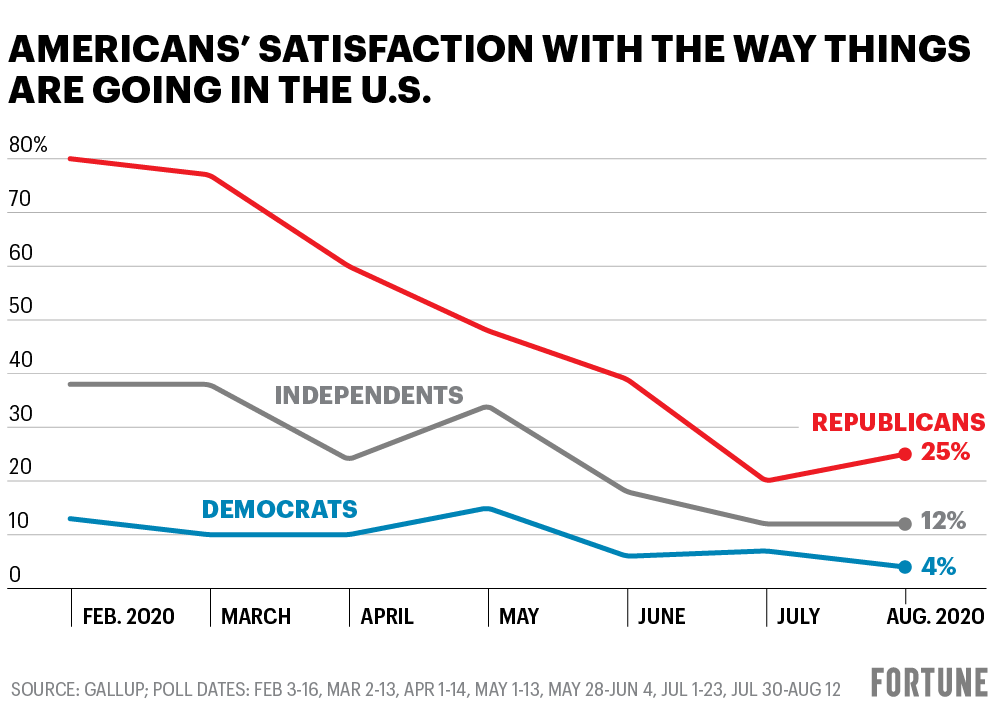
More striking still is the decline over that five-month span in the share of Republicans who feel confident about where America is headed (see chart). In the Feb. 3-16 poll, 80% of Republicans surveyed said they were satisfied with the direction of the country. By the poll ending Aug. 12, that share had fallen to 25%. Democrats dropped from 13% satisfied to 4% over the same period; independent voters, from 38% to 12%. (Another survey is currently in the field, Jones says, which will reflect some of the impact of both political conventions; so it’s possible that the Republican mood may brighten some.)
Other polling firms phrase the question in a slightly different way, asking whether people “feel that things in this country are heading in the right direction…or heading down the wrong track?” Here, too, the share of Americans who believe we’re on the “wrong track” hit a nearly seven-year high on Aug. 3, according to the average of such polls calculated by the website Realclearpolitics. On that date, the average for the wrong-track share was 70.7%, the highest percentage since October 2013. As of Sept. 5, in the wake of the conventions and some other tightening poll numbers, that figure has dipped to 65.8%. In late February, by contrast, fewer than 55% of Americans felt that we were headed the wrong way.
While the share of Republicans saying, specifically, that the country is on the “wrong track” is generally lower than it is in the Gallup satisfaction survey, the numbers here are striking as well. In the Sept. 2 Reuters/Ipsos tracker, 35% of Republican voters (and 78% of independents) gave a thumbs down to the country’s direction. Morning Consult and Politico, meanwhile, pegged the share of disaffected Republicans at 44% in their August tracker, though the percentage of GOP women expressing the same dismay was a red-flag-waving 51%.
As bad as those numbers might seem for the Trump camp, however, there’s little likelihood that the president’s campaign will abandon the strategy. Indeed, they’re almost certain to double down on it.
“To run as an incumbent, you have two options that you can hope for. One is that it’s a referendum and you can say, ‘I’m great. Reelect me.’ The second is that it’s a choice,” says Norman Ornstein, a resident scholar at the American Enterprise Institute and a contributing editor for the Atlantic, who has written extensively about American politics. “Right now, it’s a referendum. Trump is trying to make it a choice.”
On most levels, framing the election as a choice is unlikely to help him. In poll after poll this summer, voters have consistently said they believe former Vice President Joe Biden would do a better job than the incumbent on the most pressing of issues, from responding to racial inequality to tackling the coronavirus. Biden has also gained ground on the question of who would be a more able shepherd of the economy, drawing mostly even with the president on that front.
But one area where the Trump camp can move the fulcrum is in the amorphous category of fear.
“Trump knows that there were significant numbers of college-educated suburban white voters, many of them long-time Republicans who supported him [in 2016] in places like Bucks County, Pennsylvania, in the suburbs of Detroit, in the suburbs of Milwaukee, and elsewhere, who then abandoned him and the Republicans in 2018,” says Ornstein. “And what he’s hoping he can do is to get a sufficient number of them scared at violence in the cities—and the fear that it could spread to their suburbs—to come back to him.”
“I’m skeptical of that strategy,” Ornstein adds. “The idea that people will believe this is what Biden’s America will bring when it’s what Trump’s America is already bringing is not going to fly terribly well.” (Worth noting: In the eight years that Biden served as vice president under Obama, the violent crime rate actually fell 13.1% and property crime dropped 23.7%, according to the FBI’s Uniformed Crime Reporting.) “Still, you know, you can’t say that it will be a complete failure,” he says. “There’s always the chance that it will turn some of those votes at the margins back towards the president or at least get them not to vote.”
In a game of inches—as the 2016 battle for the electoral college was—that could make the difference.