• Home
  • Latest
  • Fortune 500
  • Finance
  • Tech
  • Leadership
  • Lifestyle
  • Rankings
  • Multimedia

Trendingnow

1

Bolt CEO says he let go of his entire HR team for creating problems that didn’t exist: ‘Those problems disappeared when I let them go’ 

2

Despite a $500 million net worth, Shaq just finished his fourth degree. He warns graduates: 'Your character will take you further than your resume'

3

Meet a 21-year-old community college student who's going to China as the first American woman welder in the trades Olympics

1

Bolt CEO says he let go of his entire HR team for creating problems that didn’t exist: ‘Those problems disappeared when I let them go’ 

2

Despite a $500 million net worth, Shaq just finished his fourth degree. He warns graduates: 'Your character will take you further than your resume'

3

Meet a 21-year-old community college student who's going to China as the first American woman welder in the trades Olympics
Financestate budgets

COVID-19 has another long-term side effect: A shrinking tax base

By
Clifton Leaf
Clifton Leaf
Down Arrow Button Icon
By
Clifton Leaf
Clifton Leaf
Down Arrow Button Icon
August 31, 2020, 10:00 AM ET

The coronavirus pandemic is the scourge that keeps on whipping—and its latest punishment is likely to be felt in dozens of states and municipalities across the United States as governments reckon with a massive and sudden loss of revenue. The widespread shutdown of businesses in the wake of COVID-19 didn’t just hammer sales from those businesses, along with the salaries of millions of workers, it’s also continuing to reduce the bounty that comes from taxing both of those sources of income.

Lower tax hauls from sales and personal income alone, according to recent projections, could cost state governments anywhere from $106 billion to $125 billion in fiscal year 2021, which began on July 1 in 46 states. The overall shortfall, however, could easily reach twice that amount when hits to other sources of state and local funds are factored in, says Jeffrey Clemens, an associate professor of economics at the University of California, San Diego, who published a working paper on the issue in June with Stan Veuger, an economist at the American Enterprise Institute.
The 50 states collected more than a trillion dollars in taxes in FY2019, the most recent year for which the U.S. Census Bureau has summary data. It was the eighth consecutive year state tax receipts had risen. Forty-eight states that year reported a bump in revenue, compared with 49 the year before.

Overall, more than two-thirds of that treasure derives from taxes on residents’ personal income (around 38%) as well as from general sales taxes (31%)—though the share from these and other sources (including taxes on corporate income, property, and sales of specific items such as gasoline, cigarettes, or alcohol) can differ dramatically from place to place. In Virginia, for instance, personal income taxes accounted for 51.9% of the commonwealth’s total net revenue collections in FY2019. Seven states, meanwhile—including Florida, Texas, and Wyoming—don’t levy a personal income tax at all. In the same vein, property taxes account for less than 2% of state revenues nationwide, but comprise roughly a quarter of the revenue Vermont raises each year.

While nearly all of these funding sources are vulnerable to economic downturns, personal income (which is clearly influenced by employment status) and general sales (which reflect the strength of consumer spending) have been particularly hit by the pandemic-related closures and restrictions on public gatherings.

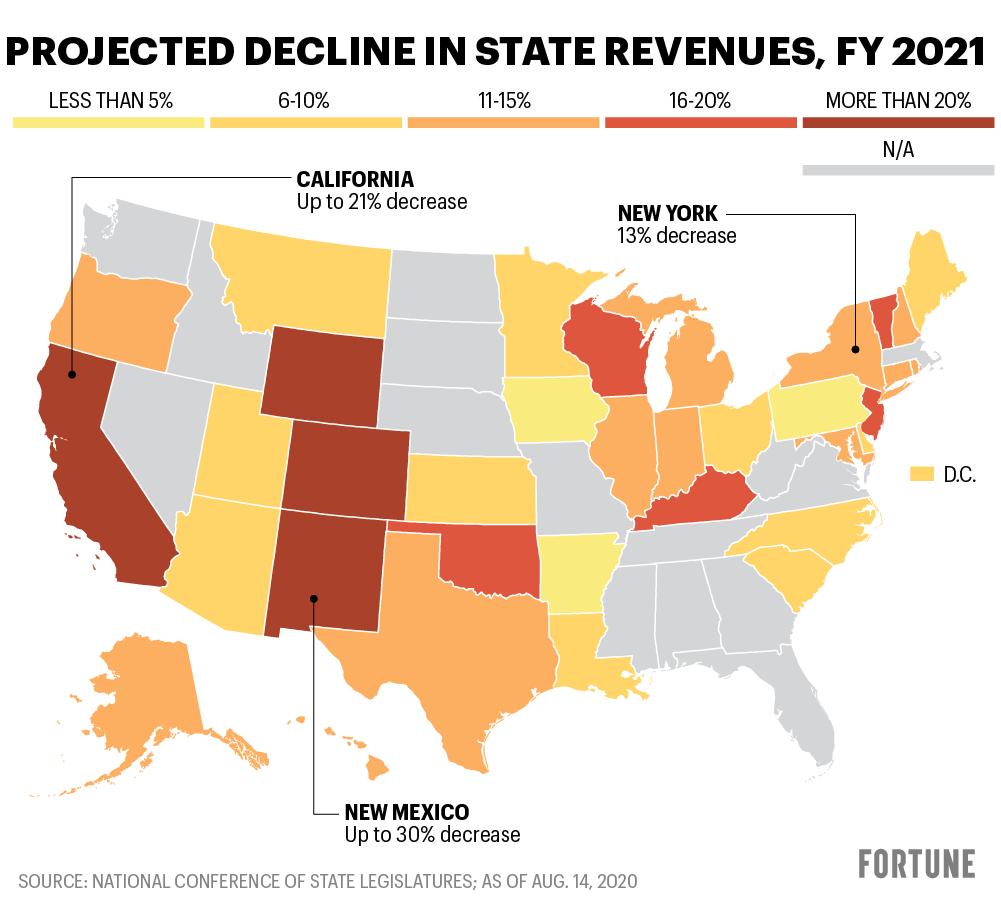
The economic pain has been so sharp and swift that, over the past five months, 35 states plus the District of Columbia have released projections revising their FY2021 revenue downward—with at least 24 of those states slicing revenue estimates by 10% or more from pre-COVID forecasts, according to data gathered by the National Conference of State Legislatures. Seven states expect revenues to be down 15% or more. These revisions come on top of revenue losses in FY2020, when the shuttering of businesses began.

New Jersey now expects to be $10 billion in the hole, the state says. California predicted in May that state coffers would have an $18 billion shortfall—if the recession and recovery ended up looking like a “U” (with a brisk comeback following the equally brisk collapse this spring). An “L-shaped” recovery, for that matter, would leave it $31 billion underwater. That assessment, notably, came before this summer’s catastrophic and costly wildfires.

Alaska doesn’t have to worry about shrinking revenues from the personal income tax—it doesn’t have one. But its coffers are nonetheless getting thumped by the coronavirus. As recently as FY2019, the state got roughly a quarter of its $11.2 billion in revenue from petroleum royalties and related taxes. (Alaska calls some of these levies “severance taxes,” to account for the oil and gas that’s being severed from its land.) In the wake of COVID-19, however, state economists estimated a billion-dollar deficit, largely based on extremely low oil prices this spring—a crash they blamed on an “extreme supply and demand imbalance” caused at least in part by a global growth-killing pandemic.

The state’s dire fiscal outlook was based on a $37-a-barrel price for Alaska North Slope crude, and the price is up about 19% since then—so state budgeteers might be a little more sanguine these days. But it’s still way down from its $70 perch at the start of the year.

Even states that rely heavily on personal income and sales taxes routinely draw non-tax dollars from a litany of sources: universities, hospitals, highways, airports, parking facilities, parks, utilities, and a slew of other things that also fall under the heading of “own-source revenue.” States received $371 billion in these non-tax fees in 2017, the latest year available from the Census Bureau. But the story is largely the same here: Lots of these line items were bludgeoned in the economic shutdown and may get hit again if COVID-19 infections surge anew.

Cities and municipalities, which receive more than a trillion dollars in their own “own-source” revenue each year, are likewise facing budgetary nightmares. While two-thirds of those funds come from property taxes, which are relatively stable from year to year, the rest—which largely hails from sales taxes and fees—is just as affected by an economic downturn as the state revenue.

“My best guess would be that, if the economy is going to be 10% smaller over this coming fiscal year, then the whole of these revenues will probably be about 10% smaller,” says Clemens. In 2017, state and local own-source revenue totaled $2.4 trillion. That translates to a $240 billion gut-punch to states and cities.

And that has many state capitals desperately looking to Washington for help. Indeed, as Democrats in the House wrangle with the Trump administration and the Republican-led Senate over a new stimulus plan, financial assistance for states and cities remains a key sticking point. For now, the two sides appear to be at an impasse. If the stalemate continues, the hardest-hit states may have to start taking aggressive measures very soon.

Unlike the federal government, which can issue as much debt as it wants (and it has shown that it wants), state and local governments have much less leeway to borrow their way out of the ditch. “Most states, which face balanced-budget requirements, are not allowed to use long-term debt to finance general fund expenditures,” says Clemens.

Without federal aid, state and city workers will face significant layoffs, and there is almost certain to be a push for new taxes too. But all the various options on the revenue-raising side come with serious downsides, Clemens says: “Increasing taxes on sales affects families across the full-income distribution; raising income taxes risks chasing higher-income folks out of the state.”

In the end, the best (and most politically acceptable) option is likely to be a combination of cost-cutting and revenue-raising measures. “Most problems of this kind are best solved by not going all-in on any one financial lever, but rather by spreading some of the pain around,” says Clemens. “The best options for avoiding more-than-necessary economic disruption would be things like wage freezes of current state and local government employees—which, of course, includes, university faculty like myself.”

More must-read finance coverage from Fortune:

  • Here’s how much tech giants are making in profit per employee
  • 12 value stocks to buy right now—and 3 to avoid—according to Bank of America
  • ‘Deal of a decade’: How buying TikTok could transform Microsoft
  • American Airlines announces plan to cut 19,000 jobs—unless Congress extends pandemic aid
  • Sacramento may pay COVID-infected workers $1,000 to stay home
About the Author
By Clifton Leaf
See full bioRight Arrow Button Icon

Latest in Finance

Finance
Lorem ipsum dolor sit amet, consectetur adipiscing elit, sed do eiusmod tempor incididunt ut labore et dolore magna aliqua. Ut enim ad minim veniam
By Fortune Editors
October 20, 2025
Finance
Lorem ipsum dolor sit amet, consectetur adipiscing elit, sed do eiusmod tempor incididunt ut labore et dolore magna aliqua. Ut enim ad minim veniam
By Fortune Editors
October 20, 2025
Finance
Lorem ipsum dolor sit amet, consectetur adipiscing elit, sed do eiusmod tempor incididunt ut labore et dolore magna aliqua. Ut enim ad minim veniam
By Fortune Editors
October 20, 2025
Finance
Lorem ipsum dolor sit amet, consectetur adipiscing elit, sed do eiusmod tempor incididunt ut labore et dolore magna aliqua. Ut enim ad minim veniam
By Fortune Editors
October 20, 2025
Finance
Lorem ipsum dolor sit amet, consectetur adipiscing elit, sed do eiusmod tempor incididunt ut labore et dolore magna aliqua. Ut enim ad minim veniam
By Fortune Editors
October 20, 2025
Finance
Lorem ipsum dolor sit amet, consectetur adipiscing elit, sed do eiusmod tempor incididunt ut labore et dolore magna aliqua. Ut enim ad minim veniam
By Fortune Editors
October 20, 2025

Most Popular

Finance
Lorem ipsum dolor sit amet, consectetur adipiscing elit, sed do eiusmod tempor incididunt ut labore et dolore magna aliqua. Ut enim ad minim veniam
By Fortune Editors
October 20, 2025
Finance
Lorem ipsum dolor sit amet, consectetur adipiscing elit, sed do eiusmod tempor incididunt ut labore et dolore magna aliqua. Ut enim ad minim veniam
By Fortune Editors
October 20, 2025
Finance
Lorem ipsum dolor sit amet, consectetur adipiscing elit, sed do eiusmod tempor incididunt ut labore et dolore magna aliqua. Ut enim ad minim veniam
By Fortune Editors
October 20, 2025
Finance
Lorem ipsum dolor sit amet, consectetur adipiscing elit, sed do eiusmod tempor incididunt ut labore et dolore magna aliqua. Ut enim ad minim veniam
By Fortune Editors
October 20, 2025
Finance
Lorem ipsum dolor sit amet, consectetur adipiscing elit, sed do eiusmod tempor incididunt ut labore et dolore magna aliqua. Ut enim ad minim veniam
By Fortune Editors
October 20, 2025
Finance
Lorem ipsum dolor sit amet, consectetur adipiscing elit, sed do eiusmod tempor incididunt ut labore et dolore magna aliqua. Ut enim ad minim veniam
By Fortune Editors
October 20, 2025
Fortune Secondary Logo
Rankings
  • 100 Best Companies
  • Fortune 500
  • Global 500
  • Fortune 500 Europe
  • Most Powerful Women
  • World's Most Admired Companies
  • See All Rankings
  • Lists Calendar
Sections
  • Finance
  • Fortune Crypto
  • Features
  • Leadership
  • Health
  • Commentary
  • Success
  • Retail
  • Mpw
  • Tech
  • Lifestyle
  • CEO Initiative
  • Asia
  • Politics
  • Conferences
  • Europe
  • Newsletters
  • Personal Finance
  • Environment
  • Magazine
  • Education
Customer Support
  • Frequently Asked Questions
  • Customer Service Portal
  • Privacy Policy
  • Terms Of Use
  • Single Issues For Purchase
  • International Print
Commercial Services
  • Advertising
  • Fortune Brand Studio
  • Fortune Analytics
  • Fortune Conferences
  • Business Development
  • Group Subscriptions
About Us
  • About Us
  • Press Center
  • Work At Fortune
  • Terms And Conditions
  • Site Map
  • About Us
  • Press Center
  • Work At Fortune
  • Terms And Conditions
  • Site Map
  • Facebook icon
  • Twitter icon
  • LinkedIn icon
  • Instagram icon
  • Pinterest icon

Latest in Finance

Current price of Ethereum for May 21, 2026
Personal FinanceEthereum
Current price of Ethereum for May 21, 2026
By Joseph HostetlerMay 21, 2026
2 hours ago
Current price of Bitcoin for May 21, 2026
Personal FinanceCryptocurrency
Current price of Bitcoin for May 21, 2026
By Joseph HostetlerMay 21, 2026
2 hours ago
Current price of gold as of May 21, 2026
Personal Financegold prices
Current price of gold as of May 21, 2026
By Danny BakstMay 21, 2026
2 hours ago
Top CD rates from major banks May 21, 2026: Chase CDs, Bank of America CDs, Citibank CDs, and more
Personal FinanceCertificates of Deposit (CDs)
Top CD rates from major banks on May 21, 2026: Chase CDs, Bank of America CDs, Citibank CDs, and more
By Joseph HostetlerMay 21, 2026
2 hours ago
Current price of oil as of May 21, 2026
Personal FinanceOil
Current price of oil as of May 21, 2026
By Joseph HostetlerMay 21, 2026
2 hours ago
Current price of silver as of Thursday, May 21, 2026
Personal Financesilver
Current price of silver as of Thursday, May 21, 2026
By Joseph HostetlerMay 21, 2026
2 hours ago

Most Popular

Bolt CEO says he let go of his entire HR team for creating problems that didn’t exist: ‘Those problems disappeared when I let them go’ 
Workplace Culture
Bolt CEO says he let go of his entire HR team for creating problems that didn’t exist: ‘Those problems disappeared when I let them go’ 
By Preston ForeMay 19, 2026
2 days ago
Despite a $500 million net worth, Shaq just finished his fourth degree. He warns graduates: 'Your character will take you further than your resume'
Success
Despite a $500 million net worth, Shaq just finished his fourth degree. He warns graduates: 'Your character will take you further than your resume'
By Preston ForeMay 20, 2026
1 day ago
Meet a 21-year-old community college student who's going to China as the first American woman welder in the trades Olympics
Future of Work
Meet a 21-year-old community college student who's going to China as the first American woman welder in the trades Olympics
By Mike Householder and The Associated PressMay 17, 2026
4 days ago
Dr. Bernice King on why companies that walked back DEI were never truly committed: 'If you retreat that quick…that reveals who you really are'
Workplace Culture
Dr. Bernice King on why companies that walked back DEI were never truly committed: 'If you retreat that quick…that reveals who you really are'
By Preston ForeMay 19, 2026
2 days ago
Pay transparency is exposing a bigger problem: Most companies can't explain why they pay what they pay
Workplace Culture
Pay transparency is exposing a bigger problem: Most companies can't explain why they pay what they pay
By Sydney LakeMay 20, 2026
19 hours ago
Current price of oil as of May 20, 2026
Personal Finance
Current price of oil as of May 20, 2026
By Joseph HostetlerMay 20, 2026
1 day ago

© 2026 Fortune Media IP Limited. All Rights Reserved. Use of this site constitutes acceptance of our Terms of Use and Privacy Policy | CA Notice at Collection and Privacy Notice | Do Not Sell/Share My Personal Information
FORTUNE is a trademark of Fortune Media IP Limited, registered in the U.S. and other countries. FORTUNE may receive compensation for some links to products and services on this website. Offers may be subject to change without notice.