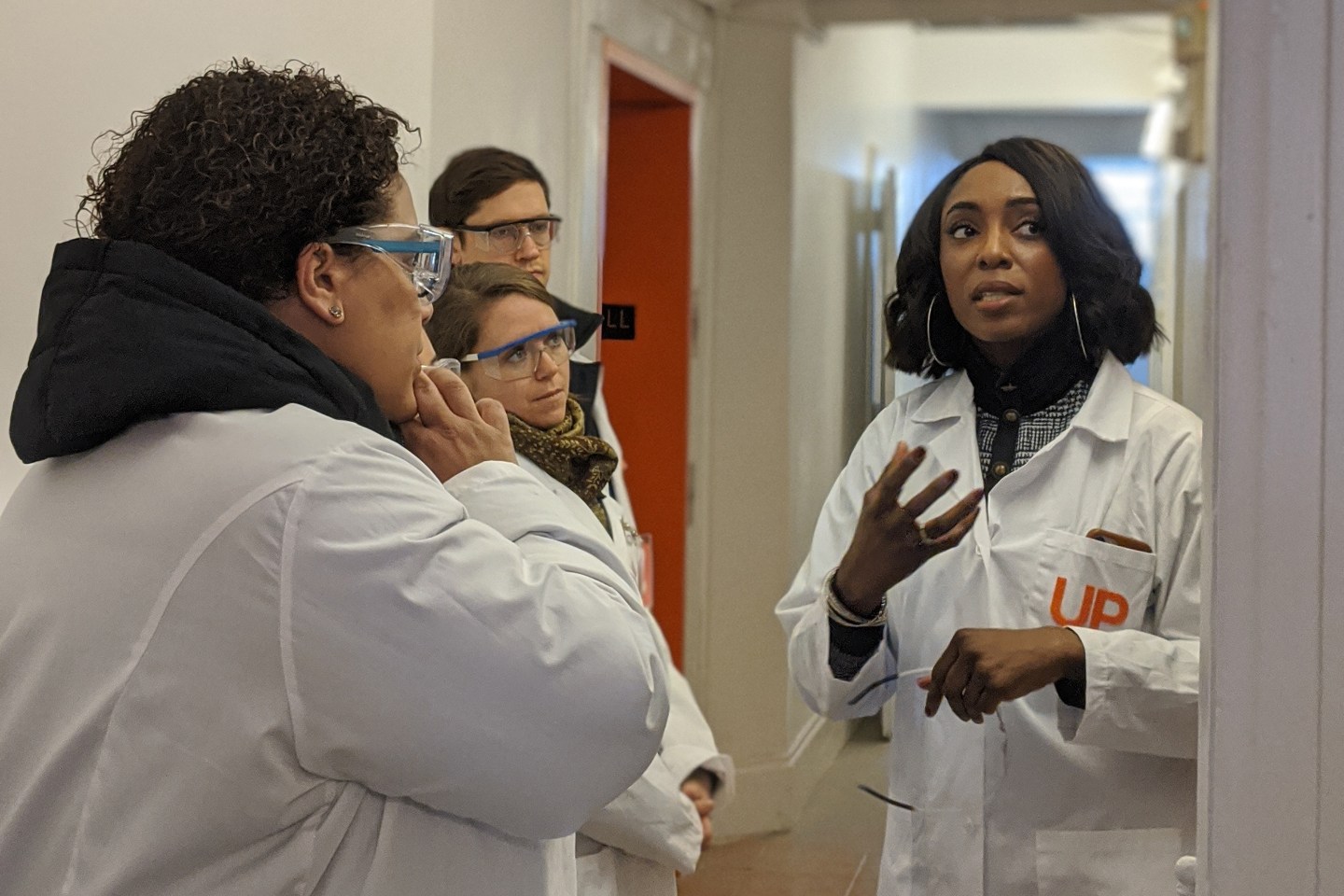
When Jessica O. Matthews heads to board meetings for Scenic Hudson, an environmental nonprofit that has fought for environmental protection since 1963, she knows she’ll stand out.
“I’m the only Black person. I’m one of maybe a handful of women. I’m the only person under the age of 35,” Matthews told Fortune. “And it has always been so incredibly surprising to me how easy it is for people who consider themselves to be environmentalists to separate themselves from a group of people who I believe are very much suited for environmental work.”
For the double Harvard graduate, the experience is nothing new—but it does point to one reason why sustainable infrastructure is still not a basic human right, even in the U.S.
The American Society of Civil Engineers graded infrastructure in the U.S. a D+—that’s a “D as in dog”, Matthews likes to say—while data from the Galvin Electricity Initiative shows that the United States experiences more power outages than any other developed nation. According to the society’s research, the U.S. would need to invest $4.59 trillion by 2025 to improve the nation’s infrastructure. Though these facts show a nationwide problem, it’s actually Black and brown communities that bear the brunt of our aging infrastructure, according to a study by Environmental Protections Agency’s National Center for Environmental Assessment.
It’s people of color who are three times more likely to die from pollution related illness, according to Yale researchers, and it’s people of color who account for half of the 9 million Americans forced to live near landfills and hazardous waste sites. It’s by including people of color in sustainability conversations that Matthews thinks that efforts to improve infrastructure will make a difference.
Matthews launched Uncharted Power in 2011 to crack what it takes to build sustainable infrastructure in communities that are under-resourced, she says.
The company’s solution for updating infrastructure in a cost effective way starts under our feet. Uncharted Power has developed pavers––the same kind you would see on a sidewalk or a road––that can house a power conduit, hardware for data collection, and servers to transmit the information collected at each location. Uncharted Power believes that cities can use the data they collect to sell to companies that want to use their information to further their own business—choosing their store location based on foot traffic data, for example—funding their infrastructure development by monetizing their data. Matthews has been testing the system at her facility in upstate New York and now Uncharted Power is looking to partner with cities in need of improving their infrastructure. Matthews spoke to Fortune about her mission to make access to power more affordable and sustainable.

This interview has been edited for length and clarity.
From the soccer ball you developed as a Harvard undergrad to harness kinetic energy until now, your work has revolved around energy efficiency. How has your approach to sustainability changed over the last ten years?
Uncharted Power essentially has focused on two main impact areas over the history of the company. The first is infrastructure and the second is education. When the company started, believe it or not, the assumption was actually that the latter was the biggest issue. I mistakenly assumed that there were smarter people who could be fixing what was clearly an infrastructural issue, but the issue was that they lacked the inspiration. They lacked the understanding or belief that they could have agency in this space.
That’s why when we started, we were making energy generating play products. The idea was to bridge the gap between the people who I think could be most impactful in this space because they’re feeling the pain the most, and the belief that they could do something and run with it. We used play as that bridge to make that happen.
And over time, our understanding of the problem evolved. We realized that society did not have the tools to build a new type of infrastructure that was more sustainable, that was easier to scale in these types of communities. We started to build intellectual property in energy transmission generation, to look at how you could rebuild the grid—the thing that hasn’t been upgraded in 150 years. We’re setting the stage not only for the way power is used today, but the way power is going to be used tomorrow.
It’s no secret that our infrastructure needs a major overhaul. What are some obstacles to progress when it comes to understanding and fixing the problem?
Well, first and foremost, it’s more expensive to design sustainably and it’s more expensive to design so that there isn’t an obvious loser in the situation. In just the United States, we’re looking at about $200 billion a year in deteriorating infrastructure. Very few people are sitting here saying “I’m super excited to go poison the Black people over there”—I mean, like there might be some—but it’s more like, “Why do I have to think about everyone? I just want to make money and hop on my jet and just live my life.” Right? Or, “Life is easier if I don’t have to see them and I can pretend they don’t exist.”
And so the number one thing we need to do is figure out how to change the narrative from a conversation of “this is what’s right and that’s wrong” to a narrative of, “this is how you actually make more money.” Doing good and doing well cannot be mutually exclusive for us to have a chance in hell at creating the world that we want to live in.
There are a lot of unintended consequences when not every community has a part of the conversation. With the National Environmental Policy Act, which was recently modified by the current administration to allow for quicker construction, what kind of consequences do you foresee?
At face value, infrastructure is something people need. It also brings jobs––accessible jobs.
The problem we have though, if we pull back these standards, we then run the risk of things being done the wrong way. We run the risk of there being quite a few environmental issues that won’t show their face immediately, but you’ll see them down the line.
Think of NIMBY. The more affluent communities have lobbyists who are ensuring that the infrastructure that they need doesn’t get built in their community. It’s the reason why most of these warehouses, most of these manufacturing facilities, most of these industrial complexes that are serving very affluent cities are never in the city. But there’s no one to lobby or truly care for the poorer group who are living near them.
Take Houston for example. Houston is a really interesting place because they have quite a bit of industry there, just the oil and gas industry there should suggest that people should be affluent there. But the air quality on the edge of Houston is so bad that the majority of people who live there, their life expectancy is anywhere from 10% to 15% less than the average person.
These people are living with respiratory illnesses and no one’s talking about it. And when I say people, I’m not just [talking] from a data perspective. My partner’s family lives in Harris County, outside of Houston. His stepmother: respiratory illnesses and asthma. His father: rare respiratory illnesses. It’s 100% because they know that the air is just bad. And it’s 100% because they know that no one cares that the air is bad for them. It kind of feels like saying the same thing over and over again, but if we do not create standards, we will see that certain groups are just getting the runoff of industry. Time and time again, we find that when we cut corners like what’s going on with the new effort from 45 [U.S. President Donald Trump], it’s usually the under resourced communities that get the short end of the stick.
How do you make people care? More than that, how do you get people to act?
You cannot underestimate the power of white guilt. I think that there are a lot of people that can sense the lack of fairness and those are the people you start with. You have to kind of package and create a streamlined way for them to reduce their guilt by being able to invest and support what you’re doing. And there’s nothing wrong with that. I mean, I grew up Catholic, so guilt is a way of life.
I do believe that the key for people who are trying to create this synergy around environmentalism, climate change, and racism, is to organize your issues into something that’s actionable. You need to create some sort of streamlined methodology for people to be able to engage with, whether it’s investment or donation, there needs to be something. It’s human nature to look for the most efficient way to decrease guilt.
I think what’s critical is to frame things from a macroeconomic perspective as well. This should not be about charity––charity isn’t sustainable in my opinion. It does not help anyone to have communities where people feel like living there is a death sentence. It does not help anyone to have a situation where there’s a whole generation of a workforce that feels so subjugated by their lack of access to clean water.
How do you go about creating a more equitable system?
I love what we’ve built with the Uncharted Power system because though it may seem like a simple paper solution, at the end of the day it comes back to three things: We have to create essentially an ethical Google for power infrastructure. We have to come in and say, let’s create a platform that streamlines the way people engage their infrastructure and streamlines the way we manage it, the same way that Google built all these amazing digital infrastructure platforms that streamlines the way that we engage with the digital world. They’re not charging us for that. They’re not saying, you know, only the affluent communities get Google Hangouts––they figured out a way for it to be for everyone. There’s a lot to learn there, and a lot that just have not been properly adopted in infrastructure.
What we were able to do [is] we’ve built this platform that allows us to build these full-scale, sustainable power grids, and financed them by essentially creating this platform to set up a co-location space and help communities and cities monetize their data. So the way Google sells ad space, we partner with communities to help them essentially sell the colocation space for 5G antennas and other smart city technologies in the ground to finance these projects without asking the city to take out more debt.
That has been such a massive innovation for us and it’s taken years to get there. Right now we are launching a local pilot and from there our hope is that we can scale this model and show people this new way of thinking about building critical infrastructure for under resourced communities without hurting their bottom line. If there are cities that need upgraded power and data infrastructure but are struggling with the financing of it, we want to start talking to them.