• Home
  • Latest
  • Fortune 500
  • Finance
  • Tech
  • Leadership
  • Lifestyle
  • Rankings
  • Multimedia

Trendingnow

1

The millennial generation is split in 2: an older crowd with boomer-style comfort, a younger set going 'back to the early 1900s'

2

'The demographic dividend of the last 40 years is ending': J.P. Morgan says the world is running out of the two things that kept interest rates down

3

Jensen Huang made his $172 billion fortune on AI chips. His family's $75 million gift to Vanderbilt argues art decides what technology is for

1

The millennial generation is split in 2: an older crowd with boomer-style comfort, a younger set going 'back to the early 1900s'

2

'The demographic dividend of the last 40 years is ending': J.P. Morgan says the world is running out of the two things that kept interest rates down

3

Jensen Huang made his $172 billion fortune on AI chips. His family's $75 million gift to Vanderbilt argues art decides what technology is for
Techfacial recognition

U.K. facial-recognition pilots broke privacy, data protection, and equality laws, court rules

By
David Meyer
David Meyer
Down Arrow Button Icon
By
David Meyer
David Meyer
Down Arrow Button Icon
August 11, 2020, 7:55 AM ET
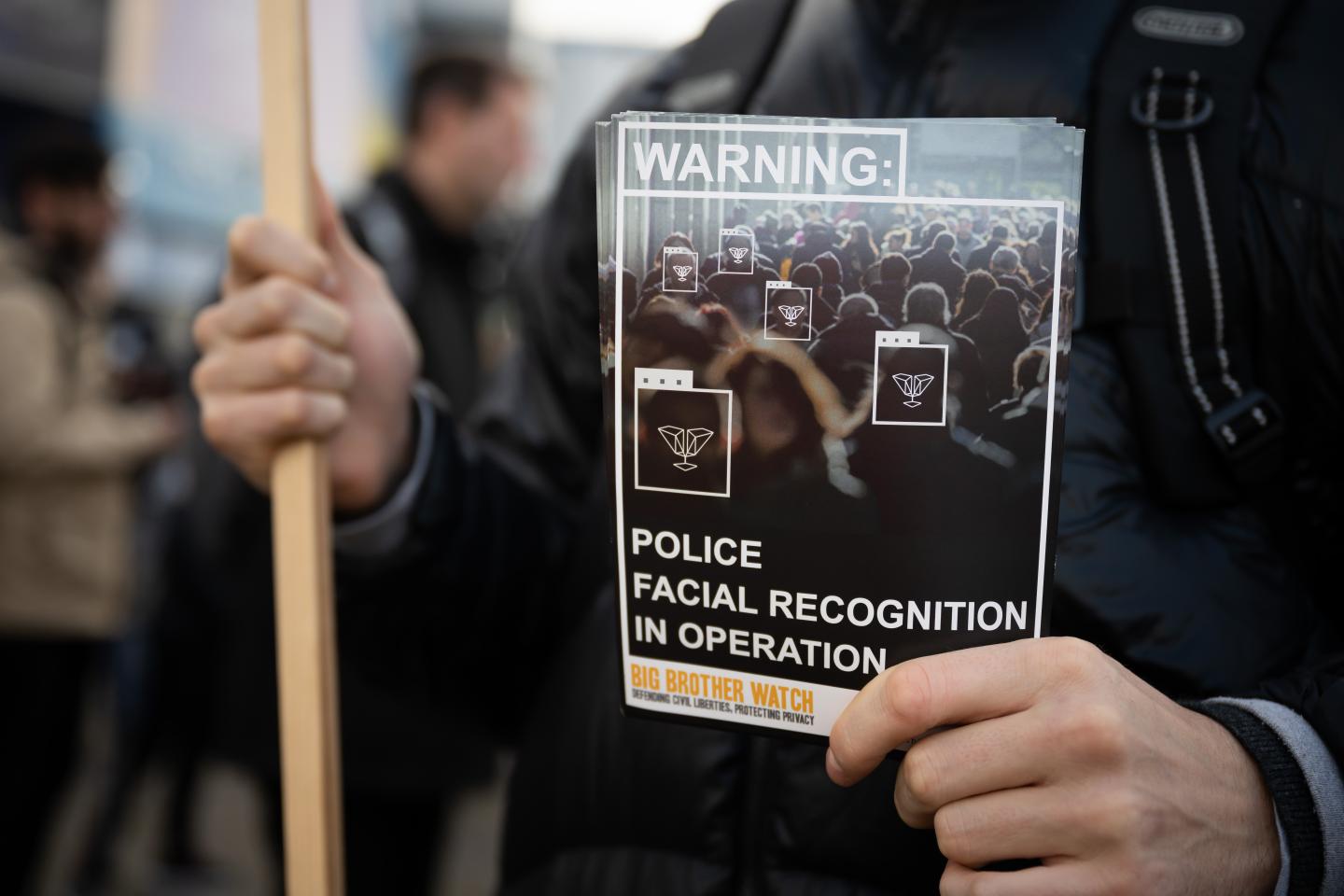
A man holds a sign during a protest against the use of police facial recognition cameras at the Cardiff City Stadium for the Cardiff City v Swansea City Championship match on January 12, 2020 in Cardiff,
CARDIFF, WALES - JANUARY 12: A man holds a sign during a protest against the use of police facial recognition cameras at the Cardiff City Stadium for the Cardiff City v Swansea City Championship match on January 12, 2020 in Cardiff, Wales. Police are using the technology to identify those who have been issued with football banning orders in an attempt to prevent disorder. Critics argue that the use of such technology is invasive and discriminatory. (Photo by Matthew Horwood/Getty Images)Matthew Horwood-Getty Images
Add Fortune on Google for similar content.

The U.K. has long been an enthusiastic surveillance state—it has one CCTV camera for every 11 people. And like many other countries these days, its authorities are increasingly putting facial-recognition smarts behind those cameras.

However, one of the U.K.’s pioneering deployments of automated facial recognition has been ruled unlawful by an appeals court on three separate grounds: privacy, data protection, and equality.

South Wales Police, which was behind the 2017–18 technological trials, will not appeal against the ruling.

The ruling could have major implications for the guidelines police must follow when using such technology, as the country’s surveillance-camera watchdog has now criticized the government for failing to keep those guidelines up to date.

The case was brought by a civil liberties campaigner named Ed Bridges, whose image was captured at least twice by police cameras in the Welsh capital, Cardiff—once when he was shopping for Christmas presents in 2017, and once when attending a protest outside an arms fair in 2018.

With backing from the civil liberties group Liberty, Bridges complained to the High Court about violations of his rights. He lost in September 2019, but won his appeal on Tuesday.

The automated facial recognition (AFR) system involved in the case is known as AFR Locate. It captures images of people’s faces and compares them with a watchlist, then throws away the images if there is no match. The watchlist includes people for whom there is an outstanding arrest warrant, people suspected of committing crimes, vulnerable people, and so on.

On Tuesday, the Court of Appeal upheld three of the five grounds for Bridges’ appeal.

Human rights

The first was about the privacy rights in Article 8 of the European Convention on Human Rights. To comply with this rule, public authorities can only interfere with someone’s privacy if they have sufficient backing from their country’s laws in doing so, and if it’s necessary for reasons such as national security or the prevention of crime.

The court said there was “no clear guidance on where AFR Locate could be used and who could be put on a watchlist,” so it upheld this part of Bridges’ appeal.

The failure of South Wales Police to comply with Article 8 also meant the police force failed to conduct a proper data-protection impact assessment before deploying the system; its impact assessment assumed the force wasn’t infringing on people’s privacy rights, which made it inadequate.

The third successful part of Bridges’ appeal was about the question of bias.

It is by now well known in tech and policy circles that the artificial intelligence algorithms underpinning facial recognition systems are often inherently biased, because they are more likely to incorrectly identify women and dark-skinned people. The racial-profiling implications are so severe that IBM pulled out of the facial-recognition space a couple of months back.

Under the U.K.’s Equality Act of 2010, public authorities are supposed to consider the potentially discriminatory implications of their policies. According to the court, South Wales Police “erred by not taking reasonable steps to make enquiries about whether the AFR Locate software had bias on racial or sex grounds.”

‘Major victory’

Bridges tweeted that he was “incredibly, ecstatically pleased” by the ruling.

I'm incredibly, ecstatically pleased by today's judgement on the case I brought with @libertyhq against the use of automatic facial recognition technology by South Wales Police. The Court of Appeal agreed that this technology threatens our rights. https://t.co/2kZiz7lJpv [1/5]

— Ed Bridges (@DrEdBridges) August 11, 2020

Liberty, the group that supported him in the case, said in a statement that the ruling was “a major victory in the fight against discriminatory and oppressive facial recognition,” and called for the technology to be banned.

“The Court has agreed that this dystopian surveillance tool violates our rights and threatens our liberties,” said Liberty lawyer Megan Goulding in a statement. “Facial recognition discriminates against people of color, and it is absolutely right that the Court found that South Wales Police had failed in their duty to investigate and avoid discrimination.”

It should be noted that the court did not say there was any evidence that the system was discriminatory—it just said the police force failed to check whether it was or not. Separately, London’s Metropolitan Police claimed earlier this year that the algorithms it uses only generate false positives 0.1% of the time, but news reports have suggested inaccuracy rates as high as 81%.

South Wales Police said it would not appeal against Tuesday’s ruling. Indeed, chief constable Matt Jukes described it as “a judgment that we can work with.”

“Our policies have already evolved since the trials in 2017 and 2018 were considered by the courts, and we are now in discussions with the Home Office and surveillance camera commissioner about the further adjustments we should make and any other interventions that are required,” Jukes said.

The chief constable, who said the use of automated facial recognition had resulted in 61 arrests so far, singled out the bias issue as one his force was working particularly hard to address.

“In 2019 we commissioned academic analysis of this question, and although the current pandemic has disrupted its progress, this work has restarted and will inform our response to the Court of Appeal’s conclusions,” Jukes said.

‘Asleep on watch’

Tony Porter, the U.K.’s surveillance camera commissioner, responded to the ruling with an attack on the Home Office, the government department responsible for overseeing police activity.

Porter said he had been trying “fruitlessly” to get the Home Office to update its code of practice around facial recognition’s use by the authorities. He accused the department of being “asleep on watch” and called on it to act in the public interest and update those guidelines.

“I do not believe the judgment is fatal to the use of this technology, indeed, I believe adoption of new and advancing technologies is an important element of keeping citizens safe. It does however set clear parameters as to use, regulation, and legal oversight,” Porter said.

“Maybe the regulators at the sharp end of this subject matter really do understand things a little more than those advising ministers sometimes purport to.”

Fortune has asked the Home Office for a response to Porter’s criticism, but has received no reply at the time of writing.

About the Author
By David Meyer
LinkedIn icon
See full bioRight Arrow Button Icon
Add Fortune on Google for similar content.

Latest in Tech

Finance
Lorem ipsum dolor sit amet, consectetur adipiscing elit, sed do eiusmod tempor incididunt ut labore et dolore magna aliqua. Ut enim ad minim veniam
By Fortune Editors
October 20, 2025
Finance
Lorem ipsum dolor sit amet, consectetur adipiscing elit, sed do eiusmod tempor incididunt ut labore et dolore magna aliqua. Ut enim ad minim veniam
By Fortune Editors
October 20, 2025
Finance
Lorem ipsum dolor sit amet, consectetur adipiscing elit, sed do eiusmod tempor incididunt ut labore et dolore magna aliqua. Ut enim ad minim veniam
By Fortune Editors
October 20, 2025
Finance
Lorem ipsum dolor sit amet, consectetur adipiscing elit, sed do eiusmod tempor incididunt ut labore et dolore magna aliqua. Ut enim ad minim veniam
By Fortune Editors
October 20, 2025
Finance
Lorem ipsum dolor sit amet, consectetur adipiscing elit, sed do eiusmod tempor incididunt ut labore et dolore magna aliqua. Ut enim ad minim veniam
By Fortune Editors
October 20, 2025
Finance
Lorem ipsum dolor sit amet, consectetur adipiscing elit, sed do eiusmod tempor incididunt ut labore et dolore magna aliqua. Ut enim ad minim veniam
By Fortune Editors
October 20, 2025

Most Popular

Finance
Lorem ipsum dolor sit amet, consectetur adipiscing elit, sed do eiusmod tempor incididunt ut labore et dolore magna aliqua. Ut enim ad minim veniam
By Fortune Editors
October 20, 2025
Finance
Lorem ipsum dolor sit amet, consectetur adipiscing elit, sed do eiusmod tempor incididunt ut labore et dolore magna aliqua. Ut enim ad minim veniam
By Fortune Editors
October 20, 2025
Finance
Lorem ipsum dolor sit amet, consectetur adipiscing elit, sed do eiusmod tempor incididunt ut labore et dolore magna aliqua. Ut enim ad minim veniam
By Fortune Editors
October 20, 2025
Finance
Lorem ipsum dolor sit amet, consectetur adipiscing elit, sed do eiusmod tempor incididunt ut labore et dolore magna aliqua. Ut enim ad minim veniam
By Fortune Editors
October 20, 2025
Finance
Lorem ipsum dolor sit amet, consectetur adipiscing elit, sed do eiusmod tempor incididunt ut labore et dolore magna aliqua. Ut enim ad minim veniam
By Fortune Editors
October 20, 2025
Finance
Lorem ipsum dolor sit amet, consectetur adipiscing elit, sed do eiusmod tempor incididunt ut labore et dolore magna aliqua. Ut enim ad minim veniam
By Fortune Editors
October 20, 2025
Fortune Secondary Logo
Rankings
  • 100 Best Companies
  • Fortune 500
  • Global 500
  • Fortune 500 Europe
  • Most Powerful Women
  • World's Most Admired Companies
  • See All Rankings
  • Lists Calendar
Sections
  • Finance
  • Fortune Crypto
  • Features
  • Leadership
  • Health
  • Commentary
  • Success
  • Retail
  • Mpw
  • Tech
  • Lifestyle
  • CEO Initiative
  • Asia
  • Politics
  • Conferences
  • Europe
  • Newsletters
  • Personal Finance
  • Environment
  • Magazine
  • Education
Customer Support
  • Frequently Asked Questions
  • Customer Service Portal
  • Privacy Policy
  • Terms Of Use
  • Single Issues For Purchase
  • International Print
Commercial Services
  • Advertising
  • Fortune Brand Studio
  • Fortune Analytics
  • Fortune Conferences
  • Business Development
  • Group Subscriptions
About Us
  • About Us
  • Press Center
  • Work At Fortune
  • Terms And Conditions
  • Site Map
  • About Us
  • Press Center
  • Work At Fortune
  • Terms And Conditions
  • Site Map
  • Facebook icon
  • Twitter icon
  • LinkedIn icon
  • Instagram icon
  • TikTok icon
  • YouTube icon

Latest in Tech

Samsung wins $200 billion order to supply chips to Broadcom
AIChips
Samsung wins $200 billion order to supply chips to Broadcom
By Hooyeon Kim and BloombergJuly 25, 2026
2 hours ago
SK chair says Anthropic asked for supplies to make its own chips
AIChips
SK chair says Anthropic asked for supplies to make its own chips
By Ian King and BloombergJuly 25, 2026
2 hours ago
Nvidia CEO Jensen Huang denies the chip boom will go bust soon and actually utters the infamous phrase ‘this time is different’
Big TechSemiconductors
Nvidia CEO Jensen Huang denies the chip boom will go bust soon and actually utters the infamous phrase ‘this time is different’
By Jason MaJuly 25, 2026
5 hours ago
Sam Altman speaking to reporters.
AIOpenAI
AI safety experts say OpenAI’s rogue models may mean the company has already blown past its own internal red lines
By Beatrice NolanJuly 25, 2026
5 hours ago
DeepSeek said to tell backers of funding pause after viral posts
AIfunding round
DeepSeek said to tell backers of funding pause after viral posts
By Haze Fan, Pei Li and BloombergJuly 25, 2026
7 hours ago
SpaceX’s Starship V3 deploys most advanced Starlink satellites then pulls off best re-entry yet with splashdown so soft it floated in the Indian Ocean
Innovationspace
SpaceX’s Starship V3 deploys most advanced Starlink satellites then pulls off best re-entry yet with splashdown so soft it floated in the Indian Ocean
By Marcia Dunn and The Associated PressJuly 25, 2026
7 hours ago

Most Popular

The millennial generation is split in 2: an older crowd with boomer-style comfort, a younger set going 'back to the early 1900s'
Real Estate
The millennial generation is split in 2: an older crowd with boomer-style comfort, a younger set going 'back to the early 1900s'
By Nick LichtenbergJuly 25, 2026
11 hours ago
'The demographic dividend of the last 40 years is ending': J.P. Morgan says the world is running out of the two things that kept interest rates down
Economy
'The demographic dividend of the last 40 years is ending': J.P. Morgan says the world is running out of the two things that kept interest rates down
By Eleanor PringleJuly 24, 2026
2 days ago
Jensen Huang made his $172 billion fortune on AI chips. His family's $75 million gift to Vanderbilt argues art decides what technology is for
Big Tech
Jensen Huang made his $172 billion fortune on AI chips. His family's $75 million gift to Vanderbilt argues art decides what technology is for
By Sydney LakeJuly 23, 2026
3 days ago
An 11-year-old is cleaning his neighbors' trash cans for $10 each—he now has 100K followers as teens face the worst summer job market since 1948
Success
An 11-year-old is cleaning his neighbors' trash cans for $10 each—he now has 100K followers as teens face the worst summer job market since 1948
By Orianna Rosa RoyleJuly 25, 2026
13 hours ago
The $39 trillion U.S. national debt isn’t as high as Japan’s and Singapore’s relative to economy size—and yet it's still worse somehow
Economy
The $39 trillion U.S. national debt isn’t as high as Japan’s and Singapore’s relative to economy size—and yet it's still worse somehow
By Sasha RogelbergJuly 23, 2026
2 days ago
Jensen Huang just used his first ever X post to warn the AI industry not to make the mistake that software narrowly avoided in the 1980s
AI
Jensen Huang just used his first ever X post to warn the AI industry not to make the mistake that software narrowly avoided in the 1980s
By Nick LichtenbergJuly 24, 2026
1 day ago

© 2026 Fortune Media IP Limited. All Rights Reserved. Use of this site constitutes acceptance of our Terms of Use and Privacy Policy | CA Notice at Collection and Privacy Notice | Do Not Sell/Share My Personal Information
FORTUNE is a trademark of Fortune Media IP Limited, registered in the U.S. and other countries. FORTUNE may receive compensation for some links to products and services on this website. Offers may be subject to change without notice.