Our mission to help you navigate the new normal is fueled by subscribers. To enjoy unlimited access to our journalism, subscribe today.
In 1909, the French daily Le Figaro carried on the front page “The Founding and Manifesto of Futurism,” a rousing essay by the radical Italian philosopher and technophile, Filippo Tommaso Marinetti. In it, Marinetti championed the rise of technology and mechanized transport to usher in an age of innovation, an enduring concept.
If there is an antithesis to futurism it might be presentism, a kind of stuck-in-neutral worldview. Few academics have written more about presentist thinking than François Hartog. The French historian has spent decades studying time, and how, in our fast-paced world, it increasingly appears to stand still—and how that phenomenon, in turn, messes with our ability to make sense of our shared past and the collective challenges we face in the future.
In his 2015 book, Regimes of Historicity: Presentism and Experiences of Time, Hartog wrote about the phenomenon of living in a presentist age. It’s not a flattering description of our modern times. Think short-termism, but only shorter. The presentism that Hartog fleshed out in his writing is a cynical worldview devoid of vision.
Presentism, Hartog explains, is “the sense that only the present exists, a present characterized at once by the tyranny of the instant and by the treadmill of an unending now.”
The treadmill of an unending now may sound abstract—that is, until you consider the plight of, say, your nephew, a recent college graduate with a mountain of debt and few job prospects. His future is too painful to think about. Or maybe it rings a bell as you tune into the arguments of climate change denialists who reject the need to act now to save the planet down the road. Or, maybe you can hear that treadmill grinding in your head in this age of social distancing and stay-at-home orders. Who hasn’t patched into a Zoom call with scruffy colleagues only to wonder, what day is it, anyhow? (Could a COVID-inspired remake of Groundhog Day be in the works?)
Hartog is quick to point out that this idea of presentism doesn’t explain all of modern life’s conundrums. It also doesn’t debunk every argument that, in the face of enormous existential challenges, it’s best to stick with the status-quo. But he did have some timely observations about our shared experience of life in the time of coronavirus, and how we are living in a truly unprecedented age.
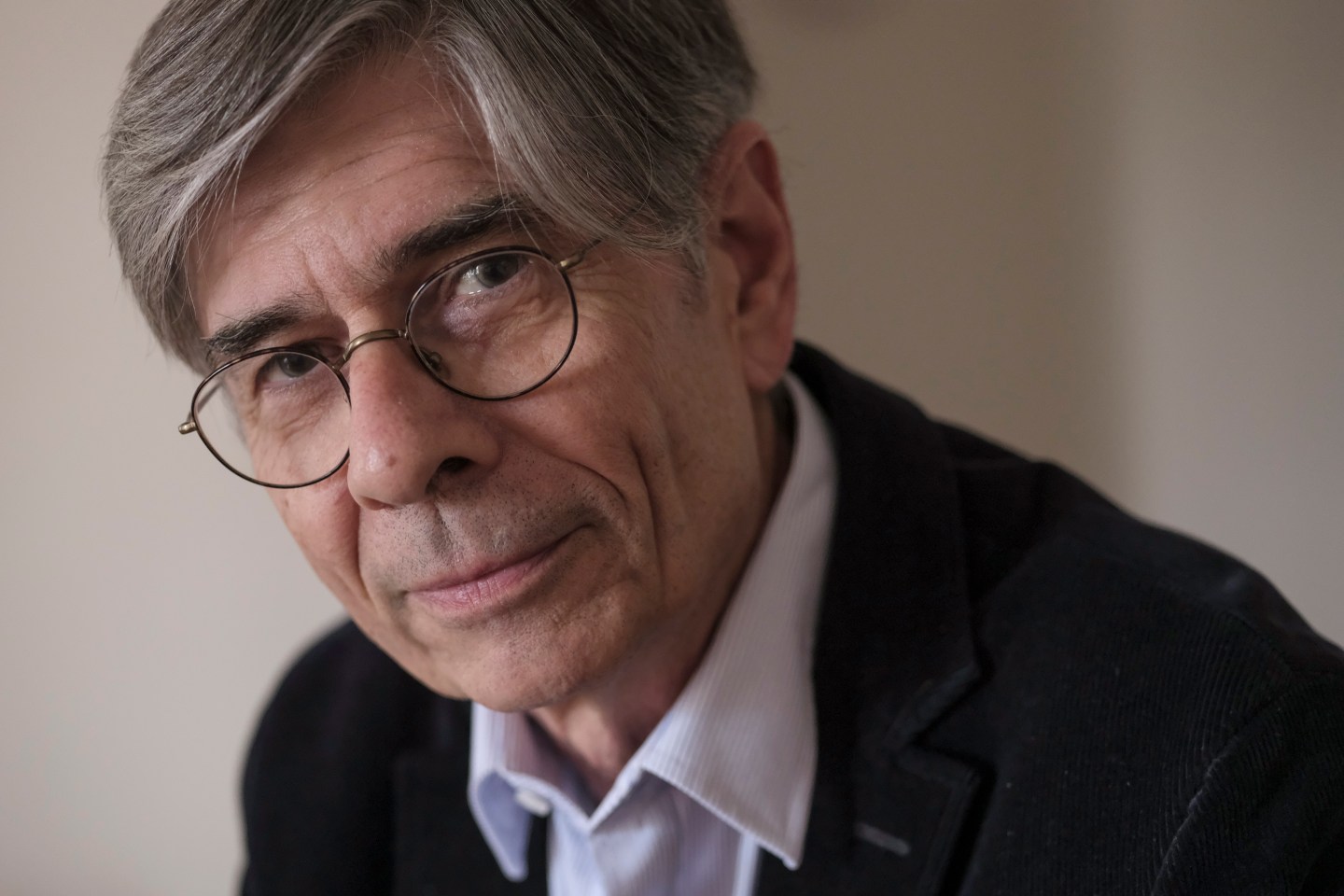
The following Q&A has been edited for brevity.
Fortune: What’s your view of our life under lockdown? Many adults juggle work from home with home-schooling the kids. For many of us, it’s warped time.
Hartog: Yes. With lockdown, people suddenly find themselves locked in a suspended time, a time that is always the same. It’s a kind of confinement. The days are passing, but time seems to have stopped. But because of computers, a person can be present everywhere in a click. Therefore, the digital world, I think, is fundamentally presentist. It’s instant and simultaneous. For those excluded from this [digital] world, it’s different, of course. But in recent months, when hundreds of millions of people were able to log in and connect, it was transformative. In doing so, we came to embrace our new digital condition. Our digital condition is a drastic change from our human condition… We were able to travel around the world without leaving our room. We could take part in aperitifs on WhatsApp with our friends, or listen to a concert. We could follow every moment, happening everywhere. We could see everything, feel everything, be present at everything. Only our physical presence was missing.
Fortune: The pandemic also forced some of us to reflect upon our relationship with the planet.
Hartog: Even before the pandemic, you had some people denouncing short-termism—the way our society was increasingly centered around instant gratification. A good example of that was the movement around slow—slow food, slow everything, the need to slow down. There were people who embraced frugal living. They moved out of the city, and into the countryside. It’s a real trend.
Fortune: In your research, you must have come across historical events that are similar to what we are facing in COVID-19.
Hartog: What we are facing here is something unprecedented. This is a very serious health crisis. Pandemics and health crises of this nature are as old as humanity… But with COVID, this pandemic stems from humanity’s deteriorating relationship with nature. We have reduced dramatically the earth’s biodiversity. What is completely new today is that humanity has become a geological force unto itself. This is what’s meant by the Anthropocene… And, thanks to COVID, we have rediscovered that we are just one species, and not necessarily the strongest one. This virus, in a way, could suppress the human species as we know it—that is, if we do nothing. This makes it unprecedented. It puts our whole view of the modern world—our vision of progress, our mastery over nature—in doubt.
Fortune: So, you’re seeing humanity at a kind of crossroads?
Hartog: Yes. At the beginning of the pandemic, the impression was that science had a prominent role, and that scientific message was sticking with the public. That’s also because governments were relying so much on scientific advice. But very quickly doubts entered the discussion. Part of this is because of the way the media set up the discussion. In France, what we saw on talk shows, on TV, were health experts. One says this. The other says that. People discovered very quickly that science cannot be so affirmative in its statements and conclusions. A lot of times the answer was, ‘We don’t know.’ … That’s extremely exhausting for people. This idea that you have to live with uncertainty is very, very difficult. It generates anxiety. And, so, when science didn’t have a permanent and definitive take on the problem, people lost trust. Naturally, conspiracy theories emerge: ‘The virus was made in a lab. The government is lying to us.’ These theories are getting a lot of attention on the streets, at least in France.
Fortune: Do you think the public’s faith in science and expertise will recover?
Hartog: I don’t know. If the epidemic fades away, probably, yes. If there is a second wave—that would be terrible. It will also sow great doubts in medical experts. The same can be said of the government. They are in an impossible position. In France, there has long been suspicions and opposition against the government. This predates the pandemic.
Fortune: Faith in government institutions is crumbling everywhere.
Hartog: Politics these days is nothing if not presentist. Trump is the best example of this, and his Tweets are the best signal of that. He represents the zero-degree of politics. The nature of Twitter is to put you in a loop—someone says something, you reply, and then a few minutes later, it has lost all its meaning. And now all politicians are using Twitter for their communications. And that can distort not only the present, but the instant—particularly, if in the very next instant, the message is totally different. In that case, you are no longer obliged to remember what was said just three minutes earlier. In this kind of politics, it’s all about, first, reaction, and then emotion. And, of course, you have no space for any kind of reflection or analysis. You cannot take any distance to assess. You have to be on the spot, every minute.
Fortune: Do you really see a danger in being “always on”?
Hartog: I think the danger is great. Particularly for democracy. Our political system in the West is based upon representation. That means decisions take time. Democracy needs time. If you advocate instant decisions, instant Democracy, you ruin totally this system. You ruin Democracy… With presentism, there are the victors, and the vanquished. The vanquished would be those who have nothing but the present in their lives. They live from one day to the next. They have no perspective of any kind. Many young people who cannot find jobs are in this position. The other emblematic figure is the migrant. The migrant is defined by his condition. That means, in a way, he is totally stuck in a present without any possibility of escaping. I see this figure as emblematic of our presentist moment. He sees no future.
Fortune: Will your next book reflect upon our shared coronavirus experience, and how it may or may not influence our relationship with time?
Hartog: My next book is called Chronos: The West’s Struggle with Time. It was supposed to come out in May. But it’s been postponed because of the crisis. It will now come out in October. It’s not a history of time, but it takes the long view on the question of our understanding of time from the Christian world up to the Anthropocene—this present crisis included.