• Home
  • Latest
  • Fortune 500
  • Finance
  • Tech
  • Leadership
  • Lifestyle
  • Rankings
  • Multimedia
Commentary

These 5 numbers tell you everything you need to know about racial disparities in health care

By
Lloyd B. Minor
Lloyd B. Minor
Down Arrow Button Icon
By
Lloyd B. Minor
Lloyd B. Minor
Down Arrow Button Icon
July 8, 2020, 1:00 PM ET
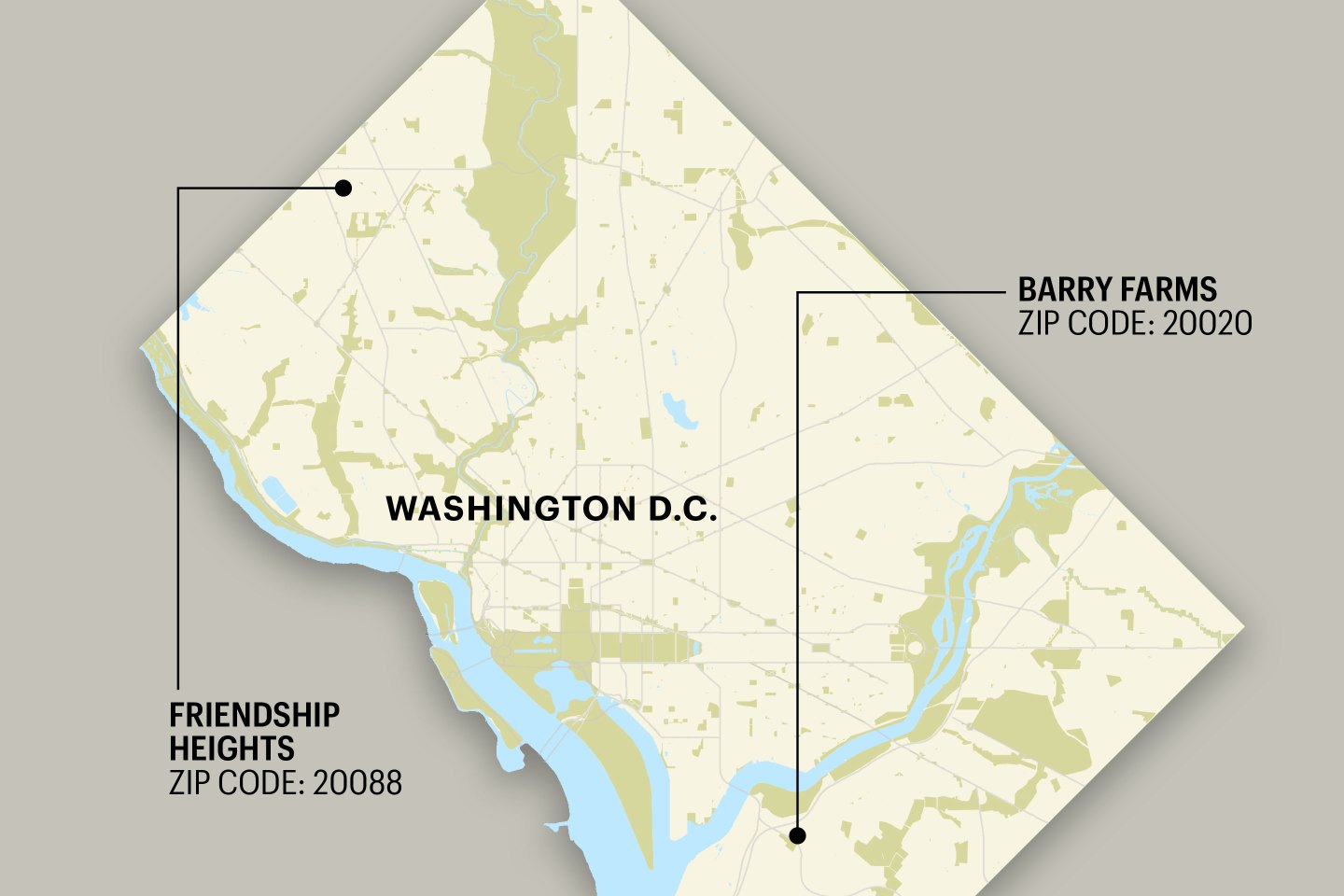
Consider Washington, DC. The difference in life expectancy between our national capital's longest-lived zip code, 20088, and its shortest, 20020, is a staggering 32.9 years. Yet the physical distance from tony Friendship Heights to hard-pressed Barry Farms is less than 10 miles.
Consider Washington, DC. The difference in life expectancy between our national capital's longest-lived zip code, 20088, and its shortest, 20020, is a staggering 32.9 years. Yet the physical distance from tony Friendship Heights to hard-pressed Barry Farms is less than 10 miles.Graphic by Nicolas Rapp

Despite all the progress we have achieved in medicine and all the knowledge accumulated, a single virus has upended our world. COVID-19 has humbled so many in biomedicine, and I must count myself among them. And yet I remain confident that this pandemic will pass to history. Although it is far from over, this is a story with an ending. As I write, researchers around the world are investigating more than 120 vaccine candidates. Long-standing business competitors have pledged to share resources and clinical trial data to accelerate new therapies. And cross-sector partnerships are flourishing. Together, these efforts will defeat the virus; human ingenuity will win out.

I am less assured, however, about how a different public health crisis ends. It is a crisis that has persisted for generations at a tragic cost. To understand this challenge, you only need five numbers: a zip code. Far more than our family histories or genetic code, our zip code—the place we call home—remains the single greatest predictor of long-term health and life expectancy.  

Consider Washington, D.C. The difference in life expectancy between our national capital’s longest-lived zip code, 20088, and its shortest, 20020, is a staggering 32.9 years. Yet the physical distance from tony Friendship Heights to hard-pressed Barry Farm is less than 10 miles. This disparity shows how health is profoundly shaped by our environment: the air we breathe, the food we eat, the services we have access to, the opportunities afforded to us. 

We refer to these factors as the social determinants of health. But beneath the surface of this term lies an ugly truth. It is not a coincidence that Friendship Heights is a majority-White neighborhood, while Barry Farm is predominantly Black. Nor is it a fluke that similar racial disparities show up in neighborhoods across Chicago, New York, Los Angeles, and other major cities. Up close, when we study social determinants of health, what we are really studying are the enduring health consequences of racist policies and prejudice encoded in our society. 

If you are not convinced, consider these facts: Food deserts—when income is accounted for—occur more frequently in Black neighborhoods; Black Americans, owing to residential segregation, are more likely to breathe polluted air and drink lead-poisoned water; Black households with children still hold just one cent of wealth for every dollar held by an average White family; schools in minority districts receive an average of $2,226 less per student per year than those in White-majority districts, a gap that adds up to billions of dollars; Black Americans are incarcerated at five times the rate of White Americans—an outcome fueled, in part, by a disturbing “school-to-prison” pipeline. And the list of inequities goes on.

These are the bitter fruits of racial prejudice, the same I encountered growing up in Little Rock, where, in junior high, I was bused from my majority-White school to a school across town as part of a court-ordered desegregation plan. It was the first time I viscerally experienced the lie that was “separate but equal.” The tragic reality—that segregation engenders inequity—lay exposed in the school’s scarcely stocked library, where rats had visibly damaged books on the shelves, between the missing rails of stairwells, and behind the plaster peeling from the walls. 

Though decades have passed since then, historically marginalized communities continue to bear the extreme financial and health costs of systemic exclusion and neglect. In every sense, it is a public health crisis—most recently exposed by COVID-19 and by the murder of George Floyd, which awoke many in our nation to the malignant nature of racial injustice. 

If we are to achieve meaningful change, we as a medical community—and a country—must see “social determinants” for what they truly are. Ten miles and a 30-year gap in life expectancy: This should not be the legacy we leave for future generations. How can we make a difference against decades of racist policies that have brought us to this pass? For the nation’s teaching hospitals and academic health centers like Stanford Medicine, we must embrace three crucial avenues of change.

First, we must make social determinants a distinct research priority. To that end, we should publicly report the annual percentage of our research portfolios dedicated to advancing the understanding of social determinants, their health effects, and—critically—how to intervene. We should likewise set clear benchmarks to grow this body of work over time.

A second and no less critical priority arises from our core mission as instructional institutions. As we train tomorrow’s physician leaders, we must strive to extend educational opportunities to promising students from underrepresented communities. A more diverse physician workforce is essential to enhancing the cultural competence of care that patients receive and improving access in under-resourced areas. 

As a path to bolstering applicant diversity and encouraging graduates to pursue their passions, Stanford Medicine has committed to providing debt-free education—including living expenses—for all medical students based upon financial need. Accredited colleges and universities must similarly address student debt as an urgent mandate. In addition, medical schools must include instruction on how to engage patients about social determinants, how implicit bias affects patient-clinician interactions, and the consequences of racism on human health.

Finally, in the care we provide, we must make lasting commitments to increasing community-based programs focused on equitable outcomes and expanding access. Treating those who are underserved and dispossessed when they come to the Emergency Department with life-threatening conditions is a bare minimum. We must find ways to systematically prevent such occurrences from happening in the first place—and this commitment must be shared by health insurance providers. 

This, however, is only a start. Advocating for nutritious eating makes a scant difference in a food desert. Praising the benefits of physical exercise helps little when jogging in a nearby neighborhood could cost your life. And warnings about the dangers of drug and alcohol abuse will hardly be heard in areas devoid of opportunity and hope. These challenges will not be solved by medicine alone. As a society, we have been shaken to our core by the recent injustices we have witnessed; we cannot look away. We must confront and address through policy the systemic inequities that have turned our zip codes into such powerful predictors of human health.

Lloyd B. Minor is a scientist, surgeon, and the Carl and Elizabeth Naumann dean of the Stanford University School of Medicine. He is also the author of Discovering Precision Health.


About the Author
By Lloyd B. Minor
See full bioRight Arrow Button Icon

Latest in Commentary

Finance
Lorem ipsum dolor sit amet, consectetur adipiscing elit, sed do eiusmod tempor incididunt ut labore et dolore magna aliqua. Ut enim ad minim veniam
By Fortune Editors
October 20, 2025
Finance
Lorem ipsum dolor sit amet, consectetur adipiscing elit, sed do eiusmod tempor incididunt ut labore et dolore magna aliqua. Ut enim ad minim veniam
By Fortune Editors
October 20, 2025
Finance
Lorem ipsum dolor sit amet, consectetur adipiscing elit, sed do eiusmod tempor incididunt ut labore et dolore magna aliqua. Ut enim ad minim veniam
By Fortune Editors
October 20, 2025
Finance
Lorem ipsum dolor sit amet, consectetur adipiscing elit, sed do eiusmod tempor incididunt ut labore et dolore magna aliqua. Ut enim ad minim veniam
By Fortune Editors
October 20, 2025
Finance
Lorem ipsum dolor sit amet, consectetur adipiscing elit, sed do eiusmod tempor incididunt ut labore et dolore magna aliqua. Ut enim ad minim veniam
By Fortune Editors
October 20, 2025
Finance
Lorem ipsum dolor sit amet, consectetur adipiscing elit, sed do eiusmod tempor incididunt ut labore et dolore magna aliqua. Ut enim ad minim veniam
By Fortune Editors
October 20, 2025

Most Popular

Finance
Lorem ipsum dolor sit amet, consectetur adipiscing elit, sed do eiusmod tempor incididunt ut labore et dolore magna aliqua. Ut enim ad minim veniam
By Fortune Editors
October 20, 2025
Finance
Lorem ipsum dolor sit amet, consectetur adipiscing elit, sed do eiusmod tempor incididunt ut labore et dolore magna aliqua. Ut enim ad minim veniam
By Fortune Editors
October 20, 2025
Finance
Lorem ipsum dolor sit amet, consectetur adipiscing elit, sed do eiusmod tempor incididunt ut labore et dolore magna aliqua. Ut enim ad minim veniam
By Fortune Editors
October 20, 2025
Finance
Lorem ipsum dolor sit amet, consectetur adipiscing elit, sed do eiusmod tempor incididunt ut labore et dolore magna aliqua. Ut enim ad minim veniam
By Fortune Editors
October 20, 2025
Finance
Lorem ipsum dolor sit amet, consectetur adipiscing elit, sed do eiusmod tempor incididunt ut labore et dolore magna aliqua. Ut enim ad minim veniam
By Fortune Editors
October 20, 2025
Finance
Lorem ipsum dolor sit amet, consectetur adipiscing elit, sed do eiusmod tempor incididunt ut labore et dolore magna aliqua. Ut enim ad minim veniam
By Fortune Editors
October 20, 2025
Fortune Secondary Logo
Rankings
  • 100 Best Companies
  • Fortune 500
  • Global 500
  • Fortune 500 Europe
  • Most Powerful Women
  • Future 50
  • World’s Most Admired Companies
  • See All Rankings
Sections
  • Finance
  • Fortune Crypto
  • Features
  • Leadership
  • Health
  • Commentary
  • Success
  • Retail
  • Mpw
  • Tech
  • Lifestyle
  • CEO Initiative
  • Asia
  • Politics
  • Conferences
  • Europe
  • Newsletters
  • Personal Finance
  • Environment
  • Magazine
  • Education
Customer Support
  • Frequently Asked Questions
  • Customer Service Portal
  • Privacy Policy
  • Terms Of Use
  • Single Issues For Purchase
  • International Print
Commercial Services
  • Advertising
  • Fortune Brand Studio
  • Fortune Analytics
  • Fortune Conferences
  • Business Development
  • Group Subscriptions
About Us
  • About Us
  • Editorial Calendar
  • Press Center
  • Work At Fortune
  • Diversity And Inclusion
  • Terms And Conditions
  • Site Map
  • About Us
  • Editorial Calendar
  • Press Center
  • Work At Fortune
  • Diversity And Inclusion
  • Terms And Conditions
  • Site Map
  • Facebook icon
  • Twitter icon
  • LinkedIn icon
  • Instagram icon
  • Pinterest icon

Latest in Commentary

assis
CommentaryIBM
The digital sovereignty dilemma is a false choice — here’s how enterprises can have both
By Ana Paula AssisApril 9, 2026
20 hours ago
housing
CommentaryHousing
The housing market has been frozen for 3 years. Here’s why this spring could finally change that
By Jessica LautzApril 8, 2026
2 days ago
curtin
CommentaryInfrastructure
TE Connectivity CEO: the real promise of AI is long-term transformation, not short-term efficiency gains
By Terrence CurtinApril 7, 2026
3 days ago
philip
CommentaryEducation
I just became CEO of one of education’s Big 3. Here’s why AI will never replace a great teacher
By Philip MoyerApril 7, 2026
3 days ago
omar
Commentarydisruption
Pearson CEO: the AI job apocalypse is a Silicon Valley story. The data tells a different one
By Omar AbboshApril 6, 2026
3 days ago
no kings
CommentaryLeadership
America’s CEOs have become reluctant guardians of democracy
By Jeffrey Sonnenfeld and Stephen HenriquesApril 6, 2026
4 days ago

Most Popular

The U.S. government is spending $88 billion a month in interest on national debt—equal to spending on defense and education combined
Economy
The U.S. government is spending $88 billion a month in interest on national debt—equal to spending on defense and education combined
By Fortune EditorsApril 9, 2026
18 hours ago
A Meta employee created a dashboard so coworkers can compete to be the company's No. 1 AI token user—and Zuckerberg doesn't even rank in the top 250
AI
A Meta employee created a dashboard so coworkers can compete to be the company's No. 1 AI token user—and Zuckerberg doesn't even rank in the top 250
By Fortune EditorsApril 9, 2026
20 hours ago
Gen Z doesn't want your full-time job. They want several part-time roles, and it's reshaping the entire workforce
Success
Gen Z doesn't want your full-time job. They want several part-time roles, and it's reshaping the entire workforce
By Fortune EditorsApril 9, 2026
21 hours ago
2 years ago, Saudi Arabia quietly canceled the ‘petrodollar’ deal with America that wired the world economy for 50 years. Then war broke out in Iran
Energy
2 years ago, Saudi Arabia quietly canceled the ‘petrodollar’ deal with America that wired the world economy for 50 years. Then war broke out in Iran
By Fortune EditorsApril 7, 2026
2 days ago
White-collar workers are quietly rebelling against AI as 80% outright refuse adoption mandates
AI
White-collar workers are quietly rebelling against AI as 80% outright refuse adoption mandates
By Fortune EditorsApril 9, 2026
19 hours ago
Gen Z workers are so fearful AI will take their job they’re intentionally sabotaging their company’s AI rollout
AI
Gen Z workers are so fearful AI will take their job they’re intentionally sabotaging their company’s AI rollout
By Fortune EditorsApril 8, 2026
2 days ago

© 2026 Fortune Media IP Limited. All Rights Reserved. Use of this site constitutes acceptance of our Terms of Use and Privacy Policy | CA Notice at Collection and Privacy Notice | Do Not Sell/Share My Personal Information
FORTUNE is a trademark of Fortune Media IP Limited, registered in the U.S. and other countries. FORTUNE may receive compensation for some links to products and services on this website. Offers may be subject to change without notice.









