• Home
  • Latest
  • Fortune 500
  • Finance
  • Tech
  • Leadership
  • Lifestyle
  • Rankings
  • Multimedia

Trendingnow

1

The millennial generation has split, new Fed research shows: Those over 35 are edging toward boomer-style wealth, while everyone else falls behind

2

Scott Bessent casually says the U.S. has more than $1 trillion in gold—and that it doesn’t matter for the dollar

3

Mark Cuban says he has the solution to growing income inequality, and it's to reward every employee—from CEO to janitor—with company stock

1

The millennial generation has split, new Fed research shows: Those over 35 are edging toward boomer-style wealth, while everyone else falls behind

2

Scott Bessent casually says the U.S. has more than $1 trillion in gold—and that it doesn’t matter for the dollar

3

Mark Cuban says he has the solution to growing income inequality, and it's to reward every employee—from CEO to janitor—with company stock
CommentaryCoronavirus bailout

To fight the coronavirus budget crisis, act like Alexander Hamilton

By
Patrick Augustin
Patrick Augustin
,
Valeri Sokolovski
Valeri Sokolovski
,
Marti G. Subrahmanyam
, and
Davide Tomio
Davide Tomio
Down Arrow Button Icon
By
Patrick Augustin
Patrick Augustin
,
Valeri Sokolovski
Valeri Sokolovski
,
Marti G. Subrahmanyam
, and
Davide Tomio
Davide Tomio
Down Arrow Button Icon
July 3, 2020, 9:00 AM ET
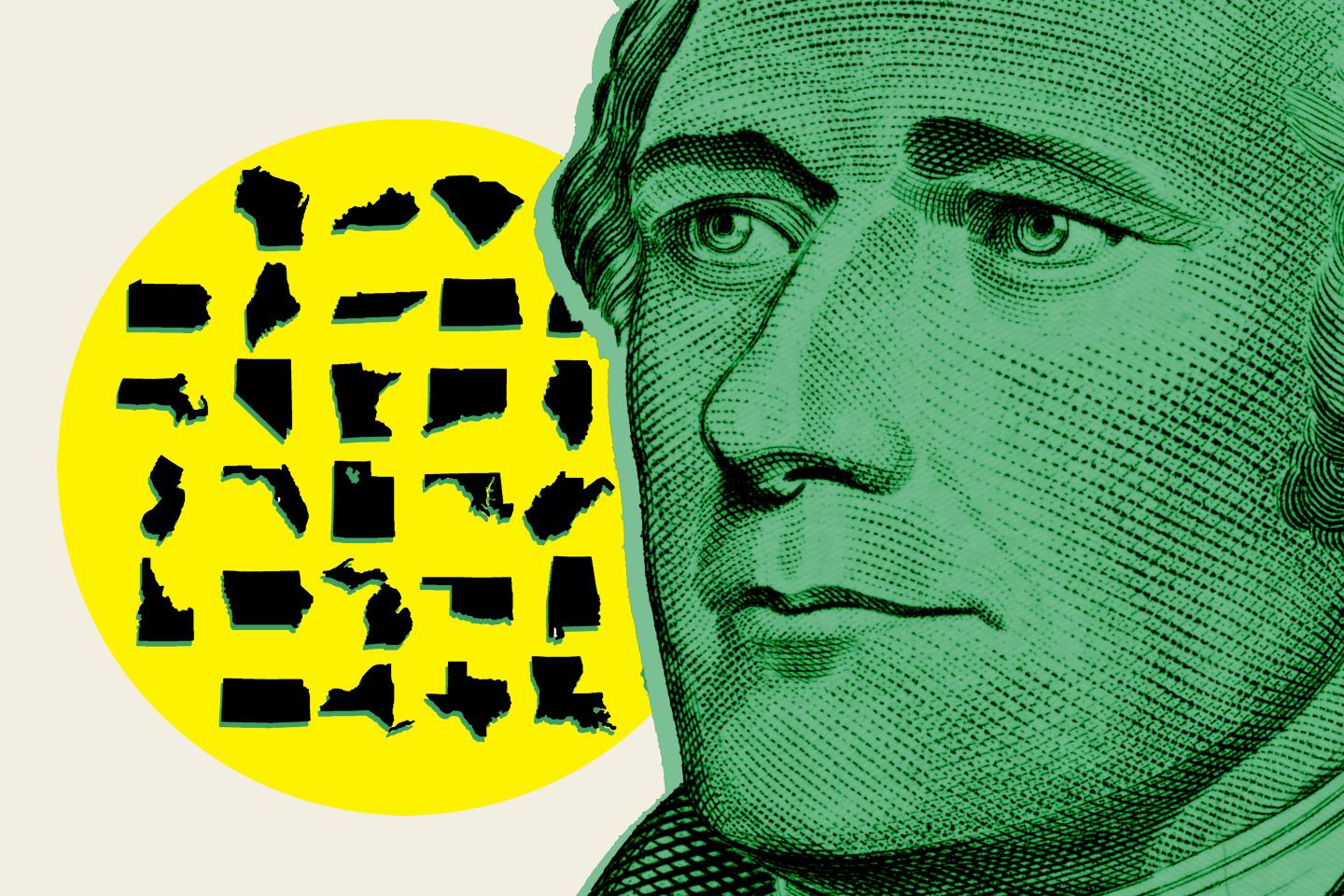
This is not the first time the US has confronted a common, disparately borne struggle. In 1790, Alexander Hamilton spurred the federal government to take over the debt accumulated by states in the fight for independence.
This is not the first time the US has confronted a common, disparately borne struggle. In 1790, Alexander Hamilton spurred the federal government to take over the debt accumulated by states in the fight for independence.Photo-Illustration by Fortune; Original Photo: Wodicka—ullstein bild via Getty Images
Add Fortune on Google for similar content.

Some U.S. states are facing disproportionate financial challenges due to the pandemic. Plunging tax revenue, unemployment, and rising healthcare expenses, coupled with high levels of existing state debt have driven some states into acute financial distress – threatening the nation’s unity.

This is not the first time the U.S. has confronted a common, disparately borne struggle. In 1790, Alexander Hamilton spurred the federal government to take over the debt accumulated by states in the fight for independence. It was the “price of liberty.” The agreement caused controversy, particularly among the states asked to contribute more. In the event, unity prevailed, and the nation strengthened.

Today, a similar act of solidarity is needed. To be clear, we are not suggesting indebted states be bailed out, but they should not be made to pay for their pandemic-induced financial strain. Instead, the incrementalcosts states incur during recovery should be considered the “price of unity” and shared at a national level, as they were over 200 years ago.

Investors, however, seem pessimistic about U.S. unity. In fact, judging by financial market indicators, they have already chosen which states are likely to come out on top post-crisis (the likes of Texas and Florida), and which will pay most dearly (California, Connecticut, Illinois, Pennsylvania, New Jersey, and New York). This divisive verdict does not foster “a more perfect union,” which the US needs today to maintain its status as the world’s most powerful economy.

What are the markets saying?

We know which U.S. states investors are most wary of; we can see the evidence in the current, volatile prices of state-specific default insurance that we examine in our research. The trajectory of these prices, as calculated based on data from IHS Markit, predicts that, over the next five years, New Jersey, Pennsylvania, and Connecticut have a 1-in-10 chance of defaulting on their debt, and Illinois a whopping 1-in-4. These numbers are in stark contrast to the 1-in-60 risk of default recorded for Florida and Texas over the same horizon.

This is surprising. While Illinois’ protracted financial woes and pension obligations are not new, investors’ negative perception of the other five states is. In January 2020, the cost of insuring against the default of California, New York, Florida, or Texas was roughly equal. Today, default insurance for California and New York costs around four times that for Florida or Texas. 

What explains the market reaction? 

There are three reasons for such a large disparity in default perceptions across states.

First, some states have higher COVID-19 infection rates, which certainly strain a state’s finances. But, infection rates do not tell the whole story; Florida has the largest share of at-risk population, and its per capita infection rates are roughly equal to California’s, while its default risk has hardly budged since January. 

Second, all six states with the largest spikes in default risk have high debt levels and overextended budgets. In short, as we have seen with the EU, the markets believe that only the fiscally strongest states avoid default. Yet, unlike the members of the EU, each state is not a separate entity, but an integral part of the United States (whose default probability has remained low, despite unprecedented debt levels). 

Last, these six states are predominantly Democratic. While Democratic-favored policies, such as subsidized healthcare, certainly left these states with less fallback finances, Republican implications that they be left to go bankrupt after suffering a shock beyond their control seems irresponsible.

Why does debt matter?

The sting of negative market perception is felt as tax bases shrink, rainy day funds of even well-managed states run dry, and state governments are forced to turn to financial markets to borrow additional funds to meet their budget commitments.

States perceived more likely to default will pay higher interest rates on their debt, making their recovery more arduous. Raising additional debt is more difficult and expensive, as Illinois recently discovered when it committed to paying a punitive 5.85% interest on its $800 million of new debt. Had Illinois issued the same debt before the pandemic, they would have paid half as much. 

Although some may experience schadenfreude in seeing a “poorly-run” state forced to tighten its belt, it seems unjust not to aid a struggling state amid a global economic and health crisis. 

Where is the unity?

Unfortunately, withholding support seems to be exactly what some leaders favor. Senator Rick Scott (R, Fla.), in a recent Wall Street Journal op-ed, asserts that states should not be rewarded for their “poor choices”. This solution is particularly unfair to strapped cities on those states. Detroit, for example, despite having recently emerged from near-crippling municipal bankruptcy, is being bowled over again by the financial consequences of the pandemic; its recovery will almost certainly require state government aid. With no compromise in sight for easing the economic burden of the most indebted states, residents of cities like Detroit face steeper taxes, reduced efficacy of municipal services, and risk having to choose between pensions and medical coverage.

Although the $3 trillion coronavirus relief bill recently passed by the House ($1 trillion of which will be reserved for state and local governments) is a step in the right direction, President Trump’s veto threat suggests that the U.S. may not be quite ready to set aside their party politics. Unfortunately, such comments will only serve to deepen market concerns, making it more difficult for the overburdened states to finance themselves. 

What the U.S. needs now are the same actions it took over two centuries ago: compromise and unity. Indeed, now is not the time for them to practice political distancing – at least not in the room where it happens. 

Patrick Augustin is an associate professor of finance in the Desautels Faculty of Management at McGill University.

Valeri Sokolovski is an assistant professor of finance at HEC Montreal.

Marti G. Subrahmanyam is the Charles E. Merrill Professor of Finance, Economics, and International Business in the Stern School of Business at New York University.

Davide Tomio is an assistant professor of business administration in the Darden School of Business at the University of Virginia.

About the Authors
By Patrick Augustin
See full bioRight Arrow Button Icon
By Valeri Sokolovski
See full bioRight Arrow Button Icon
By Marti G. Subrahmanyam
See full bioRight Arrow Button Icon
By Davide Tomio
See full bioRight Arrow Button Icon
Add Fortune on Google for similar content.

Latest in Commentary

Finance
Lorem ipsum dolor sit amet, consectetur adipiscing elit, sed do eiusmod tempor incididunt ut labore et dolore magna aliqua. Ut enim ad minim veniam
By Fortune Editors
October 20, 2025
Finance
Lorem ipsum dolor sit amet, consectetur adipiscing elit, sed do eiusmod tempor incididunt ut labore et dolore magna aliqua. Ut enim ad minim veniam
By Fortune Editors
October 20, 2025
Finance
Lorem ipsum dolor sit amet, consectetur adipiscing elit, sed do eiusmod tempor incididunt ut labore et dolore magna aliqua. Ut enim ad minim veniam
By Fortune Editors
October 20, 2025
Finance
Lorem ipsum dolor sit amet, consectetur adipiscing elit, sed do eiusmod tempor incididunt ut labore et dolore magna aliqua. Ut enim ad minim veniam
By Fortune Editors
October 20, 2025
Finance
Lorem ipsum dolor sit amet, consectetur adipiscing elit, sed do eiusmod tempor incididunt ut labore et dolore magna aliqua. Ut enim ad minim veniam
By Fortune Editors
October 20, 2025
Finance
Lorem ipsum dolor sit amet, consectetur adipiscing elit, sed do eiusmod tempor incididunt ut labore et dolore magna aliqua. Ut enim ad minim veniam
By Fortune Editors
October 20, 2025

Most Popular

Finance
Lorem ipsum dolor sit amet, consectetur adipiscing elit, sed do eiusmod tempor incididunt ut labore et dolore magna aliqua. Ut enim ad minim veniam
By Fortune Editors
October 20, 2025
Finance
Lorem ipsum dolor sit amet, consectetur adipiscing elit, sed do eiusmod tempor incididunt ut labore et dolore magna aliqua. Ut enim ad minim veniam
By Fortune Editors
October 20, 2025
Finance
Lorem ipsum dolor sit amet, consectetur adipiscing elit, sed do eiusmod tempor incididunt ut labore et dolore magna aliqua. Ut enim ad minim veniam
By Fortune Editors
October 20, 2025
Finance
Lorem ipsum dolor sit amet, consectetur adipiscing elit, sed do eiusmod tempor incididunt ut labore et dolore magna aliqua. Ut enim ad minim veniam
By Fortune Editors
October 20, 2025
Finance
Lorem ipsum dolor sit amet, consectetur adipiscing elit, sed do eiusmod tempor incididunt ut labore et dolore magna aliqua. Ut enim ad minim veniam
By Fortune Editors
October 20, 2025
Finance
Lorem ipsum dolor sit amet, consectetur adipiscing elit, sed do eiusmod tempor incididunt ut labore et dolore magna aliqua. Ut enim ad minim veniam
By Fortune Editors
October 20, 2025
Fortune Secondary Logo
Rankings
  • 100 Best Companies
  • Fortune 500
  • Global 500
  • Fortune 500 Europe
  • Most Powerful Women
  • World's Most Admired Companies
  • See All Rankings
  • Lists Calendar
Sections
  • Finance
  • Fortune Crypto
  • Features
  • Leadership
  • Health
  • Commentary
  • Success
  • Retail
  • Mpw
  • Tech
  • Lifestyle
  • CEO Initiative
  • Asia
  • Politics
  • Conferences
  • Europe
  • Newsletters
  • Personal Finance
  • Environment
  • Magazine
  • Education
Customer Support
  • Frequently Asked Questions
  • Customer Service Portal
  • Privacy Policy
  • Terms Of Use
  • Single Issues For Purchase
  • International Print
Commercial Services
  • Advertising
  • Fortune Brand Studio
  • Fortune Analytics
  • Fortune Conferences
  • Business Development
  • Group Subscriptions
About Us
  • About Us
  • Press Center
  • Work At Fortune
  • Terms And Conditions
  • Site Map
  • About Us
  • Press Center
  • Work At Fortune
  • Terms And Conditions
  • Site Map
  • Facebook icon
  • Twitter icon
  • LinkedIn icon
  • Instagram icon
  • TikTok icon
  • YouTube icon

Latest in Commentary

Can Bangkok future-proof itself against the heat?
CommentaryThailand
Can Bangkok future-proof itself against the heat?
By Curtis S. Chin and Ella TanJuly 23, 2026
38 minutes ago
mm
CommentaryLeadership
Michael Muthukrishna: The ‘lone genius’ myth is wrong and it’s holding back your business
By Michael MuthukrishnaJuly 23, 2026
10 hours ago
Paul Keary (L) and Mike Sutcliff (R).
CommentaryAI agents
Teneo & Thoughtworks CEOs: the AI race will be won with governance, not speed 
By Paul Keary and Mike SutcliffJuly 23, 2026
10 hours ago
marks
CommentaryNational Security
General James ‘Spider’ Marks: there’s a strategic risk hidden inside closed AI systems
By James MarksJuly 23, 2026
10 hours ago
glp
Commentaryobesity
The GLP-1 paradox: too expensive to cover, too effective to cut
By Bryan Sivak and Elina OnitskanskyJuly 23, 2026
10 hours ago
data
CommentaryData centers
The hidden cost of AI: Why your town is negotiating with Amazon and Microsoft
By Melody BirminghamJuly 23, 2026
11 hours ago

Most Popular

The millennial generation has split, new Fed research shows: Those over 35 are edging toward boomer-style wealth, while everyone else falls behind
Real Estate
The millennial generation has split, new Fed research shows: Those over 35 are edging toward boomer-style wealth, while everyone else falls behind
By Nick LichtenbergJuly 22, 2026
1 day ago
Scott Bessent casually says the U.S. has more than $1 trillion in gold—and that it doesn’t matter for the dollar
Economy
Scott Bessent casually says the U.S. has more than $1 trillion in gold—and that it doesn’t matter for the dollar
By Sasha RogelbergJuly 22, 2026
1 day ago
Mark Cuban says he has the solution to growing income inequality, and it's to reward every employee—from CEO to janitor—with company stock
Success
Mark Cuban says he has the solution to growing income inequality, and it's to reward every employee—from CEO to janitor—with company stock
By Sasha RogelbergJuly 20, 2026
3 days ago
'The man who dies rich dies disgraced': The last time America had such wealth inequality, Andrew Carnegie knew he had to give it all away
Success
'The man who dies rich dies disgraced': The last time America had such wealth inequality, Andrew Carnegie knew he had to give it all away
By Nick LichtenbergJuly 22, 2026
1 day ago
Mathematicians grapple with a ‘very rapid and very unsettling change’ as AI cracks yet another century-old problem
AI
Mathematicians grapple with a ‘very rapid and very unsettling change’ as AI cracks yet another century-old problem
By Eva RoytburgJuly 21, 2026
2 days ago
Despite a $156 million contract, Knicks star Jalen Brunson still calls his parents for financial advice any time he makes a big purchase
Success
Despite a $156 million contract, Knicks star Jalen Brunson still calls his parents for financial advice any time he makes a big purchase
By Emma BurleighJuly 21, 2026
2 days ago

© 2026 Fortune Media IP Limited. All Rights Reserved. Use of this site constitutes acceptance of our Terms of Use and Privacy Policy | CA Notice at Collection and Privacy Notice | Do Not Sell/Share My Personal Information
FORTUNE is a trademark of Fortune Media IP Limited, registered in the U.S. and other countries. FORTUNE may receive compensation for some links to products and services on this website. Offers may be subject to change without notice.