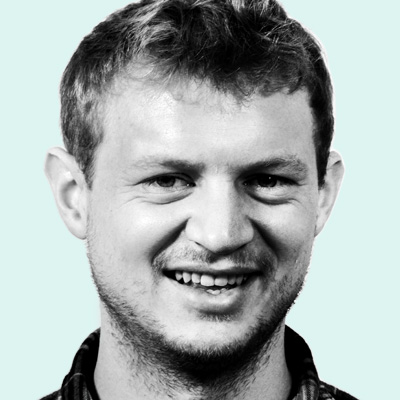
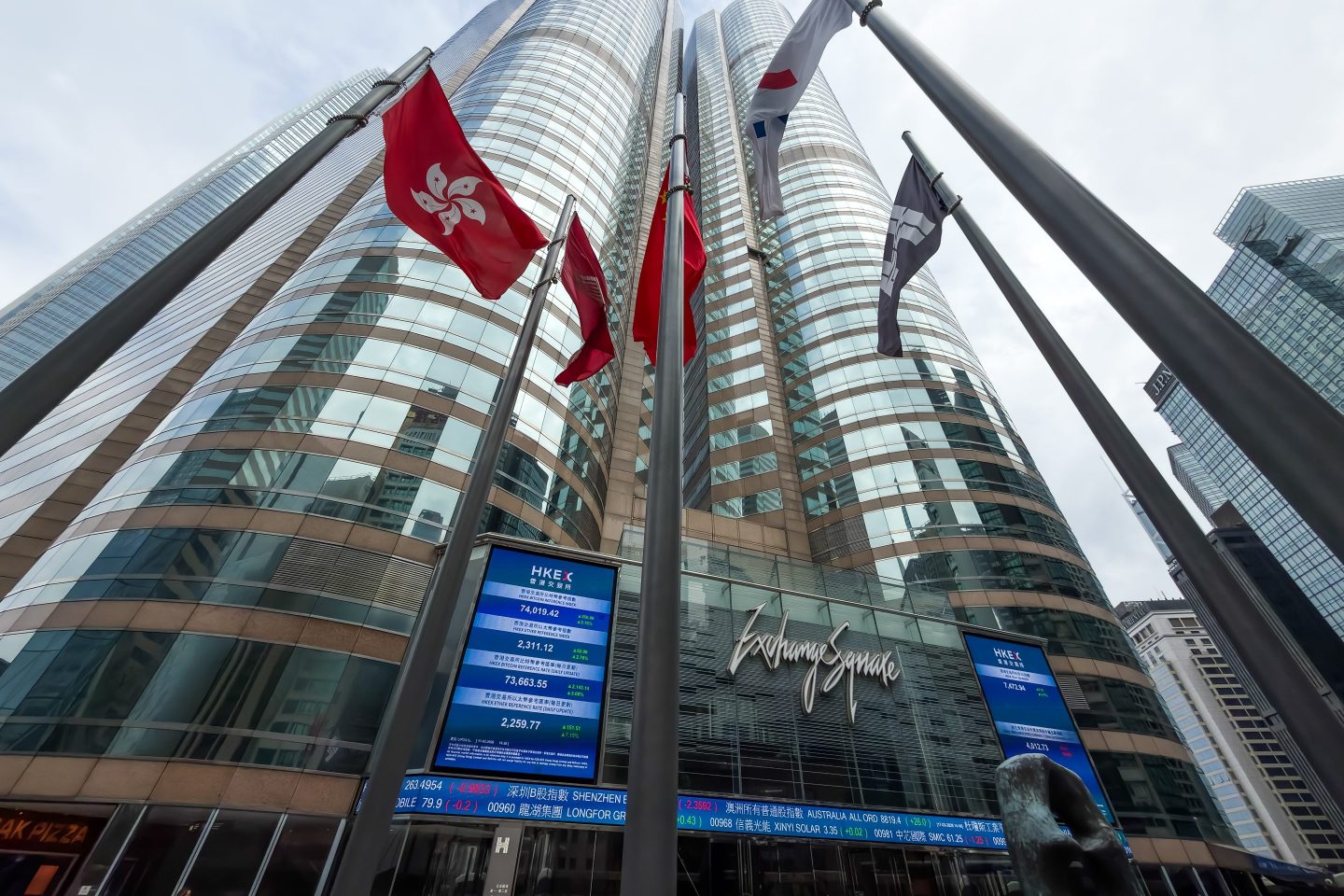
Hong Kong stock exchange boss Charles Li remembers the hardships of life in China before it opened to global trade. He grew up in northern Gansu, one of the country’s poorest provinces, during Mao Zedong’s Cultural Revolution, and toiled on oil rigs in the Bohai Sea as a teenager after the Soviet Union cut off oil exports to China.
Deng Xiaoping’s 1979 decision to welcome trade and investment from the West lifted hundreds of millions of Chinese from poverty—Li among them. He went on to earn a law degree from Columbia University and lead the China offices of Merrill Lynch and J.P. Morgan before ascending to his current perch as the highest-paid executive in Hong Kong’s financial industry. In his ten years as CEO of Hong Kong Exchanges and Clearing, Li has been an outspoken advocate of globalization, championing bold reforms that made it easier for global funds to invest in China’s stock market and Chinese companies to list in Hong Kong.
So it was something of a shock when, minutes into a conversation with Fortune’s Grady McGregor and me this week, Li mused that if China had to close its borders again, it would do just fine.
“Today, if we were closed again, we are already 100 times richer, 100 times more affluent, 100 times more resourceful” than in the Mao years, he said. “I don’t think being closed is necessarily the end of the world [for China], if it has to go that way.”
Li wasn’t urging a return to isolationism. He assured us Beijing doesn’t share Washington’s enthusiasm for “de-coupling”—the idea that the world’s two largest economies, after four decades of growing interdependence, must now pry themselves apart. “China does not want to decouple,” he said.
Rather, he seemed to be suggesting that, as a practical matter, the U.S.’s inability to contain the coronavirus leaves China no choice but to seek social—and economic—distance from the nation that has been its most important trade partner. The problem, Li said, is that the two countries have fundamentally different ideas about how to combat the virus. Li described China’s mindset as “zero-tolerance.” “They want [the virus] to be fully gone before they are ready to kick everything off.” But President Donald Trump is urging Americans back to work even as the number of new infections exceeds 25,000 per day.
China’s dilemma, Li said, is that it can’t remain virus-free “unless they permanently lock the country up, and don’t let foreigners come in.”
That dilemma may recede as other economies match China’s success in containing the virus. Time, in a recent report, notes that economies in the Asia Pacific region, which have curbed contagion faster and more effectively than counterparts in North America and Europe, already are experimenting with reopening their borders to select travellers.
Hong Kong, which has recorded only a handful of locally transmitted cases of the infection over the last several weeks, has introduced a plan to permit some business travellers and students from China’s mainland to enter the city without quarantine. Officials are discussing measures to expand quarantine-free travel to nearby Macau, the former Portuguese colony, which has reported no new cases in over a month.
China began accepting some business travellers from South Korea on May 1 on the condition that they are tested for the virus upon arrival and remain at a government facility until cleared by the results.
Australia and New Zealand are discussing plans for a “trans-Tasman bubble” allowing quarantine-free travel between the two nations.
It’s not difficult to imagine these bubbles gradually growing and joining together, reordering the world into Zones of Immunity—where people, goods, and capital resume circulation with relative freedom—and Zones of Infection, whose inhabitants are stuck within their own borders, unwelcome in any nation but their own.
China will be the dominant economy in the immune zone. In the absence of an effective COVID vaccine, the U.S. seems destined to be the last of the pandemic pariahs.
Grady has a detailed account of our conversation with Charles Li here, where you’ll also find a video excerpt.
This is the first in a series of digital dialogues we’re calling Eastworld Connect. In weeks to come, Fortune will bring you similar exchanges on matters of business, tech, and finance with executives, experts, entrepreneurs, and investors from around the region. Stay tuned!
More Eastworld news below.
Clay Chandler
clay.chandler@fortune.com
This edition of Eastworld was curated and produced by Grady McGregor. Reach him at grady.mcgregor@fortune.com.
Eastworld news
A war of escalating memos
It’s been quite a week in U.S.-China tensions. Last Saturday, the Chinese foreign ministry released an 11,000-word memo called ‘Reality Check of U.S. Allegations Against China on COVID-19,’ which, unsurprisingly, attempts to rebut 24 allegations the U.S. has made against China over the pandemic. On Wednesday, U.S. officials released a report alleging that Chinese hackers had targeted American universities and pharmaceutical companies in an attempt to steal information related to COVID-19 vaccine and treatment research. What's more, on Friday U.S. President Donald Trump said he no longer wished to speak with Chinese President Xi Jinping and suggested cutting off the whole bilateral relationship. SCMP
New outbreaks
After six people tested positive for COVID-19 in Wuhan, the city announced that it is testing its entire population of 11 million people. It looks like there may be holdups to initial plans to accomplish that feat in ten days, but authorities still seem on track to complete the monumental task not long after the initial deadline. New outbreaks in China’s northern Jilin province and South Korea have similarly been met with aggressive containment measures. Such outbreaks appear to be setbacks for countries that had largely tamed the pandemic, but scientists told Fortune this week that it was inevitable that small clusters of coronavirus would emerge as countries open up their economies. The important thing is to detect the outbreaks early and act quickly and decisively to squash them. Fortune
Spit and test
Fortune’s Naomi Xu Elegant this week wrote about her experience taking a coronavirus test in Hong Kong. Thankfully, she tested negative, but her story offers a rare look at the at-home saliva test that is widely deployed in Hong Kong but rare elsewhere in the world. “For me, the at-home test provided pain-free peace of mind that I was not infected with coronavirus,” she writes. Fortune
Listings forge ahead
On Thursday, U.S. President Donald Trump said the American government is “strongly looking at” the Chinese companies listed on U.S. exchanges. The comments follow the Luckin Coffee scandal, in which the Chinese coffeehouse chain listed on the New York Stock Exchange was found to have fabricated its financial results in early April. Chinese companies seem undeterred for the time being. Since the Luckin news broke, two Chinese companies have listed on the New York exchange. Dada, a crowd-sourced delivery platform, went forward with its New York filing on Wednesday, and is expected to raise $500 million. Kingsoft Cloud, a Beijing-based cloud computing company, raised over $500 million in its debut a week ago. Bloomberg
A looming humanitarian crisis
Bangladesh reported the first two cases of coronavirus on Thursday in the world’s largest refugee settlement that holds over 1 million Rohingya refugees. The refugees, who fled Myanmar in 2017 to avoid ethnic persecution, live near the southern Bangladesh city of Cox’s Bazar. The new cases have sparked fears of a potential humanitarian disaster, as these camps, which are some of the most densely-packed living conditions in the world, would theoretically provide ripe conditions for COVID-19 to rapidly spread. Al Jazeera
A peoples response
Hong Kong is one of the densest cities in the world, and its proximity to mainland China made it especially vulnerable to coronavirus. Yet five months after China reported the first cases of COVID-19, life in the city is largely back to normal; it's recorded just 1,000 or so cases and four deaths. In an Atlantic piece this week, University of North Carolina professor Zeynep Tufekci outlines how social organization born from the city's protest movement helped citizens mobilize to monitor virus hot spots and keep cases low. “The secret sauce of Hong Kong’s response was its people and, crucially, the movement that engulfed the city in 2019,” she writes. Atlantic
Greater Bay Area
Plans to transform southern China into a high-tech, integrated powerhouse advanced one step further on Thursday as China announced a slew of measures to enhance economic ties between Hong Kong, Macau, Guangzhou, and Shenzhen. These cities make up the heart of what China calls the 'Greater Bay Area,' a policy initiative to elevate the region to compete with the likes of Silicon Valley. The measures on Thursday are aimed at facilitating more cross-border investments and trade, and also include making Macau a more attractive destination for offshore Chinese yuan currency, setting up a futures exchange in Guangzhou, and raising more yuan-denominated funds for China's Belt and Road Initiative. Bloomberg
Coronavirus by country
Singapore was once lauded for its coronavirus response. Now, COVID-19 is exposing the city’s migrant workforce underbelly. Like other countries in Asia, Singapore had learned from its experience with SARS and initially had managed to keep case counts low with strong social controls, extensive contact-tracing, and a world-class health care system. In early April, Singapore reported just 1,000 cases of COVID-19. Yet today, Singapore has recorded over 26,000 cases and 21 deaths. The surge in cases reflects the city's narrow focus on its own citizens, which came the expense of its migrant worker dormitories, where over 1.4 million people, many from Malaysia, reside. The government only this week announced a comprehensive response: a plan to test 300,000 people living in migrant worker dormitories. CNN
Markets and movers
TSMC – Taiwan Semiconductor Manufacturing Company, one of the world’s largest chipmakers, confirmed on Thursday that it would invest $12 billion into building a chip factory in the U.S. New York Times
Gilead – The American pharmaceutical giant signed a deal with five generic pharmaceutical companies in India and Pakistan to produce remdesivir, an antiviral drug that has shown success in reducing symptoms of COVID-19. Gilead will not charge royalties on the drug until a vaccine is found or the World Health Organization declares an end to the COVID-19 public health emergency. BBC
Luckin Coffee – CEO Jenny Qian and COO Jian Liu were both terminated from their positions in another blow to the Chinese coffeehouse chain that has been spiraling downward since it came to light on April 2 that the company had been fabricating sales numbers. WSJ
Final figure
26%
On Thursday, Tencent, the Chinese social media and tech giant, posted 26% growth in revenue in the first quarter of 2020 compared to the same period in 2019. The company’s success in a quarter in which China’s economy was largely locked down is attributable to a boom in gaming that occurred as people in China were confined to their homes. Tencent is more famous for its messaging app WeChat, yet Internet gaming is the company’s most profitable division. In September, Fortune sat down with Colin Yao, the head of Tencent’s largest in-house game developer Timi Studios for his first interview with foreign media. “We’ve experienced so many transformations, from the PC gaming era, to the mobile gaming era, to 4G, with high-quality battle games, to today’s globalization era,” he said at the time. Tencent was certainly well-positioned for this latest transition—to the coronavirus era. Fortune