• Home
  • Latest
  • Fortune 500
  • Finance
  • Tech
  • Leadership
  • Lifestyle
  • Rankings
  • Multimedia
FinanceCoronavirus

Europe’s coronavirus stimulus in doubt as Germany’s top court rules ECB quantitative easing program could be illegal

By
David Meyer
David Meyer
Down Arrow Button Icon
By
David Meyer
David Meyer
Down Arrow Button Icon
May 5, 2020, 11:28 AM ET
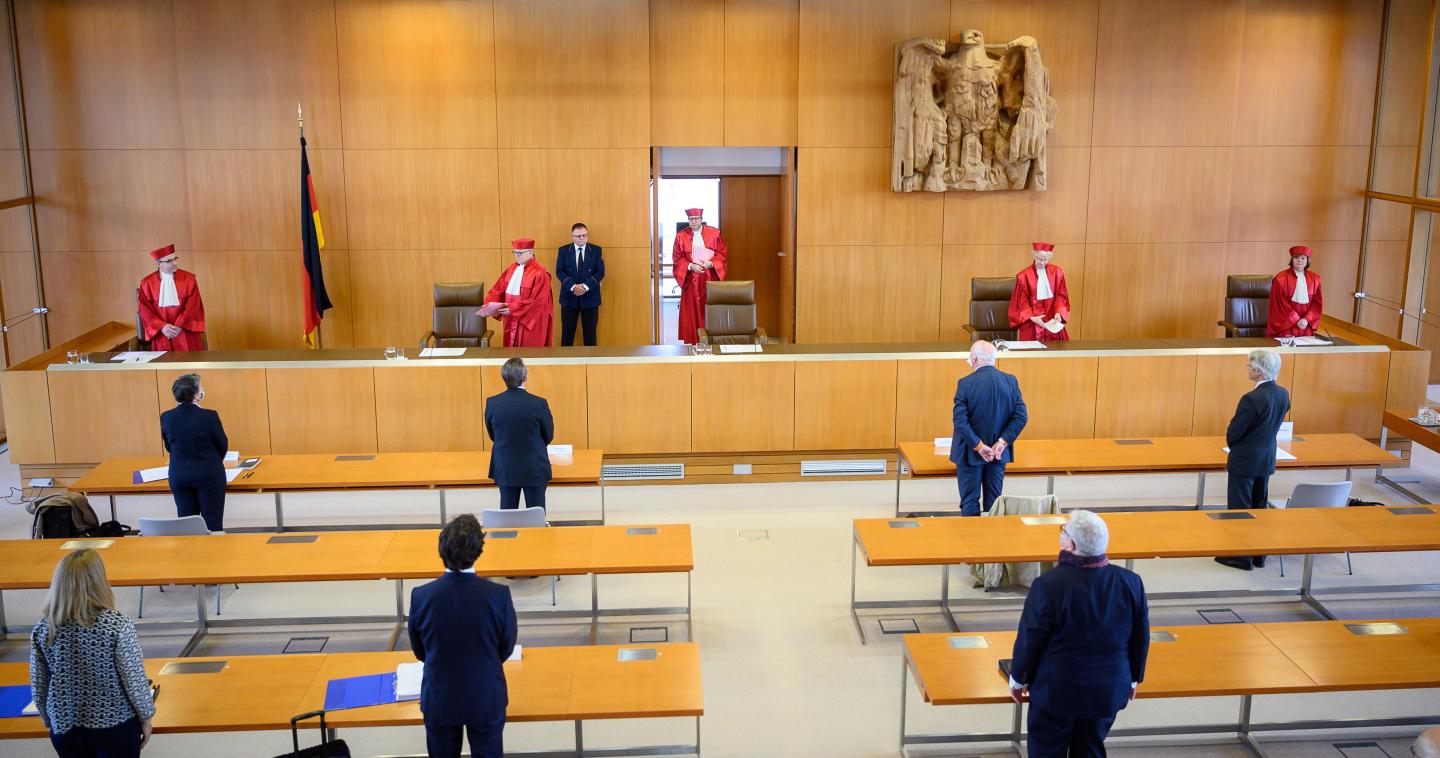
The judges of the German constitutional court (L-R) Ulrich Maidowski, Peter M. Huber, chairman Andreas Vosskuhle, Doris König and Christine Langenfeld arrive on May 5, 2020 at the Constitutional court in Karlsruhe, togive out their ruling that the European Central Bank must clarify a key bond-buying scheme to support the eurozone economy is "proportionate" or else Germany's Bundesbank central bank may no longer participate.
The judges of the German constitutional court (L-R) Ulrich Maidowski, Peter M. Huber, chairman Andreas Vosskuhle, Doris König and Christine Langenfeld arrive on May 5, 2020 at the Constitutional court in Karlsruhe, togive out their ruling that the European Central Bank must clarify a key bond-buying scheme to support the eurozone economy is "proportionate" or else Germany's Bundesbank central bank may no longer participate.SEBASTIAN GOLLNOW/dpa-AFP via Getty Images

“Whatever it takes.”

With those three words, former European Central Bank President Mario Draghi burnished his legacy during the tumult of the euro crisis in 2012 and opened an unreconcilable wedge between the euro zone’s fiscal hawks in the prosperous North and the debt-laden South.

Fast-forward to this year’s coronavirus crisis, and Draghi’s successor Christine Lagarde tried to avoid following suit—until her refusal to have the ECB buy more Italian bonds battered the markets. Days later, the Eurozone’s central bank relented. With Europe scrambling to keep its economies afloat, “whatever it takes” was back.

But is it really?

On Tuesday, the ECB’s ability to keep credit flowing (and, indirectly, the markets happy) was dealt a potentially devastating blow by Germany’s highest court. In a 7-1 decision, the federal constitutional court ruled that the ECB had overstepped its mandate back in 2015 when it began a bond-buying purchase program that’s pumped the equivalent of €2.7 trillion into Europe’s struggling economy. Since the start of the coronavirus pandemic the ECB has doubled down on its quantitative easing-styled asset-buying; for now, those more recent moves are safe, and can continue.

But longer terms, there are fresh doubts.

In essence, today’s German court ruling calls the ECB out on the scope of a favored piece of ammunition that it loads into its bazooka whenever a fresh crisis threatens to pull the union apart.

The result could be a further weakening of the European Union, which is already struggling to demonstrate economic solidarity in the face of the COVID-19 onslaught—broadly speaking, the bloc’s richer north is likely to weather the storm more easily than its poorer, harder-hit south.

What’s on the line

The court was not directly dealing with the ECB’s new coronavirus response package—a 750 billion euro ($813 billion) asset-purchase scheme called the Pandemic Emergency Purchase Programme (PEPP). Instead, it’s asking the ECB to justify the five-year-old Public Sector Purchase Programme (PSPP) scheme which was being challenged by German critics who are unhappy with how the QE-style stimulus in essence shifts the balance of power from national capitals to the European stage. It’s a particularly hot political issue in fiscally conservative Germany, which runs a tight ship; in debt-strapped Italy, Spain and Greece, the bond-purchasing program has been a godsend for its weak banks.

But although pandemic bailouts were not the subject at hand on Tuesday, the central questions are the same: is a big ECB bond-buying program compatible with Germany’s constitution, and is quantitative easing even part of the ECB’s mandate to begin with?

Pure QE, which involves the purchase of all kinds of sovereign and corporate assets from mortgage-backed securities to country-issued debt, has become monetary policy de rigueur around much of the world. Its scope, though, in Europe has always been under question, particularly during the Draghi years. The Italian central banker right up to the end of his term said the central bank had the power to open up its check book and buy, buy, buy to stimulate growth, and therefore meet that part of its mandate by… yes, “whatever it takes.”

In recent years “whatever it takes” took the form of PSPP.

“What a big bang!”

On Tuesday, The German court ruled that the PSPP program was possibly illegal in Germany because the German government and parliament had not tried to ensure that it was proportionate. The upshot is that, unless the ECB explains how PSPP is proportionate within the next three months, Germany’s central bank—the Bundesbank—will have to opt out of the coordinated scheme, and stop buying government bonds.

Here’s where the potential impact on the newer PEPP scheme—this one to bailout Europe’s coronavirus stricken economies and businesses— becomes clear. When the ECB launched PEPP in mid-March, it did so while saying: “We are fully prepared to increase the size of our asset purchase programs and adjust their composition, by as much as necessary and for as long as needed. We will explore all options and all contingencies to support the economy through this shock.”

To the markets, that sounded a lot like “whatever it takes,” the sequel. Europe’s bourses have since soared as the borrowing costs of the bloc’s shakiest economies came down.

But the question remains: can the central bank’s move to open up its balance sheet in such a generous fashion be squared with the proportionality demands of German judges who argue for clearly defined limits to the “the amount of purchases” from the start. 

Good news, bad news

Economists stepped in on Tuesday, trying to predict how this will play out.

“The good news is that the ruling does not seem to apply to the PEPP, but there is a bigger concern that it limits the ability of the ECB to ‘do whatever it takes’,” Standard Chartered chief Europe economist Sarah Hewin told Reuters.

“What a big bang!” wrote ING’s chief economist for the Eurozone, Carsten Brzeski, in an emailed note. “An optimistic interpretation could be this is lots of barking without biting and that everything is fine as long as the ECB demonstrates that it has thought through the economic consequences of its decisions, but a pessimistic interpretation could be no amount of additional ECB analysis will convince German judges and could, therefore spell the end of QE.

“Today’s decision could become a real problem for the ECB in the next phase of the crisis when the recovery starts.”

Some argued that, should the ECB’s spending powers ultimately be clipped, it would be time to rethink the central bank’s role and function.

“How is Europe supposed to deliver an appropriate economic response to the COVID-19 crisis when the ECB cannot act like a normal central bank, but must engage in legal tightrope walks all the time?” tweeted Jens Suedekum, an adviser to Germany’s economy ministry. “Maybe it’s time to reconsider the rules of the game themselves.”

Clash of the courts

Tuesday’s ruling was also notable for another reason: it set up a major conflict between Germany’s highest court and Europe’s highest court, the Court of Justice of the European Union or CJEU.

Again, this could have major implications for the European Union.

During the five-year case that led to this week, Germany’s constitutional court asked the CJEU for its view. The European court delivered its preliminary ruling at the end of 2018, saying the PSPP scheme was entirely kosher—and on Tuesday, the German court partially tossed that ruling aside. In the world of European law, this was a seismic event, because the CJEU is a higher authority even than Germany’s top court.

The German court’s reasoning was that the CJEU had not examined the actual economic-policy effects of PSPP, making it impossible to judge whether the ECB was sticking to its monetary-policy mandate or not. This decision, the German court said Tuesday, “contradicts the methodological approach taken by the CJEU in virtually all other areas of EU law.” The result, it warned, was that the ECB could gradually expand its own mandate.

So, the court argued, it was “not bound by the CJEU’s decision.”

“That the German court rejects a key plank of a decision by the European court is a legal bombshell which will make significant legal waves across Europe,” said Berenberg chief economist Holger Schmieding in a note. And, Axiom Alternative Investments research chief Jerome Legras told Reuters he had “never seen such a legal slap in the face in my entire life.”

If Europe’s member states get to decide when they do or don’t listen to the CJEU, that could have implications that extend far beyond the quantitative-easing debate. But for now, the key question is what the implications will be for the stability of the euro—and perhaps for its ultimate survival as an economic and political project.

More must-read international coverage from Fortune:

—Inside China’s reopening: 7 personal stories of life after lockdown
—Saving lives vs. saving the economy is a false tradeoff, economists say
—Photo essay: How the world has overcome pandemics over the last century
—Coronavirus could spread in prisons where censored journalists are detained
—PODCAST: How 2 CEOs outside of health care decided to pivot to fight COVID-19
—WATCH: The global crisis in recycling

Subscribe to How To Reopen, Fortune’s weekly newsletter on what it takes to reboot business in the midst of a pandemic

About the Author
By David Meyer
LinkedIn icon
See full bioRight Arrow Button Icon

Latest in Finance

Finance
Lorem ipsum dolor sit amet, consectetur adipiscing elit, sed do eiusmod tempor incididunt ut labore et dolore magna aliqua. Ut enim ad minim veniam
By Fortune Editors
October 20, 2025
Finance
Lorem ipsum dolor sit amet, consectetur adipiscing elit, sed do eiusmod tempor incididunt ut labore et dolore magna aliqua. Ut enim ad minim veniam
By Fortune Editors
October 20, 2025
Finance
Lorem ipsum dolor sit amet, consectetur adipiscing elit, sed do eiusmod tempor incididunt ut labore et dolore magna aliqua. Ut enim ad minim veniam
By Fortune Editors
October 20, 2025
Finance
Lorem ipsum dolor sit amet, consectetur adipiscing elit, sed do eiusmod tempor incididunt ut labore et dolore magna aliqua. Ut enim ad minim veniam
By Fortune Editors
October 20, 2025
Finance
Lorem ipsum dolor sit amet, consectetur adipiscing elit, sed do eiusmod tempor incididunt ut labore et dolore magna aliqua. Ut enim ad minim veniam
By Fortune Editors
October 20, 2025
Finance
Lorem ipsum dolor sit amet, consectetur adipiscing elit, sed do eiusmod tempor incididunt ut labore et dolore magna aliqua. Ut enim ad minim veniam
By Fortune Editors
October 20, 2025

Most Popular

Finance
Lorem ipsum dolor sit amet, consectetur adipiscing elit, sed do eiusmod tempor incididunt ut labore et dolore magna aliqua. Ut enim ad minim veniam
By Fortune Editors
October 20, 2025
Finance
Lorem ipsum dolor sit amet, consectetur adipiscing elit, sed do eiusmod tempor incididunt ut labore et dolore magna aliqua. Ut enim ad minim veniam
By Fortune Editors
October 20, 2025
Finance
Lorem ipsum dolor sit amet, consectetur adipiscing elit, sed do eiusmod tempor incididunt ut labore et dolore magna aliqua. Ut enim ad minim veniam
By Fortune Editors
October 20, 2025
Finance
Lorem ipsum dolor sit amet, consectetur adipiscing elit, sed do eiusmod tempor incididunt ut labore et dolore magna aliqua. Ut enim ad minim veniam
By Fortune Editors
October 20, 2025
Finance
Lorem ipsum dolor sit amet, consectetur adipiscing elit, sed do eiusmod tempor incididunt ut labore et dolore magna aliqua. Ut enim ad minim veniam
By Fortune Editors
October 20, 2025
Finance
Lorem ipsum dolor sit amet, consectetur adipiscing elit, sed do eiusmod tempor incididunt ut labore et dolore magna aliqua. Ut enim ad minim veniam
By Fortune Editors
October 20, 2025
Fortune Secondary Logo
Rankings
  • 100 Best Companies
  • Fortune 500
  • Global 500
  • Fortune 500 Europe
  • Most Powerful Women
  • World's Most Admired Companies
  • See All Rankings
  • Lists Calendar
Sections
  • Finance
  • Fortune Crypto
  • Features
  • Leadership
  • Health
  • Commentary
  • Success
  • Retail
  • Mpw
  • Tech
  • Lifestyle
  • CEO Initiative
  • Asia
  • Politics
  • Conferences
  • Europe
  • Newsletters
  • Personal Finance
  • Environment
  • Magazine
  • Education
Customer Support
  • Frequently Asked Questions
  • Customer Service Portal
  • Privacy Policy
  • Terms Of Use
  • Single Issues For Purchase
  • International Print
Commercial Services
  • Advertising
  • Fortune Brand Studio
  • Fortune Analytics
  • Fortune Conferences
  • Business Development
  • Group Subscriptions
About Us
  • About Us
  • Press Center
  • Work At Fortune
  • Terms And Conditions
  • Site Map
  • About Us
  • Press Center
  • Work At Fortune
  • Terms And Conditions
  • Site Map
  • Facebook icon
  • Twitter icon
  • LinkedIn icon
  • Instagram icon
  • Pinterest icon

Latest in Finance

amit
AISoftware
$96 billion giant ServiceNow doesn’t see a ‘SaaSpocalypse.’ It sees the ‘hard lift, heavy lifting’ phase just beginning
By Nick LichtenbergMay 7, 2026
5 hours ago
FARLEY
SuccessCareers
Ford CEO says his Gen Z son is choosing hands-on work: ‘He feels like that’s more fulfilling than doing summer school at some fancy college’
By Nick LichtenbergMay 7, 2026
7 hours ago
Indosat CEO Vikram Sinha is building an AI for Indonesia’s local languages. Can he make a business case for sovereignty? 
AsiaAsia Agenda
Indosat CEO Vikram Sinha is building an AI for Indonesia’s local languages. Can he make a business case for sovereignty? 
By Nicholas GordonMay 7, 2026
8 hours ago
Tapestry thinks it’s cracked the code of ‘expressive luxury’ for Gen Z: a ‘Goldilocks’ combo of aspirational and approachable
Investingearnings
Tapestry thinks it’s cracked the code of ‘expressive luxury’ for Gen Z: a ‘Goldilocks’ combo of aspirational and approachable
By Nick LichtenbergMay 7, 2026
8 hours ago
Motorbikes drive past a billboard with graphic showing the late Iranian Supreme Leader Ayatollah Ali Khamenei
PoliticsIran
Iran is setting up an agency to tax ships passing through Hormuz even as it negotiates a peace deal
By Adam Schreck, David McHugh, Russ Bynum and The Associated PressMay 7, 2026
9 hours ago
An almond farmer inspects a fruit on a tree.
North AmericaAgriculture
California farmers must destroy 420,000 peach trees after Del Monte closes its canneries and cancels more than $550 million in long-term contracts
By Sasha RogelbergMay 7, 2026
9 hours ago

Most Popular

U.S. Treasury will have to borrow $2 trillion this year just to continue functioning—more than $166 billion every month
Economy
U.S. Treasury will have to borrow $2 trillion this year just to continue functioning—more than $166 billion every month
By Eleanor PringleMay 7, 2026
18 hours ago
Tokyo is throwing out its strict office dress code and asking workers to wear shorts amid the war in Iran energy crisis
Success
Tokyo is throwing out its strict office dress code and asking workers to wear shorts amid the war in Iran energy crisis
By Emma BurleighMay 5, 2026
3 days ago
A Michigan farm town voted down plans for a giant OpenAI-Oracle data center. Weeks later, construction began
Magazine
A Michigan farm town voted down plans for a giant OpenAI-Oracle data center. Weeks later, construction began
By Sharon GoldmanMay 6, 2026
2 days ago
California farmers must destroy 420,000 peach trees after Del Monte closes its canneries and cancels more than $550 million in long-term contracts
North America
California farmers must destroy 420,000 peach trees after Del Monte closes its canneries and cancels more than $550 million in long-term contracts
By Sasha RogelbergMay 7, 2026
9 hours ago
Mark Zuckerberg once gave a Facebook engineer startup advice at 2 a.m. while 'hanging out with all the interns'—she quit and raised millions after
Success
Mark Zuckerberg once gave a Facebook engineer startup advice at 2 a.m. while 'hanging out with all the interns'—she quit and raised millions after
By Orianna Rosa RoyleMay 6, 2026
1 day ago
The 'PayPal Mafia' built a $1.5 billion fintech pioneer. The company they left behind is on life support
Startups & Venture
The 'PayPal Mafia' built a $1.5 billion fintech pioneer. The company they left behind is on life support
By Eva RoytburgMay 6, 2026
1 day ago

© 2026 Fortune Media IP Limited. All Rights Reserved. Use of this site constitutes acceptance of our Terms of Use and Privacy Policy | CA Notice at Collection and Privacy Notice | Do Not Sell/Share My Personal Information
FORTUNE is a trademark of Fortune Media IP Limited, registered in the U.S. and other countries. FORTUNE may receive compensation for some links to products and services on this website. Offers may be subject to change without notice.