Samsung took an unusual precaution when it held a splashy event in San Francisco during the early days of the coronavirus outbreak, before the city issued a “shelter in place” order. The tech giant hired a startup to install a sci-fi-inspired system to scan conference attendees for fevers.
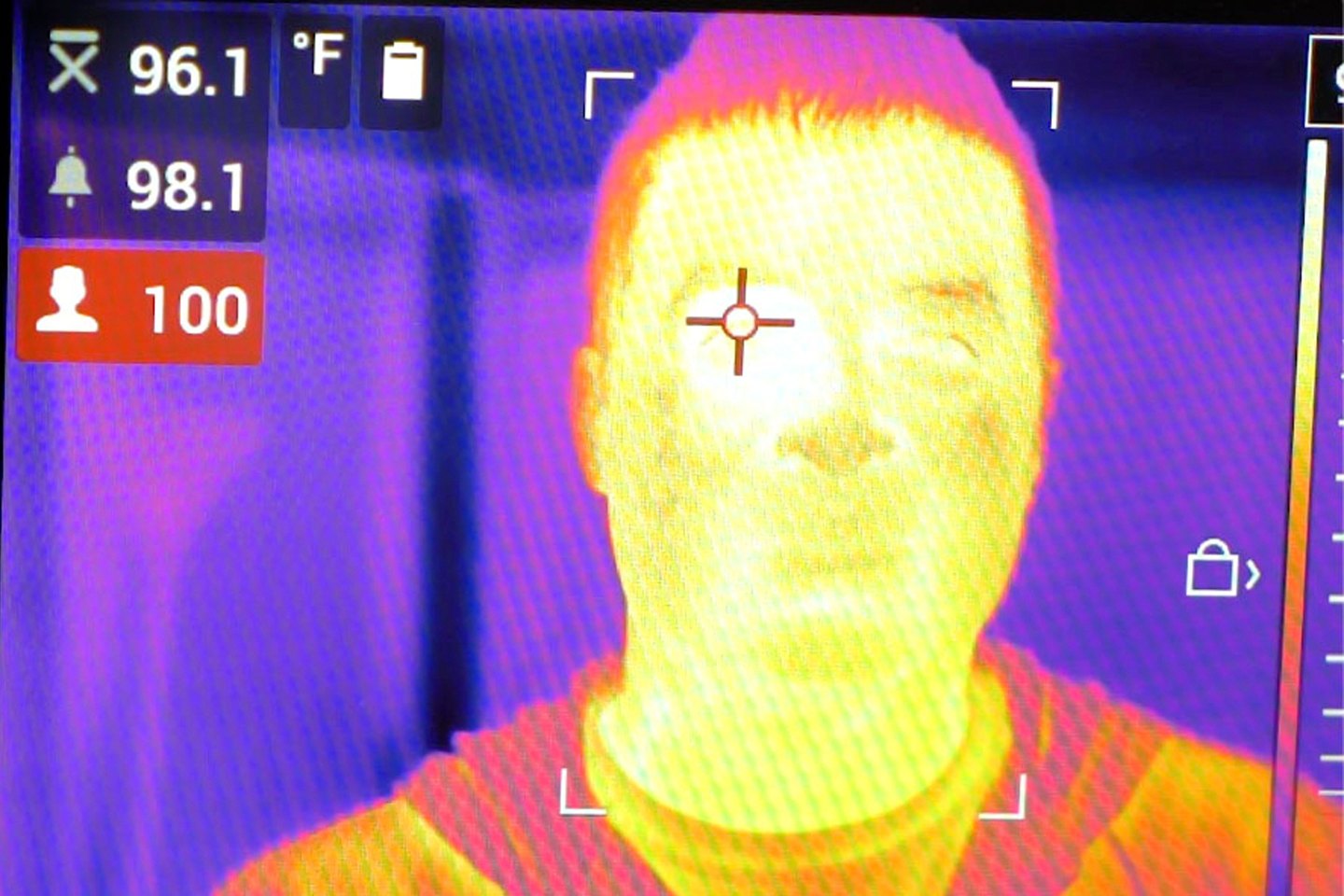
Hundreds of people going to the event had to walk past a high-resolution thermal camera that is supposed to detect body temperatures with an accuracy of within one-half a degree Fahrenheit. A laptop running software interpreted the data and alerted a technician when anyone had an above-average temperature, a potential symptom of a COVID-19 infection, so the person could be pulled aside for additional screening.
The company that supplied the technology, CrowdRx, declined to say whether it had identified anyone at the event with a possible fever. But what’s clear is that the coronavirus epidemic has put a spotlight on thermal-imaging technology as a potentially important tool in combating pandemics and protecting the global economy.
Long a fixture in airports and rail stations in Asia, a result of the previous SARS and H1N1 epidemics there, thermal imaging is increasingly being installed worldwide. Casino giant Wynn Resorts, Brazilian miner Vale, and airports in New York, Los Angeles, and San Francisco are just a few of the customers that have recently started using the equipment.
“The silver lining of this outbreak is that in the future, more advanced infectious screening will be done at all mass gatherings,” says Matt Friedman, CrowdRx’s medical director and associate medical director at Maimonides Medical Center in Brooklyn.
Demand for thermal-imaging equipment from FLIR Systems, a leading manufacturer, has grown exponentially during the coronavirus epidemic, says Jim Cannon, the company’s CEO. The privately owned firm, based in Oregon, charges $5,000 to $7,000 for entry-level cameras that are suitable for medical screening.
FLIR’s thermal cameras aren’t just for medical uses. Energy companies install them to spot leaky pipelines; factories use them to detect worn parts in machinery; and the military uses them to spot enemy fighters in the dark, including from a drone that weighs just 30 grams.
Still, Cannon is careful when discussing what his gear can do in terms of the COVID-19 pandemic. The cameras detect “elevated body temperature,” not necessarily fevers or infection. “They can’t diagnose anything,” he explains.
And that’s a growing concern for medical professionals tasked with slowing the spread of COVID-19. Even if a thermal camera accurately determines a person’s temperature, that doesn’t mean it can accurately detect whether he or she is carrying the virus. Some people have naturally higher body temperatures, or they may have raised their temperature through physical exertion. Moreover, wearing glasses can interfere with the technology taking accurate readings because it needs a clear view of a subject’s eyes.
And, far worse for the virus fighters, a person infected with COVID-19 can be contagious to others for several days before showing any symptoms. Other infected people may be using medication to lower their temperature, allowing them to slip past thermal cameras without being flagged.
A recent study by the European Centre for Disease Prevention and Control concluded that thermal scans of travelers from China, followed by additional screening including questions about symptoms like coughing and difficulty breathing, failed to identify three-quarters of those infected with the coronavirus.
Even more damning, in March, the influential U.S. nonprofit medical research group ECRI published an analysis of previous studies on the effectiveness of using thermal screening to fight outbreaks including COVID-19. It found that the technology, used alone or in conjunction with questionnaires, is “ineffective for detecting infected persons” and that it “could provide a false sense of safety.”
The review came after a large U.S. health care system asked ECRI whether it should install thermal cameras to screen people entering hospitals, explains Andrew Furman, ECRI’s executive director. “Even under a best-case scenario, you’re going to miss more than half of the infected population,” Furman says. “The evidence is telling us that this is not going to help.”
CrowdRx’s Friedman, who has also served as the lead in-house physician for Yankee Stadium, Madison Square Garden, and the U.S. Open tennis tournament, agrees that the thermal-imaging tech is imperfect. But he cites some other studies that found the technology successfully identified fevers more than 90% of the time. And people with fevers are more contagious than asymptomatic carriers, he says.
“By no means does its sensitivity approach 100% at capturing all infected persons,” Friedman says. But still, he adds, when it comes to large gatherings, either at workplaces or major events, using the technology “should be the minimum bar.”

Pandemic-fighting tools of the future
A number of far-out ideas are being developed to combat the next epidemic.
Germ-resistant clothing
An Israeli company is infusing fabric with copper to trap germs and bacteria so that it can be used in protective gear. Meanwhile, researchers in the U.K. have developed face masks manufactured with a protein coating on the fabric that they say protects against 96% of airborne virus cells.
Mapping mammals
Researchers mapped all 55 of the viruses found in a particular species of bat as a “proof of concept” for a multibillion-dollar initiative to identify and analyze all viruses in mammals. During the project’s first 10 years, orga-
nizers say they could map an estimated 320,000 viruses, which may give health officials a head start in combating future pandemics caused by viruses jumping from animals to humans.
Virus-killing robots
Chinese and Danish companies have developed robots that can disinfect hospitals and offices by emitting concentrated ultraviolet light as they maneuver around. Some countries have also tried using drones to spray disinfectant on potentially infected areas.
Meet-ups in virtual reality
As seen all too often, people like to congregate even when they’ve been or-
dered not to. Better virtual reality technology that provides more realistic and immersive experiences could provide a safer way to socialize in the future.
A cacophony of coughing
The sound of people coughing and sneezing may one day provide an early
warning about impending pandemics. University of Massachusetts researchers have created a device hooked up to microphones that monitors waiting rooms in doctors’ offices and hospitals. If software detects a rise in throat clearing and wheezing, it can, in theory, raise a red flag. In a trial in one clinic last year, the device predicted illness rates that matched the results from lab tests on patients.
A version of this article appears in the May 2020 issue of Fortune with the headline “Focusing on fevers.”
More must-read stories from Fortune:
—How Fortune 500 companies are stepping up during the pandemic
—When will stimulus checks be deposited or mailed? Ensure yours isn’t delayed
—Stocks have gained 25% since their March lows—but the math doesn’t add up
—Freelancers and independent contractors can now apply for SBA Paycheck Protection Program loans. Here’s what to know
—After coronavirus, expect to see smaller airlines
—PODCAST: COVID-19 might have upended the concept of the best companies of the year
—WATCH: The U.S. Postal Service is in deep financial trouble. Here’s why
Subscribe to Outbreak, a daily newsletter roundup of stories on the coronavirus pandemic and its impact on global business. It’s free to get it in your inbox.