This is the web version of Business x Design, a newsletter on the power of design. Sign up here to get it in your inbox.
Apple and Google announced on Friday a collaboration to design an app that will alert users if they have been in contact with someone infected with the coronavirus. The Wall Street Journal hailed the companies’ proposal as “the most concrete technological solution to date for governmental authorities searching for ways to at least partially lift the lockdown orders that have swept the nation.”
Here in Asia, where I’m based, governments have been using smartphone apps to contain the virus for more than a month now. South Korea developed an app that shows smartphone users how close they are to an area that a confirmed COVID-19 patient has visited. Hong Kong monitors quarantined patients with a “geo-fencing” app that works on an electronic wristband. Singapore deployed a Bluetooth-powered “TraceTogether” app that allows authorities to track infected individuals and those who might have been exposed to them.
The most sweeping use of smartphones has been in China, where hundreds of municipal and provincial governments, under orders from Beijing, deployed color-coded “health tracking” systems that combine artificial intelligence, government records, user-supplied personal health and transportation information, and GPS signals to identify and restrict the movements of residents at risk of infection.
Global health experts generally credit the use of apps in all four Asian nations for “flattening the curve” of new infections. They seem to broadly agree that smartphones, if paired with the right technology, can help automate the vital process of contact tracing, relieving the enormous strain of attempting to gather such information manually.
The more complicated question is how intrusive these systems must be to prove effective.
Google and Apple’s forthcoming technology is said to take a minimalist approach. Bluetooth will track whether phones have passed within a certain distance of one another. If someone who registered for the tool were to test positive for the coronavirus and choose to report that, the app would notify a public health app, which would then alert the phones that had come close enough to risk possible exposure. The system was developed without government involvement, and is designed to be voluntary, decentralized, and anonymous. But as The Verge points out, those features might be bugs if not enough users opt in.
China’s health tracking system is state-led and far more coercive. Though the apps were rolled out by tech giants Alibaba Group and Tencent Holdings, who embedded them on their mobile payment platforms, the companies insist they have no control over the algorithms and no access to the data they collect.
Registration requires surrendering personal information such as national identity card numbers and home addresses. Users then submit to a questionnaire about recent movements, personal health, and whether anyone they have been in contact with has been infected. The apps’ algorithms assign users a colored QR code to flash on their phones: A green code grants unrestricted movement; yellow and red codes require users to remain in quarantine for seven and 14 days respectively.
In theory, China’s tracking apps are voluntary in that users can choose whether or not to download them. But in cities like Wuhan, the epicenter of the outbreak, the color-codes were used in conjunction with an elaborate network of security checkpoints. Residents lacking green badges could be denied entry to shops, apartment compounds, and commercial buildings.
The workings of China’s health tracking apps remain opaque. But what does seem clear, to me at least, is that China’s system slowed the spread of the virus not only because it digitized contact tracing but also because it proved a powerful tool for enforcing citywide lockdowns. More on this question in the forthcoming issue of Fortune magazine.
In case you missed it, Fortune is partnering with IDEO, the global design consultancy, on a three-week “COVID-19 Business Pivot Challenge” to encourage companies to think creatively about how their organization can share their ideas, expertise and resources. IDEO’s social innovation platform, OpenIDEO, is soliciting proposals from businesses who can battle the virus in three ways: meeting demands for protective supplies, meeting needs for new services, and adapting to a new future. The deadline is April 30. Learn more about how your company can participate here.
More design news below.
Clay Chandler
@ClayChandler
Clay.Chandler@Fortune.com
NEWS BY DESIGN
This edition of Business By Design was curated by Margaret Rhodes.
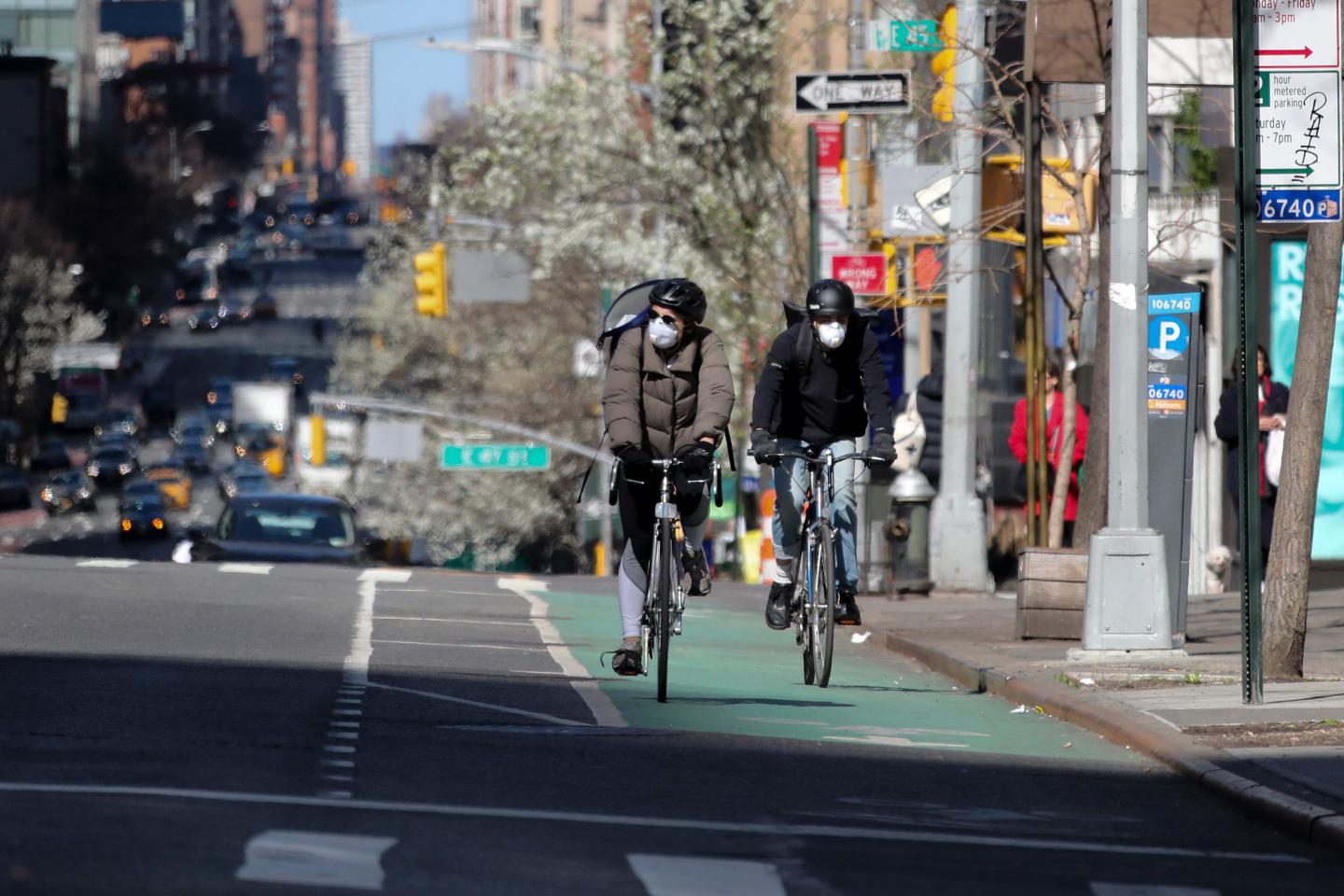
Out of sight. Among the casualties in New York City’s revised, pandemic-era budget: Vision Zero, the urban planning project to redesign the city’s streets to be safer for cyclists and pedestrians, will lose millions of dollars.
Low affect. There will be no new emoji next year. The Unicode Consortium—the international gatekeepers to the emoji library—runs on volunteer power, and cannot commit the necessary time and energy during the coronavirus pandemic.
No-touch testing. Architecture firm SITU developed a prototype for pop-up coronavirus testing centers. Modeled after spaces used in South Korea, the outdoor facilities use phone booth-like nooks and partitions to minimize contact between patients and health care workers.
Bright minds. For children stuck at home, Dyson has created 44 science and engineering Challenge Cards to keep busy. Children get briefs and illustrated tutorials and can learn about everything from how to make non-Newtonian fluid to how to make a lava lamp.
Trade offs. The global pandemic has lessened air pollution in some parts of the world, but is also leading to an uptick in single-use plastic generation and disposal.
EXECUTIVE SUMMARY
“Screens won,” tech writer Nellie Bowles recently declared in The New York Times. Now, the Times has a new analysis of exactly how and where people are spending their ample screen time during quarantine. Unsurprisingly, Facebook, Netflix, and YouTube have seen hockey-stick growth in users logging on. But notably, time spent on those company’s mobile apps has declined. For now and the near future, desktop and TV screens take precedence over smaller ones.
Among other findings: Local news websites are seeing a surge in traffic, but niche partisan sites are not; Zoom is dramatically outpacing other video-conferencing sites in new users; video game sites are thriving while sports sites flounder.
EVENTS BY DESIGN
April 15: Virtual Design Festival, a collaborative effort from Dezeen, Dutch Design Week, Design Indaba, and many others, kicks off.
April 16: The Frank Lloyd Wright Foundation will host virtual tours of several participating Wright properties. (The tours happen weekly on Thursdays.)
Mid-May: Sight Unseen will launch Offsite Online, a digital version of its annual design show.
Ongoing: The Social Distancing Festival has a full calendar of livestream concerts and art on display.
Ongoing: Harvard University’s Graduate School of Design is offering virtual public lectures.
BRAINSTORM SESSION
Content during the pandemic
Without the ability to gather in person, film crews can’t create new content. That constraint is already shaping the aesthetics of the coronavirus era, as the media—print, digital, televised, and otherwise—adapts to creating content without new photography or footage. Magazines are running more illustrations or stock photography; advertising agencies are building commercials out of smartphone footage or licensed, canned clips.
“The speed with which these commercials came together and the circumstances under which they were produced—presumably shooting as little new footage as possible—means many have a makeshift quality,” writes Vox journalist Meredith Haggerty, touching on the scrappy sameness of recent ads from big corporations. Walmart employees sing “Lean on Me” and take video selfies, and people (presumably Facebook users) around the world are seen crying in cars or greeting family through window panes. Life during the pandemic gets refracted again and again through our phone’s cameras.
That hastily-made quality isn’t necessarily a bad thing: Brands that don’t acknowledge the current moment will come off as tone-deaf. Releasing work with DIY visual qualities signals at least a little solidarity with consumers. “What reassures me,” writes Haggerty, “is that even brands that just want to sell you stuff can’t avoid the virus.”
QUOTED BY DESIGN
The new digital social order
“In 2020, the computer and the internet are fully emancipated from the basement. They occupy the entirety of our domestic spaces via our laptops and phones … Over the past few weeks, the Zoom background has appeared to me as the final symbol of the internet’s loss of anonymity and breach of personal privacy. Where once we had nonsense screen names, we now have Facebook profiles that require our real names, Facebook-attached Instagram accounts that document our intimate personal lives, and, finally, video-chat platforms that require the exposure of our homes in order to create the illusion of shared space online.”
— Journalist Kyle Chayka, writing for Curbed about video chat interfaces and the inequality of the Zoom home office