
• Home
  • Latest
  • Fortune 500
  • Finance
  • Tech
  • Leadership
  • Lifestyle
  • Rankings
  • Multimedia

Trendingnow

1

'Dr. Doom' Nouriel Roubini says we're headed for universal basic income or 'some form of socialism' as AI revolutionizes work—He calls that optimistic

2

Power companies are using eminent domain to seize land for data centers as 70% of Americans say not in my backyard

3

Red Lobster’s 37-year-old CEO waited tables before joining the C-suite—he says it was a crash course in managing ‘difficult people and situations’

1

'Dr. Doom' Nouriel Roubini says we're headed for universal basic income or 'some form of socialism' as AI revolutionizes work—He calls that optimistic

2

Power companies are using eminent domain to seize land for data centers as 70% of Americans say not in my backyard

3

Red Lobster’s 37-year-old CEO waited tables before joining the C-suite—he says it was a crash course in managing ‘difficult people and situations’
TechAI

ARM unveils two new A.I. computer chip designs

Jeremy Kahn
By
Jeremy Kahn
Jeremy Kahn
Editor, AI
Down Arrow Button Icon
Jeremy Kahn
By
Jeremy Kahn
Jeremy Kahn
Editor, AI
Down Arrow Button Icon
February 10, 2020, 9:00 AM ET
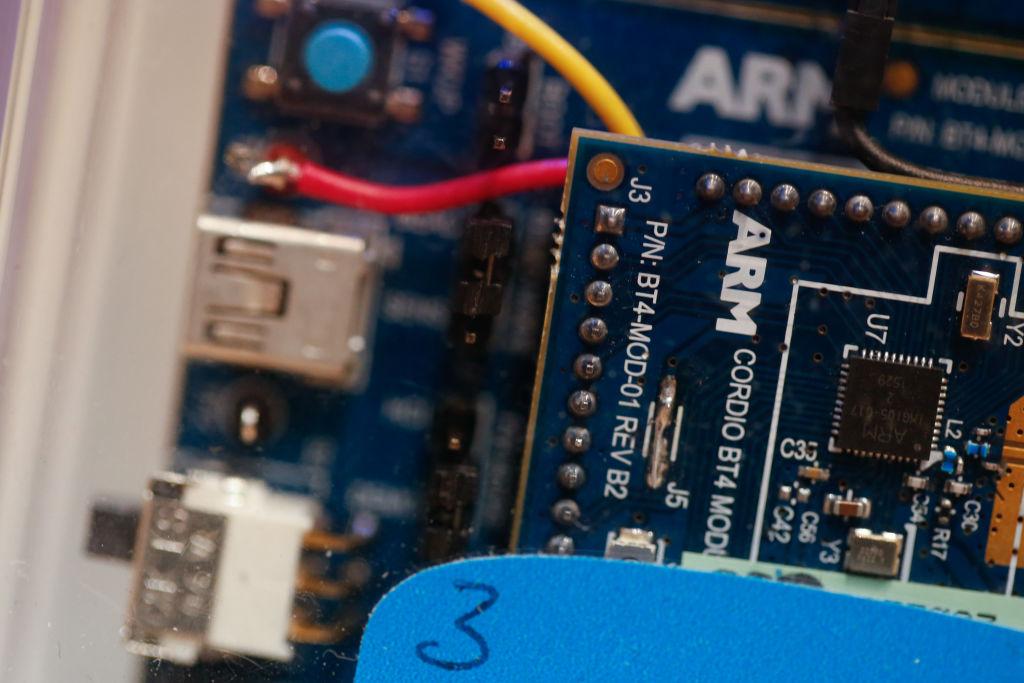
Close-up image of Arm Holdings-designed computer chips seen inside a computer.
Components manufactured by ARM Holdings Plc sit inside a demonstration ARMmbed parking meter on display on the second day of Mobile World Congress (MWC) in Barcelona, Spain, on Tuesday, Feb. 28, 2017. A theme this year at the industry's annual get-together, which runs through March 2, is the Internet of Things. Photo by Pau Barrena/Bloomberg via Getty Images
Add Fortune on Google for similar content.

Arm Holdings, the U.K.-based semiconductor design company owned by SoftBank, unveiled two new computer chip designs for artificial intelligence applications on Monday.

One chip, called the Arm Cortex-M55 processor, is the latest in Arm’s line of microcontrollers, the kind of relatively low-cost and power-efficient chips that are used to run sensors and perform simple computational tasks in everything from automobile engines to remote-controlled toys to power tools.

In the past, these sorts of chips generally lacked enough computing power to perform machine-learning functions efficiently. Instead, most of those tasks had to be performed on higher-powered chips, such as Arm’s Cortex-A microprocessors, which are found in most of the world’s smart phones.

The other new chip, called the Arm Ethos-U55 NPU, is designed to run in conjunction with the M55 as a way of accelerating applications that require neural networks, a kind of machine learning loosely-based on the human brain.

Over the past decade, much of the progress in A.I. has come from running these neural networks on graphics processing units, specialized computer chips originally designed to handle the intense number-crunching needed to render images for video games and animation.

But, more recently, a number of companies have created NPUs, or “neural processing units,” chips designed specifically for running neural networks. In benchmark tests, these chips can run neural networks much faster and efficiently than GPUs. Arm claims the Ethos-U55 is the industry’s first “microNPU”—in other words, the first of these neural network-specific chips small enough and power-efficient enough to run on the smallest electronic devices.

Consultants McKinsey & Company forecast that by 2025, AI-related semiconductors could account for $67 billion in annual sales, or about 20% of all computer chip demand. Another consulting firm, Deloitte, has forecast that the market for A.I.-specific chips designed to run on “the edge”—on devices such as mobile phones and smart speakers and not on datacenter-based servers—will total about $2.6 billion this year and double by 2024.

Arm made its first foray into the A.I.-specific chip market in 2018 when it introduced designs for a machine learning processor and another aimed specifically at detecting objects in images. But both of those processors were designed for environments where power efficiency and cost were less critical.

The U.K. firm is not the only chipmaker looking to provide machine learning capabilities designed for low-cost, power-efficient sensors and electronics. Huawei, as part of its push for 5G mobile, has invested in inexpensive NPUs, but it has packaged these as part of larger chips for higher-end mobile phones, such as its Kirin 970 chip. Intel has generally not been active in the edge-computing market, targeting data centers and personal computing devices instead. AMD has created some chips designed to run A.I.-applications on devices such as smart televisions.

Arm, which does not manufacture semiconductors itself but licenses its designs to others, says chips based on these two new designs will ship to customers in 2021. And while the company declined to name customers for the new designs, in the past Arm has licensed its A.I.-specific designs to companies that include Samsung, STMicroelectronics and NXP.

The company says that by yoking the two new chips together as a team, it managed to achieve a 480-times increase in the speed of running machine learning tasks compared to its previous Cortex M chips in benchmark tests. (The first 15-times speed-up comes from the M55, with an additional 32-times improvement from marrying it with the Ethos-U55.) Using the two chips together also results a 25-times improvement in energy efficiency, which is critical for many devices which must depend on battery power. Arm did not say how its new chips perform against competing A.I.-specific ones.

The new chips allow A.I. applications to be brought to areas such as farming, where hundreds or thousands of low-cost sensors equipped with machine learning, can be used to carefully calibrate how much water, fertilizer, or insecticide each plant should receive, Dipti Vachani, ARM’s senior vice president and general manager for automotive and IoT business, says. IoT stands for the Internet of Things, the idea of connecting all kinds of new devices, from security cameras to toasters, to the Internet.

Vachani also says that getting A.I. to function on relatively low-powered devices, rather than having to be in constant communication with cloud-based data centers where most A.I. workloads are run today, is critical for data security and privacy.

For instance, she says smart speakers, such as Alexa or Google Home, could run speech recognition and some machine learning applications directly on the device. Today, those devices have to transmit data through the Internet to remote data centers, raising the concerns about cybersecurity and eavesdropping.

She also says that getting A.I. to work on non-connected, relatively low-powered devices is essential for making connected automobiles and, ultimately, self-driving cars, a reality, and for bringing machine learning to medical devices.

Arm says that the M55 itself will be able to take on machine learning tasks ranging from very simple vibration detection—something even the previous generations of Cortex-M can handle—through to detecting objects in images. When coupled with the Ethos U-55, it can take on higher-level tasks such as detecting specific gestures, deciding whether your fingerprints or your face match the biometrics already stored on the device, and even speech recognition. But more computationally-intensive duties, such as categorizing a wide variety of objects or recognizing faces in real-time from video of a crowd, will still require more power-hungry, and expensive, chips.

Vachani also says that the new chip designs are only intended to perform what is known as A.I. “inference” —which involves taking a data input and using a statistical model that has already been trained to make a prediction from that data. The actual training of the model, the “learning” part of the machine learning, still needs to be done in a data center on more powerful chips.

More must-read stories from Fortune:

—What you need to know about new IBM CEO Arvind Krishna
—Startup uses A.I. to identify molecules that could fight coronavirus
—Governments deploy surveillance tech to track coronavirus victims
—How marketers are increasingly using A.I. to persuade you to buy
—Predicting the biggest tech headlines of 2020

Catch up with Data Sheet, Fortune’s daily digest on the business of tech.


About the Author
Jeremy Kahn
By Jeremy KahnEditor, AI
LinkedIn iconTwitter icon

Jeremy Kahn is the AI editor at Fortune, spearheading the publication's coverage of artificial intelligence. He also co-authors Eye on AI, Fortune’s flagship AI newsletter.

See full bioRight Arrow Button Icon
Add Fortune on Google for similar content.

Latest in Tech

Finance
Lorem ipsum dolor sit amet, consectetur adipiscing elit, sed do eiusmod tempor incididunt ut labore et dolore magna aliqua. Ut enim ad minim veniam
By Fortune Editors
October 20, 2025
Finance
Lorem ipsum dolor sit amet, consectetur adipiscing elit, sed do eiusmod tempor incididunt ut labore et dolore magna aliqua. Ut enim ad minim veniam
By Fortune Editors
October 20, 2025
Finance
Lorem ipsum dolor sit amet, consectetur adipiscing elit, sed do eiusmod tempor incididunt ut labore et dolore magna aliqua. Ut enim ad minim veniam
By Fortune Editors
October 20, 2025
Finance
Lorem ipsum dolor sit amet, consectetur adipiscing elit, sed do eiusmod tempor incididunt ut labore et dolore magna aliqua. Ut enim ad minim veniam
By Fortune Editors
October 20, 2025
Finance
Lorem ipsum dolor sit amet, consectetur adipiscing elit, sed do eiusmod tempor incididunt ut labore et dolore magna aliqua. Ut enim ad minim veniam
By Fortune Editors
October 20, 2025
Finance
Lorem ipsum dolor sit amet, consectetur adipiscing elit, sed do eiusmod tempor incididunt ut labore et dolore magna aliqua. Ut enim ad minim veniam
By Fortune Editors
October 20, 2025

Most Popular

Finance
Lorem ipsum dolor sit amet, consectetur adipiscing elit, sed do eiusmod tempor incididunt ut labore et dolore magna aliqua. Ut enim ad minim veniam
By Fortune Editors
October 20, 2025
Finance
Lorem ipsum dolor sit amet, consectetur adipiscing elit, sed do eiusmod tempor incididunt ut labore et dolore magna aliqua. Ut enim ad minim veniam
By Fortune Editors
October 20, 2025
Finance
Lorem ipsum dolor sit amet, consectetur adipiscing elit, sed do eiusmod tempor incididunt ut labore et dolore magna aliqua. Ut enim ad minim veniam
By Fortune Editors
October 20, 2025
Finance
Lorem ipsum dolor sit amet, consectetur adipiscing elit, sed do eiusmod tempor incididunt ut labore et dolore magna aliqua. Ut enim ad minim veniam
By Fortune Editors
October 20, 2025
Finance
Lorem ipsum dolor sit amet, consectetur adipiscing elit, sed do eiusmod tempor incididunt ut labore et dolore magna aliqua. Ut enim ad minim veniam
By Fortune Editors
October 20, 2025
Finance
Lorem ipsum dolor sit amet, consectetur adipiscing elit, sed do eiusmod tempor incididunt ut labore et dolore magna aliqua. Ut enim ad minim veniam
By Fortune Editors
October 20, 2025
Fortune Secondary Logo
Rankings
  • 100 Best Companies
  • Fortune 500
  • Global 500
  • Fortune 500 Europe
  • Most Powerful Women
  • World's Most Admired Companies
  • See All Rankings
  • Lists Calendar
Sections
  • Finance
  • Fortune Crypto
  • Features
  • Leadership
  • Health
  • Commentary
  • Success
  • Retail
  • Mpw
  • Tech
  • Lifestyle
  • CEO Initiative
  • Asia
  • Politics
  • Conferences
  • Europe
  • Newsletters
  • Personal Finance
  • Environment
  • Magazine
  • Education
Customer Support
  • Frequently Asked Questions
  • Customer Service Portal
  • Privacy Policy
  • Terms Of Use
  • Single Issues For Purchase
  • International Print
Commercial Services
  • Advertising
  • Fortune Brand Studio
  • Fortune Analytics
  • Fortune Conferences
  • Business Development
  • Group Subscriptions
About Us
  • About Us
  • Press Center
  • Work At Fortune
  • Terms And Conditions
  • Site Map
  • About Us
  • Press Center
  • Work At Fortune
  • Terms And Conditions
  • Site Map
  • Facebook icon
  • Twitter icon
  • LinkedIn icon
  • Instagram icon
  • Pinterest icon

Latest in Tech

Sumeet Agrawal is VP of Product Management (Data, AI Governance & Context Engineering for Agentic Systems) at Salesforce.
CommentaryAI agents
Salesforce VP on the leaky AI pipeline: why cheaper tokens won’t fix enterprise AI
By Sumeet AgrawalJuly 20, 2026
1 hour ago
Artificial Intelligence technology and futuristic technology transformation
C-SuiteCFO Daily
How CFOs can tell if AI is actually creating value
By Sheryl EstradaJuly 20, 2026
2 hours ago
uk
PoliticsSocial Media
France wants to ban social media for kids — but Brussels says the bill breaks EU law
By Samuel Petrequin and The Associated PressJuly 20, 2026
3 hours ago
ryan
CommentaryLeadership
I’ve interviewed 700 leaders. The ones outsourcing their thinking to AI lose their best people first
By Ryan HawkJuly 20, 2026
4 hours ago
Pharmacy technician Brandy Leroy fills a TPN bag using the ExactaMix Pro Automated Compounding System
Startups & VentureTerm Sheet
The FDA’s peptide vote could create telehealth’s next multibillion-dollar market
By Lily Mae LazarusJuly 20, 2026
4 hours ago
Tarek Mansour, co-founder of Kalshi, in Washington, D.C. on Sept. 29, 2025. (Photo: Kent Nishimura/Bloomberg/Getty Images)
NewslettersFortune Tech
Thanks to $5.7 billion in Kalshi and Polymarket bets, FIFA’s World Cup final may be ‘the largest gambling event in history’
By Andrew NuscaJuly 20, 2026
5 hours ago

Most Popular

'Dr. Doom' Nouriel Roubini says we're headed for universal basic income or 'some form of socialism' as AI revolutionizes work—He calls that optimistic
AI
'Dr. Doom' Nouriel Roubini says we're headed for universal basic income or 'some form of socialism' as AI revolutionizes work—He calls that optimistic
By Jason MaJuly 18, 2026
2 days ago
Power companies are using eminent domain to seize land for data centers as 70% of Americans say not in my backyard
AI
Power companies are using eminent domain to seize land for data centers as 70% of Americans say not in my backyard
By Aaron Walayat and The ConversationJuly 19, 2026
1 day ago
Red Lobster’s 37-year-old CEO waited tables before joining the C-suite—he says it was a crash course in managing ‘difficult people and situations’
Success
Red Lobster’s 37-year-old CEO waited tables before joining the C-suite—he says it was a crash course in managing ‘difficult people and situations’
By Preston ForeJuly 19, 2026
1 day ago
Warren Buffett says his $147 billion investing career was an accident: ‘I may be one of the 10 luckiest in the world’
Future of Work
Warren Buffett says his $147 billion investing career was an accident: ‘I may be one of the 10 luckiest in the world’
By Sarah GlodekJuly 20, 2026
8 hours ago
A decade after the ‘Godfather of AI’ said radiologists were obsolete, their salaries are up to $571K and demand is growing fast
AI
A decade after the ‘Godfather of AI’ said radiologists were obsolete, their salaries are up to $571K and demand is growing fast
By Marco Quiroz-GutierrezJuly 19, 2026
1 day ago
Indeed chief economist: Aging Baby Boomers are America's real labor problem, not AI
Commentary
Indeed chief economist: Aging Baby Boomers are America's real labor problem, not AI
By Svenja GudellJuly 18, 2026
2 days ago

© 2026 Fortune Media IP Limited. All Rights Reserved. Use of this site constitutes acceptance of our Terms of Use and Privacy Policy | CA Notice at Collection and Privacy Notice | Do Not Sell/Share My Personal Information
FORTUNE is a trademark of Fortune Media IP Limited, registered in the U.S. and other countries. FORTUNE may receive compensation for some links to products and services on this website. Offers may be subject to change without notice.