People who worry about global warming can usually contact their power company to switch their home electricity supplies to renewable sources such as windmills or hydropower. But how do they know they’re getting what they pay for?
In general, consumers have few options except to trust the limited information that third-party energy suppliers disclose about their power sources.
However, one utility, France-based Engie, is trying to create more trust. Through a subsidiary known as TEO, Engie is rolling out a program that relies on technology borrowed from an unlikely niche—cryptocurrency—to track its renewable energy sources and securely record that information so that it can’t be manipulated.
In theory, customers will be reassured by the company using technology that is said to be tamper-proof to log every megawatt produced at its source. If a company says it generates power from solar energy, customers will be able to see if that’s the case along with more detailed information about their energy use.
“You can bring the information to very small granularity, down to the hour,” says Thierry Mathieu, head of the TEO project. “If you are aware of the real impact of your energy only once a month, it’s difficult to really take control and start changing things.”
From virtual currency to the real world
The technology being used by Engie, a giant utility with 170,000 employees in 70 countries, comes from French startup Ledger. That company’s main business is creating secure storage for Bitcoin and other cryptocurrencies, but it has recently expanded into security for Internet-connected devices, through a new unit called Ledger Origin.
The TEO-Engie partnership was Ledger Origin’s first step into the new field, with development beginning in 2017. TEO and Ledger are installing tamper-resistant tracking devices on Engie’s renewable energy sources, including windmills, so data about their energy production can be recorded to a blockchain—the same kind of database that underlies Bitcoin.
Engie has installed dozens of Ledger’s devices on its equipment in France and Brazil, and plans to bring the equipment to the U.S. by early 2020. By the end of 2020, the company hopes to have connected 1,000 energy sources to the system, and 100,000 by 2023.
Financial terms of the agreement between the two companies have not been disclosed.
In addition to trying to increase trust in renewable energy, the project is a significant test for blockchain. Since 2017, blockchain supporters have touted the technology’s potential for improving trust and transparency in everything from health records to stock trading.
So far, however, blockchain has largely failed to deliver on that promise. A key problem is that there have been few attempts to protect the reliability of the data that the technology records.
Or, as Ledger CEO Pascal Gauthier puts it more bluntly: “Blockchain is secure – but shit in, shit out.”
Ledger tries to solve that problem by using hardware that is similar to what’s used in chip-and-pin credit card systems. The hardware, integrated with existing metering equipment, is supposed to prevent altering data at the source. “Nobody can tamper with it,” says Gauthier. “If you touch the [chip], it’s wiped out.”
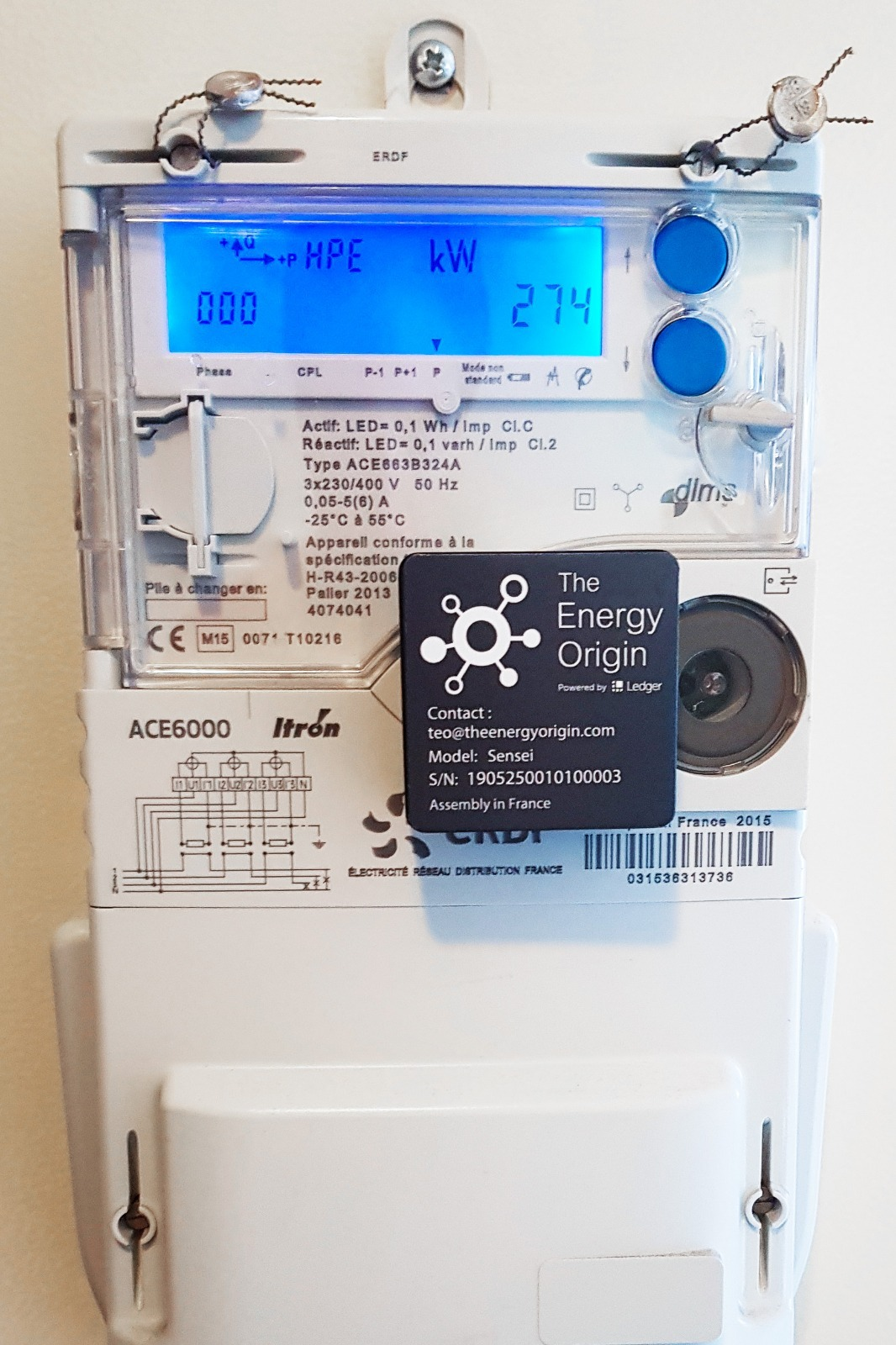
Data is also encrypted where it’s gathered before being transmitted for storage, preventing it from being altered by anyone who intercepts it. This is closely related to the technology in Ledger’s cryptocurrency wallets, which store private codes to protect access to a user’s digital currency.
That energy data is then transmitted and recorded on the Energy Web Chain, an open-source blockchain database deployed in 2019 and led by the Rocky Mountain Institute (RMI), an energy think-tank. Other supporters of that project include Tokyo Electric (Tepco) and Centrica, a British utility. As with other blockchain systems, the participation of multiple parties in Energy Web Chain is intended to increase the trustworthiness of data recorded to it.
Mathieu, from TEO, believes the extra security will help Engie sell renewable energy. Though the long-term goal is to sell consumers on the value of blockchain-verified energy, he says the company will initially try to target large corporations that have sustainability programs, such Amazon and Google.
Selling companies on the advantages of blockchain and renewables may be easier in some places than others. Rather than buying renewables directly, many corporations purchase what are known as renewable energy credits—certificates that represent the environmental benefit of a unit of green power.
Various organizations already exist to certify the reliability of renewable energy credits. And in the U.S., certification systems already use sophisticated electronic tracking.
This has essentially eliminated fraud in the U.S., according to Rachael Terada, technical director of the Center for Resource Solutions, a nonprofit focused on renewable energy.
But flaws remain in other systems. For instance, one European certification organization recently found that similar green-energy certificates known as Guarantees of Origin (GOs) had been mistakenly created for power from three gas-fired plants in Italy. While systems like TEO’s can’t fix such institutional problems, tech-driven transparency could reduce reliance on third-party organizations that monitor energy companies and their reporting about renewables.
Terada says blockchain could be a viable alternative where there are no established and trustworthy systems, in part because it may be easier and less reliant on third-party monitors. Energy Web Chain, for instance, has partnered with a Thai conglomerate, PTT, to issue blockchain-based renewable energy credits for Southeast Asia.
In addition to its project with Engie, Ledger Origin is also working with the environmental-services firm Veolia to install water quality sensors for municipal systems that are difficult to tamper with. This is a safeguard against not just environmental contamination, but active attempts to interfere with water supplies.
“This is very critical,” says Bertrand Jomard, head of Ledger Origin. “You want to make sure a terrorist isn’t sending false data.”
More must-read stories from Fortune:
—Greenpeace ranks China’s tech giants on renewable energy
—Facebook deepfake video ban may set off ‘cat and mouse’ game
—Why there are so many scooters in Los Angeles
—What a $1,000 investment in 10 top stocks a decade ago would be worth today
—Missile strike vs. cyberattack: How Iran retaliates
Catch up with Data Sheet, Fortune’s daily digest on the business of tech.