The story of Carlos Ghosn reads like a bestselling spy novel.
The former high-flying chief executive who ran two global automakers based in Tokyo and Paris simultaneously, and who salvaged Nissan from potential bankruptcy in 1999, also famously fled Japan in a musical instrument box in late December after being held for more than a year in jail and under house arrest on charges of financial misdeeds.
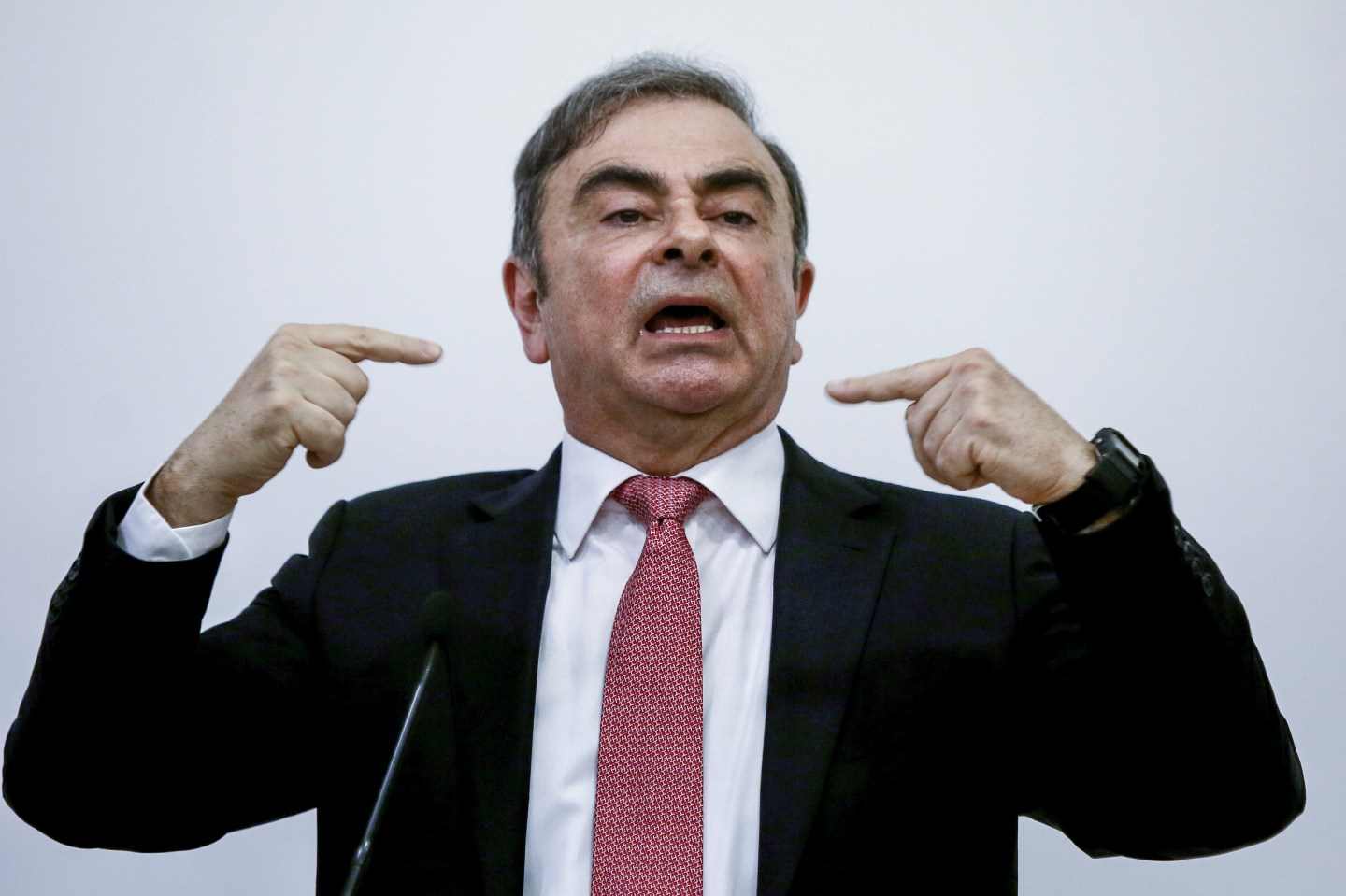
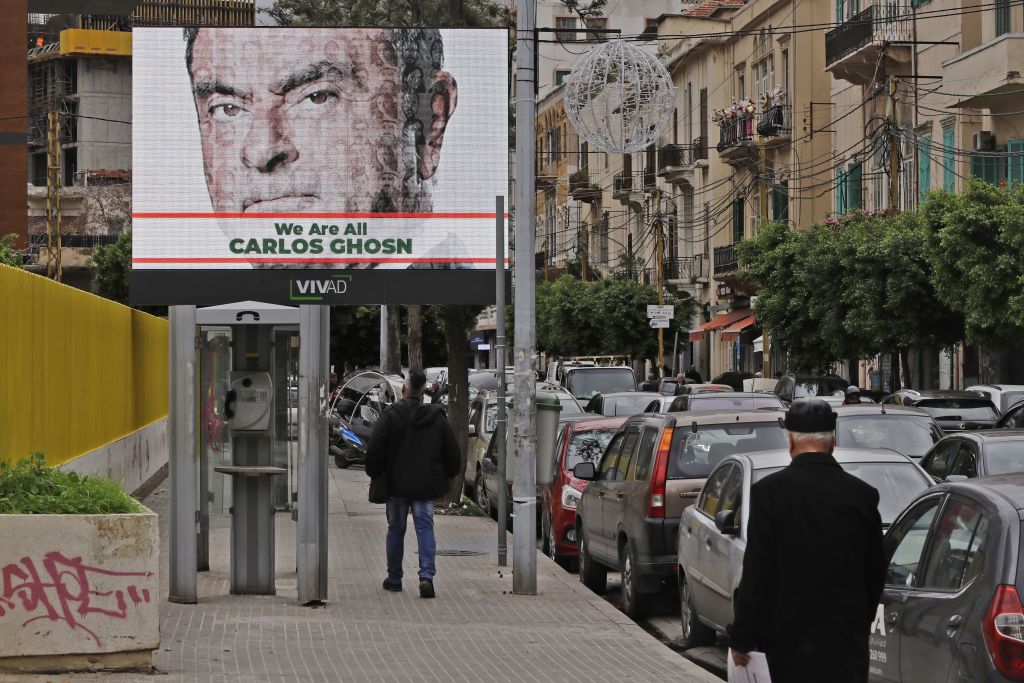
Ghosn spoke out last Wednesday from his new base of operation in his home country Lebanon for the first time since his dramatic escape, detailing what he calls the plot against him at Nissan.
Fortune spoke with a former associate of Ghosn’s who worked closely with him both at Nissan and Renault who agreed to lend insight into the former CEO’s outlook, his mindset, and what may happen next. The auto executive asked not to be named in order to speak freely about some sensitive matters about the Ghosn case and the company he left behind. (Neither Ghosn nor his associates responded to Fortune‘s attempts to reach him for comment.)
According to Fortune’s source, Ghosn’s primary interest is in clearing his name to cement his legacy as Nissan’s savior. Ghosn said as much on Wednesday at the press conference, telling the assembled he would welcome a new trial in Lebanon, or wherever he could find a jurisdiction that would treat him fairly—that is, in one of his home countries: Lebanon, France, or Brazil. In any case, it’s not clear how that could happen if Japanese prosecutors don’t agree to turn over their findings. Besides, the Japanese are turning up the pressure on the business tycoon, issuing through Interpol a “Red Warning” for Ghosn’s arrest, a move that may severely limit his ability to travel.
Furthermore, winning public validation may not be so easily attained for a millionaire who argues his finances were all above board. That ignores the fact Ghosn had to settle with the Securities and Exchange Commission for fraudulently concealing from investors the $140 million in retirement pay he was due; separately, the Japanese accuse him of not coming clean on millions more.
The consummate outsider
As a Brazilian boy growing up in Lebanon, Ghosn always felt like the outsider, this inside source told Fortune. That feeling didn’t change even once he began working in nationalistic France for one of the country’s top automakers. When Renault sent him to Japan in 1999 to defend the company’s 33% interest in the failing Japanese automaker, he arrived with a chip on his shoulder, the source said. Once again, during a two-decade span running the Nissan portion of the alliance, he steamed that the locals were reluctant to embrace him.
Although Japanese automakers these days routinely employ international staff, it’s hard to crack the cultural barrier that remains. “They’ll take your expertise, but it doesn’t mean they’ll accept you,” the source said.
Ghosn’s perception of being the outsider may ultimately have led to his downfall. The reason, according to the Fortune source, is because once he tasted success, his focus began to change. He began to isolate himself from some of his most trusted advisors, shunning those who told him “no.” Instead, he started to regard his own positive press clippings as the incontrovertible truth, a move, the source said, that ultimately blinded Ghosn to his own fallibility.
In his first five years at Nissan’s helm, first as COO, then CEO, Ghosn proved himself an exceptionally skilled manager with an eye for detail and a focus on execution—and on the bottom line, the source says.
Under Ghosn’s leadership, the company went from a $229 million loss in 1998 to the most profitable automaker in the world in 2003. By 2004, the stock of both Renault and Nissan soared; Nissan shares in Tokyo nearly doubled. In 2005, Ghosn became the first executive to be named CEO of two companies simultaneously listed on the Fortune Global 500.
Nissan’s stock has dropped by more than one-third since Ghosn’s arrest in November 2018.
“CEO disease”
During his time in Tokyo, Ghosn’s cross-town arch-rival, Toyota CEO Katsuaki Watanabe, was considered a visionary for launching the world’s first successful fuel-saving hybrid, the Prius, amid the global auto market’s inexorable march toward larger and thirstier SUVs—all the while posting consistent record profits for Toyota.
That Ghosn was christened with the moniker “Le Cost Killer,” grated on him by comparison, Fortune’s source revealed.
“It’s part of his ego that he built this incredible empire, which he arguably did. But what he didn’t do is lay a foundation to continue it. He constructed the [Nissan-Renault] alliance so it’s the Alliance starring Carlos Ghosn.”
In his press conference last week, Ghosn noted that the Nissan-Renault Alliance is functionally inert since his arrest. While a primary task of any chairman or chief executive is to put a viable succession plan in place, one never fully materialized at the Alliance. “He let go or pushed out anybody who could have challenged him as head of the Alliance, and who had credibility and good relationships within both Nissan and Renault.” While Ghosn named a successor at Nissan, he did not install a successor to run the Alliance as a whole.
Fellow famous auto executive Bob Lutz put it differently in an interview with CNBC last week. He said Ghosn suffers from “CEO disease,” a “God complex,” in which he “believes himself to be infallible.”
“I know the profile,” Lutz told CNBC. “That type of personality does tend to pretty easily slip over the line and do things that the rest of us would not do, because they think they’re … so well-connected and of such vast importance to the economy that nobody would ever call them on it.”
The former insider Fortune interviewed cites “a bit of resentment” toward Ghosn among his former turnaround team. The charges “tarnish some incredible work people did,” the person says. Much, if not all, of that work has been overshadowed by Ghosn’s arrest and subsequent flight from Japan clouding the Nissan’s entire turnaround with a brush of impropriety.
The visionary
Around 2004, in order to overcome his reputation as a mere “cost killer,” Ghosn began restyling himself a visionary, the Fortune source says, hanging out with and listening to bankers at the World Economic Forum in Davos, Switzerland; and taking their advice over that of his own company’s engineers and product planners. He began replacing his top team in Japan with ruthless yes-men—some of whom he has now accused of plotting to bring him down, the source note. That’s also when he began fixating on his own press clippings.
Around the same time he laid plans for Nissan to launch the world’s first modern all-electric car to compete with and surpass the Toyota Prius, becoming known in the electric-car community as the father of the Nissan Leaf—all while other automakers were dismissing the market viability of electric vehicles.
It’s that legacy as a visionary Ghosn is now looking to defend, the source says.
After 2001 resignation of Nissan’s previous CEO, the late Yoshikazu Hanawa, who engineered Nissan’s alliance with Renault, and who ushered Ghosn into the corner office, Ghosn said no executive should stay on the job for more than 10 years. Ghosn himself stayed on for 19 years, until Nissan’s board threw him out after his arrest on charges of squandering the company’s money.
A party at Versailles
Prosecutors and former Nissan executives accuse Ghosn of misleading investors by failing to disclose up to $140 million of deferred income on Nissan’s financial statements, starting in 2010, after Japan passed new laws requiring the disclosure of executive pay. He is also accused of accepting homes around the world—in Rio de Janeiro, Beirut, and Amsterdam—that went undisclosed on Nissan’s financial statements, as well as sending money to a Nissan distributor in the Middle East that was allegedly later funneled back to Ghosn and his family.
In his press conference, Ghosn also spent almost five minutes defending a lavish party held in Versailles, the French palace, from which pictures have emerged of entertainers costumed as Marie Antoinette and her entourage. The party coincided with his wife’s birthday, but Ghosn claims it was a corporate event for the 15th anniversary of the Alliance. He says copies of his corporate speech have disappeared, and the $50,000 payment from Nissan to Versailles for a room rental was a misunderstanding.
While the insider says he doesn’t doubt any of the charges against Ghosn, he believes Ghosn’s arrest and prosecution were motivated by a continuing sense of nationalism among Japanese executives. The Japanese officials, the source continued, felt threatened when Ghosn, under pressure from Renault’s French government owners, proposed further nudging the axis of power in the company’s alliance towards Renault—something more akin to a merger of equals. As evidence, he cites the lack of prosecutions of any Japanese Nissan executives (though Ghosn’s successor and primary accuser Hiroto Saikawa was also fired, in September, following an investigation into irregularities in his own pay).
(The Japanese have been rigorously defending the case, and its legal justification. Earlier this month, three days after Ghosn made his first appearance in Beirut, Japan’s Justice Minister Moriko Mori issued a statement saying, “our country’s criminal justice system sets out appropriate procedures to clarify the truth of cases and is administered appropriately, while guaranteeing basic individual human rights. Flight by a defendant on bail is unjustifiable.”)
The inside source sees other red flags. “Somebody had to fill out six forms to get this paid, even out of the CEO’s discretionary fund,” the insider says. “And where was the board? So many people would have had to be involved. There’s no conceivable way so many people could have not known.” So when opponents of the Alliance wanted to find dirt on Ghosn, he reckons, they knew just where to look. Ghosn made some of these very same claims at his press conference.
After his arrest, Ghosn was held in jail for 108 days, most of that time without charges and with limited access to his attorney. After he posted bail of $14 million, he was put under house arrest with his front door and all communications monitored, and very little communication allowed even with his wife, Carole. This week Japan also issued an arrest warrant for Carole Ghosn in connection with her husband’s escape.
In his escape, media reports have documented surveillance footage of Ghosn traveling across Tokyo wearing a baseball cap and a surgical mask, climbing into a musician’s “roadie” trunk with holes drilled in the bottom, and flying in the company of two American security operatives, one a former Green Beret also once convicted of fraud, to Istanbul and then on to Beirut.
Ghosn is a Lebanese citizen, and the country has no extradition treaty with Japan. After Interpol issued its “Red Notice,” the country has banned him from traveling, but has so far announced no additional investigation into his financial activity.
Life on the lam appears to be getting to Ghosn. His personal finances, the spark that started the Japanese investigation, has taken a hit. And now, he’s finding, that in his effort to clear his name, it’s generating fresh scrutiny on his entire career at the Nissan-Renault Alliance.
More must-read stories from Fortune:
—How Nissan-Renault became a ‘masquerade of an alliance,’ according to Ghosn
—Investors see a 2020 recession coming—but think they’ll make money
—As investors shrug off Iran concerns, analysts find the complacency ‘disconcerting’
—Laws meant to close down tax havens and shut loopholes could have opposite effect
—What a $1,000 investment in 10 top stocks a decade ago would be worth today
Subscribe to Fortune’s forthcoming Bull Sheet for no-nonsense finance news and analysis daily.