Google made a big splash two years ago when it introduced the standout white and silver Pixelbook, the first Chromebook laptop that cost $1,000 or more. Last week, the company added a new model to its lineup—Pixelbook Go—that is almost as slick, just as useful, and even a bit easier to carry around.
Oh, and it starts at only $650.
Designing laptops is all about making compromises. Should it be thin and light, sacrificing computing horsepower? Should the screen offer super-sharp detail and high resolution, sacrificing battery life? Or should the device be low-priced at the expense of popular features?
This time, Google made a few different choices from the original Pixelbook, aiming to build more of a workhorse for workers on the go—get it? The original Pixelbook was lightweight and had a high-quality screen, but battery life and processing power were mediocre, at best. And then there was that high price.
With the Pixelbook Go, which I’ve been using for the past week, battery life is great and it’s even lighter, all at a lower price. But processing power is still only okay and now the screen is decidedly mediocre.
In almost every way, the Pixelbook Go eschews the more interesting decisions about the features and form of the earlier Pixelbook, not to mention last year’s Pixel Slate, an iPad-like device which had a removable keyboard. Instead, the Pixelbook Go opts for the traditional laptop design we’ve seen in computers for decades.
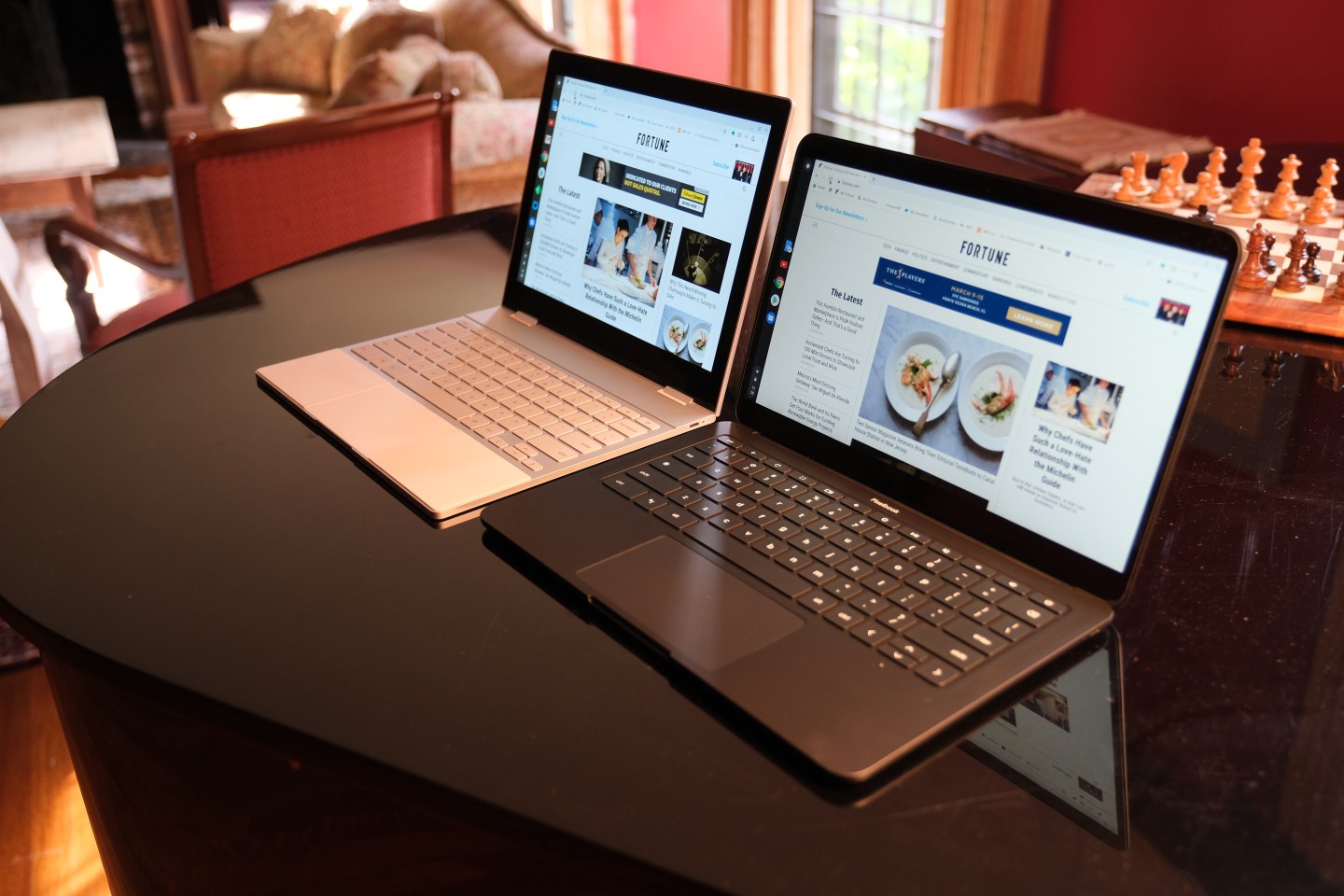
That makes Pixelbook Go more of a direct competitor to the larger field of Chromebook laptops, already crowded with me-too designs that run Google’s lightweight operating system. Samsung, Dell, ASUS, and others are all aiming for the sweet spot of 13 to 14-inch displays, easy portability, and prices around $500. The Pixelbook Go outclasses them all, though it also costs $100 to $200 more than most of its rivals.
To start, Pixelbook Go comes in a basic black or pink tone that some wise guy or gal at Google dubbed “not pink.” It also has a standard clamshell form, so you can’t fold the screen all the way over and use it like a tablet, a feature of the original Pixelbook.
The 13-inch touch screen is slightly shorter and wider than the screen on its older sibling, with the more common 16-by-9 aspect ratio that matches most videos and movies. The two speakers embedded in the keyboard are loud and clear but the display is only HD resolution (not 4K or QHD), with 166 pixels per inch, making it 29% less sharp than the older model. Google plans a higher-priced option with a 4K screen, but it’s not yet on sale or available for review.
Overall, the screen on this Pixelbook Go is a noticeable if acceptable downgrade. Also gone is compatibility with Google’s $100 Pixelbook Pen digital stylus. You’ll just have to finger paint on this touch screen, it seems.
A few things haven’t changed, starting with the awesomely responsive keyboard. For a writer like me, rating laptops has to start and end with the quality of the keyboard (sorry, Apple).
The Pixelbook Go manages to squeeze in a thin and light keyboard that still has noticeable downward movement when you hit each key, while avoiding the annoying key wobble you find on some lower-quality Chromebooks. Google opted for a slightly more slippery finish on the Pixelbook Go keys, but I quickly got used to it. The company says the decision was mostly aesthetic–the all black Pixelbook Go couldn’t have the slightly more pleasing grey-topped keys that matched the older Pixelbook’s white and silver color scheme.
The other design decision that’s stayed the same is less great. That’s the limited number of ports—just two USB-C connections and a headphone jack. Most rivals also have a USB-A port, for connecting to older gear like a mouse, and an SD or micro-SD slot for expanding storage memory. Sure, you can buy adapters and dongles, but that’s inconvenient.
There’s one new original touch, too, and I’m a fan. The bottom side of the laptop’s magnesium case is covered with small ridges that run the length of the Pixelbook Go and make it easier to grip. It’s a minor delight every time I grab the laptop and get going—and in keeping with the laptop’s name.
Battery life on the new machine was great. I easily got 10 hours of work done on a busy day, with an hour or more left in the Pixelbook Go’s tank, matching Google’s claimed 12 hours of battery life. That’s better than the average of about nine hours in PC Magazine‘s ratings of its 10 favorite Chromebooks. Battery life was decidedly mediocre on the older Pixelbook (I got just seven hours on a charge when testing for my original review).
Like all higher-end Chromebooks, the Pixelbook Go can run Android apps, greatly expanding the choice of software beyond browser-based apps that used to be the big limitation of opting for ChromeOS. Google and Android developers have steadily improved compatibility, so more mobile apps work better on Chromebooks. I tried everything from Microsoft Excel to Adobe Lightroom to the racing game Asphalt 8—and all worked without any hiccups. Google has also improved its Play app store so that Chromebook users see a variety of special categories just for them, like “Creativity on Chromebooks–apps to boost your creativity.”
Computing performance was fine–for a Chromebook. For this review, Google loaned me the $850 edition with 8 GB of RAM and an Intel 8th generation Core i5 processor in its Y-series that prioritizes power savings over calculating muscle.
For on the go, it worked well enough. I opened a bazillion tabs at once in Chrome, including a few with auto-play video, imported some photos into Lightroom, and typed in a Word document without any of the apps slowing down. Racing around a virtual Barcelona in Asphalt 8 wasn’t exactly the smoothest or most realistic-looking gaming experience I’ve ever had, but it was fine for a quick diversion. The 16-by-9 screen will be a perfect fit for all the games in Google’s upcoming Stadia cloud gaming service, too.
So if the Pixelbook Go isn’t meant to replace the more expensive Pixelbook, it has to be judged against the rest of the mid-range Chromebook field. ASUS’s Chromebook Flip C434, which came out earlier this year to much acclaim, sells for about $600 for the same processor, memory, and storage as the entry-level Pixelbook Go at $650. In comparison, the Pixelbook Go’s design is sharper looking and it weighs nearly a pound less (2.3 pounds versus 3.2 pounds) than the ASUS, which does have a better selection of ports.
For workers on the go who like living in a ChromeOS world, Pixelbook Go is worth the premium in my book. Make that: my Pixelbook.
More must-read stories from Fortune:
—The wireless industry needs more airwaves, but it’s going to be costly
—Demand for Apple’s new iPhone 11 is strong
—How to claim a cash settlement of up to $358 for Yahoo’s data breaches
—Now hiring: people who can translate data into stories and actions
—Investors are pouring money into marijuana software. Here’s the latest startup to get funding
Catch up with Data Sheet, Fortune’s daily digest on the business of tech.