• Home
  • Latest
  • Fortune 500
  • Finance
  • Tech
  • Leadership
  • Lifestyle
  • Rankings
  • Multimedia

Trendingnow

1

As Big Tech showers employees with perks to win the talent war, Nvidia built a nearly $5 trillion company by making people pay for their own lunch

2

Mark Zuckerberg feeds his cows macadamia nuts and beer to create the 'highest-quality beef in the world' on his $300 million estate in Hawaii

3

Today, Emily Blunt is worth $80 million thanks to her Hollywood career—but she actually wanted to be a UN Spanish translator on $80K

1

As Big Tech showers employees with perks to win the talent war, Nvidia built a nearly $5 trillion company by making people pay for their own lunch

2

Mark Zuckerberg feeds his cows macadamia nuts and beer to create the 'highest-quality beef in the world' on his $300 million estate in Hawaii

3

Today, Emily Blunt is worth $80 million thanks to her Hollywood career—but she actually wanted to be a UN Spanish translator on $80K
FinanceBonds

Plunge in 30-Year Treasury Bond Yields Spells the End of America’s Golden Age, to Some

By
Erik Sherman
Erik Sherman
Down Arrow Button Icon
By
Erik Sherman
Erik Sherman
Down Arrow Button Icon
August 16, 2019, 10:34 AM ET
Add Fortune on Google for similar content.

On Friday, the yield on a 30-year Treasury bond briefly dropped below 2% for the second time in history. The first was on Thursday.

No big damage was evident, but some were reminded of an icy economic wind: the decades-long downward trend of 30-year bond yields. The 2% mark aside, the trend may be a sign of the end of the American Dream, predicated on the idea that ongoing growth will create social mobility and let your children do better than you.

Come on now. Really?

“Yes,” said Lisa Shalett, chief investment officer for Morgan Stanley Wealth Management. “We can talk about things that are technically influencing it, but the trend line is an extraordinarily sad and depressing state of affairs.”

Since 1990, the yield of the 30-year bond—except for a 4-year period when the Treasury took it off the market—has seen a straight-line descent from a high of more than 9% to current rates around 2%.
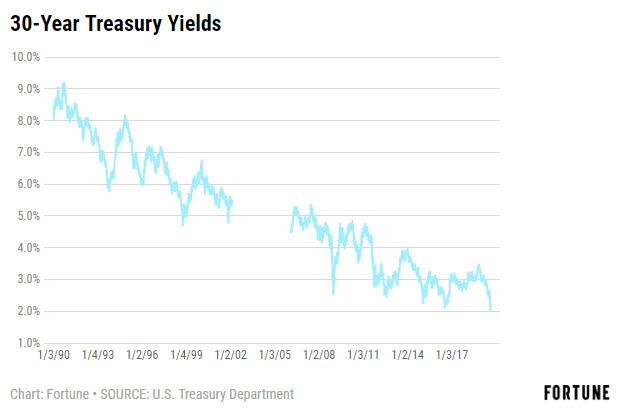
The trend is a picture that some major money advisors have been trying to explain to their clients for years now. A combination of factors seems to herald a point where overall long-range growth is virtually nonexistent.

How bonds get priced

The U.S. Treasury Department doesn’t dictate yields. Instead, it makes bonds of a given denomination and maturity term available at auction. Bids set the final price, with “par” being the face value, and the yield. A classic example of supply-and-demand determined pricing, the more buyers, the more competition there is for the bonds. The more competition, the more people have to pay to get the bond and the less the Treasury needs offer in yield.

“We would think the steady state for the 30-year bond would equal the natural interest rate plus inflation expectations plus the liquidity and risk premium,” said Rich Higgins, an assistant professor of economics at Colgate University.

The natural interest rate is the one an economy organically exhibits from the combination of population increase, availability of natural resources, and productivity and efficiency improvements that technology bring.

To the natural interest rate, add inflation—an overall additional change in how an economy grows that can occur from many factors—and the liquidity and risk premium that people want for leaving money tied up for 30 years.

The definition explains why a sub-2% 30-year bond yield is worrying. The Federal Reserve targets the maintenance of a 2% long-term inflation rate. Subtract that from the yield and you’re losing money in real terms.

Why yields have been dropping

The easiest classical economics explanations for falling yields tend to focus on the years since the Great Recession. A global chase for money and returns has seen the U.S. as a safe haven in a world teeming with negative interest rates. The more institutions and people vying for a set number of bonds, the higher the price and the lower the yield.

“When you look at the flow data, all of the money is going into bonds and very little is going into equities,” said Emily Roland, co-chief investment strategist at John Hancock Investment Management. During this year alone “there’s been a huge trend of investors selling equities and buying bonds,” she said.

Additionally, inflation has stayed at bay. “We haven’t seen any upward pressure on wage growth at all,” Roland said.

The economy, by an important measure, has been slowing, further reducing inflation pressure. The Conference Board’s Leading Economic Index, which declined 0.3% in June after no change in May and a 0.1% increase in April. “The latest tick for last month showed a year-over-year increase of 1.5%,” Roland said. “That compares to 7% in the fall.”

Adding psychology

But that still doesn’t explain the longer view. What does is the human psychology of expectations. “You can look at long-run productivity gains, long-run growth, and have an idea of what they’ll be,” said Rebecca Neumann, professor and director of undergraduate studies in economics at the University of Wisconsin—Milwaukee. “Then the expectations play in.”

There is even a theory in economics that “expectations of inflation drive interest rates,” Neumann said. Many people in the current economy don’t remember times of double-digit inflation and interest rates. Increasingly, they expect low inflation because that is what they’ve always seen, creating price increases and lower expectations of salary growth that helps cap inflation. The last time inflation was over 10% was in 1981. People under 39 weren’t even alive then, let alone aware of how it can go.

Changing demographics play in ways other than memory. “About 20 years ago we put out research we called the race to zero based on long-term demographic trends,” said Michael Collins, senior portfolio manager at PGIM Fixed Income. “Interest rates are really correlated to growth, which is correlated to the growth of the labor market.”

But labor markets have been shrinking in Japan for 20 years and in Europe for 10. Now they’ve begun to in China and the U.S. Prices tend to drop as average age increases, according to Collins, which is anti-inflationary.

The message isn’t one that many take kindly to. “People look at us like we’re crazy,” Collins said.

The ultimate result of low interest rates has what Shalett sees as a potentially inescapable implication.

“Economists can talk about money flow and people are buying the 30 year to hedge against stocks or they’re running away and escaping negative yields in other countries,” Shalett said. “But the reality is that someone buying a 30-year bond today that a 2% dividend—which is supposed to include some growth, inflation, and some risk—is willing to accept a 2% yield as a good investment. That means they aren’t all that excited that there are a lot of good investments out there that are going to return 4%, 5%, 10%, 20%. When you have bond prices that low and staying there, that’s a sad state of affairs.”

It may be the end of growth as we’ve come to expect it. But don’t call this the new normal. We’re living through the new abnormal.

More must-read stories from Fortune:

—What people get wrong about artificial intelligence and China
—Will Apple will absorb tariffs on Chinese-made products?
—Is it “only human” to feel anxious about money? Talking finance with Sophia the Robot
—The currency that’s quietly emerged as Asia’s safest bet
—Listen to our audio briefing, Fortune 500 Daily
Follow Fortune on Flipboard to stay up-to-date on the latest news and analysis.

About the Author
By Erik Sherman
See full bioRight Arrow Button Icon
Add Fortune on Google for similar content.

Latest in Finance

Finance
Lorem ipsum dolor sit amet, consectetur adipiscing elit, sed do eiusmod tempor incididunt ut labore et dolore magna aliqua. Ut enim ad minim veniam
By Fortune Editors
October 20, 2025
Finance
Lorem ipsum dolor sit amet, consectetur adipiscing elit, sed do eiusmod tempor incididunt ut labore et dolore magna aliqua. Ut enim ad minim veniam
By Fortune Editors
October 20, 2025
Finance
Lorem ipsum dolor sit amet, consectetur adipiscing elit, sed do eiusmod tempor incididunt ut labore et dolore magna aliqua. Ut enim ad minim veniam
By Fortune Editors
October 20, 2025
Finance
Lorem ipsum dolor sit amet, consectetur adipiscing elit, sed do eiusmod tempor incididunt ut labore et dolore magna aliqua. Ut enim ad minim veniam
By Fortune Editors
October 20, 2025
Finance
Lorem ipsum dolor sit amet, consectetur adipiscing elit, sed do eiusmod tempor incididunt ut labore et dolore magna aliqua. Ut enim ad minim veniam
By Fortune Editors
October 20, 2025
Finance
Lorem ipsum dolor sit amet, consectetur adipiscing elit, sed do eiusmod tempor incididunt ut labore et dolore magna aliqua. Ut enim ad minim veniam
By Fortune Editors
October 20, 2025

Most Popular

Finance
Lorem ipsum dolor sit amet, consectetur adipiscing elit, sed do eiusmod tempor incididunt ut labore et dolore magna aliqua. Ut enim ad minim veniam
By Fortune Editors
October 20, 2025
Finance
Lorem ipsum dolor sit amet, consectetur adipiscing elit, sed do eiusmod tempor incididunt ut labore et dolore magna aliqua. Ut enim ad minim veniam
By Fortune Editors
October 20, 2025
Finance
Lorem ipsum dolor sit amet, consectetur adipiscing elit, sed do eiusmod tempor incididunt ut labore et dolore magna aliqua. Ut enim ad minim veniam
By Fortune Editors
October 20, 2025
Finance
Lorem ipsum dolor sit amet, consectetur adipiscing elit, sed do eiusmod tempor incididunt ut labore et dolore magna aliqua. Ut enim ad minim veniam
By Fortune Editors
October 20, 2025
Finance
Lorem ipsum dolor sit amet, consectetur adipiscing elit, sed do eiusmod tempor incididunt ut labore et dolore magna aliqua. Ut enim ad minim veniam
By Fortune Editors
October 20, 2025
Finance
Lorem ipsum dolor sit amet, consectetur adipiscing elit, sed do eiusmod tempor incididunt ut labore et dolore magna aliqua. Ut enim ad minim veniam
By Fortune Editors
October 20, 2025
Fortune Secondary Logo
Rankings
  • 100 Best Companies
  • Fortune 500
  • Global 500
  • Fortune 500 Europe
  • Most Powerful Women
  • World's Most Admired Companies
  • See All Rankings
  • Lists Calendar
Sections
  • Finance
  • Fortune Crypto
  • Features
  • Leadership
  • Health
  • Commentary
  • Success
  • Retail
  • Mpw
  • Tech
  • Lifestyle
  • CEO Initiative
  • Asia
  • Politics
  • Conferences
  • Europe
  • Newsletters
  • Personal Finance
  • Environment
  • Magazine
  • Education
Customer Support
  • Frequently Asked Questions
  • Customer Service Portal
  • Privacy Policy
  • Terms Of Use
  • Single Issues For Purchase
  • International Print
Commercial Services
  • Advertising
  • Fortune Brand Studio
  • Fortune Analytics
  • Fortune Conferences
  • Business Development
  • Group Subscriptions
About Us
  • About Us
  • Press Center
  • Work At Fortune
  • Terms And Conditions
  • Site Map
  • About Us
  • Press Center
  • Work At Fortune
  • Terms And Conditions
  • Site Map
  • Facebook icon
  • Twitter icon
  • LinkedIn icon
  • Instagram icon
  • Pinterest icon

Latest in Finance

Those bots sending discounts to your email is dynamic pricing in action. Get revenge on those bots by abandoning your cart
RetailConsumer Spending
Those bots sending discounts to your email is dynamic pricing in action. Get revenge on those bots by abandoning your cart
By Catherina GioinoJuly 3, 2026
57 minutes ago
Mortgage rates today, July 3, 2026
Personal Financemortgages
Mortgage rates today, July 3, 2026
By Glen Luke FlanaganJuly 3, 2026
2 hours ago
Current refi mortgage rates report for July 3, 2026
Personal FinanceReal Estate
Current refi mortgage rates report for July 3, 2026
By Glen Luke FlanaganJuly 3, 2026
2 hours ago
Current ARM mortgage rates report for July 3, 2026
Personal FinanceReal Estate
Current ARM mortgage rates report for July 3, 2026
By Glen Luke FlanaganJuly 3, 2026
2 hours ago
Nissan CEO Ivan Espinosa was forced to put together a plan to save the Japanese carmaker in just six weeks: ‘I knew what had to be done’ 
AsiaAsia Agenda
Nissan CEO Ivan Espinosa was forced to put together a plan to save the Japanese carmaker in just six weeks: ‘I knew what had to be done’ 
By Andrew StaplesJuly 3, 2026
2 hours ago
The World Bank has elevated Vietnam and the Philippines to upper-middle-income status—but now they face ‘a far more demanding phase of development’
EconomyWorld Bank
The World Bank has elevated Vietnam and the Philippines to upper-middle-income status—but now they face ‘a far more demanding phase of development’
By Angelica AngJuly 3, 2026
2 hours ago

Most Popular

As Big Tech showers employees with perks to win the talent war, Nvidia built a nearly $5 trillion company by making people pay for their own lunch
Big Tech
As Big Tech showers employees with perks to win the talent war, Nvidia built a nearly $5 trillion company by making people pay for their own lunch
By Marco Quiroz-GutierrezJuly 1, 2026
2 days ago
Mark Zuckerberg feeds his cows macadamia nuts and beer to create the 'highest-quality beef in the world' on his $300 million estate in Hawaii
Success
Mark Zuckerberg feeds his cows macadamia nuts and beer to create the 'highest-quality beef in the world' on his $300 million estate in Hawaii
By Sasha RogelbergJuly 2, 2026
16 hours ago
Today, Emily Blunt is worth $80 million thanks to her Hollywood career—but she actually wanted to be a UN Spanish translator on $80K
Success
Today, Emily Blunt is worth $80 million thanks to her Hollywood career—but she actually wanted to be a UN Spanish translator on $80K
By Orianna Rosa RoyleJuly 2, 2026
1 day ago
Americans are escaping the U.S. for New Zealand where house prices have hit a new low—but only wealthy Americans with $3 million spare can invest
Success
Americans are escaping the U.S. for New Zealand where house prices have hit a new low—but only wealthy Americans with $3 million spare can invest
By Emma BurleighJuly 2, 2026
17 hours ago
Current price of oil as of July 2, 2026
Personal Finance
Current price of oil as of July 2, 2026
By Joseph HostetlerJuly 2, 2026
19 hours ago
MacKenzie Scott alone accounted for one-third of America's $19.2 billion in megagifts last year
Success
MacKenzie Scott alone accounted for one-third of America's $19.2 billion in megagifts last year
By Sydney LakeJune 25, 2026
8 days ago

© 2026 Fortune Media IP Limited. All Rights Reserved. Use of this site constitutes acceptance of our Terms of Use and Privacy Policy | CA Notice at Collection and Privacy Notice | Do Not Sell/Share My Personal Information
FORTUNE is a trademark of Fortune Media IP Limited, registered in the U.S. and other countries. FORTUNE may receive compensation for some links to products and services on this website. Offers may be subject to change without notice.