• Home
  • Latest
  • Fortune 500
  • Finance
  • Tech
  • Leadership
  • Lifestyle
  • Rankings
  • Multimedia
MagazineTech

Autonomous Trains Are Ready to Roll

By
Aaron Pressman
Aaron Pressman
Down Arrow Button Icon
By
Aaron Pressman
Aaron Pressman
Down Arrow Button Icon
July 29, 2019, 6:30 AM ET
Courtesy of Rio Tinto

If all goes as planned in August, a freight train will chug down a track near Pueblo, Colo.—entirely controlled by computers. Humans in the locomotive will merely observe, as the latest in artificial intelligence and sensor technology puts thousands of tons of steel through its paces. 

The experiment, on 48 miles of track at the railroad industry’s advanced testing ground, is a big step in the push for autonomous train technology. The outcome could fundamentally alter the railroad industry.

While still a huge, highly profitable business, railroads move less freight than they did 10 years ago, and their biggest customer—the coal industry—is in long-term decline. Almost $700 billion in cargo moved by train in 2017, the latest government figures show, but trucks carried far more, over $12 trillion.

To catch up, rail companies must appeal more to faster-growing segments of the economy, like e-commerce, which require speedier and more reliable deliveries. Automation, railroads hope, is the answer because it could reduce fuel costs and increase capacity by enabling trains to run faster and closer together. 

“I don’t think there’s much debate: This is where the railroads need to go,” says Cowen and Co. analyst Matt Elkott, who forecasts extensive automation in the industry within five to seven years.

That reinvention effort is setting off a race to add A.I., machine learning, and other high-tech features to the rail system. Age-old railroad equipment makers like Siemens, Wabtec, and Knorr-Bremse are up against tech companies like Nvidia, Microsoft, and Hitachi. 
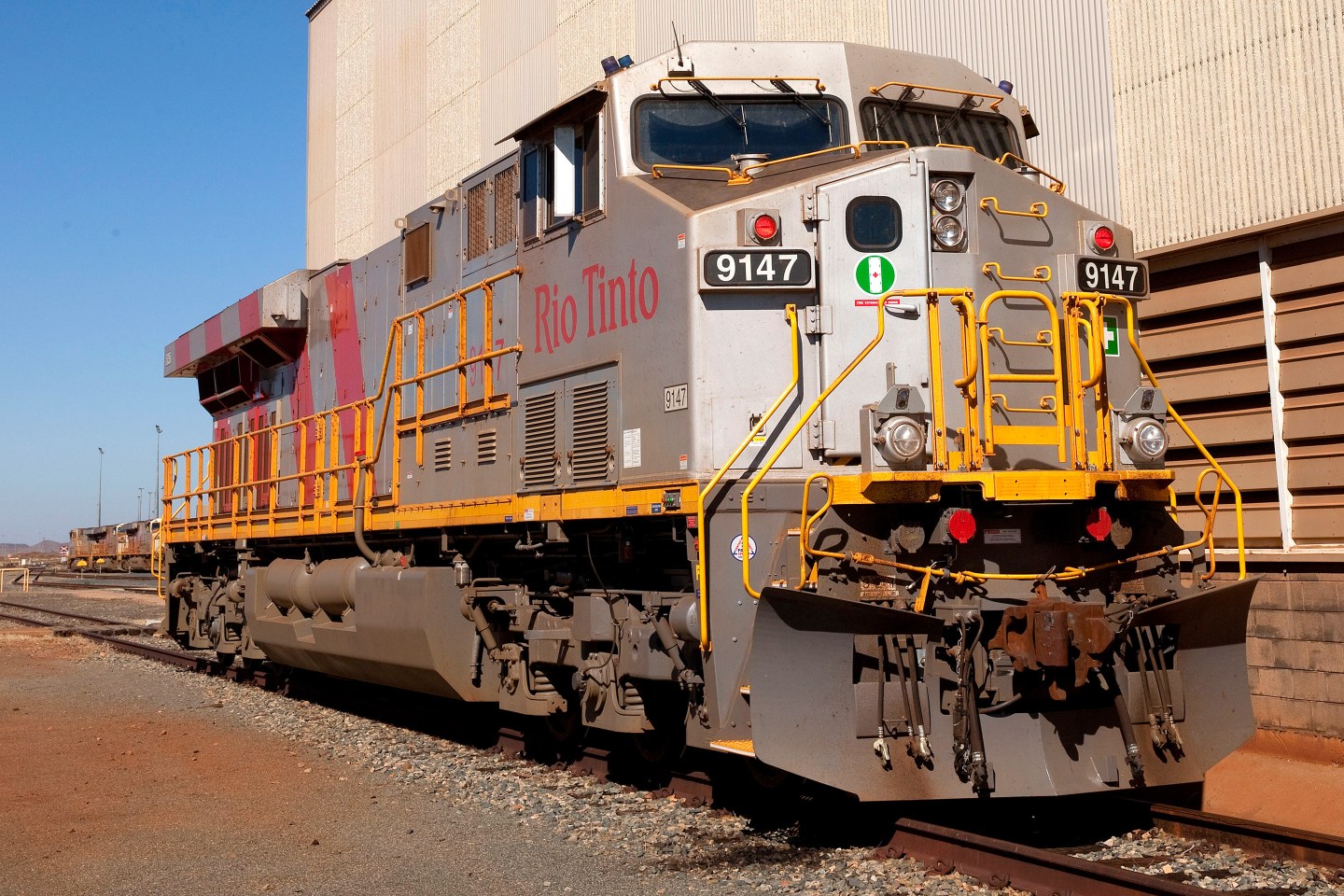
Photo: Courtesy of Rio Tinto
Courtesy of Rio Tinto

Most of the tech components—including ones that reduce fuel consumption and control emergency braking systems—have already been deployed in piecemeal fashion. What’s needed is A.I. to tie them together and testing to persuade all the stakeholders to go along for the ride. 

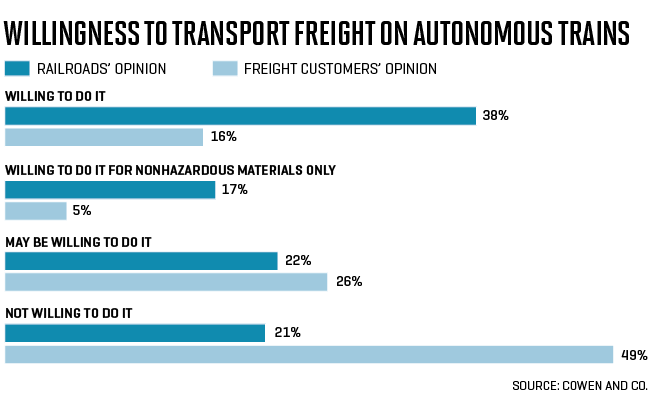
But even if the tests go well, autonomous trains face several challenges. The first is powerful railroad unions, which have fought bitterly over crew sizes. Next, the industry would have to overcome public fears that autonomous technology is unsafe. And finally, sometimes-skeptical regulators would have to give their seal of approval. 

“Of course we’ll be able to do it,” says Ulisses Camilo, CEO of New York Air Brake, the company whose technology will be tested in Colorado. “The question is how fast.”

The groundwork for autonomous rails was laid as part of a 12-year, $10 billion safety upgrade to North America’s system that should be completed by next year. The overhaul started in 2008, after 25 people died in the head-on collision of a commuter train and a Union Pacific freight train in Chatsworth, Calif. (a distracted engineer blew past a red signal light). 

In response, Congress mandated that the entire system be upgraded with automatic safety overrides. Known as Positive Train Control, or PTC, the program includes sensors on tracks and switches that send information to central servers, telling trains about traffic and conditions ahead. If an engineer fails to slow or stop a train, the system can automatically intervene. Still, by itself, PTC is equipped to handle only a few types of emergencies, like a missed signal or a train traveling too fast around a sharp curve.

In some ways, the railroads should be able to adapt or borrow from many of the camera, radar, and lidar technologies used in self-­driving cars and trucks. One big difference: Stopping a freight train can take a mile or more (versus 300 feet for a fast-moving car). 
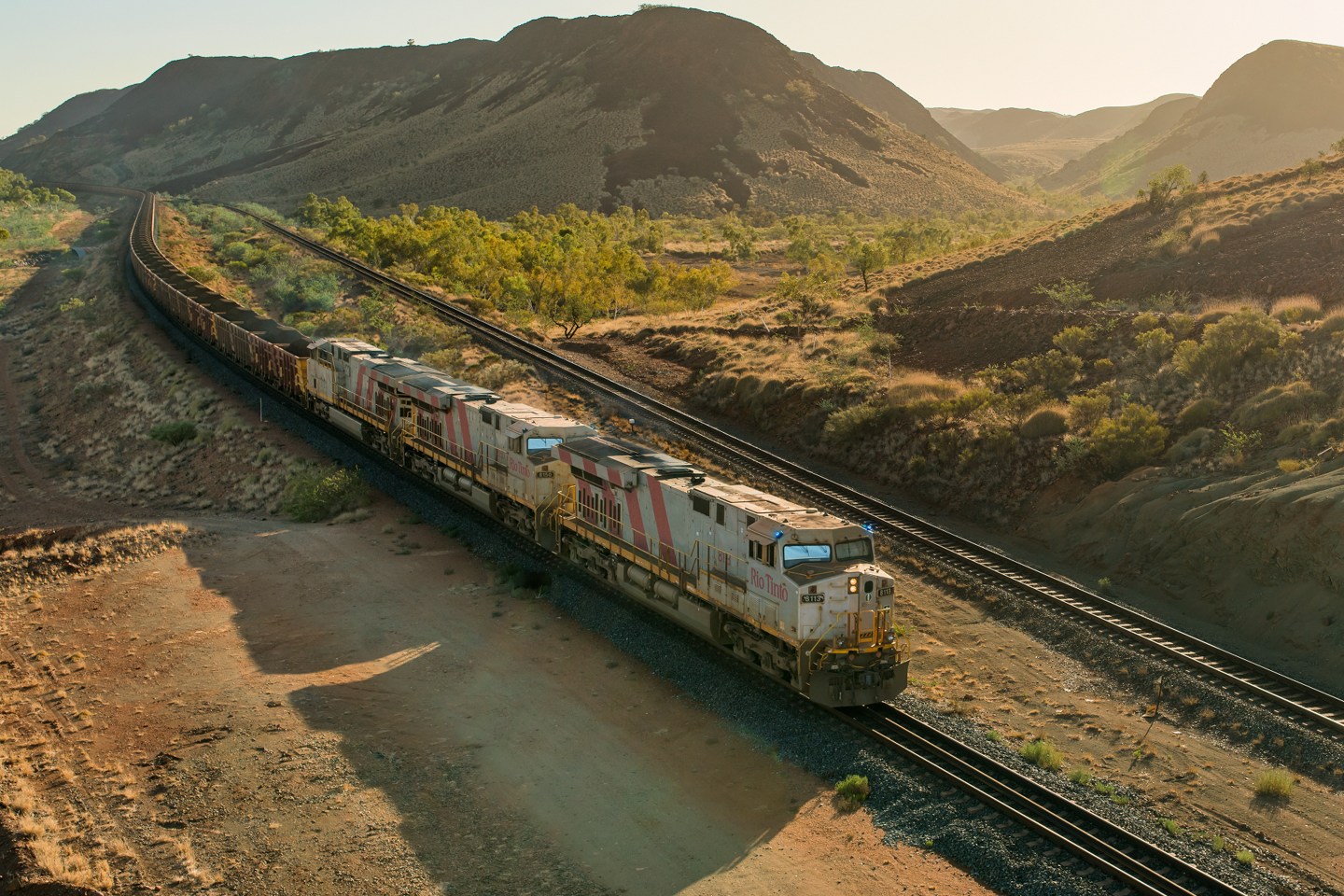
Already, mining giant Rio Tinto is using fully autonomous trains in Australia to deliver iron ore from 16 mines to ports hundreds of miles away. By the end of last year, the company said it had safely completed almost 3 million miles of autonomous travel. 

Despite the potential benefits of automation, major freight railroads declined to comment to Fortune on the issue. Union negotiations in the fall make this a sensitive time, particularly because railroads will likely propose reducing train crews to just one person from two. 

Railroad unions see automation as yet another effort to reduce their ranks. When the Federal Railroad Administration asked for public feedback last year about autonomous rail, it was flooded with 3,400 comments, 99% of which were in opposition.

“The technology is flashy, but it is not ready for prime time,” warns Fritz Edler, special representative for the Railroad Workers United union. Reducing train crews to one person and depending on automation would be “demonstrably dangerous,” he says. 

The federal government hasn’t moved forward with a plan for ­autonomous trains yet, but it may have showed its hand in June when it killed an Obama-era proposal that would have enshrined into law two-person crews. 

Even as the railroad industry debates automation, the rival trucking industry is pushing ahead, with both self-driving technology and electric vehicles that may be much cheaper to operate. 

Says Tony Hatch, an independent transportation industry analyst: “The railroads have to respond.”

This article originally appeared in the August 2019 issue of Fortune.

More must-read stories from Fortune:

—How the government should spend Facebook’s $5 billion fine

—Cloud gaming is big tech’s new street fight

—Should companies bolster their cybersecurity by “hacking back”?

—FaceApp’s Russia link is the latest alarm in an ongoing digital red scare

—Equifax may owe you some money. Here’s how to get it

Catch up with Data Sheet, Fortune‘s daily digest on the business of tech.

About the Author
By Aaron Pressman
See full bioRight Arrow Button Icon

Latest from the Magazine

Finance
Lorem ipsum dolor sit amet, consectetur adipiscing elit, sed do eiusmod tempor incididunt ut labore et dolore magna aliqua. Ut enim ad minim veniam
By Fortune Editors
October 20, 2025
Finance
Lorem ipsum dolor sit amet, consectetur adipiscing elit, sed do eiusmod tempor incididunt ut labore et dolore magna aliqua. Ut enim ad minim veniam
By Fortune Editors
October 20, 2025
Finance
Lorem ipsum dolor sit amet, consectetur adipiscing elit, sed do eiusmod tempor incididunt ut labore et dolore magna aliqua. Ut enim ad minim veniam
By Fortune Editors
October 20, 2025
Finance
Lorem ipsum dolor sit amet, consectetur adipiscing elit, sed do eiusmod tempor incididunt ut labore et dolore magna aliqua. Ut enim ad minim veniam
By Fortune Editors
October 20, 2025
Finance
Lorem ipsum dolor sit amet, consectetur adipiscing elit, sed do eiusmod tempor incididunt ut labore et dolore magna aliqua. Ut enim ad minim veniam
By Fortune Editors
October 20, 2025
Finance
Lorem ipsum dolor sit amet, consectetur adipiscing elit, sed do eiusmod tempor incididunt ut labore et dolore magna aliqua. Ut enim ad minim veniam
By Fortune Editors
October 20, 2025

Most Popular

Finance
Lorem ipsum dolor sit amet, consectetur adipiscing elit, sed do eiusmod tempor incididunt ut labore et dolore magna aliqua. Ut enim ad minim veniam
By Fortune Editors
October 20, 2025
Finance
Lorem ipsum dolor sit amet, consectetur adipiscing elit, sed do eiusmod tempor incididunt ut labore et dolore magna aliqua. Ut enim ad minim veniam
By Fortune Editors
October 20, 2025
Finance
Lorem ipsum dolor sit amet, consectetur adipiscing elit, sed do eiusmod tempor incididunt ut labore et dolore magna aliqua. Ut enim ad minim veniam
By Fortune Editors
October 20, 2025
Finance
Lorem ipsum dolor sit amet, consectetur adipiscing elit, sed do eiusmod tempor incididunt ut labore et dolore magna aliqua. Ut enim ad minim veniam
By Fortune Editors
October 20, 2025
Finance
Lorem ipsum dolor sit amet, consectetur adipiscing elit, sed do eiusmod tempor incididunt ut labore et dolore magna aliqua. Ut enim ad minim veniam
By Fortune Editors
October 20, 2025
Finance
Lorem ipsum dolor sit amet, consectetur adipiscing elit, sed do eiusmod tempor incididunt ut labore et dolore magna aliqua. Ut enim ad minim veniam
By Fortune Editors
October 20, 2025
Fortune Secondary Logo
Rankings
  • 100 Best Companies
  • Fortune 500
  • Global 500
  • Fortune 500 Europe
  • Most Powerful Women
  • Future 50
  • World’s Most Admired Companies
  • See All Rankings
Sections
  • Finance
  • Fortune Crypto
  • Features
  • Leadership
  • Health
  • Commentary
  • Success
  • Retail
  • Mpw
  • Tech
  • Lifestyle
  • CEO Initiative
  • Asia
  • Politics
  • Conferences
  • Europe
  • Newsletters
  • Personal Finance
  • Environment
  • Magazine
  • Education
Customer Support
  • Frequently Asked Questions
  • Customer Service Portal
  • Privacy Policy
  • Terms Of Use
  • Single Issues For Purchase
  • International Print
Commercial Services
  • Advertising
  • Fortune Brand Studio
  • Fortune Analytics
  • Fortune Conferences
  • Business Development
About Us
  • About Us
  • Editorial Calendar
  • Press Center
  • Work At Fortune
  • Diversity And Inclusion
  • Terms And Conditions
  • Site Map
Fortune Secondary Logo
  • About Us
  • Editorial Calendar
  • Press Center
  • Work At Fortune
  • Diversity And Inclusion
  • Terms And Conditions
  • Site Map
  • Facebook icon
  • Twitter icon
  • LinkedIn icon
  • Instagram icon
  • Pinterest icon

Latest from the Magazine

MagazineVictoria's Secret
How Victoria’s Secret got its sexy back
By Emma HinchliffeFebruary 4, 2026
24 days ago
MagazineLetter from London
Oracle billionaire Larry Ellison’s next big bet: Redefining how long–and how well–we live
By Kamal AhmedFebruary 3, 2026
24 days ago
MagazineSilicon Valley
AI is changing the CEO’s role—and could lead to a changing of the guard
By Phil WahbaFebruary 3, 2026
25 days ago
MagazineFedEx
How FedEx CEO Raj Subramaniam is adapting to the era of ‘re-globalization’
By Nicholas GordonFebruary 1, 2026
26 days ago
MagazineEducation
The 1966 cover of Fortune Magazine welcomed the Information age. Now the AI era beckons
By Indrani SenJanuary 30, 2026
28 days ago
MagazineBonds
Bonds 101: What investors need to know about the ‘shock absorber of the portfolio’
By Jeff John RobertsJanuary 29, 2026
30 days ago

Most Popular

placeholder alt text
Innovation
An MIT roboticist who cofounded bankrupt robot vacuum maker iRobot says Elon Musk’s vision of humanoid robot assistants is ‘pure fantasy thinking’
By Marco Quiroz-GutierrezFebruary 25, 2026
2 days ago
placeholder alt text
Success
Jeff Bezos says being lazy, not working hard, is the root of anxiety: ‘The stress goes away the second I take that first step’
By Sydney LakeFebruary 25, 2026
2 days ago
placeholder alt text
Economy
Trump claims America is ‘winning so much.’ The IMF agrees, adding that Trump’s trade policies are the only thing holding it back from even more
By Tristan BoveFebruary 26, 2026
1 day ago
placeholder alt text
Commentary
'The Pitt': a masterclass display of DEI in action 
By Robert RabenFebruary 26, 2026
1 day ago
placeholder alt text
Economy
It’s more than George Clooney moving to France: America is becoming the ‘uncool’ country that people want to move away from
By Nick LichtenbergFebruary 27, 2026
16 hours ago
placeholder alt text
Success
Gen Z Olympic champion Eileen Gu says she rewires her brain daily to be more successful—and multimillionaire founder Arianna Huffington says it really does work
By Orianna Rosa RoyleFebruary 25, 2026
2 days ago

© 2026 Fortune Media IP Limited. All Rights Reserved. Use of this site constitutes acceptance of our Terms of Use and Privacy Policy | CA Notice at Collection and Privacy Notice | Do Not Sell/Share My Personal Information
FORTUNE is a trademark of Fortune Media IP Limited, registered in the U.S. and other countries. FORTUNE may receive compensation for some links to products and services on this website. Offers may be subject to change without notice.