When you type the term “bike jersey” into the search field at Etsy.com, most of the results you get are, in fact, bike jerseys.
That may sound like “dog bites man” news. But not long ago, running such a search at this e-commerce site for handmade and craftsy goods would have yielded a torrent of irrelevant results—a necktie covered with tiny embroidered bikes, a baseball jersey, a vintage New Jersey bicycle license plate. Given the high proportion of sales driven by first-page rankings from a desktop search, useless results mean lost revenue, says Etsy technology chief Mike Fisher: “I’ve got to be very narrow very quickly, or else I lose you.”
Better search results are a technological victory for Etsy—and increasingly a financial one too. The site has 60 million items for sale at any given time, from prosaic goods like oven mitts and coasters to oddities such as clothes for dogs—like the sweater CEO Josh Silverman recently bought. The company, which launched in 2005, has earned cultlike devotion from sellers and buyers alike for its “keeping commerce human” ethos and its focus on small vendors rather than big corporate conglomerates. But Etsy is enjoying a striking turnaround, thanks in part to an effort to give customers the consistent, reliable experience they’d expect from … a big corporate conglomerate.
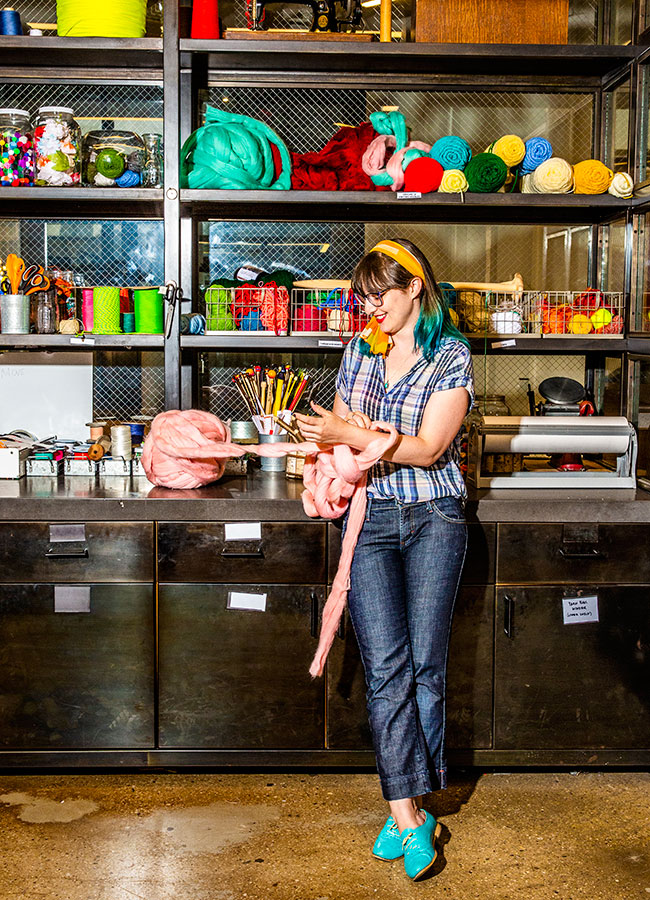
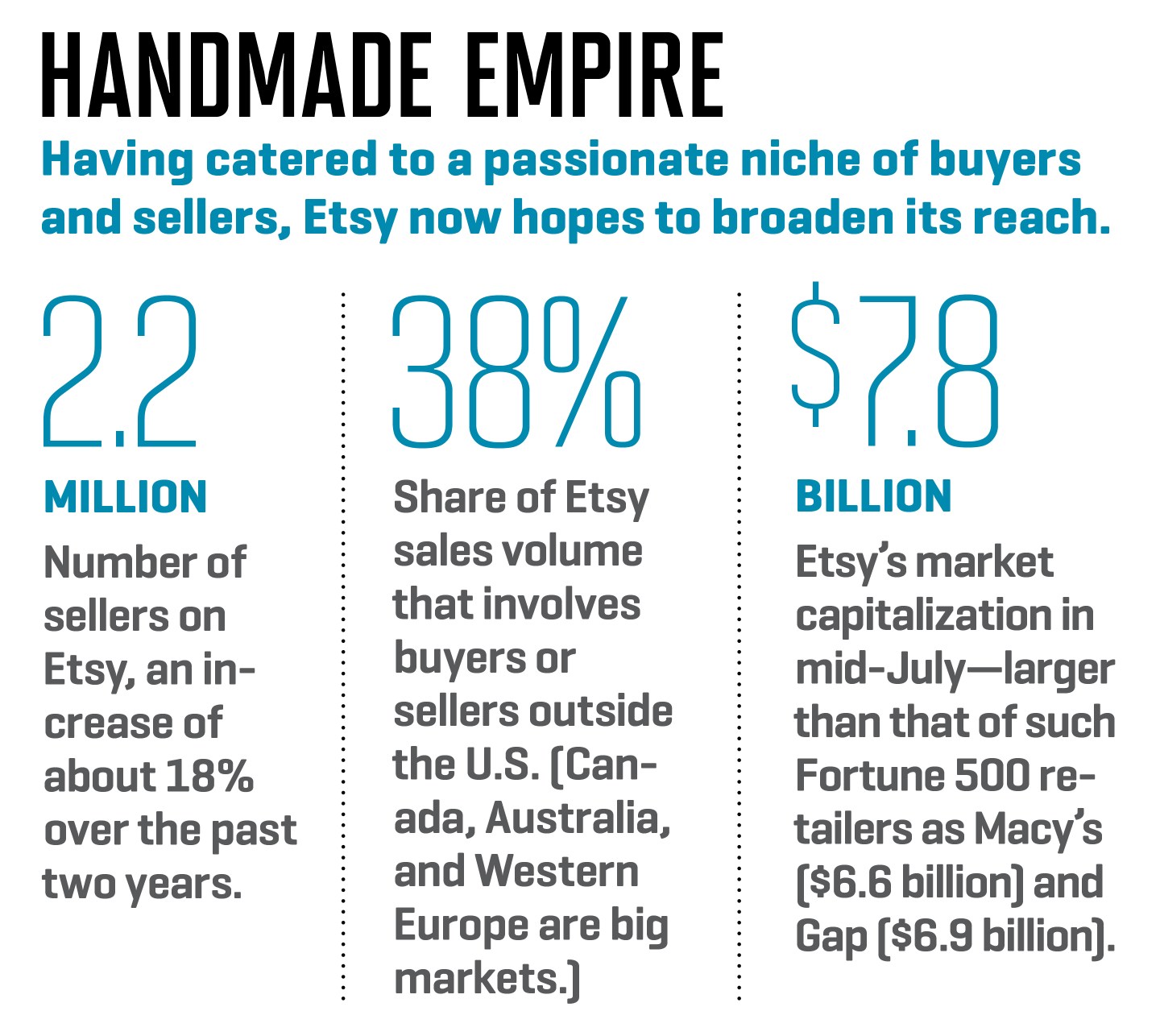
Much of that turnaround has happened under Silverman, a 50-year-old tech veteran. Since taking the reins in May 2017, Silverman has moved to improve search, payment and checkout, and shipping—the nuts and bolts that build customer trust. Etsy has also managed the difficult feat of increasing the share of each sale that it keeps for itself without driving sellers away. Revenue has risen 65% in two years, reaching $604 million in 2018. The company has also been profitable for two years, and the stock is up fivefold during Silverman’s tenure, giving Etsy a market cap bigger than that of Macy’s or Nordstrom.
Retail analysts see even more upside. “There’s a lot of great merchandise in the long tail,” says Forrester principal analyst Sucharita Kodali, referring to products that aren’t bestsellers but whose consistent sales contribute a big chunk of Etsy’s revenue. Etsy is no less quirky than it was—you can still buy, say, a taxidermied mouse posed in a tiny bathtub. But as Kodali notes, it’s starting to feel less and less like a “flea market.”
Silverman was a cofounder of 1990s Internet darling Evite, which he sold for a tidy profit in 2001. He later held top roles at eBay, where he earned a reputation as a turnaround artist, and at American Express. He’s a bald, bearded man who speaks in a soothing voice that any psychotherapist would envy.
That trait came in handy amid the tumult surrounding his arrival. Though Etsy had a passionate following, it was losing money. Growth in gross merchandise sales (GMS), the aggregate value of products sold, had slowed sharply, and an activist investor, Black-and-White Capital, was pushing Etsy to fix its business or sell itself. Within weeks of Silverman’s hiring, the company had laid off nearly a quarter of its staff. The sense in the rank and file was that Silverman would either sell off Etsy or make it go corporate.
The CEO describes his mission as doling out tough love. “The core of Etsy is amazing,” he says. “It just needs the opportunity to breathe.” One of the things suffocating it, he found, was an excess of projects—there were some 800 business development initiatives underway at a company with a staff of fewer than 1,000. Silverman’s team quickly eliminated half of them, including Etsy Studio, an ambitious plan to create a second online marketplace. Among those remaining, the team created “ambulances,” ideas whose paths could be cleared so they could be implemented in weeks rather than months or years.

Those ambulances included some easy fixes. Many shoppers were wary of using credit cards on Etsy, so the company added a message reassuring them: “The seller never sees your credit card information.” The website’s search box didn’t have autocorrect; now it does. The company also started moving many of its tech resources to Google Cloud, freeing up its tech team to focus on Etsy.com itself. “I don’t need people in data centers racking servers,” says Fisher. “I need them building more features.”
More controversial moves followed. Silverman required sellers to use the Etsy Payments platform. That allowed Etsy to garner processing fees from each transaction, capturing that revenue from other payment providers. It also let the company standardize checkout, improving customer service. In July 2018, Etsy increased its separate, per-transaction commission rate to 5%, from 3.5%.
Some sellers fumed, seeing the moves as cash grabs. “Jeez if another competitor ever gets the market share of Etsy, I’m jumping,” read a comment on a Reddit board last year. But that discontent didn’t dent Etsy’s growth. The ranks of sellers have risen to 2.2 million from 1.8 million since Silverman started. Growth in annual GMS, $3.9 billion last year, is back in the 20% range, and the share of sales captured by Etsy as revenue was 15.4% in 2018, up nearly two percentage points from 2017.
Etsy’s success in cultivating loyalty stands out in online retail, where low prices often trump all other concerns. Its emphasis on small businesses and handcrafted wares, analysts say, makes it feel like a community, even as it becomes more efficient as a business. It’s telling that Etsy has so far shrugged off a challenge from the 800-ton gorilla of e-commerce. Amazon Handmade, launched in 2015 and touted as the “Etsy killer,” has had little success wooing vendors or customers, and its product assortment is a small fraction of Etsy’s.
Having learned how to profit from its community, Etsy’s next challenge is to make that community bigger. Etsy has 41 million active buyers, which it defines as people who bought something on at least one day in the past year. However, 60% of “actives” shop only once a year, and the average shopper spends a relatively modest $100 annually.
The company is plowing some of its revenue into better online tools for sellers, such as a dashboard to track orders and streamline payments. To grow, “Etsy really needs to offer vendors that support,” says Oweise Khazi, research director at Gartner. And some of Etsy’s most important plans involve its search engine. Fisher, the technology chief, says improved search results added tens of millions of dollars to GMS last year, but there’s room for improvement. Etsy’s search algorithm has long favored lower-priced items, since they tend to sell more frequently. The site now intends to give higher-priced and better-quality goods more weight in search rankings—making Etsy’s brand more upscale and encouraging shoppers to also consider buying a desk when they’re searching for a desk lamp.
Search tweaks will also help Etsy attack another sore point: shipping. Sellers currently have great leeway to set shipping fees, something that the company believes can turn off buyers. Some 30% of items are eligible for free shipping; Silverman wants to push that figure toward 100%, even at the risk of upsetting sellers. In July, Etsy announced a push to make free shipping standard for orders of $35 or more. Sellers won’t be required to waive shipping fees—but Etsy’s algorithms will give ranking priority to products and sellers that comply, effectively forcing their hand.
For all the rigor he has brought to Etsy, Silverman has been mindful not to mess with its youthful, idealistic culture. Etsy’s headquarters in Brooklyn has amenities like a bike garage and local food offerings in the cafeteria. In February the company announced a plan to offset its shipping-related carbon dioxide emissions. On a recent visit to the website, meanwhile, items on the “bestseller” list included an LGBTQ Pride–friendly wooden rainbow puzzle for kids and a box of cards featuring “date night” ideas for young couples.
The goal of all of Etsy’s improvements, Silverman says, is to make it easier to find the good stuff. The site wants to prioritize a seller “who really delights customers regularly,” he says. “You’ve got to earn your way to prominence.”
A version of this article appears in the August 2019 issue of Fortune with the headline “Crafting a Comeback at Etsy.”
More must-read stories from Fortune:
—The 2019 Fortune Global 500: See the full list
—It’s China’s world: China has now reached parity with the U.S. on the Global 500
—China’s biggest private sector company is betting its future on data
—How the maker of the world’s bestselling drug keeps prices sky-high
—Cloud gaming is big tech’s new street fight
Get up to speed on your morning commute with Fortune’s CEO Daily newsletter.