Masashi Tomita, who leads municipal efforts to attract tech startups to Fukuoka, Japan, is laugh-out-loud tipsy. The laughter is a clue, but so is the empty mug of Mega Jim Beam Highball, his third. We leave the bar and roam the streets for shime, or drunk food, hunkering our hankering at a solo yaki-ramen cart in the posh Tenjin district. Clinking glasses of plum liquor, I ask what I think is a cheery question: “Why can’t all of Japan be this fun?” He looks crestfallen, not insulted but embarrassed.
The Japanese call it nazonazo, a mystery upon a mystery, a riddle: Why is Japan — a 130-million-strong G7 nation with the world’s third-largest nominal GDP, bullet trains, robotics, a space program, and tech renown — such a dud in the startup world?
For all its business and engineering prowess, Japan has just one unicorn, or privately-owned, venture-backed tech company worth at least $1 billion, according to CB Insights. For the record, that company is artificial intelligence startup Preferred Networks.
But despite behemoth native power players including Honda, Mitsubishi, Nintendo, SoftBank, Sony, and Toyota, its corporate salaryman circles are full of squares, by design. Nearly every member of the Japanese workforce is a de facto senior vice president of rules and regulations. Japan’s national sport is protocol. In June, the country’s largest initial public offering of the year raised ¥33.8 billion ($315 million) and shares soared 21% on the first day of trading. What was all the fuss? It was Sansan, a tedious business card management app and sales-lead generator.
But what if the lack of Silicon Valley-style disruption is a cultural asset? Consider the Japanese art of kintsugi, in which broken pottery is repaired by filling the hibi, or cracks, with gold. What if “move fast and break things” — the early Facebook motto adopted by brogrammers everywhere — isn’t lost in translation as much as it’s discarded in translation? Why break when you can beautify?
Cue the startup incubator
Cue Fukuoka Growth Next, the country’s largest startup accelerator, which debuted in 2017, refurbished this May, and in August launches a nearly half-billion yen internal venture capital fund, FGN ABBALab, that will double investment in the next year. The fund is bankrolled in part by Mistletoe, owned by Taizo Son, the brother of SoftBank CEO Masayoshi Son.
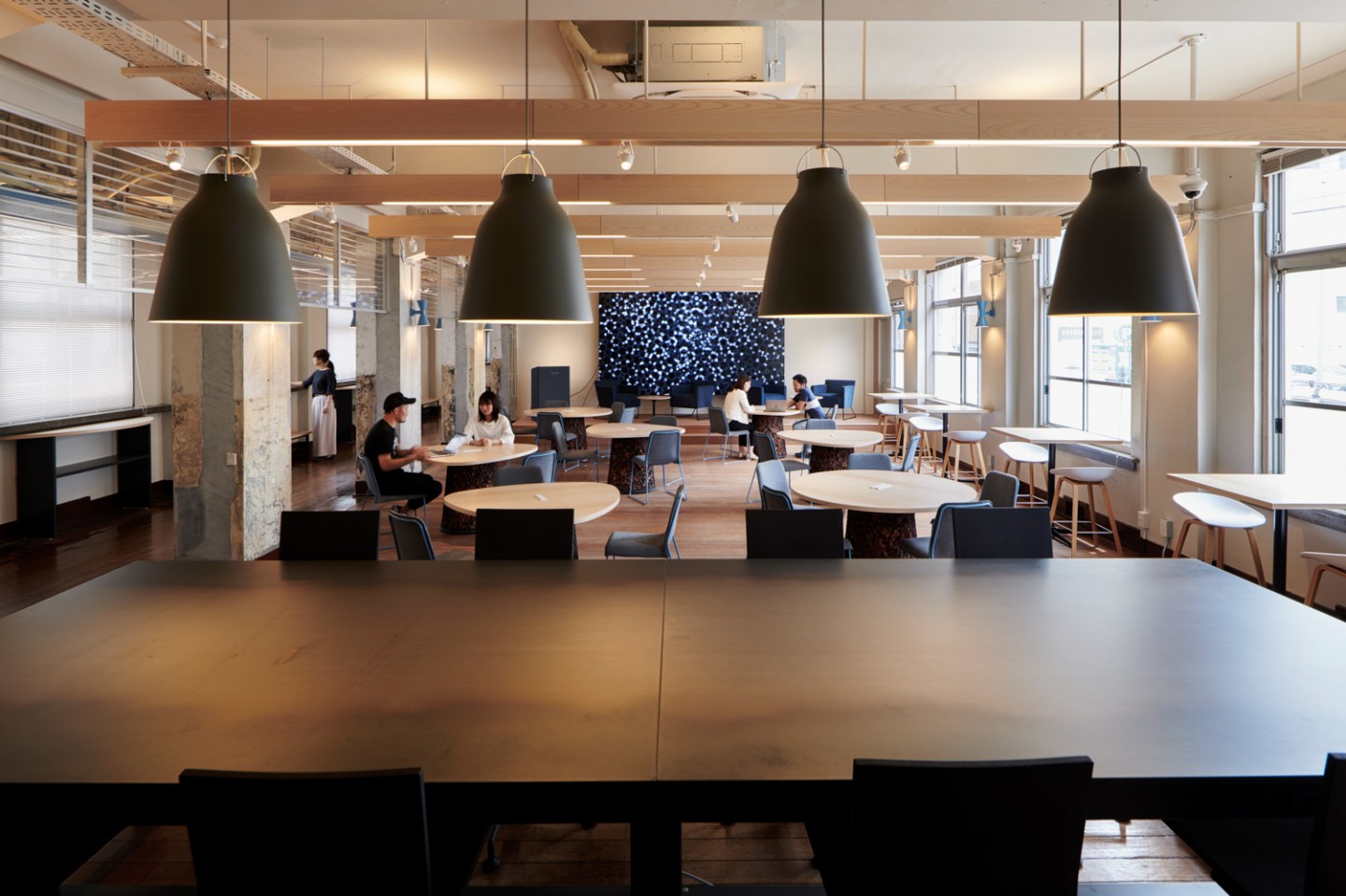
Backed by 22 companies, including Fujitsu, Ricoh, and Seiko, FGN joins other global tech hubs in the hopes of becoming its nation’s, um, Silicon Hibi. On site, in a converted three-story elementary school built in 1929, there are no foosball tables or vintage arcade games like in Silicon Valley. The whimsy comes from within.
“This city has been accepting different cultures for 2,000 years. And 100 years ago Toyota was a concept of entrepreneurial spirit—it is within us,” says Tomita. “We got organized after the war, but uniform—same, same, same—salarymen. It’s time to take our neckties off.”
Fukuoka, on the west coast of Kyushu, Japan’s southernmost big island — a five-hour bullet train ride from Tokyo — is preternaturally suited to the task. Amid Japan’s infamously aging population, Fukuoka’s 1.6 million residents comprise the nation’s youngest city. That includes 80,000 students across 19 universities (a 120-member student club at Kyushu University runs an office at FGN).
The exquisitely Instagrammable Kawachi Wisteria Garden nearby and Nokonoshima Flower Island, surf town of Itoshima, and wine country across Kyushu, famed for its hot spring spa towns, give Fukuoka a distinctly California vibe — as does its diversity.
Large populations of American, Chinese, Filipino, Indian, Indonesian, Korean, Nepalese, Portuguese, Thai, and Vietnamese immigrants were bolstered by relaxed labor laws in March. The Fukuoka Asian Art Museum, which has collections from 22 countries, bills itself as “the only museum in the world that systematically collects and exhibits Asian modern and contemporary art.”
The port town is the cruise ship capital of Japan, not including the ferries that jet to and from nearby Busan, in South Korea. And Seoul, Shanghai, and Tokyo are just two hours away by plane.
The world is at its fingertips. The city’s unofficial mantra is sumiyasui (easy living).
The force behind the tech push
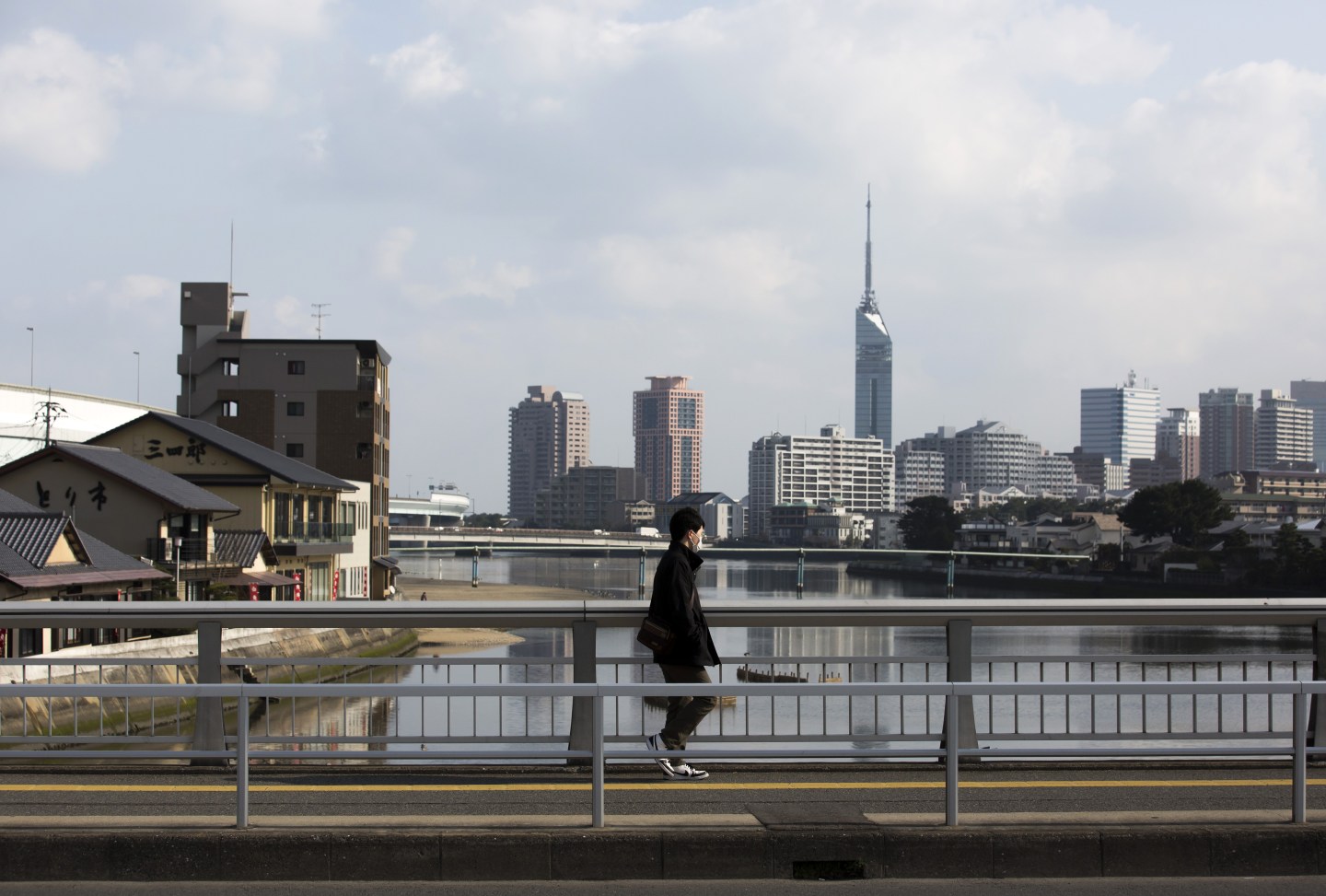
Its youngest-ever mayor, Soichiro Takashima, a television news anchor elected in 2010 at 36, returned from a trip to Seattle intent on remaking Fukuoka in its image. In 2014, he convinced the federal government to declare Fukuoka a National Strategic Special Zone. FGN opened three years later, in tandem with a startup visa specifically designed to lure foreign entrepreneurs. The mayor still drops into FGN almost weekly.
Future prospects are buoyed by Fukuoka Smart East, a 124-acre smart city campus in Hakozaki district that will be a playground (and showroom) for Internet-of-things prototypes and hydrogen power, with its own accelerator division within FGN. In June, a smart city incubation program launched. But that kind of thinking has already begun: in January, Line, Japan’s largest social network — with 78 million users — tested a digital wallet in Fukuoka.
Yuichiro Uchida, FGN’s executive director, throws his arms into a human emoticon: ¯(ツ)/¯. “There’s just less pressure here,” he says. “That leaves more room for creativity and inspiration.” His bemused grin radiates “duh.” He continues: “Tokyo aims for the U.S. or London for status. But our proximity to Asia — Korea, Taiwan, Hong Kong, Singapore — is our strength. I’d rather be big in Asia than big in New York or San Francisco.”
To keep stress low, FGN offers free consultations to startups on, say, accounting, copyright, or intellectual property (what Tomita calls “startup defense”). Uchida talks about the smart city project as a “grand vision,” a physical, infrastructural white paper.
When we meet, Uchida is dressed down in a t-shirt. A rugby star in school, he’s now 43, but retains a boyish breeziness. In contrast, his entrepreneurial radar is mature and specific: the drone startups of Bordeaux and its Darwin station, the design scene in Copenhagen, tax structures in Singapore, and the European Union’s de facto IT bureau in Tallinn, Estonia. I ask him what’s better than creating — what is the entrepreneurial equivalent of omotenashi, Japan’s hyper-hospitality? — and his answer is kyoso: co-creating.
His is a train of thought born of wabisabi, the Japanese notion that imperfection is often better than perfection. As Tomita puts it: “I value diversity. You can’t embrace diversity and expect perfection.”
At its debut, FGN’s initial goal was for its tenants to raise ¥500 million ($4.6 million) by December 2018, but they instead raised ¥8.2 billion ($75.9 million). Amid the Japanese economy’s Abenomics, the fiscal reforms of Prime Minister Shinzo Abe, FGN offers a radical oasis of wabisabinomics. As opposed to existing for the sake of getting on Google’s radar (and the acquisition bounty that comes with it) FGN’s startups seem genuinely, refreshingly focused on their users in a way that prioritizes purpose and risk over buzz and security, harkening to the era when Silicon Valley was defined more by garage-built moxie than IPO bluster.
Sakiko Taniguchi developed Nyans, a social network for cat lovers, at FGN. “There’s no word for salarywoman but there doesn’t need to be when you’re family. Here I have drinks with the mayor,” she says. “In Tokyo, I can’t think of anything other than work. I’m more than that. My company would be possible in Tokyo — I expanded there in February — but there I wouldn’t be able to run the company the way I want. Fukuoka gives me what I want and how I want it.”
Early success
She hopes to follow FGN’s successful alumni: Alterbooth, a cloud integrator, raised ¥100M ($922K) in June; Authentic Japan, an SOS app that sends rescue drones to users, became mandatory at a major ski resort in April; and Skydisc, an air quality startup with both agricultural and home/office applications, was called a “future unicorn” by Nikkei news service. In all, FGN’s 293 total companies, 21 are established players like local banks and Yahoo, while the remaining 272 startups have pulled in $82 million and lured entrepreneurs from nine countries.
FGN member Kenji Umeki frequents FGN’s ironically named bar, Awa (Bubble), a satellite of a spot popular among techies in Tokyo’s Roppongi district. Umeki named his human resources startup, You Make It, as a pun on his name. His users include Bangladeshi, Chinese, and Vietnamese workers. “Honestly, I have a Vietnamese friend and I just wanted to help him,” he says. “I want that to be a good enough reason for a business proposal.”
Strolling the bank of the curly Nakagawa River, a ¥1-a-day shared-economy umbrella in his hand, Kazuya Shidahara, FGN’s head of engineering events, sits me down with some FGN leaders among Fukuoka’s other great startups: the yatai, the here-and-gone nightly food carts selling ramen, mentaiko, and yakitori. I ask the group what would happen if one of the ramen stands were so successful that it opened locations all over the world like McDonalds or Starbucks. “Like Gong Cha?” asks Shidahara, referring to the Taiwanese bubble tea chain. “Do you know people wait up to three hours there? For what? A tea and an Instagram upload? It’s a trap, a prison. Maybe that’s why they’re called chains.” His words are scalability heresy, but they also call out a Silicon Valley contradiction: its dueling ambitions of ubiquity and unique experience.
Perhaps FGN’s roundabout unorthodoxy can solve a riddle that has been plaguing San Francisco, too — especially the toxic tumult at Facebook, Google, and Uber — while paradoxically paying tribute to an ancient Japanese tradition: Fukuoka is primed to be a beacon of entrepreneurial bushido, the samurai code, helping restore honor and morality to tech (cough, Theranos, that once-celebrated Silicon Valley blood-testing startup that ultimately imploded). Now would be a good time to practice bowing.
More must-read stories from Fortune:
—How the government should spend Facebook’s $5 billion fine
—Cloud gaming is big tech’s new street fight
—Should companies bolster their cybersecurity by “hacking back”?
—FaceApp’s Russia link is the latest alarm in an ongoing digital red scare
—Equifax may owe you some money. Here’s how to get it
Catch up with Data Sheet, Fortune‘s daily digest on the business of tech.