• Home
  • Latest
  • Fortune 500
  • Finance
  • Tech
  • Leadership
  • Lifestyle
  • Rankings
  • Multimedia
Commentary

The Fallacy of Medicare for All

By
Bill George
Bill George
Down Arrow Button Icon
By
Bill George
Bill George
Down Arrow Button Icon
April 24, 2019, 6:01 PM ET
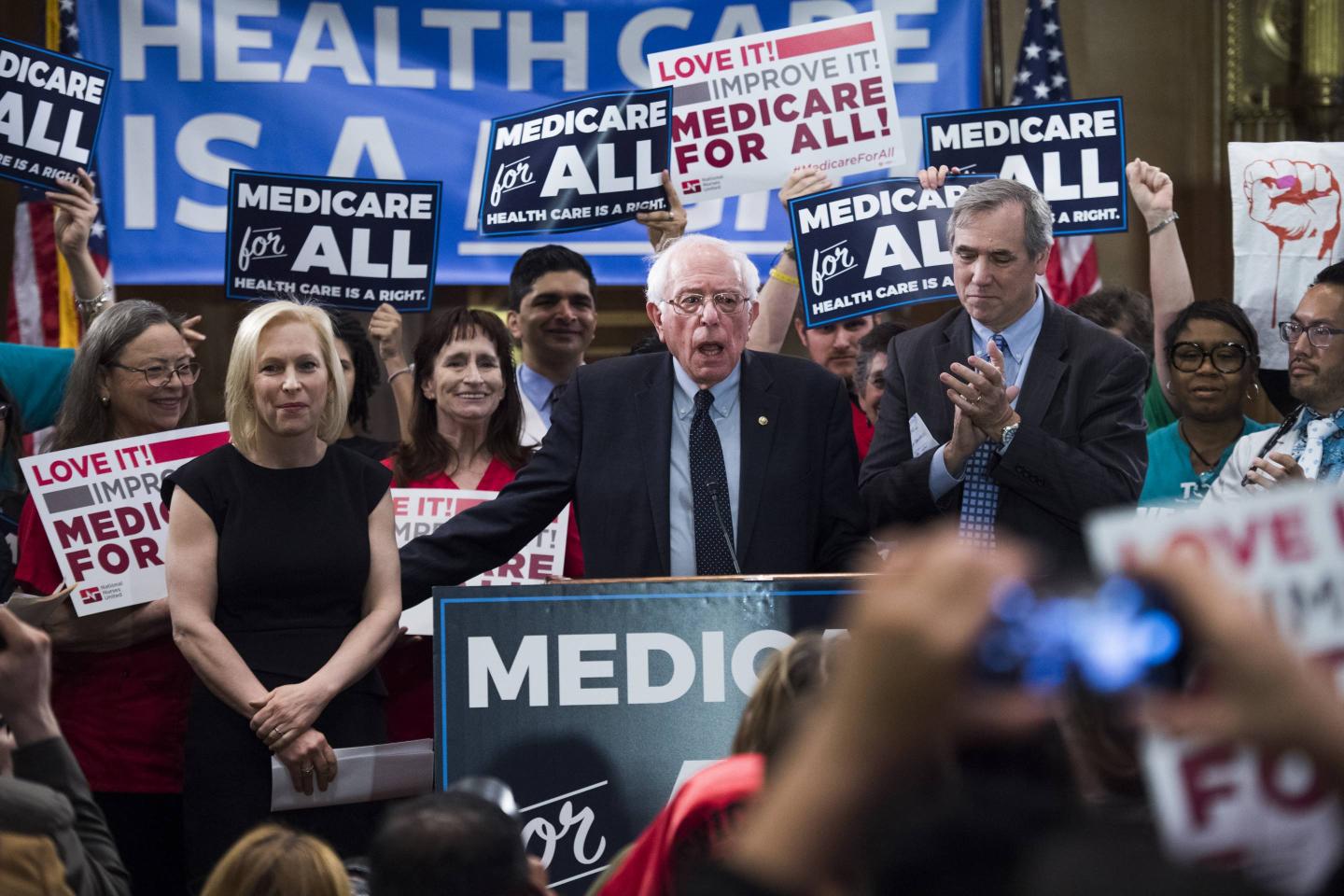
From left, Senators Kirsten Gillibrand (D-N.Y.), Bernie Sanders (I-Vt.), and Jeff Merkley (D-Ore.), introduce the "Medicare for All Act of 2019" on Apr. 10.
Tom Williams—CQ Roll Call

Presidential candidate and self-described Democratic socialist Bernie Sanders currently leads the New Hampshire polls for the Democratic nomination while campaigning on a platform that calls for Medicare for All. Senator Kamala Harris and some other Democratic presidential candidates are jumping on board the Medicare for All bandwagon, which would extend the government-run health care insurance system to all Americans.

It is ironic that Democratic politicians, after defeating the repeal of the Affordable Care Act (ACA) and using health care as a rallying cry to win the majority in the House in 2018, now want to toss out ACA and the U.S. insurance system and replace both with a government-run system.

The stock market seems to be overreacting to these political pronouncements. UnitedHealth Group reported an outstanding first quarter that beat expectations, with total revenue up 9%, earnings up 22%, and increased projections for the year. Nevertheless, its stock dropped nearly 10% in the next two trading sessions, apparently on fears of Medicare for All. Rival insurers Cigna and Anthem dropped 11% and 8%, respectively.

Health care cost $10,739 per American in 2017. Middle-class and poorer Americans clearly cannot afford these costs, nor can their employers. While offering all U.S. citizens free health care using a single-payer system sounds attractive as a political talking point, actually implementing Medicare for All would require a complex restructuring of a multi-trillion dollar industry. The likely result? A disaster.

Covering all Americans under Medicare for All could potentially add another 189 million people to the government’s payrolls, which would swamp the current government approval and payment system—especially since the Centers for Medicare and Medicaid Services require prior approval for many medical tests and procedures. More importantly, the Medicare and Medicaid payment system is almost entirely based on fee for service, wherein hospitals, physicians, and pharmaceutical dispensers are paid for services rendered. Naturally, this can incentivize doctors and hospitals to require more office visits, do more procedures, and conduct more tests to get paid more.

These perverse incentives are exacerbated by underpayment schedules in which Medicare reimburses well below hospital costs. In 2017, Medicare and Medicare reimbursement was $76.8 billion below cost and hospitals provided an additional $38.4 billion in uncompensated care. These underpayments force hospitals to increase costs to patients covered by commercial insurance. This cost-shifting distorts the billing system and places an unnecessary cost burden on non-government patients and their employers.

Medicare for All proposes to eliminate the entire commercial insurance industry—putting 538,600 people out of work. The impact on the financial stability of hospitals and doctors would be staggering. A Navigant study found that a typical mid-sized non-profit hospital system would have a net loss of 22% under the plan. I estimate that half of all hospitals would go out of business, especially smaller hospitals in rural areas.

The elimination of existing systems would be offset by a large increase in government payrolls. A Mercatus Center study estimated that Medicare for All would cost the federal government around $32 trillion. These estimates do not include likely increases in Medicare and Medicaid rates required to lessen losses to hospitals and doctors.

Who will pay for these enormous costs? The federal government cannot cover them without new revenue, as the current U.S. debt is already $22 trillion, with the annual deficit exceeding $1 trillion per year in 2020 and beyond. The Committee for a Responsible Federal Budget estimates that Medicare for All would require tripling of payroll taxes or more than doubling all other taxes. The Mercatus Center, however, found that “doubling all federal individual and corporate income taxes going forward would be insufficient to fully finance the plan.”

It is easy for voters to support the plan if they think they will get their health care for free, but when they realize their taxes will increase, approval drops dramatically. A Kaiser Family Foundation poll found that net favorability to Medicare for All is negative 23% with when participants hear it would require increases to taxes, and a staggering negative 44% when people hear it would cause delays in getting tests and procedures.

Rather than toss out our current system of health care insurance for a government-run system, it is time to find ways to further improve the ACA. Here are a few proposals to do that:

First, there should be a shift from “fee for service” to “pay for value,” thus reducing the total cost of the patient’s care.

Second, shift more government-covered people to Medicare Advantage, whereby private insurers receive a sum of money to manage their patients annually.

Third, put a greater emphasis on healthy living. I estimate that over 50% of health care costs are the result of unhealthy lifestyles such as unhealthy eating and drinking, lack of exercise, and stress. Greater focus on these areas would prevent people from getting sick in the first place and accelerate healing when they are ill.

Fourth, expand Medicaid coverage to more people experiencing economic difficulties and provide adequate health care before their conditions become severe and they wind up in the emergency room.

Fifth, revise the ACA to permit the federal government to negotiate drug prices with pharmaceutical companies, while enabling streamlined distribution of drugs from manufacturers to patients with certified physician prescriptions. This would reduce the rapid escalation in drug prices since ACA was enacted.

Sixth, enhance the insurance exchanges by permitting a public option. This would provide increased price competition in the exchanges, lowering costs for families purchasing insurance on the market.

Instead of unrealistic debates about Medicare for All, we should focus on ways to improve our current system, reduce health care costs, and make the Affordable Care Act work effectively for all Americans.

Bill George is a senior fellow at Harvard Business School and former chair and CEO of Medtronic. He serves on the board of Goldman Sachs and previously served on the boards of Mayo Clinic, ExxonMobil, Novartis, and Target.

This article is commentary. For more opinion in Fortune, click here.

About the Author
By Bill George
See full bioRight Arrow Button Icon

Latest in Commentary

Finance
Lorem ipsum dolor sit amet, consectetur adipiscing elit, sed do eiusmod tempor incididunt ut labore et dolore magna aliqua. Ut enim ad minim veniam
By Fortune Editors
October 20, 2025
Finance
Lorem ipsum dolor sit amet, consectetur adipiscing elit, sed do eiusmod tempor incididunt ut labore et dolore magna aliqua. Ut enim ad minim veniam
By Fortune Editors
October 20, 2025
Finance
Lorem ipsum dolor sit amet, consectetur adipiscing elit, sed do eiusmod tempor incididunt ut labore et dolore magna aliqua. Ut enim ad minim veniam
By Fortune Editors
October 20, 2025
Finance
Lorem ipsum dolor sit amet, consectetur adipiscing elit, sed do eiusmod tempor incididunt ut labore et dolore magna aliqua. Ut enim ad minim veniam
By Fortune Editors
October 20, 2025
Finance
Lorem ipsum dolor sit amet, consectetur adipiscing elit, sed do eiusmod tempor incididunt ut labore et dolore magna aliqua. Ut enim ad minim veniam
By Fortune Editors
October 20, 2025
Finance
Lorem ipsum dolor sit amet, consectetur adipiscing elit, sed do eiusmod tempor incididunt ut labore et dolore magna aliqua. Ut enim ad minim veniam
By Fortune Editors
October 20, 2025

Most Popular

Finance
Lorem ipsum dolor sit amet, consectetur adipiscing elit, sed do eiusmod tempor incididunt ut labore et dolore magna aliqua. Ut enim ad minim veniam
By Fortune Editors
October 20, 2025
Finance
Lorem ipsum dolor sit amet, consectetur adipiscing elit, sed do eiusmod tempor incididunt ut labore et dolore magna aliqua. Ut enim ad minim veniam
By Fortune Editors
October 20, 2025
Finance
Lorem ipsum dolor sit amet, consectetur adipiscing elit, sed do eiusmod tempor incididunt ut labore et dolore magna aliqua. Ut enim ad minim veniam
By Fortune Editors
October 20, 2025
Finance
Lorem ipsum dolor sit amet, consectetur adipiscing elit, sed do eiusmod tempor incididunt ut labore et dolore magna aliqua. Ut enim ad minim veniam
By Fortune Editors
October 20, 2025
Finance
Lorem ipsum dolor sit amet, consectetur adipiscing elit, sed do eiusmod tempor incididunt ut labore et dolore magna aliqua. Ut enim ad minim veniam
By Fortune Editors
October 20, 2025
Finance
Lorem ipsum dolor sit amet, consectetur adipiscing elit, sed do eiusmod tempor incididunt ut labore et dolore magna aliqua. Ut enim ad minim veniam
By Fortune Editors
October 20, 2025
Fortune Secondary Logo
Rankings
  • 100 Best Companies
  • Fortune 500
  • Global 500
  • Fortune 500 Europe
  • Most Powerful Women
  • Future 50
  • World’s Most Admired Companies
  • See All Rankings
Sections
  • Finance
  • Fortune Crypto
  • Features
  • Leadership
  • Health
  • Commentary
  • Success
  • Retail
  • Mpw
  • Tech
  • Lifestyle
  • CEO Initiative
  • Asia
  • Politics
  • Conferences
  • Europe
  • Newsletters
  • Personal Finance
  • Environment
  • Magazine
  • Education
Customer Support
  • Frequently Asked Questions
  • Customer Service Portal
  • Privacy Policy
  • Terms Of Use
  • Single Issues For Purchase
  • International Print
Commercial Services
  • Advertising
  • Fortune Brand Studio
  • Fortune Analytics
  • Fortune Conferences
  • Business Development
  • Group Subscriptions
About Us
  • About Us
  • Editorial Calendar
  • Press Center
  • Work At Fortune
  • Diversity And Inclusion
  • Terms And Conditions
  • Site Map
  • About Us
  • Editorial Calendar
  • Press Center
  • Work At Fortune
  • Diversity And Inclusion
  • Terms And Conditions
  • Site Map
  • Facebook icon
  • Twitter icon
  • LinkedIn icon
  • Instagram icon
  • Pinterest icon

Latest in Commentary

hormuz
CommentaryIran
With Hormuz under strain, a trade corridor built for resilience faces a real-world test
By Angela Chitkara and Samantha SuttonApril 17, 2026
7 hours ago
broker
CommentarySoftware
The 3 forces quietly dismantling the business model that made enterprise software fabulously profitable
By Michael Jacobides and Stefano PuntoniApril 17, 2026
8 hours ago
welti
CommentaryIran
Switzerland’s former ambassador to Iran: here’s how to end this war — and why Pakistan isn’t enough
By Philippe WeltiApril 17, 2026
14 hours ago
Anita Beveridge-Raffo is Head of Retail and Consumer Goods at Palantir Technologies
CommentaryAI agents
Palantir exec: the biggest mistake retailers are making with AI? Trying to do it all with one agent
By Anita Beveridge-RaffoApril 16, 2026
1 day ago
wyle
CommentaryHealth
‘The Pitt’ reveals why healthcare desperately needs a new front door
By Jeremy MorganApril 16, 2026
1 day ago
health
CommentaryHealth Care Service
Two physicians on ending the waiting-room era: bring care home
By Benjamin Kornitzer and Bill FristApril 16, 2026
1 day ago

Most Popular

Pope Leo warned the world is in ‘big trouble’ if Elon Musk becomes the first trillionaire
Success
Pope Leo warned the world is in ‘big trouble’ if Elon Musk becomes the first trillionaire
By Preston ForeApril 17, 2026
11 hours ago
A world going broke: IMF says America's $39 trillion national debt is actually a global problem—and AI may be the only rescue
Economy
A world going broke: IMF says America's $39 trillion national debt is actually a global problem—and AI may be the only rescue
By Nick LichtenbergApril 16, 2026
1 day ago
Jeff Bezos pledged $10 billion for climate change. With the 2030 clock ticking, his wife, Lauren Sánchez Bezos, is leading the charge to spend it
Environment
Jeff Bezos pledged $10 billion for climate change. With the 2030 clock ticking, his wife, Lauren Sánchez Bezos, is leading the charge to spend it
By Sydney LakeApril 15, 2026
2 days ago
MacKenzie Scott is bypassing the Ivy League and rewriting the $79 billion higher ed playbook by giving to HBCUs and community colleges
Politics
MacKenzie Scott is bypassing the Ivy League and rewriting the $79 billion higher ed playbook by giving to HBCUs and community colleges
By Sydney LakeApril 16, 2026
1 day ago
Germany already told its workers to ditch four-day weeks and work-life balance. Now the government wants to cut their pay for calling in sick, too
Success
Germany already told its workers to ditch four-day weeks and work-life balance. Now the government wants to cut their pay for calling in sick, too
By Orianna Rosa RoyleApril 16, 2026
2 days ago
NYC Mayor Zohran Mamdani points at Ken Griffin's $238 million penthouse on tax day: 'Today we're taxing the rich'
Personal Finance
NYC Mayor Zohran Mamdani points at Ken Griffin's $238 million penthouse on tax day: 'Today we're taxing the rich'
By Catherina GioinoApril 16, 2026
24 hours ago

© 2026 Fortune Media IP Limited. All Rights Reserved. Use of this site constitutes acceptance of our Terms of Use and Privacy Policy | CA Notice at Collection and Privacy Notice | Do Not Sell/Share My Personal Information
FORTUNE is a trademark of Fortune Media IP Limited, registered in the U.S. and other countries. FORTUNE may receive compensation for some links to products and services on this website. Offers may be subject to change without notice.