• Home
  • Latest
  • Fortune 500
  • Finance
  • Tech
  • Leadership
  • Lifestyle
  • Rankings
  • Multimedia

Trendingnow

1

Pentagon accuses Alibaba, Baidu and BYD, three of China's biggest companies, of supporting the Chinese military

2

'We are rapidly running out of time': Watchdog sounds Social Security alarm after 22% cut confirmed for 2032

3

Trump, who has repeatedly called climate change fake, is now threatening Brazil with tariffs over the deforestation of the Amazon

1

Pentagon accuses Alibaba, Baidu and BYD, three of China's biggest companies, of supporting the Chinese military

2

'We are rapidly running out of time': Watchdog sounds Social Security alarm after 22% cut confirmed for 2032

3

Trump, who has repeatedly called climate change fake, is now threatening Brazil with tariffs over the deforestation of the Amazon
CommentaryNATO

Trump Might Be Right About NATO—but for All the Wrong Reasons

By
Brian Finlay
Brian Finlay
and
Bethany Cianciolo
Bethany Cianciolo
Down Arrow Button Icon
By
Brian Finlay
Brian Finlay
and
Bethany Cianciolo
Bethany Cianciolo
Down Arrow Button Icon
July 6, 2018, 11:33 AM ET
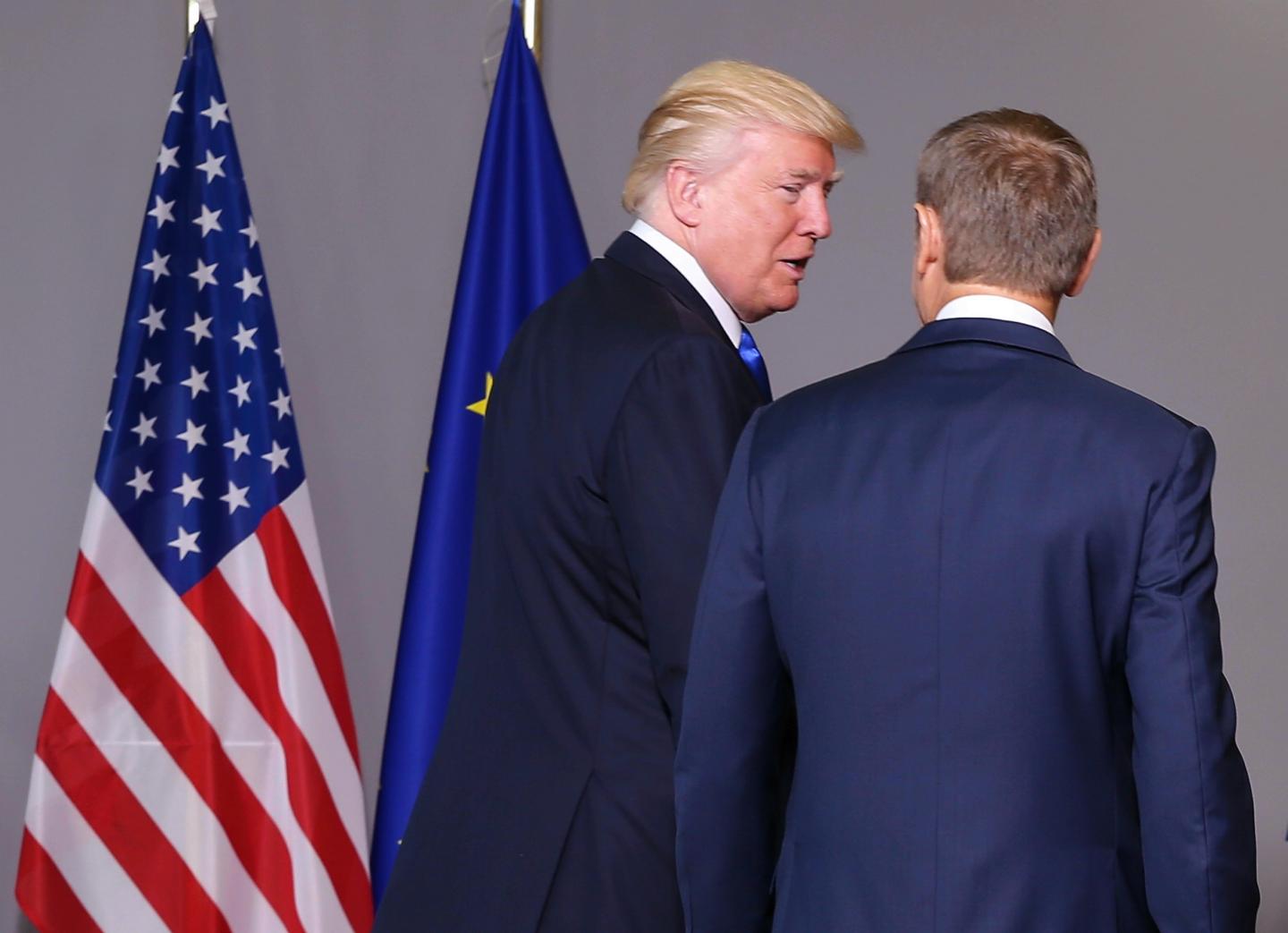
Donald Trump - Donald Tusk in Brussels
BRUSSELS, BELGIUM - MAY 25 : U.S. President Donald Trump (L) is welcomed by European Council President Donald Tusk (R), as part of the NATO meeting, in Brussels, Belgium on May 25, 2017. (Photo by Dursun Aydemir/Anadolu Agency/Getty Images)Dursun Aydemir—Anadolu Agency/Getty Images

Last month, President Trump opened yet another front in his tense relations with some of America’s closest allies, firing off terse letters admonishing Germany, Belgium, Norway, Canada, and others, warning them that the U.S. is losing patience with their failure to meet their security obligations under the NATO alliance.

The president’s blunt message and scathing remarks have been met with a mix of hand-wringing and outrage at home and abroad. Trump’s detractors, however, would do well to separate the message from the messenger and recall that the longstanding debate over NATO burden-sharing—defense lexicon for the division of responsibilities within the alliance—is as old as the alliance itself. Furthermore, the world may well need the engagement of the non-American NATO allies more today than ever with rising global threats—mass migration, the rise of cyber warfare, and a persistent terrorist threat in an unstable Middle East—coupled with an unpredictable and seemingly isolationist partner in Washington.

From its founding, NATO has operated on the principle of collective defense: “An attack on one is an attack on all.” Although this provision has only been invoked once—in response to the terrorist attacks of September 11—the strength of the military alliance was credited with helping deter conflict with the Soviet Union from NATO’s inception in 1949 through the collapse of the Soviet Union in 1991. Today, we see NATO allies supporting military operations in Afghanistan, air-policing missions in Africa, carrying out relief operations, and protecting populations against natural and humanitarian disasters around the world.

To finance these collective operations, and to demonstrate a unity of purpose and resolve, alliance members agree to set respective national defense spending at 2% of GDP. Currently, only five of the 28 NATO allies meet or exceed that target.

At one time, the military imbalance between the United States and its NATO allies was seen as fiscally convenient for America’s allies and politically desirable for some policymakers in Washington for the status and influence it afforded the U.S. abroad. When the U.S. emerged from the Cold War as the world’s sole remaining superpower, Washington wielded its military authority to not only promote peace but to exploit global prosperity. In those days, America’s allies routinely castigated the United States for being unilateralist and interventionist, and Washington criticized the allies’ free-riding tendencies. But governments on both sides of the Atlantic were happy to allow that debate to remain at a low boil, as the U.S. and its foreign allies reaped financial and security rewards of American leadership.

Upsetting this clever balance may now make some sense to certain parties, but getting what they wish for may not yield desired outcomes. For Washington, increases in allied defense spending will not necessarily allow for immediate cost savings within the U.S. defense budget. Citing increasing threats from China and Russia, as well as the need to maintain technological superiority against America’s competitors, the Pentagon asked for up to $686 billion from Congress for a major boost in military spending for 2019, one of the largest defense requests in U.S. history. It is difficult to imagine Washington reducing its own defense investments in the face of perceived threats because Luxembourg and Iceland are boosting defense expenditures. In short, American defense spending, even vis-à-vis its closest allies, is not zero sum and will not produce the savings to the U.S. taxpayer that the president is promising. Meanwhile, the current breach with our closest allies will surely erode America’s ability to lead.


Likewise, America’s NATO partners who have long complained about a unilateralist and interventionist America big-footing its way across the globe may have an incentive to scale up spending, as they began doing in 2015. Continued U.S. preponderance in multilateral operations abroad ultimately reduces the influence of American allies in when and how those operations are conducted. It also lessens the prospects that future American-led operations—like the response to the 9/11 terrorist attacks—will receive enough international backing to gain strong legitimacy in the eyes of the global community. Perhaps most importantly, as Washington becomes a seemingly less reliable partner and Russia and China become more assertive, those same NATO allies will have new incentives to fill the gap and prevent backsliding against their values around the globe.

The president has been accused of using this issue to stoke a public backlash against engagement and in favor of isolationism. Based upon the experience of the period between the two World Wars, a disengaged America is neither in the best interest of the country nor the world, but neither are over-reactions to undiplomatic rhetoric around a longstanding alliance debate. In an uncertain world, every NATO partner must help share the burden to defend the global international order from which we all benefit.

Brian Finlay is president and CEO of the nonpartisan Stimson Center.

About the Authors
By Brian Finlay
See full bioRight Arrow Button Icon
By Bethany Cianciolo
See full bioRight Arrow Button Icon

Latest in Commentary

Finance
Lorem ipsum dolor sit amet, consectetur adipiscing elit, sed do eiusmod tempor incididunt ut labore et dolore magna aliqua. Ut enim ad minim veniam
By Fortune Editors
October 20, 2025
Finance
Lorem ipsum dolor sit amet, consectetur adipiscing elit, sed do eiusmod tempor incididunt ut labore et dolore magna aliqua. Ut enim ad minim veniam
By Fortune Editors
October 20, 2025
Finance
Lorem ipsum dolor sit amet, consectetur adipiscing elit, sed do eiusmod tempor incididunt ut labore et dolore magna aliqua. Ut enim ad minim veniam
By Fortune Editors
October 20, 2025
Finance
Lorem ipsum dolor sit amet, consectetur adipiscing elit, sed do eiusmod tempor incididunt ut labore et dolore magna aliqua. Ut enim ad minim veniam
By Fortune Editors
October 20, 2025
Finance
Lorem ipsum dolor sit amet, consectetur adipiscing elit, sed do eiusmod tempor incididunt ut labore et dolore magna aliqua. Ut enim ad minim veniam
By Fortune Editors
October 20, 2025
Finance
Lorem ipsum dolor sit amet, consectetur adipiscing elit, sed do eiusmod tempor incididunt ut labore et dolore magna aliqua. Ut enim ad minim veniam
By Fortune Editors
October 20, 2025

Most Popular

Finance
Lorem ipsum dolor sit amet, consectetur adipiscing elit, sed do eiusmod tempor incididunt ut labore et dolore magna aliqua. Ut enim ad minim veniam
By Fortune Editors
October 20, 2025
Finance
Lorem ipsum dolor sit amet, consectetur adipiscing elit, sed do eiusmod tempor incididunt ut labore et dolore magna aliqua. Ut enim ad minim veniam
By Fortune Editors
October 20, 2025
Finance
Lorem ipsum dolor sit amet, consectetur adipiscing elit, sed do eiusmod tempor incididunt ut labore et dolore magna aliqua. Ut enim ad minim veniam
By Fortune Editors
October 20, 2025
Finance
Lorem ipsum dolor sit amet, consectetur adipiscing elit, sed do eiusmod tempor incididunt ut labore et dolore magna aliqua. Ut enim ad minim veniam
By Fortune Editors
October 20, 2025
Finance
Lorem ipsum dolor sit amet, consectetur adipiscing elit, sed do eiusmod tempor incididunt ut labore et dolore magna aliqua. Ut enim ad minim veniam
By Fortune Editors
October 20, 2025
Finance
Lorem ipsum dolor sit amet, consectetur adipiscing elit, sed do eiusmod tempor incididunt ut labore et dolore magna aliqua. Ut enim ad minim veniam
By Fortune Editors
October 20, 2025
Fortune Secondary Logo
Rankings
  • 100 Best Companies
  • Fortune 500
  • Global 500
  • Fortune 500 Europe
  • Most Powerful Women
  • World's Most Admired Companies
  • See All Rankings
  • Lists Calendar
Sections
  • Finance
  • Fortune Crypto
  • Features
  • Leadership
  • Health
  • Commentary
  • Success
  • Retail
  • Mpw
  • Tech
  • Lifestyle
  • CEO Initiative
  • Asia
  • Politics
  • Conferences
  • Europe
  • Newsletters
  • Personal Finance
  • Environment
  • Magazine
  • Education
Customer Support
  • Frequently Asked Questions
  • Customer Service Portal
  • Privacy Policy
  • Terms Of Use
  • Single Issues For Purchase
  • International Print
Commercial Services
  • Advertising
  • Fortune Brand Studio
  • Fortune Analytics
  • Fortune Conferences
  • Business Development
  • Group Subscriptions
About Us
  • About Us
  • Press Center
  • Work At Fortune
  • Terms And Conditions
  • Site Map
  • About Us
  • Press Center
  • Work At Fortune
  • Terms And Conditions
  • Site Map
  • Facebook icon
  • Twitter icon
  • LinkedIn icon
  • Instagram icon
  • Pinterest icon

Latest in Commentary

tim
CommentaryAirline industry
Merlin CTO: autonomy can rebuild the foundation of aviation — and national security
By Tim BurnsJune 9, 2026
16 hours ago
dewar
CommentaryLeadership
I founded McKinsey’s CEO practice: Here’s why operational excellence is a liability right now
By Carolyn DewarJune 9, 2026
17 hours ago
250
Commentary250 Years of Innovation
America turns 250. Its greatest innovation was never a product — it was a system that let anyone build one
By Keith KrachJune 7, 2026
3 days ago
retirement
CommentaryRetirement
Retiring at 62 costs the average American $250,000. Here’s the math (and the neuroscience) that explain why
By Jon SabesJune 7, 2026
3 days ago
da
CommentaryIPOs
The short seller’s argument nobody on the coming mega IPO roadshow wants you to make
By Bhaskar ChakravortiJune 7, 2026
3 days ago
bs
CommentaryCalifornia
I’ve sold property on California’s Central Coast for decades. The buyers chasing ranch and winery estates are after more than a lifestyle
By Lindsey HarnJune 6, 2026
4 days ago

Most Popular

Pentagon accuses Alibaba, Baidu and BYD, three of China's biggest companies, of supporting the Chinese military
Asia
Pentagon accuses Alibaba, Baidu and BYD, three of China's biggest companies, of supporting the Chinese military
By Kate O'Keeffe and BloombergJune 8, 2026
1 day ago
'We are rapidly running out of time': Watchdog sounds Social Security alarm after 22% cut confirmed for 2032
Economy
'We are rapidly running out of time': Watchdog sounds Social Security alarm after 22% cut confirmed for 2032
By Nick LichtenbergJune 9, 2026
12 hours ago
Trump, who has repeatedly called climate change fake, is now threatening Brazil with tariffs over the deforestation of the Amazon
Environment
Trump, who has repeatedly called climate change fake, is now threatening Brazil with tariffs over the deforestation of the Amazon
By Sasha RogelbergJune 8, 2026
1 day ago
Current price of oil as of June 8, 2026
Personal Finance
Current price of oil as of June 8, 2026
By Joseph HostetlerJune 8, 2026
2 days ago
Costco CEO Ron Vachris rose from forklift driver to the C-suite without a college degree: ‘Don’t chase a title’ is the career advice that got him there
Success
Costco CEO Ron Vachris rose from forklift driver to the C-suite without a college degree: ‘Don’t chase a title’ is the career advice that got him there
By Preston ForeJune 8, 2026
2 days ago
Gen Zers are arriving at college unable to even read a sentence—professors warn it could lead to a generation of anxious and lonely graduates
Success
Gen Zers are arriving at college unable to even read a sentence—professors warn it could lead to a generation of anxious and lonely graduates
By Preston ForeJune 7, 2026
3 days ago

© 2026 Fortune Media IP Limited. All Rights Reserved. Use of this site constitutes acceptance of our Terms of Use and Privacy Policy | CA Notice at Collection and Privacy Notice | Do Not Sell/Share My Personal Information
FORTUNE is a trademark of Fortune Media IP Limited, registered in the U.S. and other countries. FORTUNE may receive compensation for some links to products and services on this website. Offers may be subject to change without notice.