• Home
  • News
  • Fortune 500
  • Tech
  • Finance
  • Leadership
  • Lifestyle
  • Rankings
  • Multimedia
Tech

Facebook Accused of Ignoring Government Warnings Before Mob Violence in Sri Lanka

By
David Z. Morris
David Z. Morris
Down Arrow Button Icon
By
David Z. Morris
David Z. Morris
Down Arrow Button Icon
April 22, 2018, 12:30 PM ET
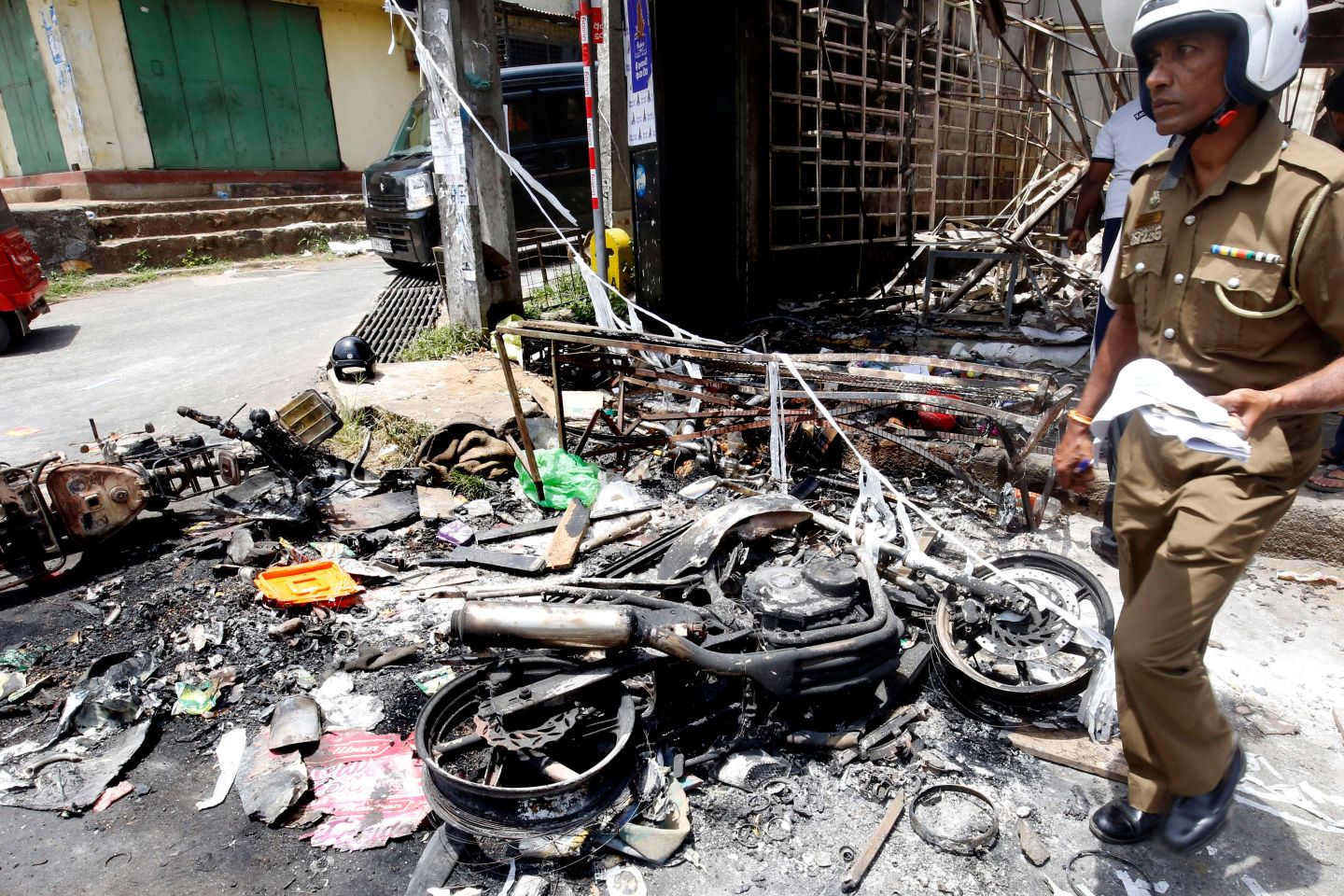
Sri Lanka declares emergency following communal clashes, Kandy - 07 Mar 2018
A Sri Lankan policeman examines the gutted remains of a business establishment and motorcycles in the riot torn Digana area in Kandy 117kms from Colombo, Sri Lanka, 07 March 2018. Social networks across Sri Lanka were blocked on 07 March by the government as around 600 troops were deployed in the central Kandy region, where incidents of violence between Muslims and Sinhalese Buddhists continued despite a state of emergency, that was declared on 06 March and led to the death of two people, the torching of around 20 shops and a dozen arrests. Sri Lanka declares emergency following communal clashes, Kandy - 07 Mar 2018M.A.Pushpa Kumara—EPA-EFE/REX/Shutterstock

Angry mobs of Buddhists in Sri Lanka last month attacked minority Muslims, burning mosques and killing at least one. Those riots appear to have been triggered in part by false stories spread on Facebook and WhatsApp. And despite efforts by governments and nonprofits to alert them to the mounting risk, Facebook is accused of doing next to nothing to remove clear incitements to violence in the weeks leading up to the attacks.

The sequence of events in Sri Lanka is detailed in a bruising new report by the New York Times, which threatens to undermine Facebook’s longstanding claim to be a force for good in the world. At their heart were allegations of a plot by Muslim Sri Lankans to sterilize the country’s Sinhalese-speaking Buddhist majority, supported by a false story on Facebook saying that police had seized 23,000 sterilization pills from a Muslim pharmacist in the town of Ampara.

In an episode eerily reminiscent of reactions to the Hillary Clinton Pizzagate conspiracy theory, those stories led a mob of Buddhists to storm a Muslim-owned restaurant in the town of Ampara, falsely claiming its food was laced with drugs. The exchange exploded into beatings, rioting, and mosque-burning. Video of those events was also uploaded to Facebook, feeding further violence and the death of a 27-year-old aspiring journalist.

Aside from the brutal violence itself, the most disturbing part of the Times report is the allegation that Facebook, which has no offices in Sri Lanka, ignored or deflected repeated attempts by government officials and nonprofit monitors to intervene in a growing storm of hatred. As early as October of 2017, Sri Lankan officials pleaded with Facebook to better police hate speech, hire more Sinhalese-speaking content screeners, and establish a direct point of contact with local authorities.

Get Data Sheet, Fortune’s technology newsletter.

Instead, Facebook insisted its content-flagging tool would be enough to alert the company to dangerous content. Members of a Sri Lankan group called the Center for Policy Alternatives did as recommended, repeatedly flagging posts including messages such as “Kill all Muslims, don’t even save an infant.” But “nearly every report,” according to the Times, was deemed to not violate Facebook’s standards. According to the Times, Facebook still has not filled around 25 positions for Sinhalese screeners that have been open since June.

The violence in Sri Lanka mirrors similar events in Myanmar, India, Mexico, and even the United States. They strike at the heart of Facebook’s utopian promise to connect people, showing that such connections can spread violent hatred as quickly as cute baby pictures.

Ethnic and religious resentments are not created by Facebook. But as the Times points out, Facebook’s core structure – including an algorithm that prioritizes content that gets the most engagement – may help foment outrage and tribalism. In nations with weak legal systems, citizens may be more likely to take justice into their own hands.

“The germs are ours,” as one Sri Lankan official told the Times, referring to the sectarian devisions in Sri Lanka, “but Facebook is the wind, you know?”


About the Author
By David Z. Morris
See full bioRight Arrow Button Icon

Latest in Tech

AIpalantir
New contract shows Palantir is working on a tech platform for another federal agency that works with ICE
By Jessica MathewsDecember 9, 2025
35 minutes ago
Databricks CEO speaking on stage.
AIBrainstorm AI
Databricks CEO Ali Ghodsi says his company will be worth $1 trillion by doing these three things
By Beatrice NolanDecember 9, 2025
1 hour ago
AIBrainstorm AI
CoreWeave CEO: Despite see-sawing stock, IPO was ‘incredibly successful’ after challenges of Liberation Day tariff timing
By Sharon GoldmanDecember 9, 2025
1 hour ago
Arm CEO on stage at Brainstorm AI
AIBrainstorm AI
Physical AI robots will automate ‘large sections’ of factory work in the next decade, Arm CEO says
By Beatrice NolanDecember 9, 2025
3 hours ago
AIBrainstorm AI
‘Customers don’t care about AI’—they just want to boost cash flow and make ends meet, Intuit CEO says
By Jason MaDecember 9, 2025
5 hours ago
A man and robot sitting opposite each other.
AIEye on AI
The problem with ‘human in the loop’ AI? Often, it’s the humans
By Jeremy KahnDecember 9, 2025
5 hours ago

Most Popular

placeholder alt text
Success
When David Ellison was 13, his billionaire father Larry bought him a plane. He competed in air shows before leaving it to become a Hollywood executive
By Dave SmithDecember 9, 2025
14 hours ago
placeholder alt text
Real Estate
The 'Great Housing Reset' is coming: Income growth will outpace home-price growth in 2026, Redfin forecasts
By Nino PaoliDecember 6, 2025
4 days ago
placeholder alt text
Success
Craigslist founder signs the Giving Pledge, and his fortune will go to military families, fighting cyberattacks—and a pigeon rescue
By Sydney LakeDecember 8, 2025
1 day ago
placeholder alt text
Investing
Baby boomers have now 'gobbled up' nearly one-third of America's wealth share, and they're leaving Gen Z and millennials behind
By Sasha RogelbergDecember 8, 2025
1 day ago
placeholder alt text
Uncategorized
Transforming customer support through intelligent AI operations
By Lauren ChomiukNovember 26, 2025
13 days ago
placeholder alt text
Banking
Jamie Dimon taps Jeff Bezos, Michael Dell, and Ford CEO Jim Farley to advise JPMorgan's $1.5 trillion national security initiative
By Nino PaoliDecember 9, 2025
6 hours ago
Rankings
  • 100 Best Companies
  • Fortune 500
  • Global 500
  • Fortune 500 Europe
  • Most Powerful Women
  • Future 50
  • World’s Most Admired Companies
  • See All Rankings
Sections
  • Finance
  • Leadership
  • Success
  • Tech
  • Asia
  • Europe
  • Environment
  • Fortune Crypto
  • Health
  • Retail
  • Lifestyle
  • Politics
  • Newsletters
  • Magazine
  • Features
  • Commentary
  • Mpw
  • CEO Initiative
  • Conferences
  • Personal Finance
  • Education
Customer Support
  • Frequently Asked Questions
  • Customer Service Portal
  • Privacy Policy
  • Terms Of Use
  • Single Issues For Purchase
  • International Print
Commercial Services
  • Advertising
  • Fortune Brand Studio
  • Fortune Analytics
  • Fortune Conferences
  • Business Development
About Us
  • About Us
  • Editorial Calendar
  • Press Center
  • Work At Fortune
  • Diversity And Inclusion
  • Terms And Conditions
  • Site Map

© 2025 Fortune Media IP Limited. All Rights Reserved. Use of this site constitutes acceptance of our Terms of Use and Privacy Policy | CA Notice at Collection and Privacy Notice | Do Not Sell/Share My Personal Information
FORTUNE is a trademark of Fortune Media IP Limited, registered in the U.S. and other countries. FORTUNE may receive compensation for some links to products and services on this website. Offers may be subject to change without notice.